

“My savings came from 55 years of work, not greed.”
— Boomer reader, June 2026
“I am 37 years old, married with four children. I work full-time. I live in New York City. And I do not see homeownership in my future.”
— Millennial reader, June 2026
These voices come from the same economy and came to the same inbox (mine, as my series on generational economics provoked a widespread reaction, ever since I compared Boomers to “the pig in the python“), but they might as well be from different planets. It doesn’t matter if I lay out the facts that inequality is a scourge within the Boomer cohort, or that the defense that millennials (like me) are “whiny” is a classic deflection from a power group, it’s just obvious: the generations speak different languages.
The generational framing, of course, is often dismissed, even compared to something like the astrology of sociology, but what if there was an empirical economic basis for it?
A new report from O.C. Tanner, the workplace research and recognition firm, argues the different communication styles of the generations in the economy are the predictable outputs of four distinct economies—and four fundamentally different unspoken agreements each generation made with the world of work on the day they entered it. It calls them “generational contracts.”
“Employees have different approaches to work that are rooted in their experiences coming of age in the labor market,” the report states, drawing on surveys of 5,702 employees across 17 countries conducted in early 2026. “These generational contracts help determine where each generation shines, and where they struggle.”
The “pragmatic and balanced” Gen Xer, with a built-in lack of trust in institutions, might put it best. Billy wrote to me he was “watching the Boomer/Millennial story play out with a big bowl of popcorn” but said he was “more open-eyed about millennial challenges but more conscious too of how we all are challenged to see the POV of those who came before us.”
There’s a chicken-and-egg dynamic at the heart of the pig in the python, he wrote. Boomers told their millennial children to “do what you love” and “go follow your passion,” largely because many of them “had to sacrifice their own passions for stability and opportunities” in order to raise a family. How much should you blame either side for that?
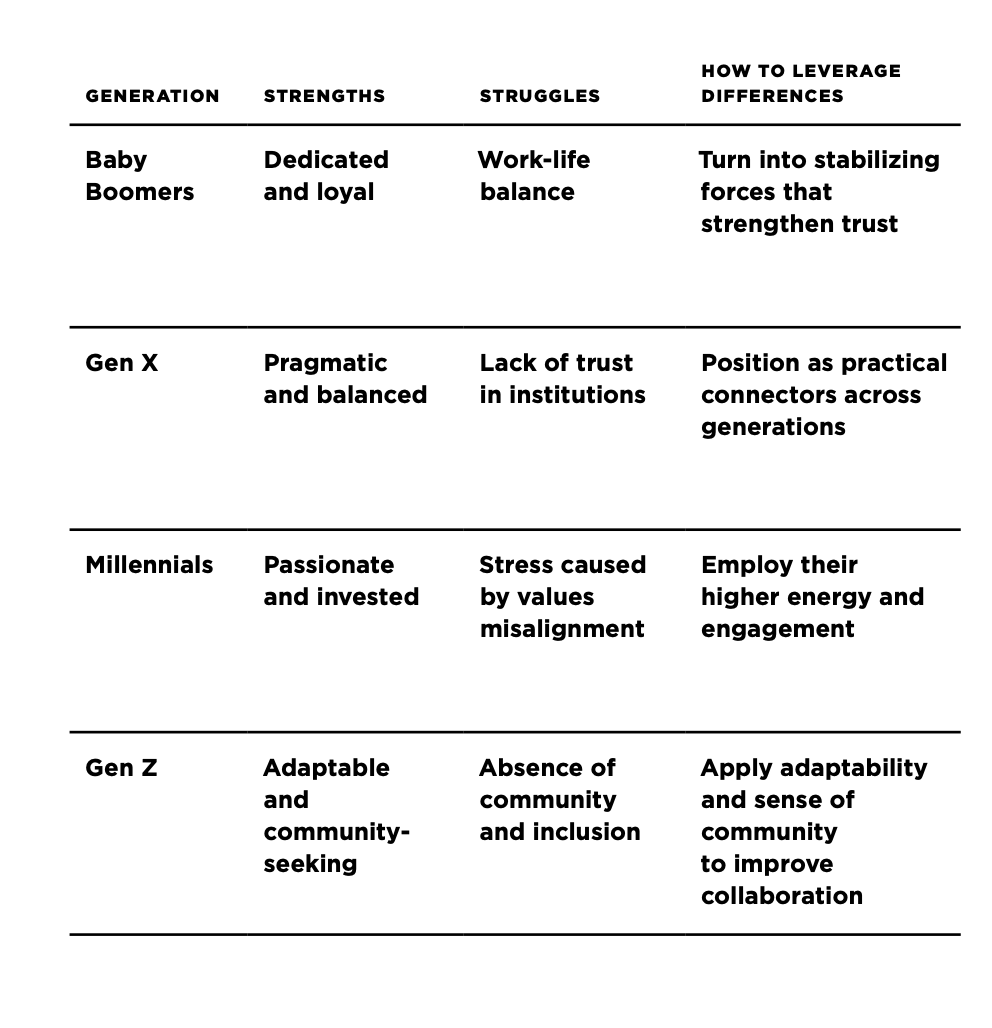
The problem, of course, is millennials actually believed their Boomer parents. It is, in miniature, the story of four generations inheriting four different sets of instructions—and then being baffled when everyone else isn’t following the same ones.
O.C. Tanner’s report digs into four very different mindsets, leading to widespread confusion. As ADP’s Nela Richardson has noted, this is the first time ever so many generations are all occupying the workplace at the same time.
Boomers: the ‘industrial contract’
Baby Boomers (born 1946–1964) graduated into the tail end of postwar prosperity—a labor market that rewarded long tenure, respected hierarchy, and delivered job security to those who showed up, kept their heads down, and stayed loyal.
The deal was simple: Give the company your working life, and the company takes care of you.
That contract calcified into a worldview. Boomers today are 59% more likely than other generations to believe hierarchies are important at work, and 45% more likely to say loyalty should be rewarded with job security, fair pay, and recognition, according to the report. Their strength is precisely that loyalty: They are, the study finds, stabilizing organizational forces, and are the workers most likely to champion institutional knowledge and cultural continuity.
“Work hard, stay loyal, and the system will reward you,” one Boomer physician told the O.C. Tanner researchers. It is an ethos that reads as wisdom to those who experienced it working—and as naïveté to everyone who came after.
Their blind spot is the mirror: They can struggle with expecting the same total devotion from colleagues who signed a very different contract.
Richard from Florida explicitly laid the blame at what he called “generational values,” writing to me that when he grew up, “there was emphasis on respect, neighbors, church, regardless of denomination. There was trust in governments, local, and federal.” He said my reporting prompted a conversation with his 49-year-old son during a camping trip near Mount Shasta, Calif.
“I was shocked to learn how poorly people were treating each other,” with squatters stealing each others’ campsites, stealing each others’ gear,” he wrote. “These two examples would and never occurred when I was camping with my parents or later on with my own family.”
Richard also said the “abominable driving” on the roads these days is “very scary,” but he cast the mirror inward.
“My opinion on why morals and respect have faded (some) is how the younger generations are raised and schooled,” he wrote. “We were raised by our parents and what we learned in schools taught us to respect others, listen to others, have hope and know your fundamental rights and laws of the U.S.”
The Boomers did a “pretty good job raising the standard of living,” he continued, and with technology, civil rights and family values, but a “poor job at enabling our children, meaning wanting them to have a better life than we did growing up.”
Gen X: the ‘performance contract’
Gen X (born 1965–1980) came of age watching corporations betray the very deal Boomers had been promised. Waves of institutional downsizing in the 1980s and early 1990s taught this generation a different lesson: Loyalty is a liability. The only real job security is your own skill set.
The result is a generation of pragmatic individualists. Fully 75% of Gen X workers describe themselves as self-sufficient at work. They are independent, results-oriented, and deeply skeptical of corporate authority—21% less likely than other generations to trust their organizations to do the right thing, and 30% less likely to trust senior leaders.
Often labeled as a cynical generation, their economic circumstances reframe their contract as a rational response to watching their parents’ generation get laid off after decades of faithful service. Gen X has been conditioned not to expect loyalty, let alone love, from a company or employer.
One Gen X reader captured this generational stoicism bluntly: “It has always been hard. Someone lied to the younger generation” about college degrees guaranteeing security. He noted when he was a child in the 1970s, his father had a “good job” in an industrial mill but he also struggled: “Struggling isn’t a bad thing. It builds character and makes people stronger and more resilient.”
The report suggests positioning Gen X as “practical connectors across generations”—people whose comfort with independence and low need for validation can make them effective bridges between Boomers’ institutional loyalty and younger workers’ demands for meaning.
“If you’ve got the skills that a company needs so they can sell, or whatever they’re doing, you’re in the door,” one Gen X manager told researchers—a worldview so transactional it could read as cold to millennial colleagues, who want their employer to share their values.
Millennials: the ‘purpose contract’
Millennials (born 1981–1996) entered the workforce under a different set of conditions entirely: rapid technological disruption, the 2008 financial crisis, and a cultural moment that told them work should be more than a paycheck—it should be an expression of who you are.
They took that idea seriously. Millennials are five times more likely to feel fulfilled and seven times more likely to do great work when their job aligns with their personal values, according to the report. Fully 80% say it is important that the organization they work for is ethical. They have 28% higher odds of being engaged than other generations—when the conditions are right.
The liability is the other side of that coin. When leadership “doesn’t do the right thing,” 63% of millennials disengage—and that misalignment drives 52% higher odds of burnout. This is the generation most likely to quit a well-paying job over a values conflict, a behavior that baffles Gen X colleagues who learned to separate their personal ethics from their professional obligations.
An older millennial, born in 1985, wrote to say he appreciated my reporting, explaining even though he’s got “an okay job as an engineer at Boeing,” he still feels “stuck and sort of hopeless about the future.”
“It is important to me that the work that I do aligns with my values because it takes so much time out of my life,” a millennial data analyst told the O.C. Tanner researchers. “It’s important to me that whatever I’m doing, I can make it make sense to me.”
Gen Z: the ‘community contract’
Gen Z (born 1997–2013) is the first generation to have grown up entirely inside social media—and perhaps paradoxically, it is the generation most starved for real human connection at work.
Seventy-seven percent say inclusion is “very important” to them. They want to be welcomed, to belong, to be part of something with other people. The report describes their core contract as “inclusion for engagement”: Give them community, and they will give you everything.
The problem is that workplaces are failing them on this dimension more than any other. Gen Z workers have 47% higher odds of saying they cannot find community at work, and 25% higher odds of saying they would like more friends there. Nearly half—49%—report feeling they must suppress their values at work, compared to just 26% of Boomers.
“The ‘hitting financial targets’ part, yeah, whatever, I could do that,” one Gen Z insurance agent told researchers. “But that’s not the part that would drive me to want to do better. I like working with people.”
The report notes Gen Z’s communal orientation can create friction with millennials’ more individually centered, values-alignment approach—a tension that often gets misread as Gen Z being needy, when it is more accurately understood as a generation whose fundamental workplace need isn’t purpose but belonging.
Gen Z, notably, did not write in to me at all on this subject. Whether that reflects their higher odds of feeling they can’t find community, that they don’t read Fortune, or they don’t care about Boomer economics, is left as an exercise for the reader.
The business case for translation
Understanding these contracts isn’t just a management curiosity. O.C. Tanner’s data suggests organizations where all four contracts are honored—where generations work with each other rather than around each other—see 10x better customer satisfaction, 8x better financial stability, and 9x higher odds that employees do great work.
Only 26% of employees report experiencing that kind of generational synergy today.
The report’s most pointed warning may be about AI. As companies push AI adoption, 44% of employees say organizational encouragement to use AI has made them seek out human subject matter experts less—a finding especially pronounced among millennials (52%) and Gen Z (49%). When younger employees turn to ChatGPT instead of the 40-year veteran down the hall, the institutional knowledge transfer that makes intergenerational workplaces function stops happening.
“I use AI to interpret dense regulations,” one Gen Z safety advisor told researchers, “but I listen to my boss—40 years of experience matters.”
The four contracts are different languages, but translation is possible—and the organizations that learn to do it will outperform the ones that don’t.
“Both generations should try to see the other’s point of view,” wrote Billy, the Gen X reader watching the whole thing unfold from a comfortable distance. Until they figure it out, he’s got his popcorn.