• Home
  • Latest
  • Fortune 500
  • Finance
  • Tech
  • Leadership
  • Lifestyle
  • Rankings
  • Multimedia

Trendingnow

1

U.S. companies have finally gotten $71 billion in tariff refunds, but they’re using it to offset inflation caused by the Iran war

2

FedEx CEO says we are in the middle of the biggest supply chain shift he’s seen in 35 years: ‘We are the referendum’

3

Buffett says AI giants are ‘playing a game they don’t want to play’ in the AI race, reveals he was behind Berkshire’s $31 billion bet on Google

1

U.S. companies have finally gotten $71 billion in tariff refunds, but they’re using it to offset inflation caused by the Iran war

2

FedEx CEO says we are in the middle of the biggest supply chain shift he’s seen in 35 years: ‘We are the referendum’

3

Buffett says AI giants are ‘playing a game they don’t want to play’ in the AI race, reveals he was behind Berkshire’s $31 billion bet on Google
EconomyConsumer Spending

It’s not a recession. But Goldman says your paycheck is acting like it

Nick Lichtenberg
By
Nick Lichtenberg
Nick Lichtenberg
Business Editor
Down Arrow Button Icon
Nick Lichtenberg
By
Nick Lichtenberg
Nick Lichtenberg
Business Editor
Down Arrow Button Icon
June 2, 2026, 2:30 AM ET
goldman
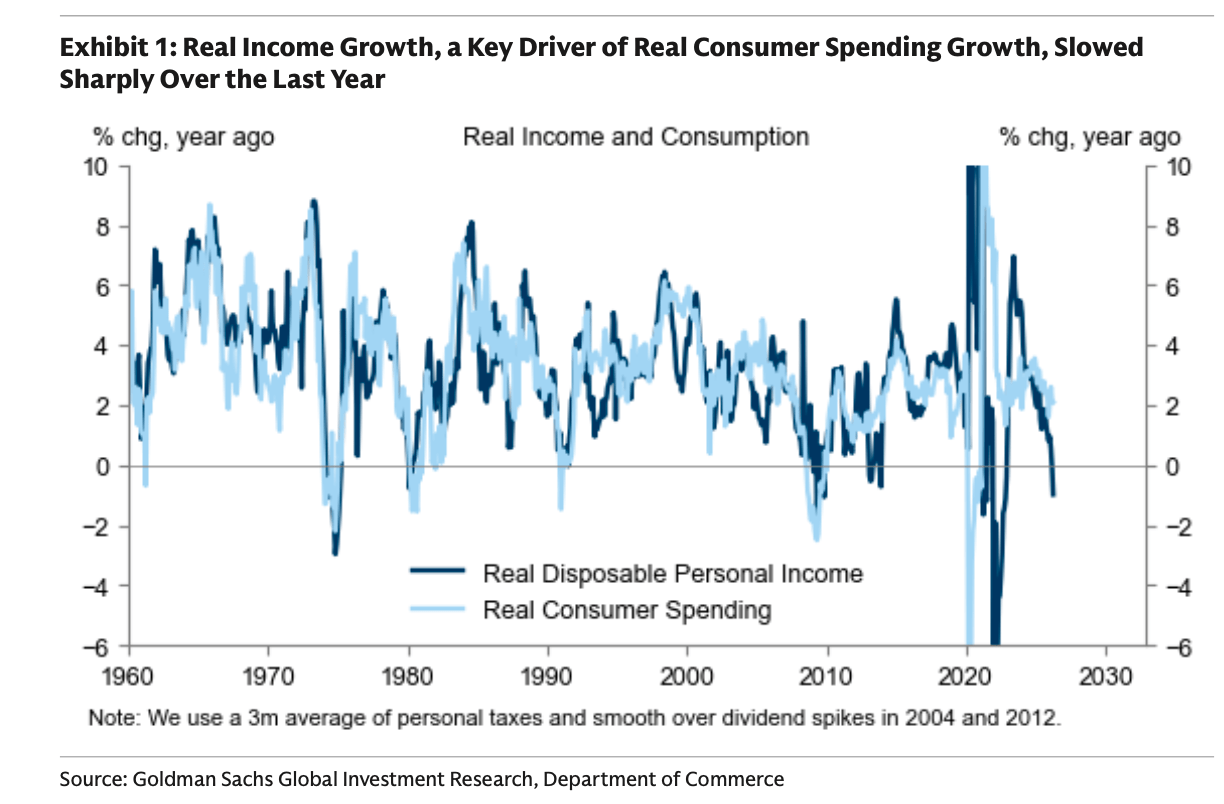
Real income growth is almost the lowest on record.Goldman Sachs
Add Fortune on Google for similar content.

Americans aren’t losing their jobs. The stock market isn’t in freefall. And the official recession call is nowhere in sight. But Goldman Sachs is sounding an alarm about something quieter and more insidious: the purchasing power of the American paycheck is eroding at a pace the economy almost never sees unless it’s already in a downturn.

Recommended Video

In a research note published Sunday, Goldman economists Manuel Abecasis and Joseph Briggs found that real personal income per worker — stripped of government transfers and adjusted for inflation — declined 0.6% over the past year. That’s a pace they describe as “rarely seen outside of recession,” with the only comparable non-recessionary episodes being a brief inflation shock in mid-2022 and a tax-policy distortion in 2013.

The culprits are familiar by now: tariffs driving up the cost of goods, energy prices eroding what’s left, and wage growth that simply hasn’t kept up. Together, they’ve done something that job growth and a resilient labor market haven’t been able to prevent — they’ve quietly made most Americans poorer in real terms.

It’s a dynamic Goldman has been tracking with growing alarm. In April, the bank warned that the U.S. economy was becoming increasingly K-shaped — one where the income divide between higher and lower earners had been quietly accelerating. The latest note puts numbers to why: lower-income households, who spend a larger share of their budgets on food and energy, are bearing the brunt of the real income squeeze, facing headwinds that higher earners can more easily absorb.

The cushion is running out

So far, consumers haven’t blinked. Spending has held up, and the economy hasn’t shown the kind of demand collapse that typically accompanies recession-level income weakness. But Goldman says that resilience has a clear explanation — and an expiration date.

Two factors have kept spending propped up. First, tax cuts in the One Big Beautiful Bill Act generated larger-than-usual refunds earlier this year, effectively handing consumers a cash cushion just as income was weakening. Second, Americans have been saving less — the personal savings rate dropped to just 2.6% in April, one of the lowest readings on record outside of the pre-financial-crisis era and 2022.

Goldman economists think the savings rate is likely understated a bit because of measurement issues with interest payments in the national accounts, but point out that even a 3.5% rate would be one of the lowest on record.

Goldman does not get into recent economic history, but it’s worth noting that by mid-2022, the post-pandemic inflation surge was at its peak, and real incomes cratered not because wages were falling, but because inflation was running so far ahead of pay increases, crushing real purchasing power. The culprits were pandemic-era supply chain bottlenecks, high demand fueled by massive fiscal stimulus, and then the Russia-Ukraine war spiking energy prices.

As for 2013, wealthy Americans and companies knew that Bush-era tax cuts were expiring, so companies rushed to pay out unusually large special dividends in late 2012, which front-loaded income into 2012, creating an artificial negative base effect: income appeared to fall simply because the prior year’s number was artificially inflated. Neither episode reflected a structural problem with worker pay, unlike the situation Goldman now describes.

Neither tax refunds nor savings can last as buffers. Goldman expects real consumer cash-flow growth to slow to just 0.3% year over year by the fourth quarter as the tax refund boost fades. And with the savings rate already near the floor, there’s little room left to offset the income squeeze by drawing down further.

A below-potential slowdown ahead

The firm now forecasts consumer spending growth of just 1.3% for the remainder of 2026 — below consensus expectations and below Goldman’s own estimate of the economy’s potential growth rate. Real income growth for the full year is projected at only 0.9% on a Q4/Q4 basis.

The squeeze won’t be felt equally. Lower-income households face the steepest real income headwinds as energy prices stay elevated. For those families, the recession-like feeling isn’t just a data artifact, it’s a lived reality.

To be sure, a faster decline in energy prices, stronger equity gains or a rebound in hiring could push spending above Goldman’s forecast. But higher oil prices — particularly if the conflict in the Middle East escalates — or a deteriorating labor market could make the consumer slowdown sharper than currently anticipated.

Not a recession. Not yet.

Goldman stops well short of calling a recession. The labor market remains intact, wealth effects from elevated equity prices are still providing a partial offset, and the income weakness partly reflects one-off distortions — including base effects from a Social Security payout last year and policy-induced swings in farm income — that should fade in coming months.

But once those distortions are removed, the underlying trend is hard to spin. Six decades of data show that real income per worker contracting at this rate almost exclusively happens when the economy is already in a formal downturn. Right now, it isn’t. But Goldman’s message is clear: your paycheck doesn’t know that.

For this story, Fortune journalists used generative AI as a research tool. An editor verified the accuracy of the information before publishing.

Subscribe to Fortune Gulf Brief. Every Tuesday, this new newsletter delivers clear-eyed, authoritative intelligence on the deals, decisions, policies, and power shifts shaping one of the world’s most consequential regions, written for the people who need to act on it. Sign up here.
About the Author
Nick Lichtenberg
By Nick LichtenbergBusiness Editor
LinkedIn icon

Nick Lichtenberg is business editor and was formerly Fortune's executive editor of global news.

See full bioRight Arrow Button Icon
Add Fortune on Google for similar content.

Latest in Economy

Finance
Lorem ipsum dolor sit amet, consectetur adipiscing elit, sed do eiusmod tempor incididunt ut labore et dolore magna aliqua. Ut enim ad minim veniam
By Fortune Editors
October 20, 2025
Finance
Lorem ipsum dolor sit amet, consectetur adipiscing elit, sed do eiusmod tempor incididunt ut labore et dolore magna aliqua. Ut enim ad minim veniam
By Fortune Editors
October 20, 2025
Finance
Lorem ipsum dolor sit amet, consectetur adipiscing elit, sed do eiusmod tempor incididunt ut labore et dolore magna aliqua. Ut enim ad minim veniam
By Fortune Editors
October 20, 2025
Finance
Lorem ipsum dolor sit amet, consectetur adipiscing elit, sed do eiusmod tempor incididunt ut labore et dolore magna aliqua. Ut enim ad minim veniam
By Fortune Editors
October 20, 2025
Finance
Lorem ipsum dolor sit amet, consectetur adipiscing elit, sed do eiusmod tempor incididunt ut labore et dolore magna aliqua. Ut enim ad minim veniam
By Fortune Editors
October 20, 2025
Finance
Lorem ipsum dolor sit amet, consectetur adipiscing elit, sed do eiusmod tempor incididunt ut labore et dolore magna aliqua. Ut enim ad minim veniam
By Fortune Editors
October 20, 2025

Most Popular

Finance
Lorem ipsum dolor sit amet, consectetur adipiscing elit, sed do eiusmod tempor incididunt ut labore et dolore magna aliqua. Ut enim ad minim veniam
By Fortune Editors
October 20, 2025
Finance
Lorem ipsum dolor sit amet, consectetur adipiscing elit, sed do eiusmod tempor incididunt ut labore et dolore magna aliqua. Ut enim ad minim veniam
By Fortune Editors
October 20, 2025
Finance
Lorem ipsum dolor sit amet, consectetur adipiscing elit, sed do eiusmod tempor incididunt ut labore et dolore magna aliqua. Ut enim ad minim veniam
By Fortune Editors
October 20, 2025
Finance
Lorem ipsum dolor sit amet, consectetur adipiscing elit, sed do eiusmod tempor incididunt ut labore et dolore magna aliqua. Ut enim ad minim veniam
By Fortune Editors
October 20, 2025
Finance
Lorem ipsum dolor sit amet, consectetur adipiscing elit, sed do eiusmod tempor incididunt ut labore et dolore magna aliqua. Ut enim ad minim veniam
By Fortune Editors
October 20, 2025
Finance
Lorem ipsum dolor sit amet, consectetur adipiscing elit, sed do eiusmod tempor incididunt ut labore et dolore magna aliqua. Ut enim ad minim veniam
By Fortune Editors
October 20, 2025
Fortune Secondary Logo
Rankings
  • 100 Best Companies
  • Fortune 500
  • Global 500
  • Fortune 500 Europe
  • Most Powerful Women
  • World's Most Admired Companies
  • See All Rankings
  • Lists Calendar
Sections
  • Finance
  • Fortune Crypto
  • Features
  • Leadership
  • Health
  • Commentary
  • Success
  • Retail
  • Mpw
  • Tech
  • Lifestyle
  • CEO Initiative
  • Asia
  • Politics
  • Conferences
  • Europe
  • Newsletters
  • Personal Finance
  • Environment
  • Magazine
  • Education
Customer Support
  • Frequently Asked Questions
  • Customer Service Portal
  • Privacy Policy
  • Terms Of Use
  • Single Issues For Purchase
  • International Print
Commercial Services
  • Advertising
  • Fortune Brand Studio
  • Fortune Analytics
  • Fortune Conferences
  • Business Development
  • Group Subscriptions
About Us
  • About Us
  • Press Center
  • Work At Fortune
  • Terms And Conditions
  • Site Map
  • About Us
  • Press Center
  • Work At Fortune
  • Terms And Conditions
  • Site Map
  • Facebook icon
  • Twitter icon
  • LinkedIn icon
  • Instagram icon
  • Pinterest icon

Latest in Economy

After the Supreme Court killed his first tariffs, Trump turns to a new legal workaround to impose 25% tariffs on Brazil and possibly others
EconomyTariffs
After the Supreme Court killed his first tariffs, Trump turns to a new legal workaround to impose 25% tariffs on Brazil and possibly others
By Marco Quiroz-GutierrezJuly 17, 2026
7 hours ago
koch
RetailWorld Cup
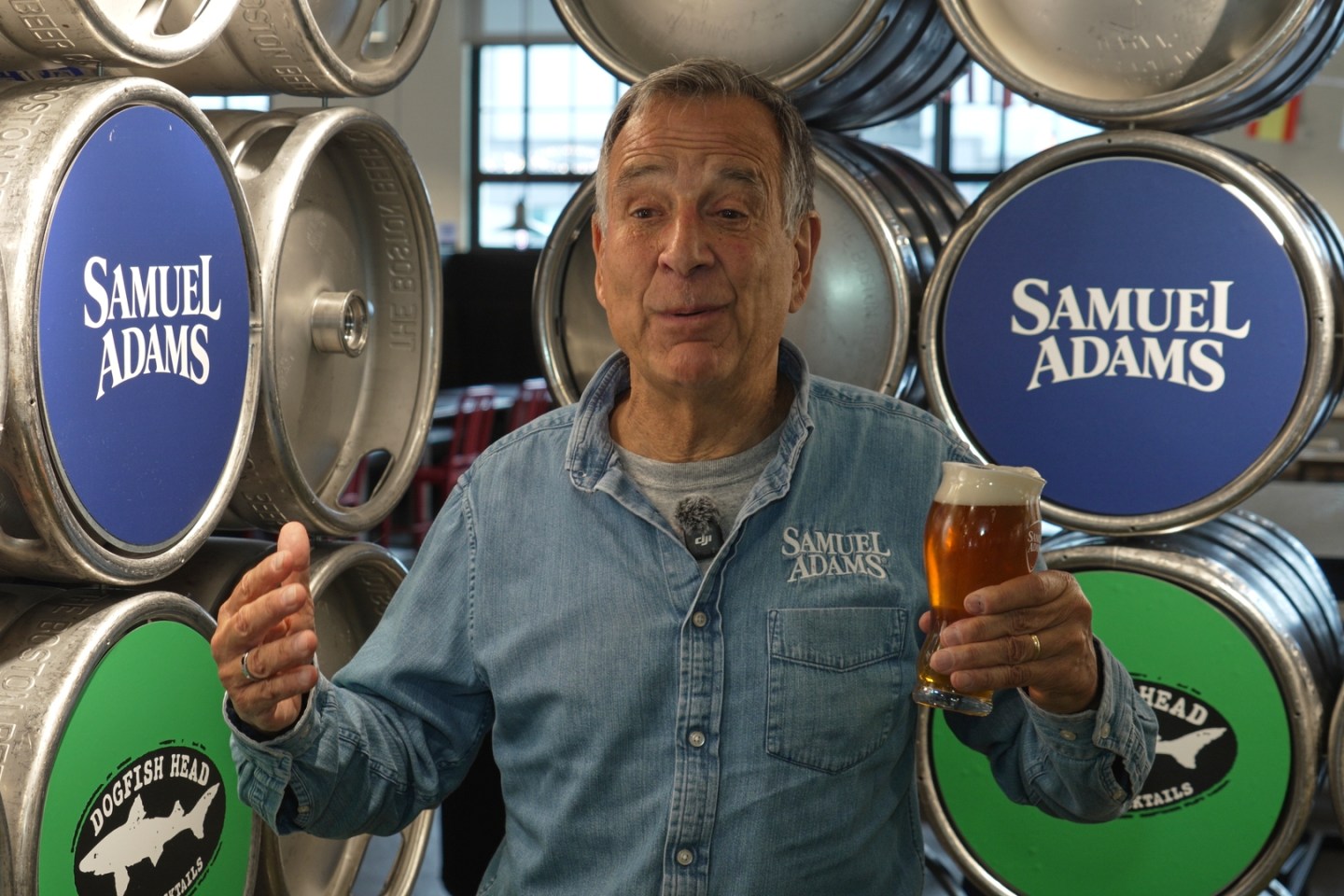
‘What a wonderful group of people’: Sam Adams beer founder said the Scots were consuming one every 12 seconds at their World Cup peak
By Dee-Ann Durbin and The Associated PressJuly 17, 2026
13 hours ago
Alex Karp gestures
SuccessWealth
With a $15 billion net worth, Palantir CEO Alex Karp predicts he will get 20x richer from AI—but that middle-class workers will get just modest raises
By Preston ForeJuly 17, 2026
13 hours ago
shelton
Commentarydisruption
Former Obama official on AI anxiety and the depression nobody remembers — and the training model that gives him hope
By Jim SheltonJuly 17, 2026
16 hours ago
dollar
CommentaryCurrency
The dollar’s demise has been predicted for 55 years. The BCG Institute says it’s still overstated
By Philipp Carlsson-Szlezak, Nikolaus Lang and Paul SwartzJuly 17, 2026
19 hours ago
Current price of oil as of July 17, 2026
Personal FinanceOil
Current price of oil as of July 17, 2026
By Joseph HostetlerJuly 17, 2026
19 hours ago

Most Popular

U.S. companies have finally gotten $71 billion in tariff refunds, but they’re using it to offset inflation caused by the Iran war
Economy
U.S. companies have finally gotten $71 billion in tariff refunds, but they’re using it to offset inflation caused by the Iran war
By Sasha RogelbergJuly 17, 2026
22 hours ago
FedEx CEO says we are in the middle of the biggest supply chain shift he’s seen in 35 years: ‘We are the referendum’
C-Suite
FedEx CEO says we are in the middle of the biggest supply chain shift he’s seen in 35 years: ‘We are the referendum’
By Fortune EditorsJuly 15, 2026
3 days ago
Buffett says AI giants are ‘playing a game they don’t want to play’ in the AI race, reveals he was behind Berkshire’s $31 billion bet on Google
Big Tech
Buffett says AI giants are ‘playing a game they don’t want to play’ in the AI race, reveals he was behind Berkshire’s $31 billion bet on Google
By Mia OsmonbekovJuly 16, 2026
1 day ago
Current price of oil as of July 17, 2026
Personal Finance
Current price of oil as of July 17, 2026
By Joseph HostetlerJuly 17, 2026
19 hours ago
Current price of silver as of Friday, July 17, 2026
Personal Finance
Current price of silver as of Friday, July 17, 2026
By Joseph HostetlerJuly 17, 2026
19 hours ago
Kevin O’Leary claimed opposition to his Utah data center was fueled by Chinese money. Now he and Fox News are being sued for defamation
Law
Kevin O’Leary claimed opposition to his Utah data center was fueled by Chinese money. Now he and Fox News are being sued for defamation
By Marco Quiroz-GutierrezJuly 17, 2026
22 hours ago

© 2026 Fortune Media IP Limited. All Rights Reserved. Use of this site constitutes acceptance of our Terms of Use and Privacy Policy | CA Notice at Collection and Privacy Notice | Do Not Sell/Share My Personal Information
FORTUNE is a trademark of Fortune Media IP Limited, registered in the U.S. and other countries. FORTUNE may receive compensation for some links to products and services on this website. Offers may be subject to change without notice.