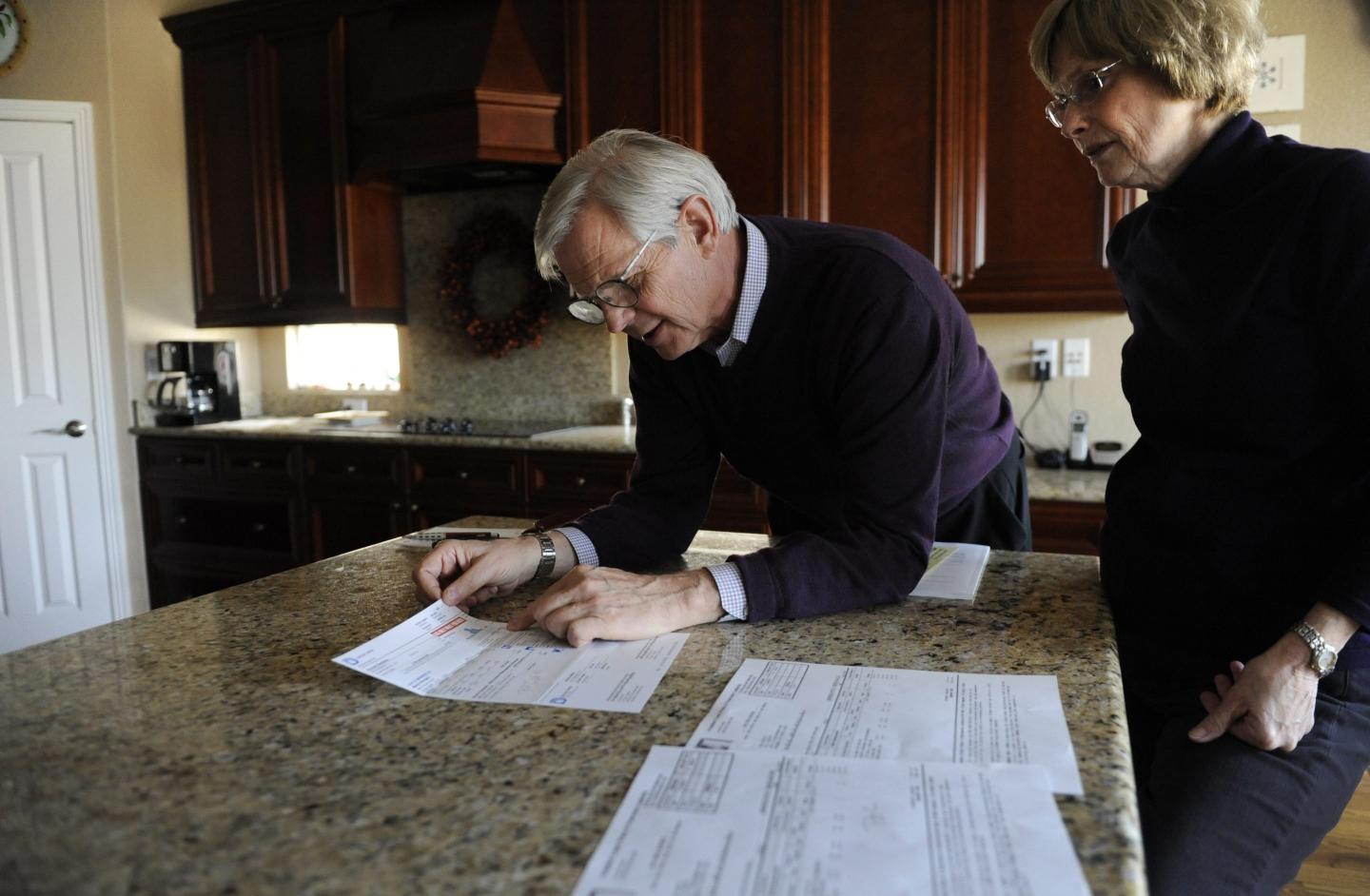
They cut the dining out first. Then they stopped putting money away. Then came the retirement account—the one thing financial advisors tell you never to touch—drawn down not for an emergency exactly, but for the slow-motion emergency of a life where the math stopped working and never started again. For many of Americans, simply existing has been the most expensive line item they’ve had, and they have pessimistic views of it ever improving.
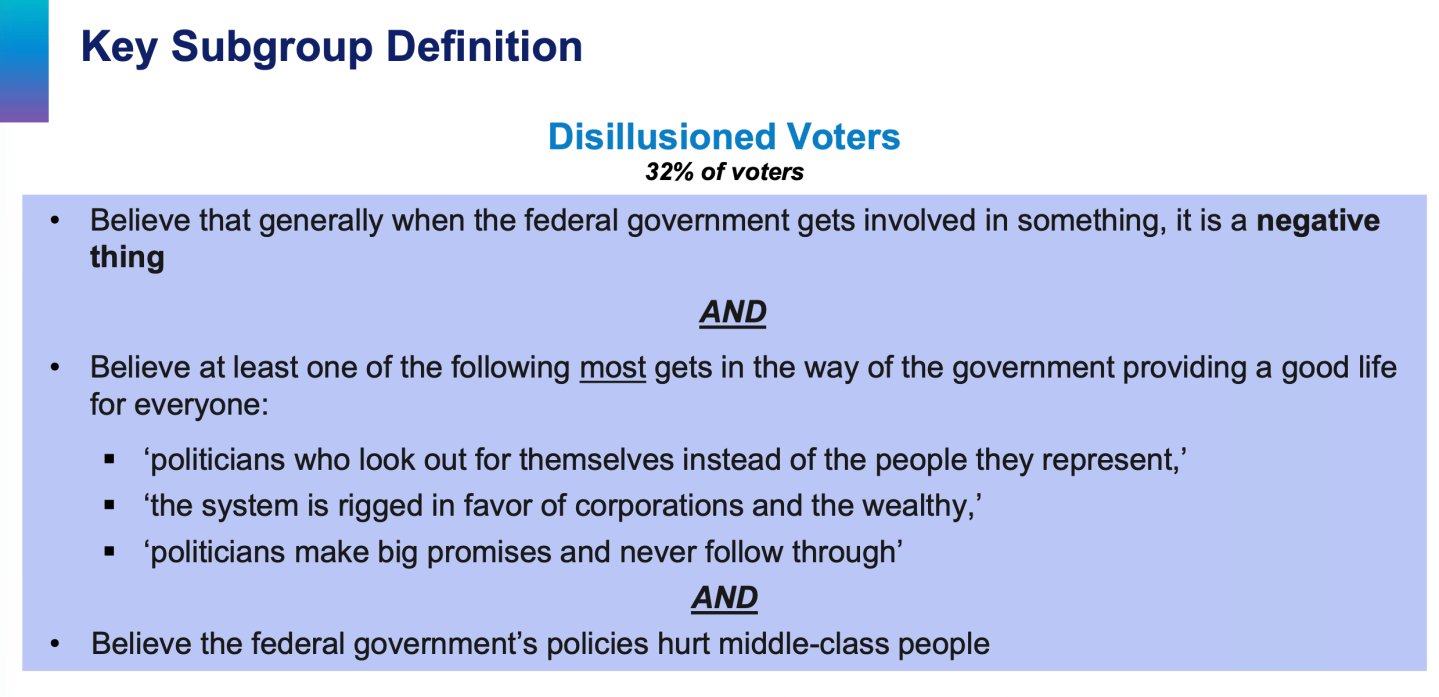
Nearly a third of American voters are living some version of this story. A new poll from the Roosevelt Institute, conducted by Impact Research in May 2026 among 1,000 registered voters, gives this cohort a name: the “disillusioned.” It has a surprisingly precise definition, of people who believe the system is rigged in favor of corporations and the wealthy, that government involvement makes things worse, and that federal policies actively hurt the middle class.
What the poll cannot quite capture is the exhaustion driving those beliefs. The disillusioned 32% aren’t angry in the abstract. Eighty-five percent of them are financially worried, more than any other group surveyed. Nearly half say their quality of life has gotten worse over the past two years. Twenty-seven percent have dipped into retirement savings just to cover ordinary expenses. Forty-two percent have stopped saving entirely.
The Roosevelt Institute is interested in what this means for the political future of the country, but this story is at root an economic one—and it has been building for a very long time.
The portrait
Start with who they are not: they’re not primarily rural; not overwhelmingly conservative; not the caricature of the forgotten white working-class voter that pundits have been recycling since 2016.
Disillusioned voters are distributed across urban, suburban, and rural zip codes in almost exactly the same proportions as the broader electorate. They are 68% White, the same as the overall voter pool. They are nearly evenly split by gender. They span every age cohort.
What does set them apart is class and income. They over-index as working class (35% vs. 33% overall) and lower income, with 64% earning under $75,000 a year. Seventy percent lack a college degree. And they have made financial sacrifices at rates that outpace almost every other group in the poll: cutting transportation, buying groceries on credit, taking on gig work, skipping bills.
Their financial lives aren’t dramatically different from the working-class majority. They’re just a few degrees worse, sustained long enough to harden into a worldview.
And this is not a MAGA story: 43% of the disillusioned identify as Democrats, 29% as independents and just 25% Republican. They are nearly a third of the electorate and they over-index as working and lower class. They are the 20th-century backbone of the Democratic Party, in other words, the type of voter that formed the “blue wall” in Michigan, Wisconsin and Pennsylvania that broke for Trump in 2016, and they remain hopeless about what the 21st century economy has to offer.
Elizabeth Wilkins, CEO and President of Roosevelt Institute, said it’s less about politics and more about general sentiment in today’s economy. “I think this moment that we’re in right now is really less of a left-right moment than a bottom-top moment,” she told Fortune. She argued that the nearly one-third of Americans who fall into this category are not necessarily at wit’s end with the government, so much as fully disappointed with what they have versus what they were promised. “That is the dissolution of the American Dream — that you contribute and you’re taken care of in return.”
“The disillusionment is not a full walking away. It means people have expectations, and those expectations haven’t been met in the past, but we have an opportunity to meet them in the future.”
The long unraveling
Marc Levinson has spent much of his career trying to explain why the math stopped working for so many Americans, and when.
The economic historian, whose book An Extraordinary Time traced the end of the postwar growth era, argues that the buoyancy most Americans associate with the mid-20th century—rising wages, affordable housing, a sense that each year would be better than the last—effectively ended in the early 1970s and has never genuinely returned. “We’re certainly not getting back to the age where people could feel that their living standards were rising day to day,” Levinson told Fortune in a recent interview. “It’s not like that at all.”
What followed were decades of growth that looked fine in the aggregate and felt hollow in practice—punctuated by brief spurts of genuine buoyancy that raised expectations before collapsing them. Think the dot-com boom, or the pre-financial-crisis expansion. And most recently, the strange, compressed labor market of 2021 and 2022, when COVID reshuffling briefly gave workers leverage they hadn’t felt in a generation.
“The closest thing we’ve had to it was actually immediately post-COVID,” Levinson said. “And that lasted for about a year. And now we’re back to, well, if you’re good, maybe we’ll give you a little wage increase next year. That’s about it.”
Levinson, who declined to talk about his personal politics because he said they are just not relevant for this conversation the way economic data is, acknowledged that people didn’t like his prescient 2016 book, which warned that populist demagogues would continue to be elected amid widespread economic malaise. “I think the part of the thesis that really bothered people of all political persuasions,” he said, “is that there’s not some lever the government can pull to fix all this.”
Wilkins agreed, saying that for a brief moment during COVID, Americans once again were able to achieve the prosperity realized during the post-WWII boom. (She noted that government-issued stimulus checks and a proactive health care system were a big part of the picture.)
“We did have this moment where we brought part of it back, and then we disappeared it again,” she said, adding that its disappearance is surely “giving people overall a sense of insecurity and uncertainty.”
The betrayal economy
The disillusioned aren’t wrong about the numbers—the wider electorate backed up many of their opinions. The Roosevelt poll asked voters whether federal government policies help or hurt various groups. Across all groups, survey respondents said policies help wealthy people (+60 net), billionaires (+57), and corporations (+54)—while hurting low-income people (–26), young people (–20), and the middle class (–18).
Fifty-two percent of voters overall say they can’t retire comfortably. Among working-class voters, that figure rises to 67%. Among those with insecure income—a category that overlaps heavily with the disillusioned—it hits 73%. Only one in five voters overall are on track to retire with confidence. Among working-class voters under 35, that number is 8%.
The poll asked voters to rate the federal government’s performance across nine policy areas. It received negative marks on all nine. Its worst scores came on housing affordability (–59 net), Social Security and Medicare (–53), wages (–53), and healthcare access (–51). Among working-class voters, every single score was worse, sometimes dramatically so.
These are not the results of a government that has been neutral. They are the results of a government that has, in the lived experience of a third of its voters, been actively failing them.
The paradox
Here is where the story turns, and where it becomes relevant to anyone trying to understand what comes next, in business or in politics.
Despite their conviction that government makes things worse, 78% of disillusioned voters support the Roosevelt Institute’s Good Life Agenda—a sweeping platform of healthcare affordability, living wages, expanded retirement security, housing investment, and worker protections. Their net support score (+68) is statistically identical to the electorate at large. Three-quarters say they’d be more likely to vote for an elected official who backs it.
They don’t think government is incapable of acting in their interests. Nearly half (49%) think this agenda is “long overdue,” more than any other group tested.
Levinson’s structural lens complicates this in an important way. His argument isn’t that policy is irrelevant—it’s that the forces suppressing productivity and living standards for most workers run deeper than any single agenda can fully address.
Levinson said left, right and center all have different “pet theories” about how to grow the economy again: “maybe you’ve got to control the money supply better, maybe you’ve got to pump more money into ailing industries, maybe you’ve got to raise tariffs, maybe you’ve got to give free child care … everybody’s got their solution to the problem, but people are very reluctant to accept the idea that there’s really serious limitations on what government can do about productivity in a deliberate sense.”
He concluded: “There just are no buttons to push, and people wish there were.”
Wilkins said this is typical of people in the disillusioned category: they still expect the American Dream they were promised. “People are disillusioned, but they are ready to believe in something if there is a credible plan to deliver the building blocks of a good life for people,” she said.
The stakes
The disillusioned are not going away. Their financial distress is structural, not cyclical. The brief post-COVID window that offered relief has closed. Productivity growth remains elusive. The housing market is frozen. The retirement math doesn’t work. And neither party has demonstrated, to their satisfaction, that it has a credible answer.
“Most families aren’t falling behind because they’re doing something wrong,” the Good Life Agenda framing reads. “They’re falling behind because the system is tilted against them.”
Wilkins said the government should take this into consideration when making new policy and looking to solve for the costs truly felt at the dinner table. “I see that as the right kind of challenge and opportunity for policymakers,” she said. “I think that’s evidence that the ‘affordability crisis’ runs a lot deeper than my weekly grocery bill. It is a deep sense of anxiety and insecurity about the future that we have an obligation to respond to.”