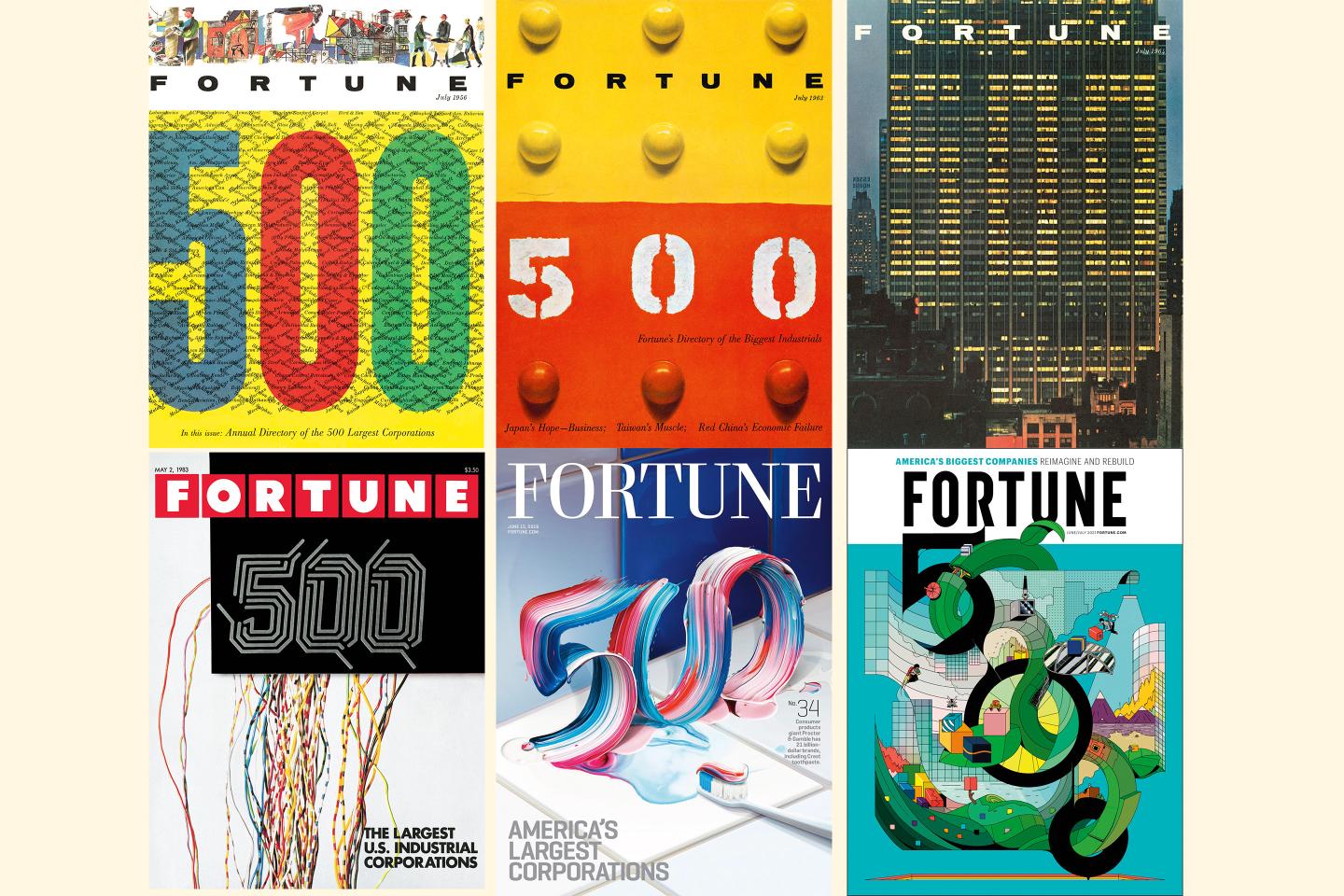
Fortune publishes lists to celebrate all kinds of qualities in companies—from how admired they are to how much they have changed the world for the better. But our foundational list measures just one thing: bigness.
The Fortune 500, launched in 1955 as a “Box Score of Business Bigness,” ranks companies by annual revenue in the past fiscal year. Some Fortune 500 covers feature a person whose impact on the business world is undeniable, as was the case with Microsoft’s Satya Nadella in 2024.
But historically, the cover has portrayed this bigness artistically, with fittingly ambitious designs. In 1964, for example, art director Walter Allner arranged for dozens of windows across 20 floors of the Time & Life Building in New York City to be lit up at night so they spelled “500.”
Often the covers conveyed the zeitgeist of the time, as in 1983 when a tangle of wires evoked the age of electronics. Some were odes to companies on the list, as in 2016, when illustrator Pawel Nolbert squeezed a 500 from a tube of Procter & Gamble’s Crest toothpaste.
In this, the 72nd year of the Fortune 500, the list’s members brought in record combined revenue of $21 trillion. That’s undeniable bigness.
This article appears in the June/July issue of Fortune.