• Home
  • Latest
  • Fortune 500
  • Finance
  • Tech
  • Leadership
  • Lifestyle
  • Rankings
  • Multimedia

Trendingnow

1

Elon Musk on MacKenzie Scott giving away $26 billion of her fortune: 'Sadly,' it makes the world a worse place

2

MacKenzie Scott alone accounted for one-third of America's $19.2 billion in megagifts last year

3

Philanthropy leader at Warren Buffett and Bill Gates’ Giving Pledge says children of billionaires are pushing them to give their wealth away faster

1

Elon Musk on MacKenzie Scott giving away $26 billion of her fortune: 'Sadly,' it makes the world a worse place

2

MacKenzie Scott alone accounted for one-third of America's $19.2 billion in megagifts last year

3

Philanthropy leader at Warren Buffett and Bill Gates’ Giving Pledge says children of billionaires are pushing them to give their wealth away faster
Environmentclimate change
Asia

Rice feeds more than half the world. It’s also the climate equivalent of 239 million cars

By
Hanqin Tian
Hanqin Tian
,
Jingting Zhang
Jingting Zhang
,
Pep Canadell
Pep Canadell
,
Shufen (Susan) Pan
Shufen (Susan) Pan
, and
The Conversation
The Conversation
Down Arrow Button Icon
By
Hanqin Tian
Hanqin Tian
,
Jingting Zhang
Jingting Zhang
,
Pep Canadell
Pep Canadell
,
Shufen (Susan) Pan
Shufen (Susan) Pan
, and
The Conversation
The Conversation
Down Arrow Button Icon
May 25, 2026, 11:27 AM ET
r
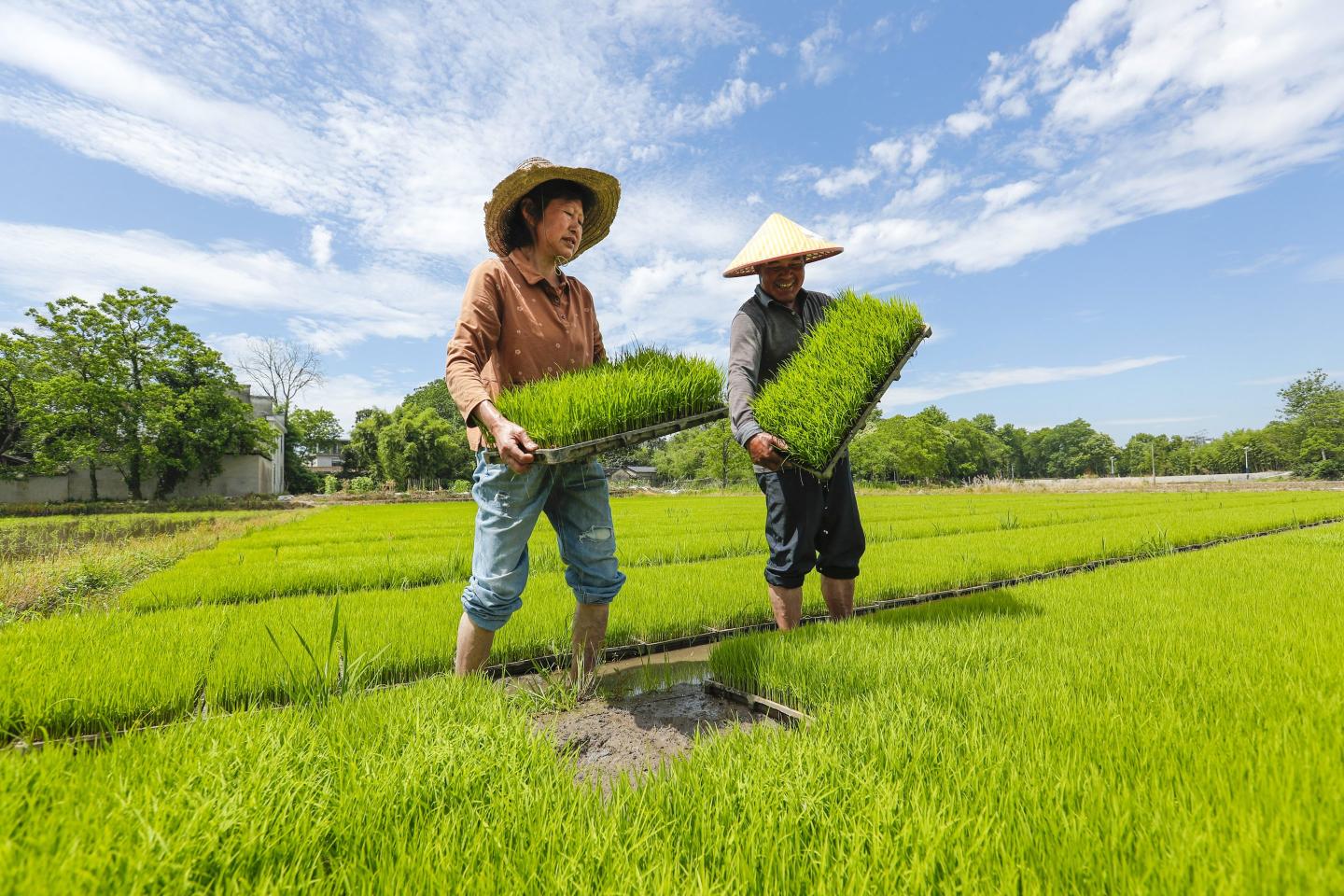
Villagers carry out field management work in rice paddies at a farm on May 18, 2026 in Xiuning County, Huangshan City, Shi Yalei/VCG via Getty Images
Add Fortune on Google for similar content.

Rice feeds more than half the world. From terraced paddies in Southeast Asia to irrigated fields in China and India, it underpins daily meals for billions of people.

Recommended Video

But the same flooded soils that help rice thrive also create ideal conditions for microbes that release climate-warming gases.

In a new study, our team of environment and agriculture scientists found that greenhouse gas emissions from rice paddies have nearly doubled globally since the 1960s, averaging about 1.1 billion tons of carbon dioxide-equivalent emissions per year in the 2010s. That’s roughly equal to the annual emissions of 239 million cars.

This makes rice-growing the largest emissions source in agriculture outside of livestock, and rice demand is expected to keep rising.

Farmers have ways to reduce their rice crops’ emissions without lowering their yields. If every grower used the best currently available “climate-smart” options, we found that global rice emissions could be reduced by about 10% by midcentury. However, greater reductions are needed to slow climate change, which would require developing additional, more effective strategies.

Why rice emissions have increased

Rice emissions have risen for two reasons: the expansion of rice cultivation area and the intensification of management practices.

Just over half of the global increase is from the expansion of rice-growing areas. In Africa, for example, the rice-growing area has roughly doubled since the 1960s, helping drive a twofold rise in methane emissions in the region.

At the same time, rice farmers are using more fertilizers and organic amendments, such as straw and manure, planting more productive rice varieties and growing the plants closer together. The result is more rice but also more greenhouse gas emissions.

People walk through a rice field on a hill with golden crops and more hills in the distances.
After rice is harvested, one technique for improving soil fertility is to plow the dried rice stalks back into the soil. But this also increases methane emissions. Jingting Zhang

We found that one practice in particular – leaving rice stalks in the field after harvest and then plowing them into the soil to improve soil fertility – was responsible for about 18% of rice’s increase in overall net emissions since the 1960s. The reason: It increases the organic matter in the soil, which microbes then decompose, creating more methane emissions.

Rising global temperatures further accelerate microbial activity in the soils, meaning even more emissions.

Fertilizer is another major contributor to emissions. Use of synthetic nitrogen increased by about 76% after 2000, boosting nitrous oxide – another powerful greenhouse gas. It contributed about 9% of the increase in total global net emissions from human activities.

Irrigation practices also affect emissions. In the past, irrigated rice paddies were kept flooded throughout the growing season, resulting in constant greenhouse gas emissions produced by microbes that thrive in the wet environment. Over the past two decades, however, more farmers have used intermittent flooding – draining their fields periodically.

This change has lowered methane emissions compared with keeping the paddies continuously flooded. However, we found a slight increase in nitrogen oxide emissions as soils cycled between wet and dry, which induces microbes to transform nitrogen in organic matter into nitrogen oxide gases, particularly nitrous oxide.

Climate impact of rice production

Putting a full climate price tag on rice production is harder than measuring one greenhouse gas at a time.

Rice paddies emit methane and nitrous oxide from wet or flooded soils. They also remove carbon dioxide from the atmosphere as rice grows, and they lose carbon from their soils between crop seasons.

A credible global estimate requires consistently accounting for different gases and soil carbon changes, as well as the uncertainty involved in tracking data across space and time.

To do that, we combined three approaches:

  • An ecosystem computer model allowed us to simulate crop growth, water conditions and soil processes to estimate changes in methane, nitrous oxide and soil carbon together.
  • An artificial intelligence-powered machine learning model improved estimates where measurements were sparse to cover all rice regions in the world.
  • And a meta-analysis of more than 1,200 field experiment sites provided direct evidence of how practices such as irrigation, fertilizer use and management of crop residue affect emissions.

Together, they allowed us to quantify emissions from 1961 to 2020, determine what drove those emissions, and test the potential of mitigation techniques under future climate conditions.

What works and doesn’t for climate mitigation

There are ways to reduce emissions from rice production without sacrificing yield.

Our study found that reducing fertilizer use and residue applications, managing irrigation to allow dry periods in between flooded ones and reducing tillage could, together, reduce global greenhouse gas emissions from rice by about 10% by midcentury.

We were surprised to find that replacing chemical fertilizers with more organic choices is not always better from a greenhouse gas perspective, although it is valued in organic farming.

Maintaining moderate amounts of straw and other crop residue in the field can help boost soil fertility, but too much can increase methane emissions and accelerate the loss of carbon from the soil. Another option is to convert part of the residue into biochar – burning it under low-oxygen conditions before mixing it into flooded soils. Biochar can help stabilize soil carbon and reduce methane emissions.

A view across flooded rice paddies with mountains in the distance.
Rice has long been grown in flooded fields, which promotes methane production. By intermittently draining the fields, researchers found farmers could reduce their fields’ methane emissions. Jingting Zhang

Improving water management can be a powerful tool for reducing emissions. Periodically draining fields reduces methane production, though it may slightly raise nitrous oxide emissions. This strategy is particularly effective in regions with reliable irrigation infrastructure, including large parts of Asia.

Managing fertilizer use is also an effective mitigation strategy, particularly in highly fertilized systems, including parts of China and South Asia. Excess nitrogen increases nitrous oxide without a clear increase in crop yields and increases water pollution. Reducing overapplication of nitrogen reduces emissions and water pollution, and it saves farmers money in the process.

The effects of tilling, the practice of plowing the soil between crop seasons, have large regional differences. Reducing tilling is often promoted as climate-friendly, but we found that it does not always minimize net emissions in flooded systems. In rice fields in temperate zones, including much of the U.S. and China, cooler conditions can limit methane production, allowing the soil carbon benefits of reduced tilling to outweigh the methane risk. In warmer, persistently flooded systems, however, low-oxygen conditions can boost microbial activity, increasing methane production and accelerating soil carbon loss.

Overall, we found that no single practice works everywhere. Each region will need to assess the most effective practices for reducing emissions.

A climate ceiling for rice production

The bottom line is both hopeful and sobering: Targeted sets of optimized practices can deliver meaningful emission reductions without losing rice yields, but the total global possible reduction is modest.

To reduce emissions further will require better guidance to help farmers determine the best levels of organic amendments, such as straw or biochar, and new approaches that can reduce emissions without undermining rice production.

Hanqin Tian, Director and Institute Professor, Center for Earth System Science and Global Sustainability, Boston College; Jingting Zhang, Research Scientist at the Center for Earth System Science and Global Sustainability, Boston College; Pep Canadell, Chief Research Scientist, CSIRO Environment; Executive Director, Global Carbon Project, CSIRO, and Shufen (Susan) Pan, Associate Professor of Environmental Science, Boston College

This article is republished from The Conversation under a Creative Commons license. Read the original article.

The Conversation
Subscribe to Fortune Gulf Brief. Every Tuesday, this new newsletter delivers clear-eyed, authoritative intelligence on the deals, decisions, policies, and power shifts shaping one of the world’s most consequential regions, written for the people who need to act on it. Sign up here.
About the Authors
By Hanqin Tian
See full bioRight Arrow Button Icon
By Jingting Zhang
See full bioRight Arrow Button Icon
By Pep Canadell
See full bioRight Arrow Button Icon
By Shufen (Susan) Pan
See full bioRight Arrow Button Icon
By The Conversation
See full bioRight Arrow Button Icon
Add Fortune on Google for similar content.

Latest in Environment

Finance
Lorem ipsum dolor sit amet, consectetur adipiscing elit, sed do eiusmod tempor incididunt ut labore et dolore magna aliqua. Ut enim ad minim veniam
By Fortune Editors
October 20, 2025
Finance
Lorem ipsum dolor sit amet, consectetur adipiscing elit, sed do eiusmod tempor incididunt ut labore et dolore magna aliqua. Ut enim ad minim veniam
By Fortune Editors
October 20, 2025
Finance
Lorem ipsum dolor sit amet, consectetur adipiscing elit, sed do eiusmod tempor incididunt ut labore et dolore magna aliqua. Ut enim ad minim veniam
By Fortune Editors
October 20, 2025
Finance
Lorem ipsum dolor sit amet, consectetur adipiscing elit, sed do eiusmod tempor incididunt ut labore et dolore magna aliqua. Ut enim ad minim veniam
By Fortune Editors
October 20, 2025
Finance
Lorem ipsum dolor sit amet, consectetur adipiscing elit, sed do eiusmod tempor incididunt ut labore et dolore magna aliqua. Ut enim ad minim veniam
By Fortune Editors
October 20, 2025
Finance
Lorem ipsum dolor sit amet, consectetur adipiscing elit, sed do eiusmod tempor incididunt ut labore et dolore magna aliqua. Ut enim ad minim veniam
By Fortune Editors
October 20, 2025

Most Popular

Finance
Lorem ipsum dolor sit amet, consectetur adipiscing elit, sed do eiusmod tempor incididunt ut labore et dolore magna aliqua. Ut enim ad minim veniam
By Fortune Editors
October 20, 2025
Finance
Lorem ipsum dolor sit amet, consectetur adipiscing elit, sed do eiusmod tempor incididunt ut labore et dolore magna aliqua. Ut enim ad minim veniam
By Fortune Editors
October 20, 2025
Finance
Lorem ipsum dolor sit amet, consectetur adipiscing elit, sed do eiusmod tempor incididunt ut labore et dolore magna aliqua. Ut enim ad minim veniam
By Fortune Editors
October 20, 2025
Finance
Lorem ipsum dolor sit amet, consectetur adipiscing elit, sed do eiusmod tempor incididunt ut labore et dolore magna aliqua. Ut enim ad minim veniam
By Fortune Editors
October 20, 2025
Finance
Lorem ipsum dolor sit amet, consectetur adipiscing elit, sed do eiusmod tempor incididunt ut labore et dolore magna aliqua. Ut enim ad minim veniam
By Fortune Editors
October 20, 2025
Finance
Lorem ipsum dolor sit amet, consectetur adipiscing elit, sed do eiusmod tempor incididunt ut labore et dolore magna aliqua. Ut enim ad minim veniam
By Fortune Editors
October 20, 2025
Fortune Secondary Logo
Rankings
  • 100 Best Companies
  • Fortune 500
  • Global 500
  • Fortune 500 Europe
  • Most Powerful Women
  • World's Most Admired Companies
  • See All Rankings
  • Lists Calendar
Sections
  • Finance
  • Fortune Crypto
  • Features
  • Leadership
  • Health
  • Commentary
  • Success
  • Retail
  • Mpw
  • Tech
  • Lifestyle
  • CEO Initiative
  • Asia
  • Politics
  • Conferences
  • Europe
  • Newsletters
  • Personal Finance
  • Environment
  • Magazine
  • Education
Customer Support
  • Frequently Asked Questions
  • Customer Service Portal
  • Privacy Policy
  • Terms Of Use
  • Single Issues For Purchase
  • International Print
Commercial Services
  • Advertising
  • Fortune Brand Studio
  • Fortune Analytics
  • Fortune Conferences
  • Business Development
  • Group Subscriptions
About Us
  • About Us
  • Press Center
  • Work At Fortune
  • Terms And Conditions
  • Site Map
  • About Us
  • Press Center
  • Work At Fortune
  • Terms And Conditions
  • Site Map
  • Facebook icon
  • Twitter icon
  • LinkedIn icon
  • Instagram icon
  • Pinterest icon

Latest in Environment

This summer’s heat is a live stress test for data centers—here’s what it’s revealing in real time
AIData centers
This summer’s heat is a live stress test for data centers—here’s what it’s revealing in real time
By Tristan BoveJune 29, 2026
9 hours ago
usa
EnvironmentHeat
Long and dangerous heat wave to roast America from Dallas to New York through July 4th holiday
By Marc Levy and The Associated PressJune 29, 2026
13 hours ago
wendy
Commentary250 Years of Innovation
Wendy Schmidt: Three centuries of science is something to celebrate
By Wendy SchmidtJune 29, 2026
16 hours ago
green
RetailWorld Cup
France wearing green for the Statue of Liberty: inside the unusual interpretation of ‘national pride’ that makes World Cup jerseys
By Claire Rush and The Associated PressJune 28, 2026
1 day ago
How Paris is using the Seine to try to keep cool in scorching heat
EnvironmentWeather and forecasting
How Paris is using the Seine to try to keep cool in scorching heat
By Francois de Beaupuy and BloombergJune 28, 2026
1 day ago
France suffers 1,000 additional deaths in just the past week amid record heat wave—and 85% involved people aged 65 and above
EuropeWeather and forecasting
France suffers 1,000 additional deaths in just the past week amid record heat wave—and 85% involved people aged 65 and above
By Kirsten Grieshaber, John Leicester and The Associated PressJune 28, 2026
2 days ago

Most Popular

Elon Musk on MacKenzie Scott giving away $26 billion of her fortune: 'Sadly,' it makes the world a worse place
Success
Elon Musk on MacKenzie Scott giving away $26 billion of her fortune: 'Sadly,' it makes the world a worse place
By Sydney LakeJune 29, 2026
11 hours ago
MacKenzie Scott alone accounted for one-third of America's $19.2 billion in megagifts last year
Success
MacKenzie Scott alone accounted for one-third of America's $19.2 billion in megagifts last year
By Sydney LakeJune 25, 2026
5 days ago
Philanthropy leader at Warren Buffett and Bill Gates’ Giving Pledge says children of billionaires are pushing them to give their wealth away faster
Success
Philanthropy leader at Warren Buffett and Bill Gates’ Giving Pledge says children of billionaires are pushing them to give their wealth away faster
By Preston ForeJune 27, 2026
3 days ago
The retired college professor fighting a $313 trespassing ticket in Wisconsin thinks he's part of a national struggle
Environment
The retired college professor fighting a $313 trespassing ticket in Wisconsin thinks he's part of a national struggle
By Catherina GioinoJune 28, 2026
2 days ago
Ex-Google engineer says Larry Page, Sergey Brin and Sundar Pichai share the same trait—it's the lesson he swears by as a $7.2 billion AI CEO
Success
Ex-Google engineer says Larry Page, Sergey Brin and Sundar Pichai share the same trait—it's the lesson he swears by as a $7.2 billion AI CEO
By Orianna Rosa RoyleJune 28, 2026
2 days ago
Cristiano Ronaldo is soccer's first-ever billionaire: He went from begging for burgers outside McDonald's to landing a $400 million contract
Success
Cristiano Ronaldo is soccer's first-ever billionaire: He went from begging for burgers outside McDonald's to landing a $400 million contract
By Preston ForeJune 28, 2026
2 days ago

© 2026 Fortune Media IP Limited. All Rights Reserved. Use of this site constitutes acceptance of our Terms of Use and Privacy Policy | CA Notice at Collection and Privacy Notice | Do Not Sell/Share My Personal Information
FORTUNE is a trademark of Fortune Media IP Limited, registered in the U.S. and other countries. FORTUNE may receive compensation for some links to products and services on this website. Offers may be subject to change without notice.