• Home
  • Latest
  • Fortune 500
  • Finance
  • Tech
  • Leadership
  • Lifestyle
  • Rankings
  • Multimedia

Trendingnow

1

26 Meta employees accuse Mark Zuckerberg of using AI to target 8,000 layoffs against workers on medical, parental or family leave

2

FedEx CEO says we are in the middle of the biggest supply chain shift he’s seen in 35 years: ‘We are the referendum’

3

He sold his last company to Palantir. Now he's betting $32 million that robots can fix construction's labor crisis

1

26 Meta employees accuse Mark Zuckerberg of using AI to target 8,000 layoffs against workers on medical, parental or family leave

2

FedEx CEO says we are in the middle of the biggest supply chain shift he’s seen in 35 years: ‘We are the referendum’

3

He sold his last company to Palantir. Now he's betting $32 million that robots can fix construction's labor crisis
EconomyChina
Asia

Scott Bessent made a fortune spotting currency manipulation. He says Beijing’s $2.5 trillion black hole is ‘a problem for the Europeans’

By
Eva Roytburg
Eva Roytburg
Fellow, News
Down Arrow Button Icon
By
Eva Roytburg
Eva Roytburg
Fellow, News
Down Arrow Button Icon
May 14, 2026, 12:17 PM ET
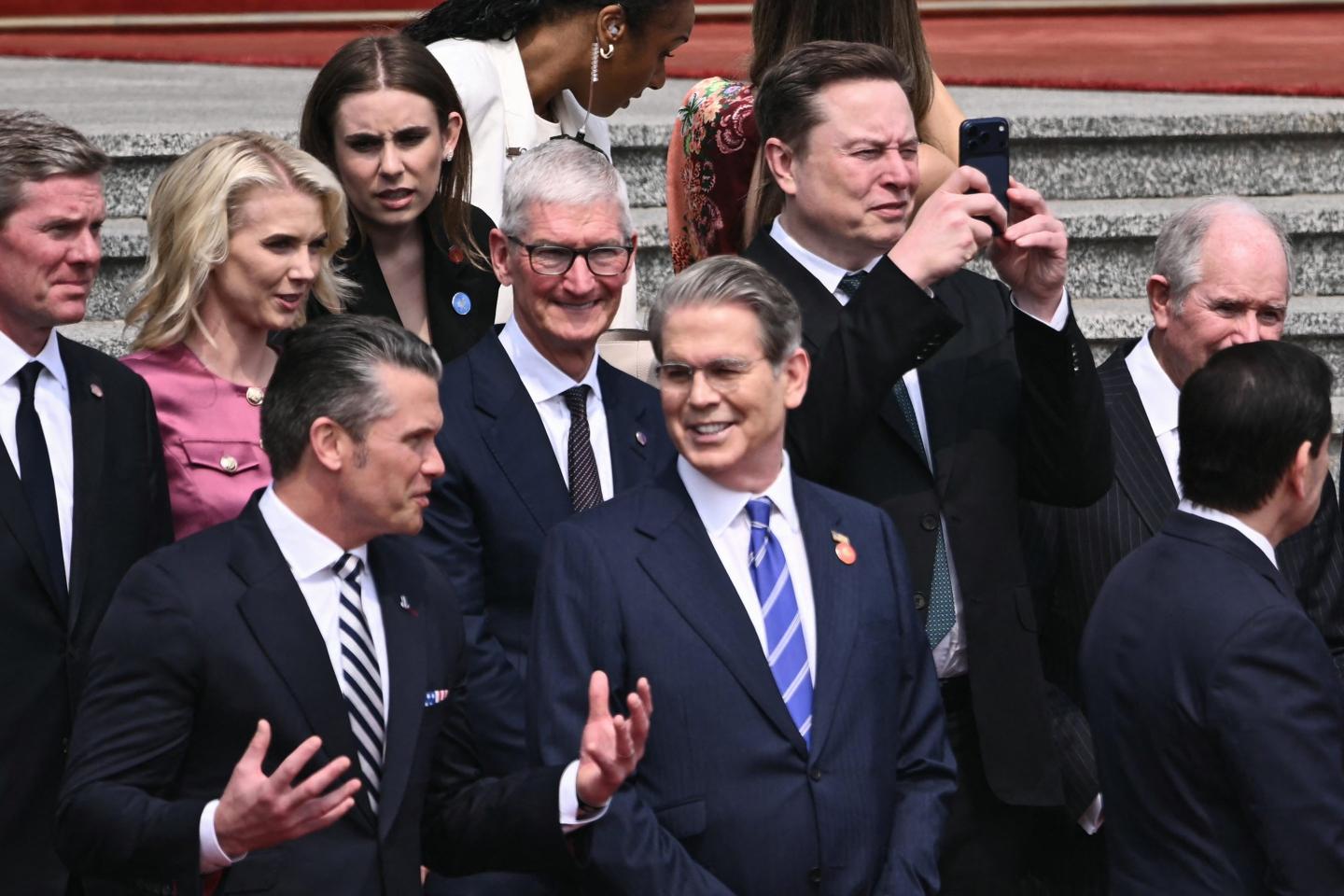
US Secretary of Defense Pete Hegseth (bottom L) speaks with US Treasury Secretary Scott Bessent (bottom centre R), as Tesla and SpaceX CEO Elon Musk (top R) uses his phone and Apple CEO Tim Cook (C) looks on at a welcome ceremony for US President Donald Trump at the Great Hall of the People in Beijing on May 14, 2026.
US Secretary of Defense Pete Hegseth (bottom L) speaks with US Treasury Secretary Scott Bessent (bottom centre R), as Tesla and SpaceX CEO Elon Musk (top R) uses his phone and Apple CEO Tim Cook (C) looks on at a welcome ceremony for US President Donald Trump at the Great Hall of the People in Beijing on May 14, 2026. Brendan SMIALOWSKI / AFP via Getty Images
Add Fortune on Google for similar content.

In 1992, a 29-year-old Scott Bessent looked at the Bank of England and saw something no one else did. 

Recommended Video

The Bank of England couldn’t afford to keep its promises. It had committed to keeping the pound trading within a narrow radius against the German mark, requiring it to spend whatever it took to defend the currency’s value. The trouble was that the British economy was fragile—most mortgages in the UK at the time had variable rates, so raising interest rates  would devastate British homeowners. Bessent convinced his boss, George Soros, to bet against the pound. When it crashed a week later, Bessent made $1 billion for the firm and made himself and Soros famous.

The lesson Bessent learned on that “Black Wednesday” is simple: when a central bank is artificially holding its currency at a level the market wouldn’t otherwise support, eventually the market will win. Though the yuan is harder to trade than the pound—China has a number of capital controls—the same logic, more or less, should apply to China today.

Thirty-four years later, Bessent is flying to Beijing, where he will sit across from a central bank, the People’s Bank of China (PBOC), that is, by his private firm’s research, artificially holding the yuan at a level the market wouldn’t otherwise support. But Bessent isn’t working for that firm now; he’s the Treasury Secretary of the United States.

The dynamics in 2026 are the opposite of 1992 in the UK: Beijing has spent decades suppressing the yuan to keep its exports cheap, as opposed to propping it up to defend a peg. Throughout the 2010s, the scandal of America looking the other way on this plagued Ben Bernanke’s Fed and Bush and Obama’s presidencies, propelling  Trump to classify China as a “currency manipulator” on the 2016 campaign trail, and then officially in 2019. That designation became the justification for the Mar-a-Lago Accord, which built the financial structure of Trump’s tariff regime: something Bessent called on  Bloomberg “an answer to currency manipulation.”

The yuan, by the estimate of Brad Setser, a Council on Foreign Relations senior fellow who tracks Chinese capital flows and who previously served at Treasury, is about 20% undervalued. “If you assume the financial account stays closed as it is now, I think you could easily see the yuan trade up to six or stronger,” Setser told Fortune. “Ten to twenty percent higher is relatively straightforward.”

How China quietly depresses the yuan 

China has been the “world’s factory” since joining the World Trade Organization in 2001, and since then they’ve bought up dollar-denominated assets to keep the yuan cheap, and their exports competitive.  It has done so through its foreign exchange agency, the State Administration of Foreign Exchange (SAFE), which currently holds about $1.8 trillion in dollar reserves.

The trouble is that these purchases are public, and have drawn the ire of Washington. So, since 2015, China has tried a new strategy; buying treasuries through state-owned commercial banks, policy banks or its sovereign wealth fund. Right now, Setser estimates, China has about $1.1 trillion at state commercial banks, close to $1 trillion in policy bank claims abroad, and a majority of the China Investment Corporation’s $450 billion portfolio; around $2.5 trillion off balance sheet in total. 

“China, Inc. could hold more dollars off SAFE’s balance sheet than on SAFE’s balance sheet,” Setser wrote for the Council of Foreign Relations. “Nice little trick.”

It seemed to partially work to stave off Washington. In June 2025, six months into his tenure, Bessent’s Treasury Department declined to designate China a currency manipulator, citing only the country’s “lack of transparency.”

The case for designation is, by most technical measures, stronger now than it was in 2019, when Trump’s first Treasury actually pulled the trigger. “I don’t think China met the criteria in 2019,” Setser said. “I think that was a very political designation.” At the time, he explained,  there was not a buildup of foreign exchange and China’s global trade surplus was actually much smaller. Now, he said, China actually does meet the criteria, if you consider that state regional banks are essentially doing the FSOB’s bidding off-balance sheet. So why the silence?

Bessent’s own answer came last September, in Madrid. Asked whether he had raised yuan devaluation with Chinese Vice Premier He Lifeng, the Treasury Secretary told reporters: “Well, they haven’t done it to the U.S. The RMB is actually stronger this year versus the dollar. Now it’s at an all-time low versus the euro, which is a problem for the Europeans.” Asked whether the decline was manipulation, he said only that the yuan is “a closed currency.”

Other analysts see game theory. “Xi is coming into the summit feeling confident he has solved Trump,” Jeremy Chan, a senior analyst at Eurasia Group and former U.S. diplomat, told Bloomberg. Beijing controls 90% of the world’s processed rare earths—the inputs vital for defense systems and AI chips. The U.S. ran tariffs up to 145% earlier in the year and walked them back to 30% when China retaliated by tightening export controls on those minerals; a moment that exposed a severe lack of preparedness to answer China’s points of leverage.

Jon Hilsenrath, who runs the economic advisory firm Serpa Pinto and covered the Federal Reserve for 26 years at The Wall Street Journal, has puzzled over the same issue, and reads the silence as a form of triage. “They’ve got so many other bigger issues on their mind that it just hasn’t risen to the level of something they want to make a fuss about,” he told Fortune.

Plus, he added, the Chinese are actually letting the yuan appreciate a little bit. The yuan has climbed about 7% against the dollar over the past year, moving from 7.3 in January 2025 to around 6.80 today. “So they’re probably happy to see that,” Hilsenrath said. 

But really, the broader dynamic of the relationship isn’t pulling one way or the other; just stagnation. Hilsenrath likes to call it tangping, borrowing the post-Covid Chinese internet term for “lying flat.”

“Our relationship with China is lying flat. It’s not changing, it’s stable,” Hilsenrath said.

That’s the bar for the summit. While Bessent and analysts might once have wanted a structural fix: a yuan that actually reflects China’s surpluses, or an economy rebalanced away from export dependence, none of that is on the table. All Trump wants out of the trip, in Hilsenrath’s read, is “headline material”—a Chinese commitment to buy $50 billion in soybeans, or a Boeing order. Just a handshake. “That’s more concrete than saying they’re going to let the yuan appreciate another percentage point.”

Subscribe to Fortune Gulf Brief. Every Tuesday, this new newsletter delivers clear-eyed, authoritative intelligence on the deals, decisions, policies, and power shifts shaping one of the world’s most consequential regions, written for the people who need to act on it. Sign up here.
About the Author
By Eva RoytburgFellow, News
Instagram iconLinkedIn icon

Eva covers macroeconomics, market-moving news, and the forces shaping the global economy.

See full bioRight Arrow Button Icon
Add Fortune on Google for similar content.

Latest in Economy

Finance
Lorem ipsum dolor sit amet, consectetur adipiscing elit, sed do eiusmod tempor incididunt ut labore et dolore magna aliqua. Ut enim ad minim veniam
By Fortune Editors
October 20, 2025
Finance
Lorem ipsum dolor sit amet, consectetur adipiscing elit, sed do eiusmod tempor incididunt ut labore et dolore magna aliqua. Ut enim ad minim veniam
By Fortune Editors
October 20, 2025
Finance
Lorem ipsum dolor sit amet, consectetur adipiscing elit, sed do eiusmod tempor incididunt ut labore et dolore magna aliqua. Ut enim ad minim veniam
By Fortune Editors
October 20, 2025
Finance
Lorem ipsum dolor sit amet, consectetur adipiscing elit, sed do eiusmod tempor incididunt ut labore et dolore magna aliqua. Ut enim ad minim veniam
By Fortune Editors
October 20, 2025
Finance
Lorem ipsum dolor sit amet, consectetur adipiscing elit, sed do eiusmod tempor incididunt ut labore et dolore magna aliqua. Ut enim ad minim veniam
By Fortune Editors
October 20, 2025
Finance
Lorem ipsum dolor sit amet, consectetur adipiscing elit, sed do eiusmod tempor incididunt ut labore et dolore magna aliqua. Ut enim ad minim veniam
By Fortune Editors
October 20, 2025

Most Popular

Finance
Lorem ipsum dolor sit amet, consectetur adipiscing elit, sed do eiusmod tempor incididunt ut labore et dolore magna aliqua. Ut enim ad minim veniam
By Fortune Editors
October 20, 2025
Finance
Lorem ipsum dolor sit amet, consectetur adipiscing elit, sed do eiusmod tempor incididunt ut labore et dolore magna aliqua. Ut enim ad minim veniam
By Fortune Editors
October 20, 2025
Finance
Lorem ipsum dolor sit amet, consectetur adipiscing elit, sed do eiusmod tempor incididunt ut labore et dolore magna aliqua. Ut enim ad minim veniam
By Fortune Editors
October 20, 2025
Finance
Lorem ipsum dolor sit amet, consectetur adipiscing elit, sed do eiusmod tempor incididunt ut labore et dolore magna aliqua. Ut enim ad minim veniam
By Fortune Editors
October 20, 2025
Finance
Lorem ipsum dolor sit amet, consectetur adipiscing elit, sed do eiusmod tempor incididunt ut labore et dolore magna aliqua. Ut enim ad minim veniam
By Fortune Editors
October 20, 2025
Finance
Lorem ipsum dolor sit amet, consectetur adipiscing elit, sed do eiusmod tempor incididunt ut labore et dolore magna aliqua. Ut enim ad minim veniam
By Fortune Editors
October 20, 2025
Fortune Secondary Logo
Rankings
  • 100 Best Companies
  • Fortune 500
  • Global 500
  • Fortune 500 Europe
  • Most Powerful Women
  • World's Most Admired Companies
  • See All Rankings
  • Lists Calendar
Sections
  • Finance
  • Fortune Crypto
  • Features
  • Leadership
  • Health
  • Commentary
  • Success
  • Retail
  • Mpw
  • Tech
  • Lifestyle
  • CEO Initiative
  • Asia
  • Politics
  • Conferences
  • Europe
  • Newsletters
  • Personal Finance
  • Environment
  • Magazine
  • Education
Customer Support
  • Frequently Asked Questions
  • Customer Service Portal
  • Privacy Policy
  • Terms Of Use
  • Single Issues For Purchase
  • International Print
Commercial Services
  • Advertising
  • Fortune Brand Studio
  • Fortune Analytics
  • Fortune Conferences
  • Business Development
  • Group Subscriptions
About Us
  • About Us
  • Press Center
  • Work At Fortune
  • Terms And Conditions
  • Site Map
  • About Us
  • Press Center
  • Work At Fortune
  • Terms And Conditions
  • Site Map
  • Facebook icon
  • Twitter icon
  • LinkedIn icon
  • Instagram icon
  • Pinterest icon

Latest in Economy

Jamie Dimon surrounded by construction workers.
SuccessCareers
JPMorgan CEO Jamie Dimon says 300,000 workers are needed to rebuild American shipbuilding—with jobs paying $100,000 without a college degree
By Preston ForeJuly 16, 2026
1 hour ago
Europe optimized its supply chains for cost. Now it must pay for resilience  
Commentarysupply chains
Europe optimized its supply chains for cost. Now it must pay for resilience  
By Richard SaynorJuly 16, 2026
2 hours ago
US Federal Reserve Chair Kevin Warsh testifies during a Senate Banking Committee hearing titled "The Semiannual Monetary Policy Report to the Congress" on Capitol Hill in Washington, DC, on July 15, 2026.
EconomyBonds
Warsh’s Fed plan means it’s time to read the bond market backwards, says Morgan Stanley chief—and it could be great news for borrowers and homeowners
By Eleanor PringleJuly 16, 2026
3 hours ago
inflation
EconomyInflation
Wholesale inflation falls 0.3% in June, but Iran war clouds outlook
By Paul Wiseman and The Associated PressJuly 16, 2026
3 hours ago
steel
North Americasteel
‘British Steel now belongs to the British people’: China booted from national champion to save thousands of jobs
By Danica Kirka and The Associated PressJuly 16, 2026
4 hours ago
t
EconomyTariffs
Rubio blames Brazil’s 25% tariffs on Lula’s ‘ego’ — but exempts coffee and beef
By Michelle L. Price and The Associated PressJuly 16, 2026
5 hours ago

Most Popular

26 Meta employees accuse Mark Zuckerberg of using AI to target 8,000 layoffs against workers on medical, parental or family leave
Law
26 Meta employees accuse Mark Zuckerberg of using AI to target 8,000 layoffs against workers on medical, parental or family leave
By Barbara Ortutay, Alexandra Olson and The Associated PressJuly 15, 2026
1 day ago
FedEx CEO says we are in the middle of the biggest supply chain shift he’s seen in 35 years: ‘We are the referendum’
C-Suite
FedEx CEO says we are in the middle of the biggest supply chain shift he’s seen in 35 years: ‘We are the referendum’
By Fortune EditorsJuly 15, 2026
1 day ago
He sold his last company to Palantir. Now he's betting $32 million that robots can fix construction's labor crisis
Innovation
He sold his last company to Palantir. Now he's betting $32 million that robots can fix construction's labor crisis
By Lily Mae LazarusJuly 15, 2026
1 day ago
Jamie Dimon understands why people are anti-rich: 'We have, in fact, left the lower-income folks behind' and 'that's kind of annoying'
Economy
Jamie Dimon understands why people are anti-rich: 'We have, in fact, left the lower-income folks behind' and 'that's kind of annoying'
By Eleanor PringleJuly 15, 2026
1 day ago
MacKenzie Scott, Melinda French Gates, and Lauren Sánchez Bezos are rewriting the rules of billionaire giving—one quietly, one strategically, one very publicly
Newsletters
MacKenzie Scott, Melinda French Gates, and Lauren Sánchez Bezos are rewriting the rules of billionaire giving—one quietly, one strategically, one very publicly
By Sydney LakeJuly 14, 2026
2 days ago
Current price of oil as of July 15, 2026
Personal Finance
Current price of oil as of July 15, 2026
By Joseph HostetlerJuly 15, 2026
1 day ago

© 2026 Fortune Media IP Limited. All Rights Reserved. Use of this site constitutes acceptance of our Terms of Use and Privacy Policy | CA Notice at Collection and Privacy Notice | Do Not Sell/Share My Personal Information
FORTUNE is a trademark of Fortune Media IP Limited, registered in the U.S. and other countries. FORTUNE may receive compensation for some links to products and services on this website. Offers may be subject to change without notice.