
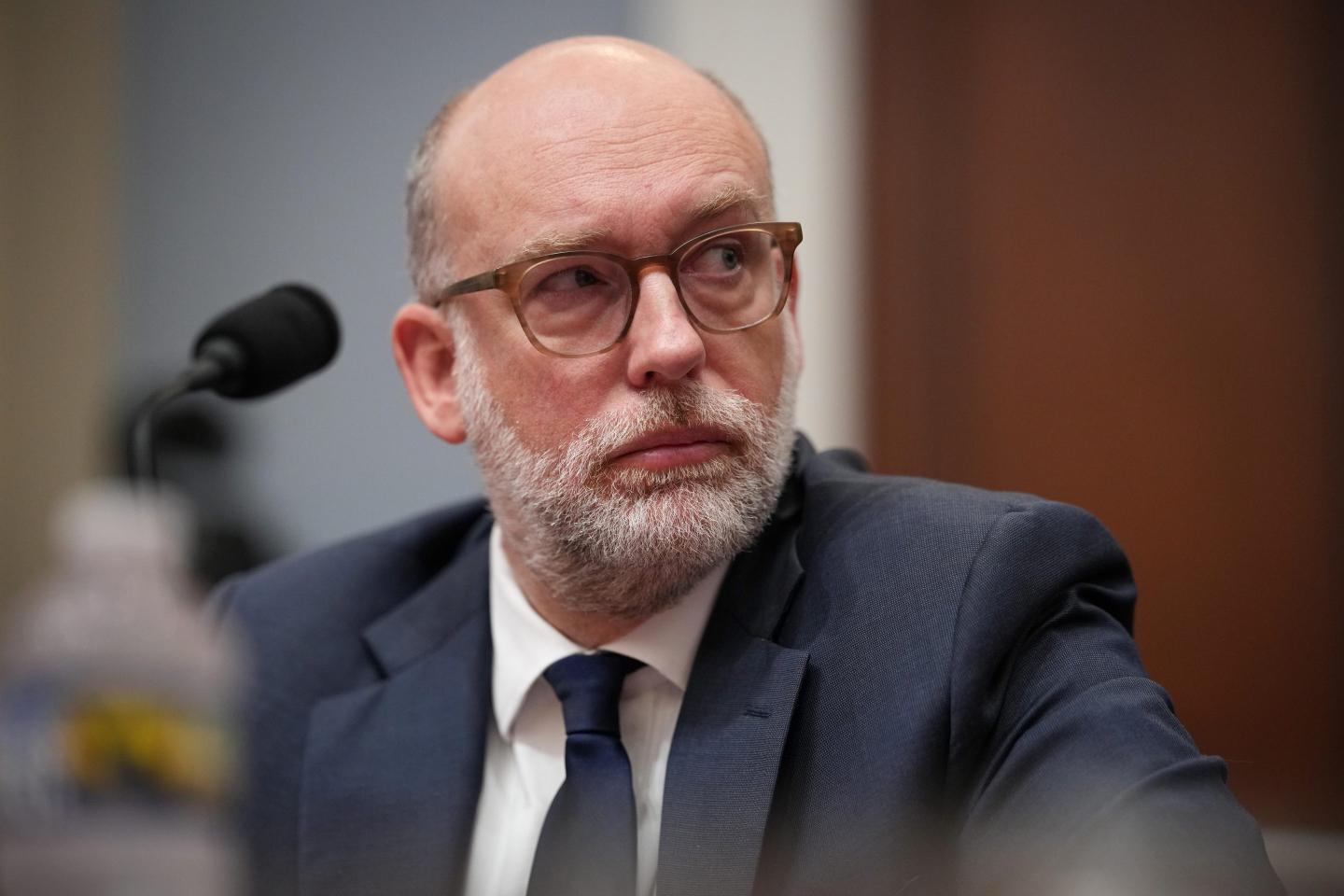
The confrontation was inevitable. When White House budget director Russell Vought appeared before the House Budget Committee on Wednesday to defend President Trump’s fiscal year 2027 budget, the hearing erupted almost immediately—with protesters ejected from the chamber before Vought could finish his opening statement, and Democratic lawmakers waiting their turn to unload.
The budget at the center of it all proposes $1.5 trillion in total defense spending—a roughly 44% increase over current levels—while cutting nondefense discretionary programs by 10% across the board. In dollar terms, that means a roughly $442 billion increase for the Pentagon, funded in part by reductions to Medicaid, housing assistance, childcare, and home energy aid for low-income seniors—a tradeoff that Democrats called a moral obscenity and Republicans called overdue.
“The budget builds upon the historic $1 trillion fiscal year 2026 defense top line by requesting $1.5 trillion for 2027, a 42% increase, as promised by President Trump last year,” Vought told the committee. “The 2027 budget will ensure that the United States continues to maintain the world’s most powerful and capable military as we grapple with an increasingly dangerous world.”
The backdrop to Vought’s testimony was a comment Trump made weeks earlier at a private White House Easter lunch, in which he said: “We’re fighting wars. We can’t take care of day care.” Trump went further, lumping in Medicaid and Medicare as things that should be pushed to states, which he said should raise their own taxes to cover the costs.
Pressed on those remarks by Rep. Brendan Boyle (D-Pa.), the committee’s ranking member, Vought pushed back—awkwardly. “No,” Vought said, when asked if the administration had taken any steps to turn Medicare over to the states.
“The president doesn’t want to do that,” he continued.
When Boyle noted Trump had not mentioned fraud in his Easter remarks—and that the comments plainly included Medicaid, Medicare, and childcare as programs the federal government simply shouldn’t fund—Vought sidestepped, saying Trump was “talking about fraud” in those programs.
The exchange over childcare grew sharper when Rep. Becca Balint (D-Vt.) asked Vought whether $350 billion for the ongoing U.S.-Iran war helped reduce costs for Americans. Vought replied childcare is “fully funded” in this budget. Rep. Morgan McGarvey (D-Ky.) later challenged that claim directly, holding up page 164 of the budget document and citing a provision he said slashed the fruit and vegetable benefit for breastfeeding mothers under the WIC nutrition program from $52 to $13 a month. Vought again replied: “We fully fund the WIC program.” McGarvey cut him off: “No, you don’t. It’s right here.”
The macro numbers looming over the debate were stark. The national debt already stands near $39 trillion, and the Congressional Budget Office has said the administration’s One Big Beautiful Bill—enacted last year—adds more to the deficit than any single piece of legislation in American history, stripping health care coverage from as many as 15 million to 17 million Americans, according to CBO and the Kaiser Family Foundation. Boyle asked Vought if he could seriously maintain, with a straight face, that all of those people were either in the country illegally or defrauding the system. “I didn’t say all of them are illegal,” Vought replied, adding, there’s “also the benefit of people returning to the workforce.”
The committee also heard from Rep. Pramila Jayapal (D-Wash.), who noted the Department of Defense has now failed eight consecutive audits and remains the only federal agency that has never passed one—even as Vought requests a historic budget increase for the Pentagon.
“You want to talk to me about fraud?” Jayapal asked. “There is over $10 billion in confirmed fraud within the Department of Defense, but you’re not going after any of that.”
Meanwhile, energy prices rose nearly 11% last month, according to the Department of Labor’s own data—gas is up more than 21%, and home energy more than 30%—a backdrop that made the budget’s elimination of the Low Income Home Energy Assistance Program especially pointed. Consumer confidence has plunged to its lowest level ever in the long-running University of Michigan survey, dating back 74 years, hitting 47.6 in preliminary April readings, a 10.7% drop from March.
Vought closed his opening remarks with a signature phrase, saying it’s “the end of fiscal futility.” Whether Congress agrees—and whether it can pass a budget before the fiscal year deadline—remains an entirely open question.
For this story, Fortune journalists used generative AI as a research tool. An editor verified the accuracy of the information before publishing.