• Home
  • Latest
  • Fortune 500
  • Finance
  • Tech
  • Leadership
  • Lifestyle
  • Rankings
  • Multimedia
Commentarydisruption

I was a government official in the 1990s and watched the economy get turned upside-down. It’s happening again

By
Maria Flynn
Maria Flynn
Down Arrow Button Icon
By
Maria Flynn
Maria Flynn
Down Arrow Button Icon
April 15, 2026, 8:00 AM ET
Maria Flynn is president and CEO of Jobs for the Future (JFF), a national nonprofit focused on transforming U.S. education and workforce systems, and a former senior official at the U.S. Department of Labor's Employment and Training Administration.
clinton
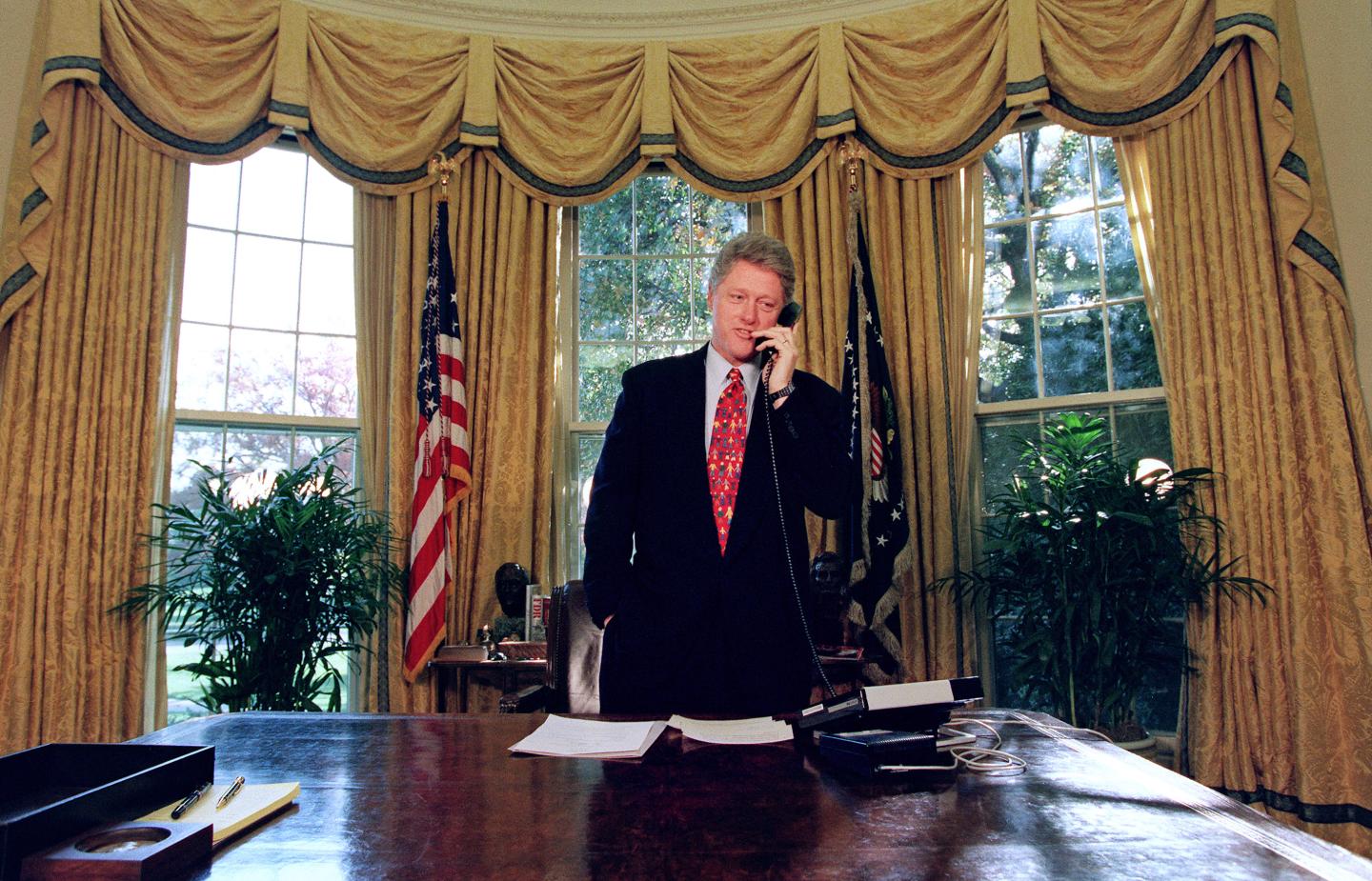
US President Bill Clinton speaks on the phone to Vice President Al Gore who is in Denver at a rally in support of North American Free Trade Agreement (NAFTA), 10 November 1993 in the Office of the White House. Clinton congratulates Gore on his debate with Ross Perot on the 'Lary King Show' on CNN. J. DAVID AKE / AFP via Getty Images

Today’s economy is being shaped by a range of competing forces: technological disruption, a rapidly globalizing marketplace, and a workforce caught in between — largely without a safety net designed for the speed of change. But this isn’t the first time that’s happened. As someone who worked for the U.S. government throughout the 1990s, I’m seeing evidence that the ‘90s are back in ways that extend beyond FX’s Love Story and the resurgence of grunge.

Recommended Video

My work at the U.S. Department of Labor in the ‘90s coincided with the passage of the North American Free Trade Agreement and the acceleration of trade with China. I saw the ways those dynamics created winners and losers: some industries flourished while others collapsed, and six million manufacturing jobs disappeared. Today, AI may be creating a similarly defining moment of labor-market uncertainty, and at an even larger scale. Some estimates suggest that 6% of American jobs could disappear due to AI, affecting 11 million American workers.  

At a time of major labor market disruption, the ‘90s offer both a playbook and a warning. Some of the responses I helped the government build supported workers in a time of economic turmoil, but others missed the mark. As we try to navigate a world increasingly dominated by AI, what can we learn from what was attempted, what worked, and what fell short thirty years ago?

Ideas Whose Time Has Come 

“The rising costs of postsecondary education are putting higher education out of reach for an increasing number of citizens.” 

“The skills of United States workers have not kept pace with the complexity of current job requirements.”  

These may sound like today’s concerns. But they come from the introductions to the 1993 act that created AmeriCorps and the Youth Apprenticeship Act of 1990. Those bills reflected a growing recognition that many previous career paths for high school graduates who did not attend college—especially in manufacturing—were no longer viable. Along with the School-to-Work Opportunities Act of 1994, they aimed to help young Americans access education and training experiences that would set them up for their future careers. 

But neither youth apprenticeship nor career-connected learning ever became central to the American education system. The lesson from the 1990s is not that these ideas were flawed. It’s that they were never fully embraced (The Apprenticeship Act never even came to a floor vote).

Today, as AI’s initial impacts hit younger workers hardest, these approaches are more relevant than ever.  Youth apprenticeship offers workers the opportunity to learn and earn simultaneously, gaining experience, skills, and professional networks.  Skilled service offers similar opportunities: Governors like Spencer Cox of Utah and Wes Moore of Maryland are looking for ways to create paths from service to careers. And modern career-connected learning efforts led by nonprofits like Britebound are doubling down on mentorship and real-world experience.

Ways We Missed the Mark

We were, perhaps, less prescient in our signature safety-net response to trade displacement, Trade Adjustment Assistance. It was intended to support workers negatively impacted by globalization by providing income support and, in theory, retraining. But the scale of the effort never matched the level of need, and results were mixed at best. Many workers never received support due to insufficient funds or bureaucratic barriers. Others saw benefits expire before the end of their retraining programs.   

Policymakers in the ‘90s also missed the mark in supporting the most-affected regions.  Displaced workers rarely moved to where jobs were. Most stayed put, often taking lower-paying, service-sector jobs or leaving the workforce entirely. Communities in the Rust Belt and the furniture and fabric-making regions of the Mid-Atlantic took a generation to recover. In short, programs like trade adjustment assistance cushioned individuals while doing little for the communities they came from.

Though AI’s impact will be more diffuse than the trade-related impacts of the ‘90s, it still will not affect every place equally. Some regions will be more resilient, particularly those with a wider range of occupations able to absorb displaced workers. Other regions may struggle to adapt. Ignoring that reality risks repeating the same mistakes. A regional lens allows public sector investment to focus on industries emerging within a particular area and the pathways into them.  Rather than expecting workers to move to opportunity, policy can bring opportunity—and preparation—to them.

For Congress, that should include expanding the Reemployment Services and Eligibility Assessments (RESEA) program, which provides individualized career counseling, job search assistance, labor market information, and resume support. RESEA is one of the most effective tools for reconnecting unemployed workers to jobs, with each dollar invested saving the government four dollars in avoided unemployment insurance costs. Those high-ROI programs are the ones the government needs to be investing in as we brace for AI’s continued impact.

History Doesn’t Repeat, It Rhymes

Of course, today’s moment differs from the ‘90s in important ways.  

The biggest difference is speed and scale. When manufacturing jobs disappeared in the ’90s, the pace of change — though devastating in concentrated communities — unfolded over many years. AI is moving faster and will impact many more industries. The workers in today’s disrupted roles may have a fraction of the adjustment time that displaced manufacturing workers had, and the systems meant to support them haven’t gotten any larger or better-connected than they were 30 years ago. If programs were underpowered to meet the scale of change in the ‘90s, they are woefully underprepared for the scale of change that may happen next. 

Today, we have a window of opportunity to respond differently. We can lean into the promising practices of the ‘90s while also upleveling our response, creating the foundation to support workers at the scale and speed of AI. If we can learn from, and improve upon, what we did 30 years ago, we’ll be better prepared to lead in the economy of 30 years from now.

The opinions expressed in Fortune.com commentary pieces are solely the views of their authors and do not necessarily reflect the opinions and beliefs of Fortune.

Join us at the Fortune Workplace Innovation Summit May 19–20, 2026, in Atlanta. The next era of workplace innovation is here—and the old playbook is being rewritten. At this exclusive, high-energy event, the world’s most innovative leaders will convene to explore how AI, humanity, and strategy converge to redefine, again, the future of work. Register now.
About the Author
By Maria Flynn
See full bioRight Arrow Button Icon

Latest in Commentary

Finance
Lorem ipsum dolor sit amet, consectetur adipiscing elit, sed do eiusmod tempor incididunt ut labore et dolore magna aliqua. Ut enim ad minim veniam
By Fortune Editors
October 20, 2025
Finance
Lorem ipsum dolor sit amet, consectetur adipiscing elit, sed do eiusmod tempor incididunt ut labore et dolore magna aliqua. Ut enim ad minim veniam
By Fortune Editors
October 20, 2025
Finance
Lorem ipsum dolor sit amet, consectetur adipiscing elit, sed do eiusmod tempor incididunt ut labore et dolore magna aliqua. Ut enim ad minim veniam
By Fortune Editors
October 20, 2025
Finance
Lorem ipsum dolor sit amet, consectetur adipiscing elit, sed do eiusmod tempor incididunt ut labore et dolore magna aliqua. Ut enim ad minim veniam
By Fortune Editors
October 20, 2025
Finance
Lorem ipsum dolor sit amet, consectetur adipiscing elit, sed do eiusmod tempor incididunt ut labore et dolore magna aliqua. Ut enim ad minim veniam
By Fortune Editors
October 20, 2025
Finance
Lorem ipsum dolor sit amet, consectetur adipiscing elit, sed do eiusmod tempor incididunt ut labore et dolore magna aliqua. Ut enim ad minim veniam
By Fortune Editors
October 20, 2025

Most Popular

Finance
Lorem ipsum dolor sit amet, consectetur adipiscing elit, sed do eiusmod tempor incididunt ut labore et dolore magna aliqua. Ut enim ad minim veniam
By Fortune Editors
October 20, 2025
Finance
Lorem ipsum dolor sit amet, consectetur adipiscing elit, sed do eiusmod tempor incididunt ut labore et dolore magna aliqua. Ut enim ad minim veniam
By Fortune Editors
October 20, 2025
Finance
Lorem ipsum dolor sit amet, consectetur adipiscing elit, sed do eiusmod tempor incididunt ut labore et dolore magna aliqua. Ut enim ad minim veniam
By Fortune Editors
October 20, 2025
Finance
Lorem ipsum dolor sit amet, consectetur adipiscing elit, sed do eiusmod tempor incididunt ut labore et dolore magna aliqua. Ut enim ad minim veniam
By Fortune Editors
October 20, 2025
Finance
Lorem ipsum dolor sit amet, consectetur adipiscing elit, sed do eiusmod tempor incididunt ut labore et dolore magna aliqua. Ut enim ad minim veniam
By Fortune Editors
October 20, 2025
Finance
Lorem ipsum dolor sit amet, consectetur adipiscing elit, sed do eiusmod tempor incididunt ut labore et dolore magna aliqua. Ut enim ad minim veniam
By Fortune Editors
October 20, 2025
Fortune Secondary Logo
Rankings
  • 100 Best Companies
  • Fortune 500
  • Global 500
  • Fortune 500 Europe
  • Most Powerful Women
  • Future 50
  • World’s Most Admired Companies
  • See All Rankings
Sections
  • Finance
  • Fortune Crypto
  • Features
  • Leadership
  • Health
  • Commentary
  • Success
  • Retail
  • Mpw
  • Tech
  • Lifestyle
  • CEO Initiative
  • Asia
  • Politics
  • Conferences
  • Europe
  • Newsletters
  • Personal Finance
  • Environment
  • Magazine
  • Education
Customer Support
  • Frequently Asked Questions
  • Customer Service Portal
  • Privacy Policy
  • Terms Of Use
  • Single Issues For Purchase
  • International Print
Commercial Services
  • Advertising
  • Fortune Brand Studio
  • Fortune Analytics
  • Fortune Conferences
  • Business Development
  • Group Subscriptions
About Us
  • About Us
  • Editorial Calendar
  • Press Center
  • Work At Fortune
  • Diversity And Inclusion
  • Terms And Conditions
  • Site Map
  • About Us
  • Editorial Calendar
  • Press Center
  • Work At Fortune
  • Diversity And Inclusion
  • Terms And Conditions
  • Site Map
  • Facebook icon
  • Twitter icon
  • LinkedIn icon
  • Instagram icon
  • Pinterest icon

Latest in Commentary

hormuz
CommentaryIran
With Hormuz under strain, a trade corridor built for resilience faces a real-world test
By Angela Chitkara and Samantha SuttonApril 17, 2026
16 hours ago
broker
CommentarySoftware
The 3 forces quietly dismantling the business model that made enterprise software fabulously profitable
By Michael Jacobides and Stefano PuntoniApril 17, 2026
18 hours ago
welti
CommentaryIran
Switzerland’s former ambassador to Iran: here’s how to end this war — and why Pakistan isn’t enough
By Philippe WeltiApril 17, 2026
23 hours ago
Anita Beveridge-Raffo is Head of Retail and Consumer Goods at Palantir Technologies
CommentaryAI agents
Palantir exec: the biggest mistake retailers are making with AI? Trying to do it all with one agent
By Anita Beveridge-RaffoApril 16, 2026
2 days ago
wyle
CommentaryHealth
‘The Pitt’ reveals why healthcare desperately needs a new front door
By Jeremy MorganApril 16, 2026
2 days ago
health
CommentaryHealth Care Service
Two physicians on ending the waiting-room era: bring care home
By Benjamin Kornitzer and Bill FristApril 16, 2026
2 days ago

Most Popular

Pope Leo warned the world is in ‘big trouble’ if Elon Musk becomes the first trillionaire
Success
Pope Leo warned the world is in ‘big trouble’ if Elon Musk becomes the first trillionaire
By Preston ForeApril 17, 2026
21 hours ago
A world going broke: IMF says America's $39 trillion national debt is actually a global problem—and AI may be the only rescue
Economy
A world going broke: IMF says America's $39 trillion national debt is actually a global problem—and AI may be the only rescue
By Nick LichtenbergApril 16, 2026
1 day ago
Jeff Bezos pledged $10 billion for climate change. With the 2030 clock ticking, his wife, Lauren Sánchez Bezos, is leading the charge to spend it
Environment
Jeff Bezos pledged $10 billion for climate change. With the 2030 clock ticking, his wife, Lauren Sánchez Bezos, is leading the charge to spend it
By Sydney LakeApril 15, 2026
3 days ago
Germany already told its workers to ditch four-day weeks and work-life balance. Now the government wants to cut their pay for calling in sick, too
Success
Germany already told its workers to ditch four-day weeks and work-life balance. Now the government wants to cut their pay for calling in sick, too
By Orianna Rosa RoyleApril 16, 2026
2 days ago
Iran has reopened the Strait of Hormuz—but experts say it now holds a card that works ‘almost like a nuclear deterrent’
Energy
Iran has reopened the Strait of Hormuz—but experts say it now holds a card that works ‘almost like a nuclear deterrent’
By Eva RoytburgApril 17, 2026
14 hours ago
Older millennials are starting to act like boomers in the housing market—and pulling away from the pack
Real Estate
Older millennials are starting to act like boomers in the housing market—and pulling away from the pack
By Nick LichtenbergApril 17, 2026
21 hours ago

© 2026 Fortune Media IP Limited. All Rights Reserved. Use of this site constitutes acceptance of our Terms of Use and Privacy Policy | CA Notice at Collection and Privacy Notice | Do Not Sell/Share My Personal Information
FORTUNE is a trademark of Fortune Media IP Limited, registered in the U.S. and other countries. FORTUNE may receive compensation for some links to products and services on this website. Offers may be subject to change without notice.