The rapid development of generative AI has gone hand-in-hand with growing anxiety about what the technology might do to the world’s white-collar labor force. Amid a steady cadence of conflicting signals on that front in the first few months of 2026, one of the biggest drumbeats was a report released in early March by the AI giant Anthropic.
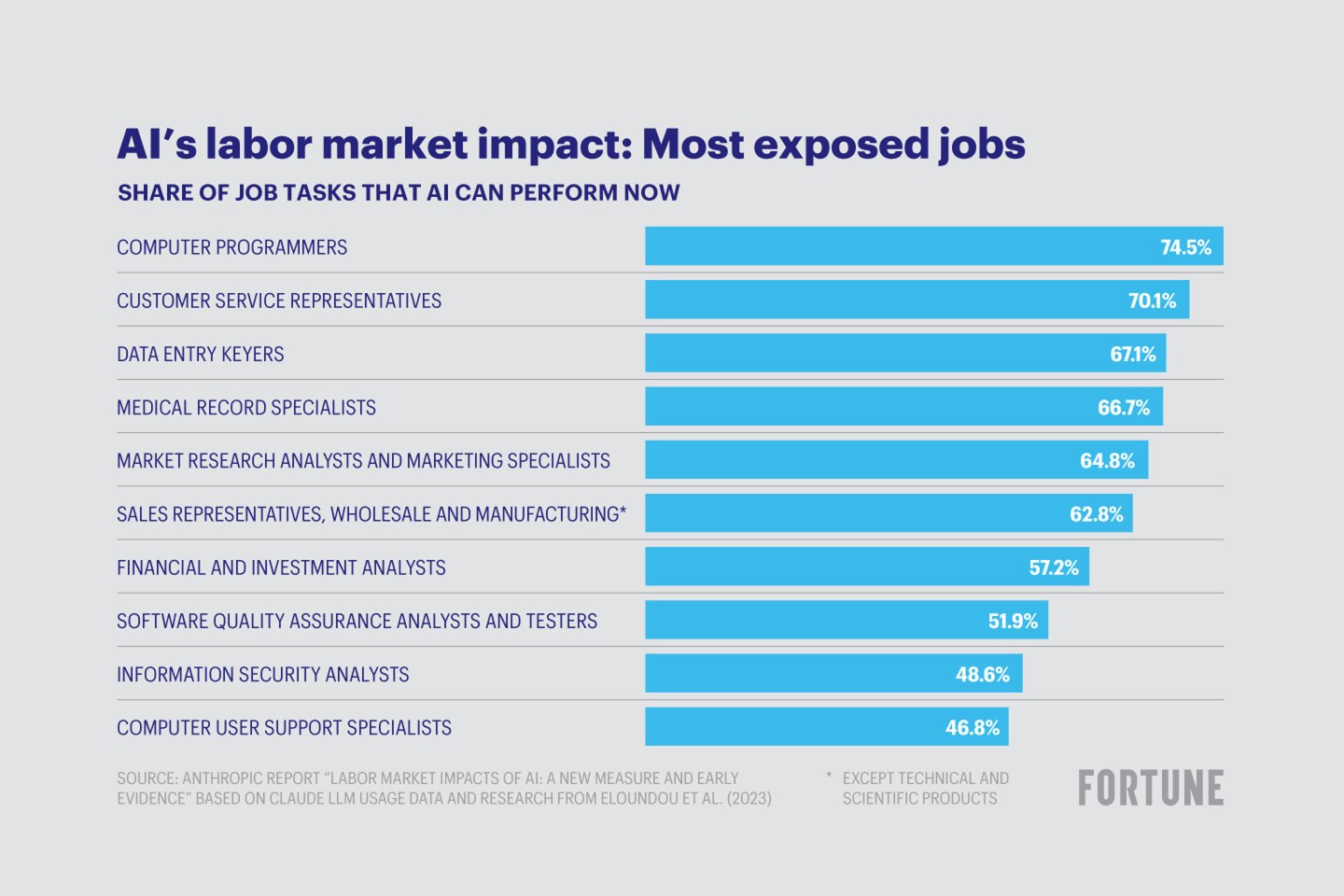
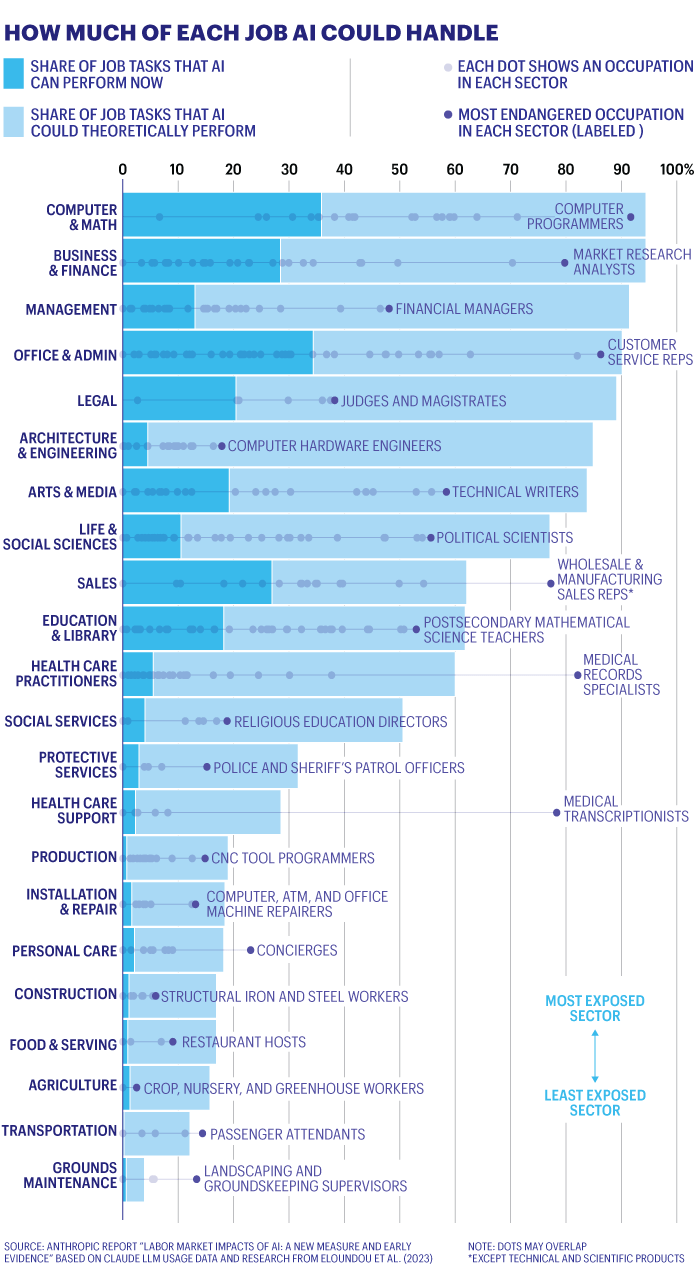
The report, “Labor market impacts of AI: A new measure and early evidence,” was based on real-life enterprise usage of Anthropic’s popular Claude large-language model. It broke down a host of professions by their “observed exposure” and “theoretical exposure” to AI—in essence, what share of the work in a given occupation Al systems can already do, and how much more they could theoretically take on.
For a wide range of previously secure and well-paying white-collar occupations, including computer programming, market research, and financial management, the theoretical exposure is very high—and perhaps inevitably, the report stoked worries about a white-collar recession.
But to mangle a medical metaphor, exposure to AI is by no means fatal. Peter McCrory, head of economics at Anthropic and one of the principal authors of the labor market paper, makes the case that exposure data could help corporate leaders, policy makers, and individual professionals adapt their workflows and careers to AI—and perhaps help head off severe job-market disruptions before they become major social problems.
McCrory delved deeper into Anthropic’s research in a conversation with Fortune in mid-March; the conversation has been edited for brevity and clarity.
Matt Heimer, Fortune: One thing that I really found fascinating is the framing around AI “exposure”—the idea that the extent of a profession’s exposure to AI depends on the job tasks inherent to that profession. Could you talk a little bit about the sort of distinction between tasks and the job itself?
Peter McCrory, Anthropic: So this idea of jobs as bundles of tasks is a very useful analytic frame for thinking about what impact the technology might have on different types of workers. And because what we see on our platform are discrete actions that people and businesses use Claude for, it’s very natural to map in a privacy preserving way that usage back into the jobs themselves.
One of the things that we do in the report is distinguish between conceptual exposure to large language models and AI and actual usage. I think this is really important, because we all recognize now that AI is a general purpose technology that is poised to affect every sector of the economy and almost every job, to some extent. But what we have in our data is how that theoretical ability of these models meets the real world, and by tracking it over time, we can have a sense of how the gap between theoretical exposure and actual adoption is taking place.
Were there particular industries where the gap between the theoretical and the observed exposure was either bigger or smaller than you anticipated?
I was somewhat surprised that the gap between sort of coding in general, which as we point out had something like 94% theoretical exposure, but then based on actual adoption, it was closer to 30% of the tasks across all the jobs in that pocket of the economy. I think that’s somewhat surprising, because overall roughly three to four in 10 conversations on claude.ai are coding related. So have this extreme concentration of adoption on our platform in coding-related occupations that are as a whole, only represent 3% of the workforce.
So there’s this already disproportionate adoption. But then once you look in the underlying details, you realize that there’s this extreme concentration of adoption among a small set of a relatively small set of tasks that these sorts of workers do.
This helps to reinforce the idea that the impact of AI at present is likely to be very uneven. Some workers have much higher rates of exposure, whereas other knowledge workers have lower rates of exposure, or even the extent to which they are exposed is in ways that might reinforce their own expertise. So you can think about, say, real estate managers who can use Claude to automate some of the administrative aspects of their work, while reinforcing the value of their expertise in interpersonal negotiation, going to community meetings and other sorts of convenings where knowing how to navigate and pursue the work that they need to pursue is key to their success.
Another fun example would be microbiologists. Some part of their job is analyzing data and synthesizing and collating information, something that large language models are very good at. Bu t if you to go and collect samples in person, that’s something that the model is not able to do. And so [AI] actually reinforces some of the most expert and central tasks of a microbiologist while helping them become more productive and scale up their ability to understand the incredible world of microbiology.
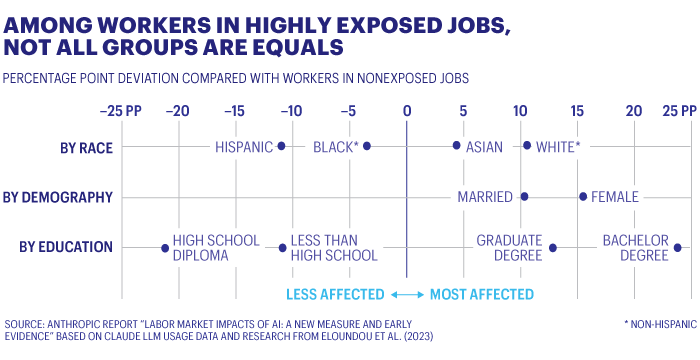
And so our motivation in this report was to say, Well, what’s a framework that would allow us to monitor the extent to which, if it occurs, widespread displacement should [take place]? So we focus on Claude adoption that is primarily automated for work -elated reasons in tasks that are central to different workers jobs. And so data entry workers show up as an example of high observed exposure, because we see on our platform Claude is used for getting information and plugging it into data systems, and it’s very reliable at that, and to the extent that that generates a large rise in unemployment for workers with high AI observed exposure, we would expect it to at least show up in the official statistics that the BLS publishes. We don’t see that yet.
As an economist, what is the degree of current exposure versus theoretical exposure for your own work?
That’s a great question. The way that I think about it for my own job, and I think this maybe generalizes more broadly, is you can think about work in terms of asking the right question and sort of directing the work. You can think about an aspect of your job that is pure implementation. So as an economist, that would be mean going and downloading the data, running the statistical analysis, writing up a summary of the results. And then there is a step in the process, which is evaluating the quality of that work in terms of my own work as an economist.
I feel that centerpiece of pure implementation increasingly being saturated [by AI]. So if I have the right methodology and I’m asking the right question, I can give that to Claude, and specify, hey, take a prompt, go off, download data. I was looking at some micro data in the CPS [the Current Population Survey, a federal database of labor force statistics], sort of studying a related question of AI exposure and sensitivity to the business cycle,. Claude was able go off and then provide me with some results.
And sometimes it was wrong. And I had that the expertise and ability to say, “Actually, no, it looks like you estimated the wrong model, go back and iterate.” So that role of expert evaluation is really important.

More broadly, in other research we see evidence that for the hardest tasks that Claude is being asked to do, something like sophisticated econometric analysis, that’s also where the model tends to struggle the most. And so if you don’t have expertise to evaluate the quality of that work, you might not get the productivity gains that you would otherwise expect.
On a related point, we also look at the prompt that the human provides in the conversation. How many years of formal education would someone need to understand the prompt? And then we look at what Claude does, and we say, how many years of formal education would you need to understand claude’s response? And what’s interesting, across tasks, across countries, there’s an extremely high correlation between the expertise that is provided by the human in measured in this way, and the sort of sophisticated actions that the model produces. If you’re going to get Claude to do machine learning for you, you actually, at present, need to know something about machine learning in order to direct it in the right way.
That’s fascinating and in some ways heartening to a newbie.
These very complex tasks rely on disproportionately more context information. And I think what this illustrates is another aspect of the distinction between potential exposure and actual adoption, which is i which is, as with past technologies, firms will need to make complementary investments to make this technology work well.
So that might mean data modernization; if you don’t have access to the right contextual information, even if Claude is capable, it won’t be able to complete it. Or another example would be organizational workflows, like: If your colleague has information in their minds about that is relevant for a sales strategy that you want to help have Claude develop for you, if Claude doesn’t have access to the knowledge in your co workers mind, then it doesn’t matter how powerful Claude is, without that information, it won’t be able to complete the task.
Would it be fair to say that if you’re in an industry where the theoretical exposure is very high, you probably need to anticipate that you need to prepare yourself for greater changes?
I would respond to that in a two-fold way. It is very clear that this general purpose technology will be very applicable in the types of knowledge worker occupations, and that we’re still in the early stages of figuring out how these tools will end up reshaping the nature of this work. I think about the example of the arrival of another important general-purpose technology: Electricity, which initially was just plugged into the factory floor. That generated some productivity benefit, but the really transformative effect was when you changed how the power was supplied. And so electricity being provided right at the point at which it was needed, that that power generation was needed for some aspect of production.
And so I think the gap between potential and actual adoption does suggest greater scope for this type of change in all of our jobs. It’s also the case that the capabilities are very jagged at the moment. And so I think what I would really recommend people to do is to start using the tool. It doesn’t have to be our tool. Just use the technology and get a handle on where it does well and where it falls short, and have a sense for where is your human expertise, your skills that these models themselves can’t provide, where that allows you to access greater capabilities. In my own experience, I find that experimentation process to be very rewarding and exciting, and it actually feels like, in some instances, it like broadens out what I’m able to do. So it might be the case that product managers are becoming more like software engineers, and software engineers are becoming more like product managers. Job boundaries and occupational boundaries are likely to change in big ways.
Part of the narrative about AI adoption is that it’s going to have the most deleterious effect on entry level workers. if you’re a college student right now, should you just assume that getting comfortable with AI is going to matter, no matter where you end up?
The lesson of history, in some sense, is that being adaptable, and having curiosity and a willingness to try out new technologies and new tools, that’s where young people have have flourished the most in the past. This is an incredible technology, and the impact might not be from making us better at what we’re already doing, but finding new totally hard to imagine ways to deploy these tools.
Earlier I described this framework for asking a question, implementation and evaluation. I also think it is not necessarily the case that you shouldn’t learn expert skills. When you do something hard, you develop cognitive endurance. That cognitive endurance is transferable beyond the domain in which you acquire it. And identifying and acquiring transferable skills will be beneficial as you figure out how to use use AI in in your professional career.
Any other themes that you’d like to address?
This research represents what I think we really need to prioritize, which is mapping what we see in terms of usage and diffusion into what’s actually happening in the broader economy. This work is important because we’re not just solving a prediction problem. We also have a choice in the matter. So what motivates me, what motivates our work here on the economic research team at anthropic is this recognition that the impact of this technology is will be shaped, not just by the capabilities as they advance, but also the choices that we make, and those choices will help us pursue a vision that the benefits of the technology can be broadly felt, and whatever transition costs associated with this technology are not unequally borne.
This article appears in the April/May 2026 issue of Fortune with the headline “The work AI can already do—and where it could do more.”