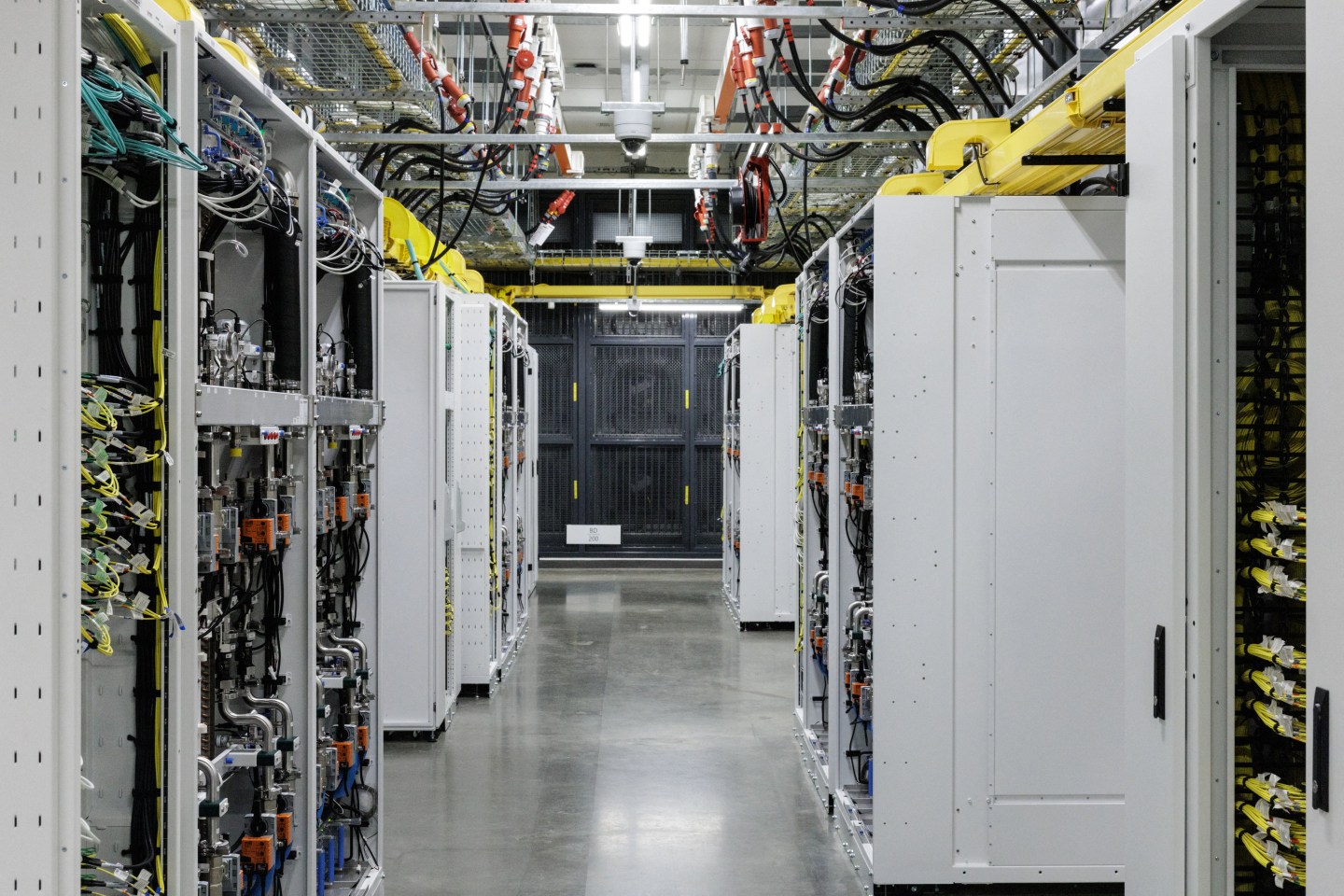
Southeast Asia is racing to build the infrastructure powering the AI boom, but its hot, humid climate could be making that expansion more complicated. Data center demand in the region, where supply is up to 70% lower than in mature markets like the U.S. and China, is expected to grow by 20% each year through 2028, according to the U.S.-ASEAN Business Council. There are now 370 data centers in the region, with the majority in Singapore, Indonesia and Malaysia.
“The ecosystem has realized that if they don’t latch on to this next wave, they might end up being digitally colonized,” Mayank Shrivastava, the CEO of Singapore-headquartered BDx Data Centers, told Fortune. “Economic gains flow to the country that converts raw material into finished goods–and, in this case, the raw material is data.”
Yet, Southeast Asia’s sultry, tropical climate presents a unique challenge for its data centers, which require more energy than counterparts in cooler climates to keep servers up and running. The region’s temperature ranges between 80 and 95°F throughout the year, while data centers should ideally be maintained between 64 and 81°F, according to the American Society of Heating, Refrigerating and Air-Conditioning Engineers.
“The central issue in the tropics is not heat alone, but heat and humidity together,” Lee Poh Seng, a professor specializing in thermal systems at the National University of Singapore (NUS), explains. “In tropical climates, higher ambient temperatures make heat rejection more difficult, while high humidity complicates dew-point control, increases condensation and corrosion risk, and reduces long-term reliability.”
That puts data center operators in a bind. Lots of people live in the tropics, and data centers need to be close by to ensure speedy access. “You can’t ignore the fact that 85% of the world’s population lives outside temperate regions,” Shrivastava says.
On March 11, BDx became the first firm to implement Singapore’s Tropical Data Center Standard, a set of guidelines aiming to help data centers gradually increase operating temperatures to 26°C (or 78.8°F). The standard was launched last August, and is a core tenet of the country’s Green Data Center roadmap, which seeks to chart sustainable growth pathways for Singapore’s data centers. According to the country’s Infocomm Media Development Authority, every 1°C increase in operating temperature translates to up to 5% in energy savings.
“It’s been a mammoth effort to get different stakeholders to agree on changing the operating metrics of a data center,” Shrivastava says. “It had to be done with extreme caution, since we were tinkering with the engines while the aircraft was flying.”
‘Room to build’
Data center CEOs see Southeast Asia as filling a critical gap in the global AI ecosystem, particularly as companies in the U.S. struggle to overcome outdated power infrastructure and political opposition to new projects.
“The U.S. is still the world’s largest data center market, but it’s facing a lot of constraints, with each state having different regulations on the speed of grid build-up,” Eric Fan, the CEO of Bridge Data Centers, tells Fortune. “Many projects in the U.S. have thus been delayed—and it’s been a global play for where this gap can be plugged.”
Malaysia plans to add as much as eight gigawatts of gas-fired power by 2030 to meet the growing needs of data centers, while Singapore has pledged over 1 billion Singapore dollars ($784 million) over the next five years for public AI research.
The global tech sector is also pouring into the region, with giants like Amazon, Microsoft, Google, Alibaba and Tencent all investing billions of dollars in hyperscale data centers.
“Southeast Asia still offers room to build,” says Lee, from NUS. “Tech companies also increasingly see the region as an attractive deployment zone because of its population scale, fibre connectivity and position between the large North Asian and South Asian digital markets.”
BDx Data Centers was founded in 2019, and is now in four different markets: Singapore, Hong Kong, mainland China, and Indonesia. The firm’s largest operations are in Indonesia, where it has six data centers, including a 100MW campus in Jakarta.
Fellow operator Bridge Data Centers was also founded in Singapore in 2017, and now operates data centers across India, Malaysia and Thailand. The firm is backed by Boston-headquartered Bain Capital, which sold a data center firm, Chindata, to a Chinese-led consortium for $4 billion.
‘An energy-and-cooling challenge’
Despite the excitement about AI’s ability to scale in the digital world, companies can’t escape the real world problems of heat and electricity.
“AI infrastructure is fundamentally an energy-and-cooling challenge wrapped inside a digital-economy opportunity,” Lee says. “The winning projects in Southeast Asia will not be the ones that simply build the fastest, but the ones to show credible performance in power usage effectiveness, water use, carbon intensity, and grid compatibility.”
He suggests that firms need to take a “power-first, water-aware and thermally intelligent approach”, by situating projects in places with access to clean power, employing high-efficiency designs and moving beyond room-level cooling to chip-level or liquid-based heat removal.
Both BDx and Bridge Data Centres are exploring alternate energy sources to power their operations. “The big advantage of being in a tropical climate is that you get lots of sun and wind, and you have water around you,” explains Shrivastava of BDx.
Separately, Bridge Data Centers is studying hydrogen and nuclear power, with the goal of achieving carbon neutrality by 2040. One of its Malaysian data centers already sources half its energy from solar, a model Fan wants to adopt in its other locations.
And with traditional sources under strain due to conflict in the Middle East, data centers know they need alternatives. “The Iran war has caused the price of oil to skyrocket, raising concern on the reliability of traditional energies,” Fan says. “This will further push the region’s AI firms to diversify into renewable and greener forms of energy.”