• Home
  • Latest
  • Fortune 500
  • Finance
  • Tech
  • Leadership
  • Lifestyle
  • Rankings
  • Multimedia
AsiaIran
Asia

How the Strait of Hormuz poses an existential threat to Asia’s economies

Nicholas Gordon
By
Nicholas Gordon
Nicholas Gordon
Asia Editor
Down Arrow Button Icon
Nicholas Gordon
By
Nicholas Gordon
Nicholas Gordon
Asia Editor
Down Arrow Button Icon
March 21, 2026, 3:00 AM ET
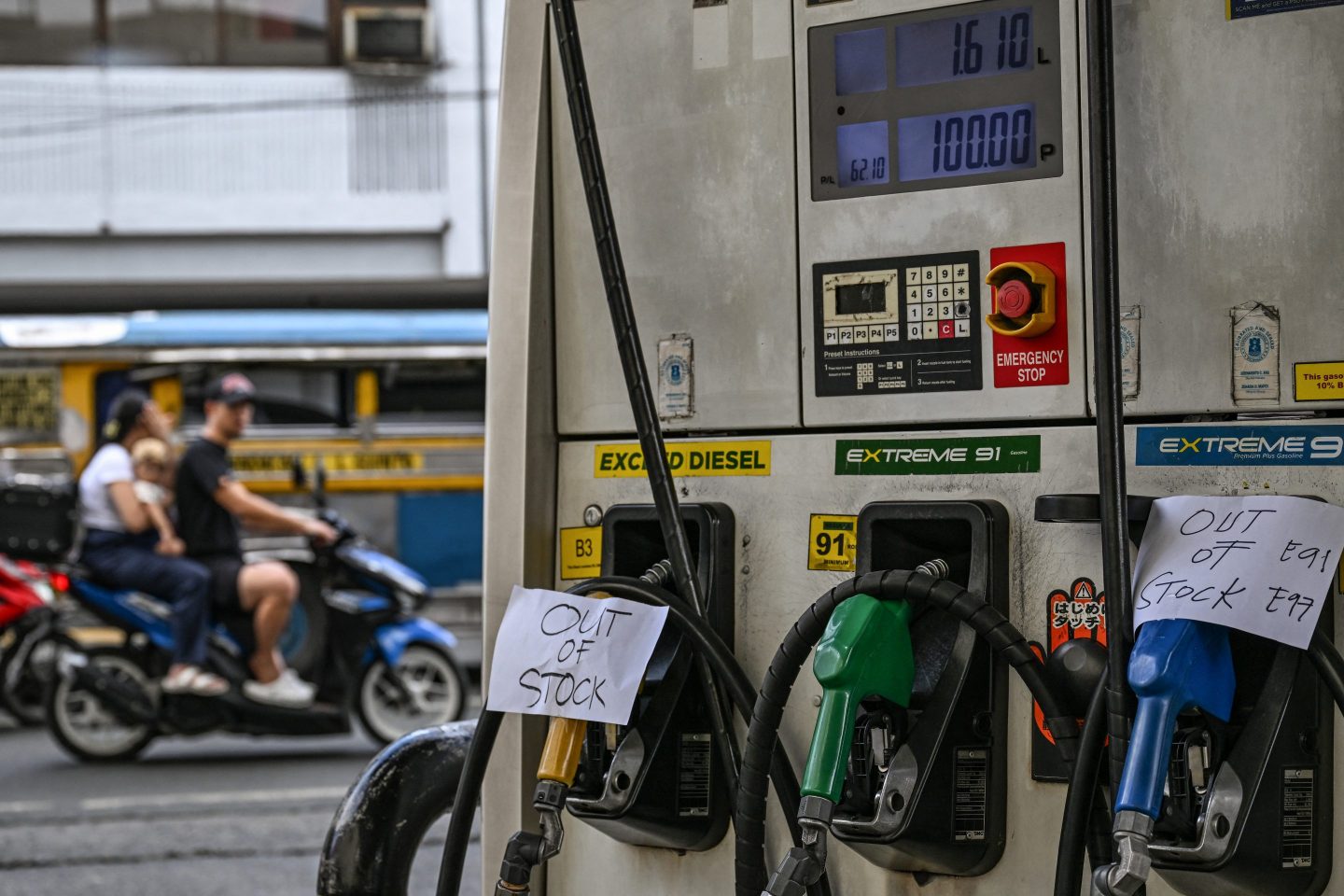
Signs reading 'out of stock' are displayed at a gas station amid rising petrol prices in Manila on March 9, 2026.
Signs reading 'out of stock' are displayed at a gas station amid rising petrol prices in Manila on March 9, 2026.Jam Sta Rosa—AFP via Getty Images

As the Iran war enters its fourth week, much of its cost is being borne by countries that had nothing to do with starting it. 

Recommended Video

Iran closed the Strait of Hormuz soon after the U.S. and Israel launched their strikes on the country, choking the maritime artery through which nearly all of the Persian Gulf’s oil and natural gas flow. The closure has strangled shipments from major energy exporters—Qatar, Saudi Arabia, and the United Arab Emirates—and poses an existential threat to Asia, a region that relies on imported energy.

“Asia is at the heart of this drama, in that it is the chief area…of collateral damage,” said Columbia University historian Adam Tooze at the Jefferies Asia Forum in Hong Kong this week.

The Iran war threatens to become an inflationary shock targeted at the world’s growth engine. For three decades, governments turned to rate cuts and looser fiscal policy when faced with a crisis. This time, those tools may no longer work.

Fiscal and monetary policy was already loosening across much of the world economy. “Coming into the current crisis with Iran…it was pretty obvious, whether Japan, whether Europe, whether the United States, whether the UK, that we were very much in an inflationary boom,” Louis-Vincent Gave, CEO of Gavekal Research, told conference attendees.

But now an energy supply shock threatens to push inflation higher while slowing growth: what Gave calls an inflationary bust, and what people may better know as stagflation.

Roughly 84% of crude that transits Hormuz goes to Asia, while the U.S. now imports little through the strait. That asymmetry shows up in prices: West Texas Intermediate is near $100 a barrel, while Dubai crude has jumped past $160.

Natural gas has also been hit. Iran has struck key infrastructure in Qatar, which accounts for roughly 20% of global liquefied natural gas supply. On Thuesday, QatarEnergy declared force majeure on deliveries after Iranian drone and missile strikes on the Ras Laffan Industrial City, the world’s largest LNG export hub.

‘A perfect dilemma’

Governments across the region have moved quickly to limit the damage, deploying a mix of price caps, rationing, and stockpile releases.

South Korea imposed a fuel price cap, the first in 30 years. Seoul is urgently seeking oil supplies that bypass Hormuz and accelerating a longer-term shift toward nuclear power generation.

Asia’s fourth-largest economy grew by just 1.0%—the worst in five years and below the 2.0% annual rate that Peter Kim, senior managing director at KB Securities, described as the minimum for political legitimacy in a sideline interview.

“An oil price shock, with a weak currency and a central bank that can’t cut because of inflation pressure? That could really jeopardize that 2% target,” Kim warned in an interview with Fortune.

Japan’s Prime Minister Sanae Takaichi started the release of roughly 80 million barrels from the country’s petroleum reserves on Monday. Tokyo faces not only an energy crisis but a diplomatic one. U.S. President Donald Trump has publicly pressed allies like Japan to contribute to any coalition to reopen the strait, citing their dependence on the strait for energy. Takaichi, for now, has cited constitutional limits on the use of force as a reason for Japan’s hesitance to send ships. 

“It’s a perfect dilemma,” said Ken Jimbo, a professor of international relations at Keio University to Fortune. “We don’t wish to be too hostile to the United States, because there’s a quid pro quo type of Trump psychology: I defend you. Why do you not defend me?”​

Governments can’t ‘subsidize forever’

Emerging markets are absorbing the shock in more desperate ways. Thailand, which imports 70% of its oil, has capped diesel prices, instructed officials to work from home, and urged citizens to wear short-sleeved shirts.

“If the price of global crude oil increases, our GDP automatically decreases,” said Tanawat Ruenbanterng, head of institutional research at Tisco Securities, to Fortune. A weaker baht and higher bond yields give Bangkok even less fiscal room to respond. “Because of limited fiscal space, they could not subsidize forever,” Tanawat said. 

Thailand isn’t alone in needing to impose emergency measures. Indonesia is shielding retail pump prices ahead of the Eid al-Fitr holiday, even as that threatens to blow through Jakarta’s fuel subsidy budget of 381 trillion rupiah ($22.6 billion). Bangladesh has imposed daily fuel purchase limits and closed universities early; Sri Lanka has declared Wednesdays a holiday to conserve fuel. 

Concern is spreading to advanced economies too: On March 20, the International Energy Agency warned its member economies, like Australia and the UK, to consider carpooling or working from home to save fuel. 

What happens next?

China, the world’s largest oil importer, banned the export of diesel, gasoline, and aviation fuel until at least the end of March to pre-empt domestic shortages. The ban is forcing Southeast Asian buyers who relied on Chinese fuel exports to scramble for alternatives.

That may push countries back to a fuel that many environmentalists hoped would be left behind: coal. Countries like South Korea, Thailand, and Bangladesh are quickly ramping up coal power generation to make up for halted LNG imports. 

“Coal is, and remains, the cheapest way to produce electricity,” Gave told the Jefferies audience, “if you don’t care, and if you don’t price the environmental costs.”

Join us at the Fortune Workplace Innovation Summit May 19–20, 2026, in Atlanta. The next era of workplace innovation is here—and the old playbook is being rewritten. At this exclusive, high-energy event, the world’s most innovative leaders will convene to explore how AI, humanity, and strategy converge to redefine, again, the future of work. Register now.
About the Author
Nicholas Gordon
By Nicholas GordonAsia Editor
LinkedIn iconTwitter icon

Nicholas Gordon is an Asia editor based in Hong Kong, where he helps to drive Fortune’s coverage of Asian business and economics news.

See full bioRight Arrow Button Icon

Latest in Asia

Finance
Lorem ipsum dolor sit amet, consectetur adipiscing elit, sed do eiusmod tempor incididunt ut labore et dolore magna aliqua. Ut enim ad minim veniam
By Fortune Editors
October 20, 2025
Finance
Lorem ipsum dolor sit amet, consectetur adipiscing elit, sed do eiusmod tempor incididunt ut labore et dolore magna aliqua. Ut enim ad minim veniam
By Fortune Editors
October 20, 2025
Finance
Lorem ipsum dolor sit amet, consectetur adipiscing elit, sed do eiusmod tempor incididunt ut labore et dolore magna aliqua. Ut enim ad minim veniam
By Fortune Editors
October 20, 2025
Finance
Lorem ipsum dolor sit amet, consectetur adipiscing elit, sed do eiusmod tempor incididunt ut labore et dolore magna aliqua. Ut enim ad minim veniam
By Fortune Editors
October 20, 2025
Finance
Lorem ipsum dolor sit amet, consectetur adipiscing elit, sed do eiusmod tempor incididunt ut labore et dolore magna aliqua. Ut enim ad minim veniam
By Fortune Editors
October 20, 2025
Finance
Lorem ipsum dolor sit amet, consectetur adipiscing elit, sed do eiusmod tempor incididunt ut labore et dolore magna aliqua. Ut enim ad minim veniam
By Fortune Editors
October 20, 2025

Most Popular

Finance
Lorem ipsum dolor sit amet, consectetur adipiscing elit, sed do eiusmod tempor incididunt ut labore et dolore magna aliqua. Ut enim ad minim veniam
By Fortune Editors
October 20, 2025
Finance
Lorem ipsum dolor sit amet, consectetur adipiscing elit, sed do eiusmod tempor incididunt ut labore et dolore magna aliqua. Ut enim ad minim veniam
By Fortune Editors
October 20, 2025
Finance
Lorem ipsum dolor sit amet, consectetur adipiscing elit, sed do eiusmod tempor incididunt ut labore et dolore magna aliqua. Ut enim ad minim veniam
By Fortune Editors
October 20, 2025
Finance
Lorem ipsum dolor sit amet, consectetur adipiscing elit, sed do eiusmod tempor incididunt ut labore et dolore magna aliqua. Ut enim ad minim veniam
By Fortune Editors
October 20, 2025
Finance
Lorem ipsum dolor sit amet, consectetur adipiscing elit, sed do eiusmod tempor incididunt ut labore et dolore magna aliqua. Ut enim ad minim veniam
By Fortune Editors
October 20, 2025
Finance
Lorem ipsum dolor sit amet, consectetur adipiscing elit, sed do eiusmod tempor incididunt ut labore et dolore magna aliqua. Ut enim ad minim veniam
By Fortune Editors
October 20, 2025
Fortune Secondary Logo
Rankings
  • 100 Best Companies
  • Fortune 500
  • Global 500
  • Fortune 500 Europe
  • Most Powerful Women
  • Future 50
  • World’s Most Admired Companies
  • See All Rankings
Sections
  • Finance
  • Fortune Crypto
  • Features
  • Leadership
  • Health
  • Commentary
  • Success
  • Retail
  • Mpw
  • Tech
  • Lifestyle
  • CEO Initiative
  • Asia
  • Politics
  • Conferences
  • Europe
  • Newsletters
  • Personal Finance
  • Environment
  • Magazine
  • Education
Customer Support
  • Frequently Asked Questions
  • Customer Service Portal
  • Privacy Policy
  • Terms Of Use
  • Single Issues For Purchase
  • International Print
Commercial Services
  • Advertising
  • Fortune Brand Studio
  • Fortune Analytics
  • Fortune Conferences
  • Business Development
  • Group Subscriptions
About Us
  • About Us
  • Editorial Calendar
  • Press Center
  • Work At Fortune
  • Diversity And Inclusion
  • Terms And Conditions
  • Site Map
  • About Us
  • Editorial Calendar
  • Press Center
  • Work At Fortune
  • Diversity And Inclusion
  • Terms And Conditions
  • Site Map
  • Facebook icon
  • Twitter icon
  • LinkedIn icon
  • Instagram icon
  • Pinterest icon

Latest in Asia

AsiaIran
How the Strait of Hormuz poses an existential threat to Asia’s economies
By Nicholas GordonMarch 21, 2026
4 hours ago
AsiaPepsiCo
Three Asias, three different playbooks: How PepsiCo’s Anne Tse views the world’s fastest-growing snack market
By Nicholas GordonMarch 20, 2026
14 hours ago
drone in dry grass
PoliticsIran
Ukraine is quietly helping five Middle East nations shoot down Iranian drones, even as Trump says he doesn’t need Kyiv’s help
By The Associated Press and Hanna ArhirovaMarch 20, 2026
21 hours ago
AsiaMitsubishi
How an MBA internship led Mitsubishi to e-commerce platform Yami—and into the U.S. snacks market
By Nicholas GordonMarch 20, 2026
1 day ago
EconomyTariffs
China is becoming a ‘factory to the factories,’ powering global manufacturing in places like Southeast Asia even as U.S. trade declines
By Angelica AngMarch 20, 2026
1 day ago
indonesia
BankingIndonesia
Indonesia’s richest man, tobacco tycoon Michael Bambang Hartono, dies at 86
By Niniek Karmini and The Associated PressMarch 19, 2026
2 days ago

© 2026 Fortune Media IP Limited. All Rights Reserved. Use of this site constitutes acceptance of our Terms of Use and Privacy Policy | CA Notice at Collection and Privacy Notice | Do Not Sell/Share My Personal Information
FORTUNE is a trademark of Fortune Media IP Limited, registered in the U.S. and other countries. FORTUNE may receive compensation for some links to products and services on this website. Offers may be subject to change without notice.