• Home
  • Latest
  • Fortune 500
  • Finance
  • Tech
  • Leadership
  • Lifestyle
  • Rankings
  • Multimedia

Trendingnow

1

After forcing workers back to the office, Goldman Sachs and JPMorgan Chase are now letting their staff work remotely—but only for the World Cup

2

The Pentagon said Iran War costs $29 billion, but the real cost is closer to $200 billion—and counting

3

Amazon's record Prime Day masks a darker truth: Americans are spending more and getting less

1

After forcing workers back to the office, Goldman Sachs and JPMorgan Chase are now letting their staff work remotely—but only for the World Cup

2

The Pentagon said Iran War costs $29 billion, but the real cost is closer to $200 billion—and counting

3

Amazon's record Prime Day masks a darker truth: Americans are spending more and getting less
EuropeGreenland
Europe

Denmark offered to trade Greenland to the U.S. in 1910—and America thought it was crazy

By
Steven Lamy
Steven Lamy
and
The Conversation
The Conversation
Down Arrow Button Icon
By
Steven Lamy
Steven Lamy
and
The Conversation
The Conversation
Down Arrow Button Icon
January 22, 2026, 11:28 AM ET
greenland
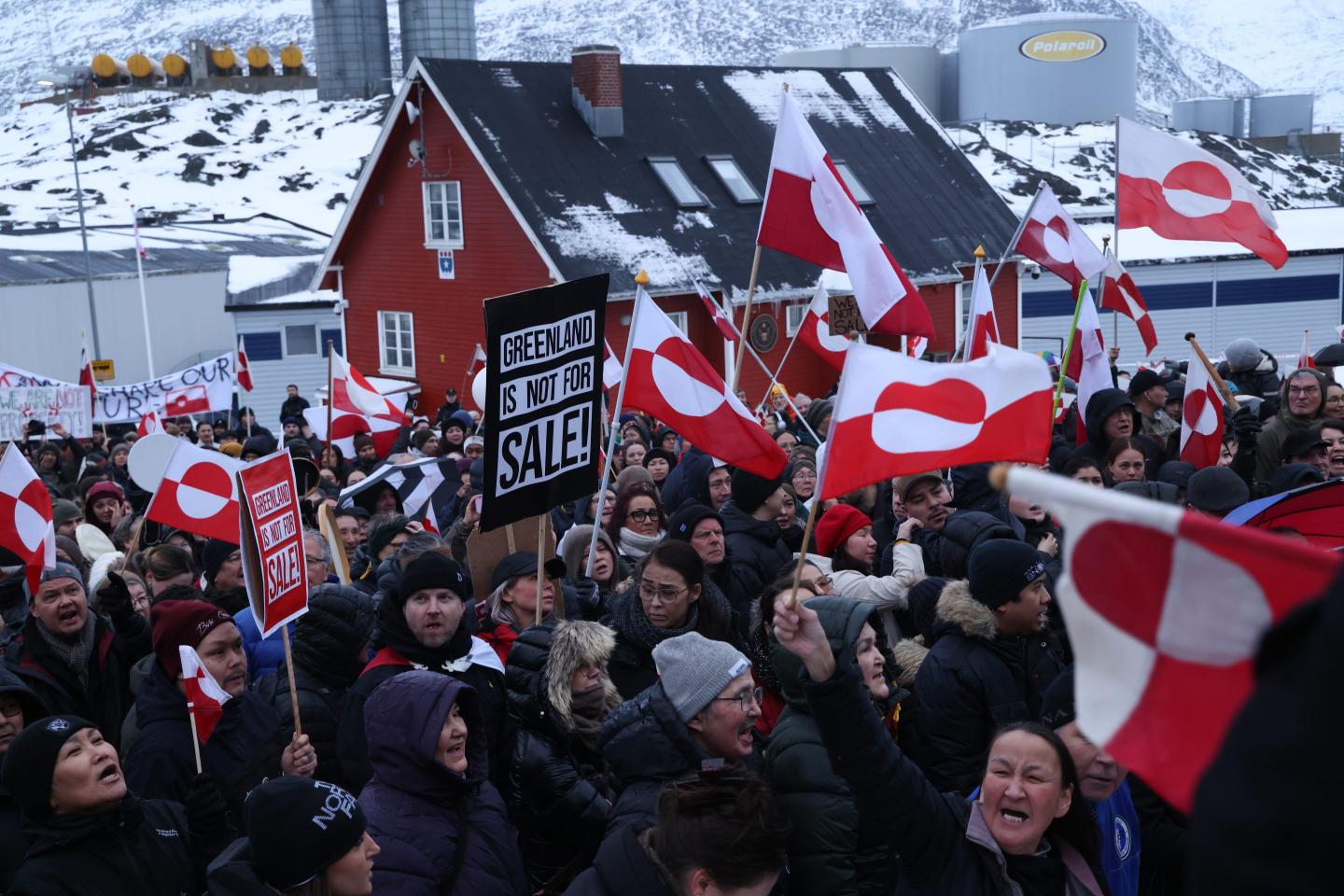
People bear Greenlandic flags as they gather in front of the U.S. consulate protest against U.S. President Donald Trump and his announced intent to acquire Greenland on January 17, 2026 in Nuuk, Greenland. Greenlandic, Danish and other European leaders are hoping they can still avert an intervention by the United States to forcefully acquire the island as U.S. President Donald Trump continues to insist the U.S. must have Greenland, suggesting even by military means if necessary.Sean Gallup/Getty Images
Add Fortune on Google for similar content.

In 2019, during his first term, U.S. President Donald Trump expressed a desire to buy Greenland, which has been a part of Denmark for some 300 years. Danes and Greenlanders quickly rebuffed the offer at the time.

Recommended Video

During Trump’s second term, those offers have turned to threats.

Trump said on his social media platform Truth Social in late December 2024 that, for purposes of national security, U.S. control over Greenland was a necessity. The president has continued to insist on the national security rationale into January 2026. And he has refused to rule out the use of military force to control Greenland.

From my perspective as an international relations scholar focused on Europe, Trump’s national security rationale doesn’t make sense. Greenland, like the U.S., is a member of NATO, which provides a collective defense pact, meaning member nations will respond to an attack on any alliance member. And because of a 1951 defense agreement between the U.S. and Denmark, the U.S. can already build military installations in Greenland to protect the region.

Trump’s 2025 National Security Strategy, which stresses control of the Western Hemisphere and keeping China out of the region, provides insight into Trump’s thinking.

US interests in Greenland

The United States has tried to acquire Greenland several times.

In 1867, Secretary of State William Seward commissioned a survey of Greenland. Impressed with the abundance of natural resources on the island, he pushed to acquire Greenland and Iceland for US$5.5 million – roughly $125 million today.

But Congress was still concerned about the purchase of Alaska that year, which Seward had engineered. It had seen Alaska as too cold and too distant from the rest of the U.S. to justify spending $7.2 million – roughly $164 million today – although Congress ultimately agreed to do it. There was not enough national support for another frozen land.

In 1910, the U.S. ambassador to Denmark proposed a complex trade involving Germany, Denmark and the United States. Denmark would give the U.S. Greenland, and the U.S. would give Denmark islands in the Philippines. Denmark would then give those islands to Germany, and Germany would return Schleswig-Holstein – Germany’s northernmost state – to Denmark.

But the U.S. quickly dismissed the proposed trade as too audacious.

During World War II, Nazi Germany occupied Denmark, and the U.S. assumed the role of protector of both Greenland and Iceland, both of which belonged to Denmark at the time. The U.S. built airstrips, weather stations and radar and communications stations – five on Greenland’s east coast and nine on the west coast.

A military base is seen in front of a snowy hillside.
The Pituffik Space Base, formerly Thule Air Base, is pictured in northern Greenland on Oct. 4, 2023. Thomas Traasdahl/Ritzau Scanpix/AFP via Getty Images

The U.S. used Greenland and Iceland as bases for bombers that attacked Germany and German-occupied areas. Greenland had a high value for military strategists because of its location in the North Atlantic – to counter Nazi threats to Allied shipping lanes and protect transatlantic routes, and because it was a midpoint for refueling U.S. aircraft. Greenland’s importance also rested on its deposits of cryolite, useful for making aluminum.

In 1946, the Truman administration offered to buy Greenland for $100 million, as U.S. military leaders thought it would play a critical role in the Cold War.

The secret U.S. project Operation Blue Jay at the beginning of the Cold War resulted in the construction of Thule Air Base in northwestern Greenland, which allowed U.S. bombers to be closer to the Soviet Union. Renamed Pituffik Space Base, today it provides a 24/7 missile warning and space surveillance facility that is critical to NATO and U.S. security strategy.

At the end of World War II, Denmark recognized Greenland as one of its territories. In 1953, Greenland gained constitutional rights and became a country within the Kingdom of Denmark. Greenland was assigned self-rule in 1979, and by 2009 it became a self-governing country, still within the Kingdom of Denmark, which includes Denmark, Greenland and the Faroe Islands.

Denmark recognizes the government of Greenland as an equal partner and recently gave it a more significant role as the first voice for Denmark in the Arctic Council, which promotes cooperation in the Arctic.

What the US may want

The Trump administration’s 2025 National Security Strategy identifies three threats in the Western Hemisphere: migration, drugs and crimes, and China’s increasing influence.

Two of those threats are irrelevant when considering Greenland. Greenlandic people are not migrating to the U.S., and they are not drug traffickers. However, Greenland is rich in rare earth minerals, including neodymium, dysprosium, graphite, copper and lithium.

Additionally, China seeks to establish mining interests in Greenland and the Arctic as part of its Polar Silk Road initiative. China had offered to build an infrastructure for Greenland, including improving the airport, until Denmark stepped in and offered airport funding. And China has worked with Australian companies to secure mining opportunities on the island.

A U.S. Air Force helicopter flies over snow.
A U.S. Air Force helicopter flies near Thule Air Base in Greenland in 1955. James McAnally/Archive Photos/Getty Images

Those rare earth minerals appeal to the European Union, too. The EU lists some 30 raw materials that are essential for their economies. Twenty-five are in Greenland.

The Trump administration has made it clear that controlling these minerals is a national security issue, and the president wants to keep them away from China.

Figures vary, but it is estimated that over 60% of rare earth elements or minerals are currently mined in China. China also refines some 90% of rare earths. This gives China tremendous leverage in trade talks. And it results in a dangerous vulnerability for the U.S. and other nation states seeking to modernize their economies. With few suppliers of these rare earth elements, the political and economic costs of securing them are high.

Greenland has only two operating mines. One is the Tan Breez project in southern Greenland. It produces 17 metals, including terbium and neodymium, that are used in high-strength magnets used in many green technologies and in aircraft manufacturing, including for the F-35 fighter planes.

Consider for a moment that Trump is not interested in owning Greenland.

Instead, he is using this threatening position to secure promises from the Greenlandic government to make economic deals with the U.S. and not China. Thus, Trump’s threats could be less about national security and much more about eliminating competition from China and securing wealth for U.S. interests.

This form of coercive diplomacy threatens the political and economic development of not only Greenland but Europe. In recent interviews, Trump has made it clear that he does not respect international law and the sovereignty of countries. His position, I believe, undermines the international order and removes the U.S. as a responsible leader of that framework established after World War II.

Steven Lamy, Professor Emeritus of Political Science and International Relations and Spatial Sciences, USC Dornsife College of Letters, Arts and Sciences

This article is republished from The Conversation under a Creative Commons license. Read the original article.

The Conversation
About the Authors
By Steven Lamy
See full bioRight Arrow Button Icon
By The Conversation
See full bioRight Arrow Button Icon
Add Fortune on Google for similar content.

Latest in Europe

Finance
Lorem ipsum dolor sit amet, consectetur adipiscing elit, sed do eiusmod tempor incididunt ut labore et dolore magna aliqua. Ut enim ad minim veniam
By Fortune Editors
October 20, 2025
Finance
Lorem ipsum dolor sit amet, consectetur adipiscing elit, sed do eiusmod tempor incididunt ut labore et dolore magna aliqua. Ut enim ad minim veniam
By Fortune Editors
October 20, 2025
Finance
Lorem ipsum dolor sit amet, consectetur adipiscing elit, sed do eiusmod tempor incididunt ut labore et dolore magna aliqua. Ut enim ad minim veniam
By Fortune Editors
October 20, 2025
Finance
Lorem ipsum dolor sit amet, consectetur adipiscing elit, sed do eiusmod tempor incididunt ut labore et dolore magna aliqua. Ut enim ad minim veniam
By Fortune Editors
October 20, 2025
Finance
Lorem ipsum dolor sit amet, consectetur adipiscing elit, sed do eiusmod tempor incididunt ut labore et dolore magna aliqua. Ut enim ad minim veniam
By Fortune Editors
October 20, 2025
Finance
Lorem ipsum dolor sit amet, consectetur adipiscing elit, sed do eiusmod tempor incididunt ut labore et dolore magna aliqua. Ut enim ad minim veniam
By Fortune Editors
October 20, 2025

Most Popular

Finance
Lorem ipsum dolor sit amet, consectetur adipiscing elit, sed do eiusmod tempor incididunt ut labore et dolore magna aliqua. Ut enim ad minim veniam
By Fortune Editors
October 20, 2025
Finance
Lorem ipsum dolor sit amet, consectetur adipiscing elit, sed do eiusmod tempor incididunt ut labore et dolore magna aliqua. Ut enim ad minim veniam
By Fortune Editors
October 20, 2025
Finance
Lorem ipsum dolor sit amet, consectetur adipiscing elit, sed do eiusmod tempor incididunt ut labore et dolore magna aliqua. Ut enim ad minim veniam
By Fortune Editors
October 20, 2025
Finance
Lorem ipsum dolor sit amet, consectetur adipiscing elit, sed do eiusmod tempor incididunt ut labore et dolore magna aliqua. Ut enim ad minim veniam
By Fortune Editors
October 20, 2025
Finance
Lorem ipsum dolor sit amet, consectetur adipiscing elit, sed do eiusmod tempor incididunt ut labore et dolore magna aliqua. Ut enim ad minim veniam
By Fortune Editors
October 20, 2025
Finance
Lorem ipsum dolor sit amet, consectetur adipiscing elit, sed do eiusmod tempor incididunt ut labore et dolore magna aliqua. Ut enim ad minim veniam
By Fortune Editors
October 20, 2025
Fortune Secondary Logo
Rankings
  • 100 Best Companies
  • Fortune 500
  • Global 500
  • Fortune 500 Europe
  • Most Powerful Women
  • World's Most Admired Companies
  • See All Rankings
  • Lists Calendar
Sections
  • Finance
  • Fortune Crypto
  • Features
  • Leadership
  • Health
  • Commentary
  • Success
  • Retail
  • Mpw
  • Tech
  • Lifestyle
  • CEO Initiative
  • Asia
  • Politics
  • Conferences
  • Europe
  • Newsletters
  • Personal Finance
  • Environment
  • Magazine
  • Education
Customer Support
  • Frequently Asked Questions
  • Customer Service Portal
  • Privacy Policy
  • Terms Of Use
  • Single Issues For Purchase
  • International Print
Commercial Services
  • Advertising
  • Fortune Brand Studio
  • Fortune Analytics
  • Fortune Conferences
  • Business Development
  • Group Subscriptions
About Us
  • About Us
  • Press Center
  • Work At Fortune
  • Terms And Conditions
  • Site Map
  • About Us
  • Press Center
  • Work At Fortune
  • Terms And Conditions
  • Site Map
  • Facebook icon
  • Twitter icon
  • LinkedIn icon
  • Instagram icon
  • Pinterest icon

Latest in Europe

As marketers grapple with AI, business leaders at Cannes Lions say human creativity and authenticity matter more than ever 
Europecannes lions
As marketers grapple with AI, business leaders at Cannes Lions say human creativity and authenticity matter more than ever 
By Sam BirchallJune 24, 2026
10 hours ago
Woman hides from the sun in front of Big Ben in London
EconomyEurope
‘London isn’t just calling—it’s cooking.’ Europe’s largest economies face over $600 billion in heat-driven losses by 2030
By Tristan BoveJune 23, 2026
1 day ago
ks
PoliticsUnited Kingdom
10 years of Brexit means 7 Prime Ministers and a broken British politics
By Jill Lawless and The Associated PressJune 23, 2026
1 day ago
burnham
PoliticsUnited Kingdom
Britain poised for ‘Manchesterism’ under presumptive next Prime Minister Andy Burnham
By Jill Lawless and The Associated PressJune 23, 2026
1 day ago
fr
EnvironmentUnited Kingdom
France rues widespread lack of air conditioning as country roasts under 104-degree heat wave
By Samuel Petrequin and The Associated PressJune 23, 2026
1 day ago
merz
EuropeGermany
The German government thinks ‘failure is not an option’ in its quest to raise the retirement age
By Geir Moulson and The Associated PressJune 23, 2026
1 day ago

Most Popular

After forcing workers back to the office, Goldman Sachs and JPMorgan Chase are now letting their staff work remotely—but only for the World Cup
Success
After forcing workers back to the office, Goldman Sachs and JPMorgan Chase are now letting their staff work remotely—but only for the World Cup
By Orianna Rosa RoyleJune 23, 2026
1 day ago
The Pentagon said Iran War costs $29 billion, but the real cost is closer to $200 billion—and counting
Economy
The Pentagon said Iran War costs $29 billion, but the real cost is closer to $200 billion—and counting
By Jacqueline MunisJune 24, 2026
15 hours ago
Amazon's record Prime Day masks a darker truth: Americans are spending more and getting less
Retail
Amazon's record Prime Day masks a darker truth: Americans are spending more and getting less
By Nick LichtenbergJune 24, 2026
7 hours ago
Ray Dalio just finished a 10-day trip to China. He says global leaders know America 'doesn’t have what it takes to fight to maintain its empire'
Asia
Ray Dalio just finished a 10-day trip to China. He says global leaders know America 'doesn’t have what it takes to fight to maintain its empire'
By Nick LichtenbergJune 24, 2026
8 hours ago
Current price of oil as of June 23, 2026
Personal Finance
Current price of oil as of June 23, 2026
By Joseph HostetlerJune 23, 2026
1 day ago
Current price of gold as of June 23, 2026
Personal Finance
Current price of gold as of June 23, 2026
By Danny BakstJune 23, 2026
1 day ago

© 2026 Fortune Media IP Limited. All Rights Reserved. Use of this site constitutes acceptance of our Terms of Use and Privacy Policy | CA Notice at Collection and Privacy Notice | Do Not Sell/Share My Personal Information
FORTUNE is a trademark of Fortune Media IP Limited, registered in the U.S. and other countries. FORTUNE may receive compensation for some links to products and services on this website. Offers may be subject to change without notice.