Gen Z’s “2016 vibes” fixation is less about pastel Instagram filters and more about an economic and cultural shift: they are coming of age in a world where cheap Ubers, underpriced delivery, and a looser-feeling internet simply no longer exist. What looks like a lighthearted nostalgia trend is something more structural: a reaction to coming of age against the backdrop of a fully mature internet economy.
On TikTok and Instagram, “2016 vibes” has become a full-blown aesthetic, with POV clips, soundtracks of mid‑2010s hits, and filters that soften the present into a memory. Searches for “2016” on TikTok jumped more than 450% in the first week of January, and more than 1.6 million videos celebrating the year’s look and feel have been uploaded, according to creator‑economy newsletter After School by Casey Lewis. Lewis noted that only a few months ago, “millennial cringe” was rebranded as “millennial optimism,” with Gen Zers longing to experience a more carefree era. Lin-Manuel Miranda’s Hamilton, although it debuted in 2015, arguably has a 2016 vibe, for instance. Some millennial optimism is downright bewildering to Gen Z, such as what it calls the “stomp, clap, hey” genre of neo-folk pop music, recalling millennials’ own rediscovery (and new naming) of “yacht rock.”
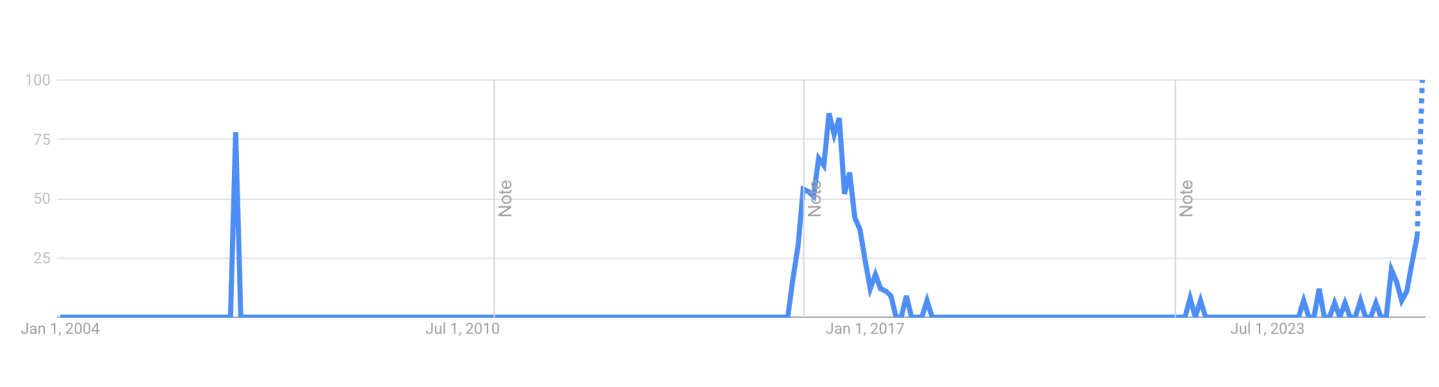
Meanwhile, Google Trends reports that the search hit an all-time high in mid-January, with the top five trending “why is everyone…” searches all being related to 2016. The top two were “… posting 2016 pics” and “... talking about 2016.”
Creators caption posts “2026 is the new 2016” and stitch side‑by‑side footage of house parties, festivals, and mall hangs, inviting viewers to imagine a version of young adulthood that feels more spontaneous and frictionless. At the risk of being too self-referential, the difference can be tracked in Fortune covers, from the stampeding of the unicorns, the billion-dollar startup that defined the supposedly carefree days of 2016, to the bust a decade later and the dawn of the “unicorpse” era.
And while the comparison may feel ridiculous to anyone who actually lived through 2016 as an adult and can remember the stresses and anxieties of that particular time, there is something going on here, with economics at its core. In short, millennials were able to enjoy the peak of a particular Silicon Valley moment in 2016, but 10 years later, Gen Z is late to the party, finding the price of admission is just too high for them to get in the door.
Everyone used to love Silicon Valley
For millennials, 2016 marked a time when technology expanded opportunity rather than eliminating it. Venture capital was cheap, platforms were underpriced, and software functioned to your personal advantage, with aforementioned unicorns flush with cash and willing to offer millennials a crazy deal. The early iterations of the gig-economy ecosystem—Uber, Airbnb, TaskRabbit—were at their peak affordability, lowering the cost of living and making urban life feel frictionless. And at work, new digital tools helped young employees do more, faster, standing out from the pack.
For older millennials, 2016 evokes a very specific consumer reality: Ubers that were often cheaper than cabs and takeout that arrived in minutes for a few dollars in fees. Both were the product of what The New York Times‘ Kevin Roose labeled the “millennial lifestyle subsidy” in 2021, looking back on the era “from roughly 2012 through early 2020, when many of the daily activities of big-city 20- and 30-somethings were being quietly underwritten by Silicon Valley venture capitalists.” Because Uber and Seamless were not really turning a profit all those years while they gained market share, as on a grander scale Amazon and Netflix were underpriced for years before cornering the market on ecommerce and streaming, these subsidies “allowed us to live Balenciaga lifestyles on Banana Republic budgets,” as Roose put it.
Gen Z never really knew what it felt like to take a practically free late-night ride across town, or feast on $50 worth of Chinese takeout while paying half that. And they certainly never knew what it felt like to see unlimited movies in theaters each month, for the flat rate allowed by one MoviePass app. For the generation seeking the 2016 vibe, $40 surge‑priced trips and double‑digit delivery fees are standard, not a shocking new inconvenience, and the frictionless urban lifestyle of the millennial heyday, before they entered their 40s, had (a declining number of) kids, and fought their way into the suburban housing market amid the pandemic housing boom, reads more like historical fiction than a realistic blueprint.
Tech and digital culture was also just fun. Gen-Z remembers the heyday of Pokemon Go, the only app that somehow forced the youth outside and interacting with each other. Viral trends felt collective rather than segmented by algorithmic feeds. Back then, Vine jokes, Harambe memes, and Snapchat filters could sweep through timelines in a way that made the internet feel weirdly communal, even as politics darkened the horizon.
That helps explain why The New York Times‘ Madison Malone Kircher recently framed the new 2016 nostalgia as part of a broader reexamination of millennial optimism on social media. Celebrities like Kylie Jenner, Selena Gomez, and Karlie Kloss have joined in, uploading 2016 throwbacks that signal a desire to rewind to an era when influencer culture felt less high‑stakes and more experimental.
The moment tech stopped being fun
Then, something shifted. The attitude towards tech companies as nerdy but general do-gooders who “move fast and break things” for the sake of the world faded into a “techlash.” The Cambridge Analytica scandal rocked what was then called Meta and fueled panic around data privacy. Former tech insiders like Tristan Harris started popularizing the idea that the algorithms were addictive.
Thus, when Silicon Valley entered another boom cycle after the release of ChatGPT in 2022—producing a new generation of young, ambitious entrepreneurs and icons like Sam Altman and Elon Musk with a new breed of unicorns to go along with them—the moment was met with skepticism from Gen Z. Where millennials once found a quite literal free lunch, Gen Z increasingly sees threat.
The entry-level work that once functioned as a professional apprenticeship—research, synthesis, junior coding, coordination—is now being handled by autonomous systems. Companies are no longer hiring large cohorts of juniors to train up, often citing AI as the reason. Economists describe this as a “jobless expansion,” with data showing that the share of early-career employees at major tech firms has nearly halved since 2023. The result is a generation of so-called “digital natives” left to wonder whether the very skills they were told would future-proof them have instead been commoditized out of their reach.
Instead of innovation making technology feel communal and fun, as it did in 2016, generative AI has flooded platforms with low-quality content—what users now call “slop”—while raising alarms about addictive chatbots dispensing confident but dangerous advice to children. The promise of technology hasn’t vanished, but its emotional valence has flipped from something people used to get ahead to something they increasingly feel subjected to.
Gen Z’s view from the present
Commentators stress that this is largely a millennial‑led nostalgia wave—but Gen Z is the audience making it go massively viral. Many were children or young teens in 2016, old enough to remember the music and memes but too young to fully participate in the nightlife and freedom the year now symbolizes. For those now juggling college debt, precarious work, and a cost‑of‑living crisis, the grainy clips of suburban parking lots, festival wristbands, and crowded Ubers feel like evidence of a slightly easier universe that just slipped out of reach.
In that sense, “2016 vibes” is a way for Gen Z to process a basic unfairness: they inherited the platforms without the perks. Casey Lewis argues that, even if Gen Z may be driving this trend’s surge to prominence, even a new kind of monocultural moment, it’s by definition a “uniquely millennial trend,” part of an ongoing reexamination of what is emerging with time as a culture created by the millennial generation. Lewis argues that 2016 has an “economic” hold on the cultural imagination, representing “a version of modern life with many of today’s technological advancements but greater financial accessibility.”
Chris DeVille, managing editor of the (surviving millennial-era) music blog Stereogum, tracked a similar trajectory in his introspective cultural history of indie rock, released in August 2025. He documented, at times with lacerating self-criticism, how the underground musical genre grew out of Gen X’s alternative music scene of the 1990s and turned into something that openly embraced synthesizers, arena sing-alongs and countless sellouts to nationally broadcast car commercials.
And that may be what the “2016 vibes” trend represents more than anything: an acknowledgement that the internet is fully professionalized and corporatized now, and the search for something organic, indie, and authentic will have to take place somewhere else.