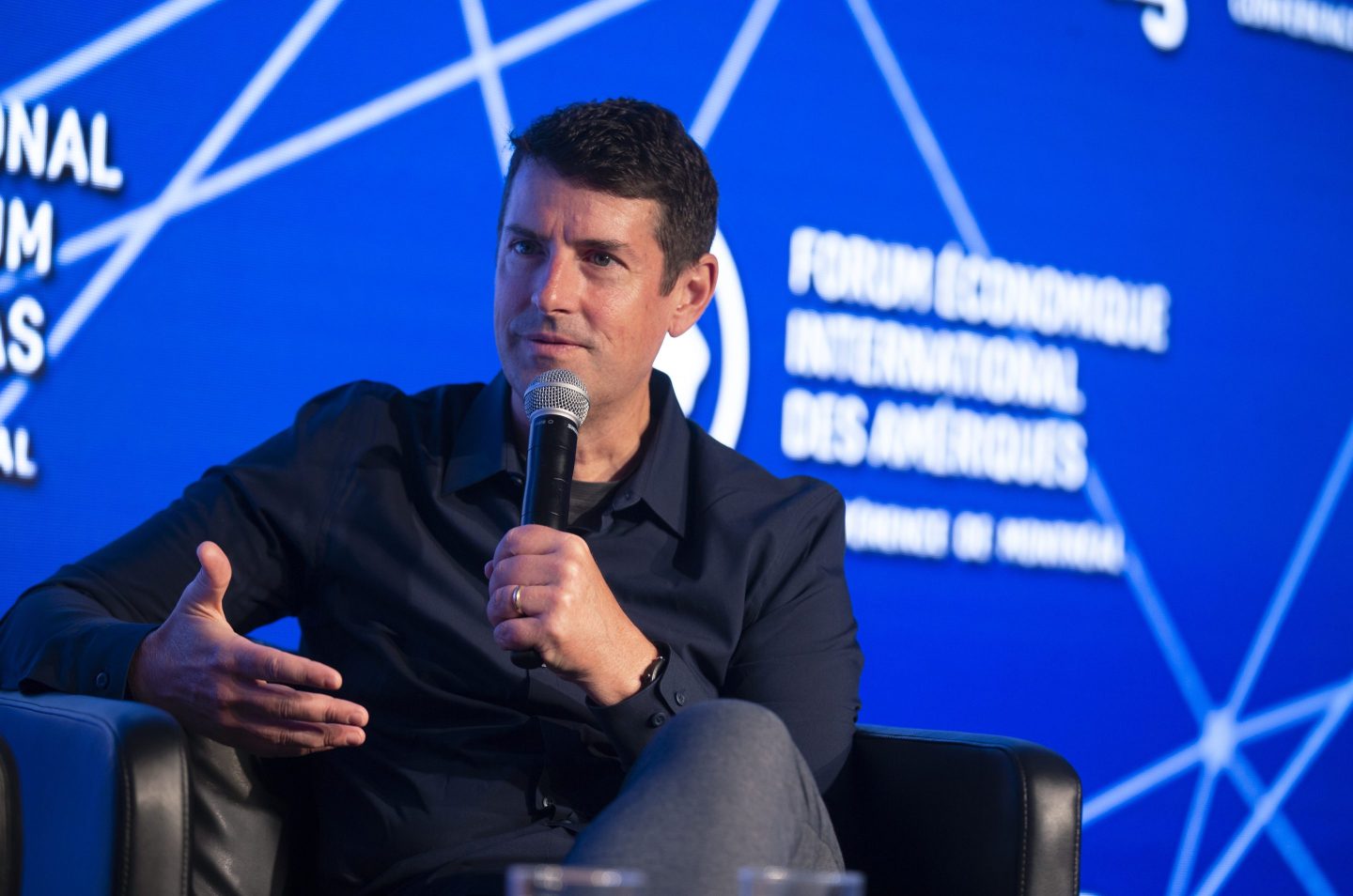

It’s never been easy to be the boss, but Mark Thompson and Byron Loflin, the coauthors of CEO Ready: What You Need to Know to Earn the Job—and Keep the Job, believe the pressure cooker has never been as intense as it is now.
Thompson, chairman of the Chief Executive Alliance and previously ranked as the world’s top CEO coach, and Loflin, Nasdaq’s global head of board advisory, joined forces to provide a 360-view of this loaded moment for leadership, from the C-suite and board perspectives, respectively. In a wide-ranging conversation with Fortune, they talked about the Shakespearean themes of leadership and turmoil and the feeling that “heavy is the head that wears the crown.”
For those aspiring to reach the top, Thompson shared the conventional wisdom he’d learned from his mentor, Marshall Goldsmith: “What got you here got you halfway there.” (Goldsmith had a New York Times bestseller in 2007 with What Got You Here Won’t Get You There.)
The transition from being a high-performing executive in a “swim lane” to having the “aperture of having a full enterprise” requires substantial new learning and skill development, Thompson argued, because no matter how great an executive you are or how prepared you think you might be, the stakes are existentially high. The risk that a CEO might “lose his or her head within the next year or so” is “easily like 20% or at the big brands it feels like it’s twice that,” said Thompson, who recently penned an essay on the subject of CEO “decapitation” for Fortune.
Adding to this pressure, Thompson and Loflin added, is the radical shift in board member expectations. Board members, who once might have been “golf buddies,” are now “really under the gun to perform.” They are “less patient” and expected to “actually deliver,” based on their subject matter expertise.
This environment demands nearly every candidate be ready to serve as a “peacetime in a wartime CEO,” Thompson said, capable of harvesting the best aspects of the company culture while also being “disrupting and breaking new ground.” An executive promoted from a functional role, such as CFO, may possess the “gravitas of understanding the street and the shareholders,” but often lacks the breadth to “light hearts and minds” across the workforce, or do “ride-alongs with customers.”
The loneliness of the tower, and ‘relationology’
Fortune has been tracking this tenuous moment for leaders throughout 2025. Top recruitment firm Challenger Gray & Christmas found 1,235 CEOs had left (or lost) their jobs through the first half of 2025, a stunning 12% increase from 2024 and the highest year-to-date total since Challenger began tracking CEO turnover in 2002.
Jim Rossman, Barclays’ global head of shareholder advisory, who’s been closely tracking shareholder activism for decades, similarly found record activist-linked turnover at the top for 2025. “It feels like what activists have done is basically [to hold] public companies to the standards of private equity,” Rossman told Fortune in a previous interview, as they have come to view the CEO “more as an operator, not somebody who’s risen through the ranks.” In other words: Results matter.
The intense environment contributes to feelings of isolation. As CEOs often note, being the boss is a lonely job where leaders are caught in the middle, with information they cannot share with reports but must share with the board, creating a huge information asymmetry, as Microsoft CEO Satya Nadella previously told McKinsey.
Carolyn Dewar, the co-leader and founder of McKinsey’s CEO practice, previously told Fortune: “No one else in your organization or above you, like your board or your investors, see all the pieces you see.” She advocated for leaders to surround themselves with trusted advisors—“a kitchen cabinet” of sorts.
Similarly, Loflin told Fortune he’s fond of the concept of “relationology,” which he describes as “sort of a study of relationships.” He suggested leaders must develop a “portfolio of relationships of intimacy” that are “very context-relevant.” A leader’s effectiveness hinges on having fluency, for instance, when speaking to a CFO about analyst days, or working with a compliance team to keep the business safe or connecting authentically with union executives. Loflin said he’s often seen it being a “big surprise” to accomplished leaders that they have, say, seven different groups they need to engage and maybe as many as six new skills to really flesh out before they’re ready to take the enterprise to the next level.
This need for deep, context-aware connection also applies to personal life, Loflin added. The idea that a personal life and professional life can be entirely separate “undermines leadership and undermines the fabric of a company.” Critically, Loflin said, the chair must really know his CEO “at a deep level, like a Shakespearean level,” requiring a transparency that ensures appropriate accountability. After all, Loflin noted as one example, boards have to be mindful that a personal relationship that violates company policy can jeopardize corporate governance at the drop of a hat. The board really needs to know who their CEO is, maybe better than the CEO knows themselves.
The power and the privilege, the hubris and the humility
Loflin, who admitted to Fortune that he’s a bit of a Shakespeare nerd, noted the difference between a tragedy and a comedy is determined by “the vulnerability and the self-awareness of the protagonist,” and a tragic outcome results from a feeling he likened to “never recognizing whether I needed to grow or change.”
Thompson added that surviving as a CEO requires an “odd combination” of traits you might encounter in a Greek tragedy: hubris and humility.
The CEO must possess the hubris, or excessive pride, to believe they can be the best in their field, but also the profound humility that acknowledges they can’t do it alone.
The professional mandate is relentless, Thompson added, citing a key interview for the book from Qualcomm CEO Cristiano Amon: If you were the “same guy you were a year ago, you don’t deserve to be promoted.” Thompson said he thinks of hubris as being at “the edge of your competence, so rather than retreating, you actually should lean into that” to acquire the skills and help you need to keep growing as a professional.
For top leaders, Thompson said, the top job is not a prize to be won, but a “privilege to do this role.” Just as Olympic athletes must constantly improve, he added, leaders must recognize that breaking a record only attracts more competition.
Loflin urged boards and executives alike to move beyond a Wolf of Wall Street mindset and into “what it means to authentically care for and build the confidence and foster appropriate accountability.” He said that for many executives, admitting you have areas to improve on and get better at is a “special vulnerability.” He argued boards need more genuine, interpersonal affection—sometimes of the tough love variety—to prevent a truly Shakespearean tragedy on their watch.
Loflin said he’d just had breakfast with a board director for a $30 billion company and the subject of love arose: “Do you love your management team?” The director said yes, definitely, almost like relatives. After all, they had been with the company over a decade and had deep relationships with other directors and their C-suite. Loflin argued that over decades of advising boards on corporate governance, he wishes more would adopt this sort of attitude.
“I don’t think it’s going to hurt anything in business, because a good father has to talk to a troubled son; hopefully he’s mentoring when [the son is] getting himself in trouble.” After all, Loflin continued, “bad stuff happens, and I think some of these metaphors are important.” In other words, it shouldn’t be the Wolf of Wall Street, but the wolf—or the activist—is always at the door.