• Home
  • News
  • Fortune 500
  • Tech
  • Finance
  • Leadership
  • Lifestyle
  • Rankings
  • Multimedia
InvestingMarkets

Central banks will end up holding Bitcoin in their reserves even though it is ‘backed by nothing,’ Deutsche Bank predicts

Jim Edwards
By
Jim Edwards
Jim Edwards
Executive Editor, Global News
Down Arrow Button Icon
Jim Edwards
By
Jim Edwards
Jim Edwards
Executive Editor, Global News
Down Arrow Button Icon
October 7, 2025, 7:12 AM ET
Mark Garlick / Science Photo Library via Getty Images
  • Deutsche Bank predicts Bitcoin could be added to central bank reserves by 2030 as its volatility falls and its behavior resembles gold, despite not being “backed by anything.” Recent surges in gold and Bitcoin, driven by central banks seeking diversification and companies creating Bitcoin “treasuries,” show Bitcoin’s growing appeal as a safe-haven asset.

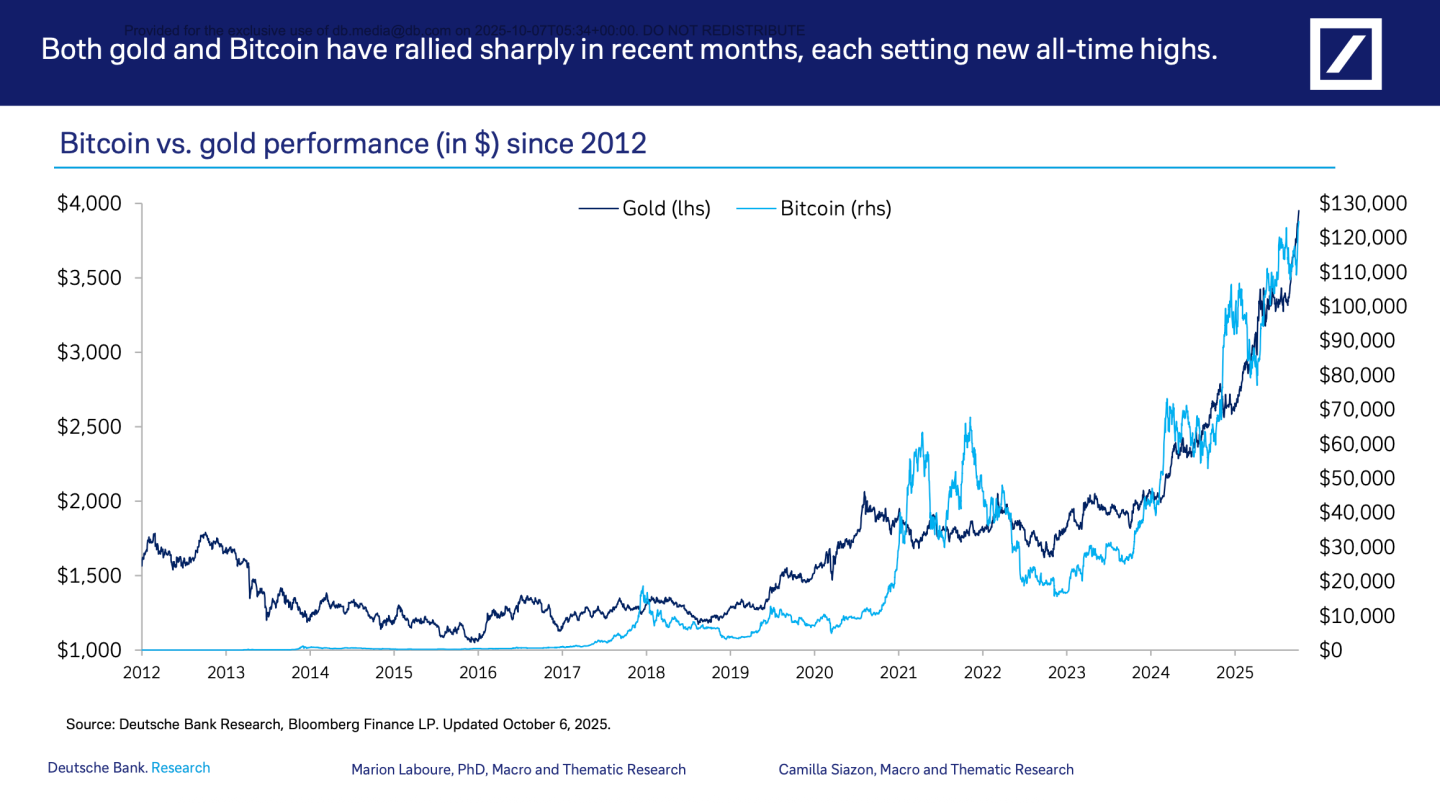
The price of Bitcoin briefly topped $125,000 yesterday, a new record high. And as its price goes up, its relative volatility declines, a new analysis by Deutsche Bank argues. That factor is making Bitcoin more like gold—an asset that has a fixed supply and a low price correlation with other assets.

Recommended Video

And that in turn increasingly makes Bitcoin a candidate to be added to central bank reserve assets, according to Deutche analysts Marion Laboure and Camilla Siazon.

“A strategic Bitcoin allocation could emerge as a modern cornerstone of financial security, echoing gold’s role in the 20th century. Assessing volatility, liquidity, strategic value and trust, we find that both assets will likely feature on central bank balance sheets by 2030,” they said in a research slide deck Tuesday. 

Their argument is based on the fact that gold (a common central bank asset) and Bitcoin have both risen precipitously in price over the last few years. They produced this chart. (Note the differing vertical axes, which are flattering to the price of gold):
There’s another factor favoring Bitcoin right now: Companies that have created “Bitcoin treasuries” on their balance sheet. Hundreds of companies now count Bitcoin as an asset, most famously Michael Saylor’s Strategy, whose entire strategy is to buy more Bitcoin.

Gold is going up because central banks are steadily buying it has a hedge against political uncertainty in the U.S. and the weakening dollar. Central banks worldwide usually hold U.S. dollars in their reserves, and while that continues to be the case, many nations have chosen to add gold to diversify their assets.

Marion Laboure and Camilla Siazon’s theory is that as Bitcoin behaves more like gold, and as central banks seek assets that don’t move in tandem with other assets, they’ll be tempted to add crypto.

There is, of course, one catch. Technically, Bitcoin is not an asset. It’s merely a piece of computer code signalling a price. Unlike cash, bonds, property or stocks, Bitcoin does not entitle the owner to any underlying asset, interest, or cash flow.

“The main counter-argument is that Bitcoin – backed by nothing – is too volatile for long-term value,” Laboure and Siazon admit. “Yet, its volatility has now fallen to historic lows.”  

The price of gold—as measured by the Comex continuous contract market—sits at $3,983.80 per troy ounce this morning, a whisker below $4,000. Goldman Sachs expects it to go higher. Goldman analysts Lina Thomas and Daan Struyven raised their target price for gold to $4,900, up from their previous estimate of $4,300 because of “sticky” demand.

A big driver of that demand is emerging market central banks, they told clients. “EM central banks are likely to continue the structural diversification of their reserves into gold (contributing 19pp to the 23% price increase we expect by [December 2026]),” they said. 

Gold prices have now risen more than 50% this year. That’s the kind of rise you’d normally see in a crisis, according to Jim Reid and his team at Deutsche Bank. They told clients Tuesday morning that markets haven’t seen prices rise like that for more than 40 years. It was “their fastest annual gain since 1979, when they rose +127% amidst a surge in inflation after the oil crisis that year,” they wrote.

And yet the stock markets aren’t behaving as if there is a crisis. The S&P 500 hit a new record high yesterday. It’s up 14.6% year-to-date.

That’s the central, weird theme of the markets right now: Investors are optimistic about stocks at the same time as they’re piling into “safe haven” assets like gold and—if you buy Deutsche Bank’s argument—Bitcoin.

Here’s a snapshot of the markets ahead of the opening bell in New York this morning:

  • S&P 500 futures were flat this morning. The index closed up 0.36% in its last session at a new high of 6,740.28.
  • STOXX Europe 600 was up 0.15% in early trading. 
  • The U.K.’s FTSE 100 was up 0.15% in early trading. 
  • Japan’s Nikkei 225 was flat.
  • China’s CSI 300 was up 0.45%. 
  • The South Korea KOSPI was up 2.7%. 
  • India’s Nifty 50 was up 0.54% before the end of the session. 
  • Bitcoin was flat at around $123.8K.

Fortune Brainstorm AI returns to San Francisco Dec. 8–9 to convene the smartest people we know—technologists, entrepreneurs, Fortune Global 500 executives, investors, policymakers, and the brilliant minds in between—to explore and interrogate the most pressing questions about AI at another pivotal moment. Register here.
About the Author
Jim Edwards
By Jim EdwardsExecutive Editor, Global News
LinkedIn iconTwitter icon

Jim Edwards is the executive editor for global news at Fortune. He was previously the editor-in-chief of Business Insider's news division and the founding editor of Business Insider UK. His investigative journalism has changed the law in two U.S. federal districts and two states. The U.S. Supreme Court cited his work on the death penalty in the concurrence to Baze v. Rees, the ruling on whether lethal injection is cruel or unusual. He also won the Neal award for an investigation of bribes and kickbacks on Madison Avenue.

See full bioRight Arrow Button Icon

Latest in Investing

Elon Musk
Big TechSpaceX
SpaceX to offer insider shares at record-setting $800 billion valuation
By Edward Ludlow, Loren Grush, Lizette Chapman, Eric Johnson and BloombergDecember 6, 2025
10 hours ago
EconomyDebt
The most likely solution to the U.S. debt crisis is severe austerity triggered by a fiscal calamity, former White House economic adviser says
By Jason MaDecember 6, 2025
10 hours ago
Sarandos
InvestingM&A
Netflix’s $5.8 billion breakup fee for Warner among largest ever
By Elizabeth Fournier and BloombergDecember 6, 2025
17 hours ago
index
Investingindex funds
Quant who said passive era is ‘worse than Marxism’ doubles down
By Denitsa Tsekova, Vildana Hajric and BloombergDecember 6, 2025
18 hours ago
Netflix
InvestingAntitrust
Netflix–Warner Bros. deal sets up $72 billion antitrust test
By Josh Sisco, Samuel Stolton, Kelcee Griffis and BloombergDecember 5, 2025
1 day ago
InvestingMarkets
Facing a vast wave of incoming liquidity, the S&P 500 prepares to surf to a new record high
By Jim EdwardsDecember 5, 2025
2 days ago

Most Popular

placeholder alt text
AI
Nvidia CEO says data centers take about 3 years to construct in the U.S., while in China 'they can build a hospital in a weekend'
By Nino PaoliDecember 6, 2025
15 hours ago
placeholder alt text
Big Tech
Mark Zuckerberg rebranded Facebook for the metaverse. Four years and $70 billion in losses later, he’s moving on
By Eva RoytburgDecember 5, 2025
2 days ago
placeholder alt text
Real Estate
The 'Great Housing Reset' is coming: Income growth will outpace home-price growth in 2026, Redfin forecasts
By Nino PaoliDecember 6, 2025
20 hours ago
placeholder alt text
Success
Nvidia CEO Jensen Huang admits he works 7 days a week, including holidays, in a constant 'state of anxiety' out of fear of going bankrupt
By Jessica CoacciDecember 4, 2025
3 days ago
placeholder alt text
Economy
The most likely solution to the U.S. debt crisis is severe austerity triggered by a fiscal calamity, former White House economic adviser says
By Jason MaDecember 6, 2025
10 hours ago
placeholder alt text
Asia
Despite their ‘no limits’ friendship, Russia is paying a nearly 90% markup on sanctioned goods from China—compared with 9% from other countries
By Jason MaNovember 29, 2025
7 days ago
Rankings
  • 100 Best Companies
  • Fortune 500
  • Global 500
  • Fortune 500 Europe
  • Most Powerful Women
  • Future 50
  • World’s Most Admired Companies
  • See All Rankings
Sections
  • Finance
  • Leadership
  • Success
  • Tech
  • Asia
  • Europe
  • Environment
  • Fortune Crypto
  • Health
  • Retail
  • Lifestyle
  • Politics
  • Newsletters
  • Magazine
  • Features
  • Commentary
  • Mpw
  • CEO Initiative
  • Conferences
  • Personal Finance
  • Education
Customer Support
  • Frequently Asked Questions
  • Customer Service Portal
  • Privacy Policy
  • Terms Of Use
  • Single Issues For Purchase
  • International Print
Commercial Services
  • Advertising
  • Fortune Brand Studio
  • Fortune Analytics
  • Fortune Conferences
  • Business Development
About Us
  • About Us
  • Editorial Calendar
  • Press Center
  • Work At Fortune
  • Diversity And Inclusion
  • Terms And Conditions
  • Site Map

© 2025 Fortune Media IP Limited. All Rights Reserved. Use of this site constitutes acceptance of our Terms of Use and Privacy Policy | CA Notice at Collection and Privacy Notice | Do Not Sell/Share My Personal Information
FORTUNE is a trademark of Fortune Media IP Limited, registered in the U.S. and other countries. FORTUNE may receive compensation for some links to products and services on this website. Offers may be subject to change without notice.