
Deutsche Bank called it “the summer AI turned ugly,” and there was certainly a heated war of words between Nvidia CEO Jensen Huang and Anthropic CEO Dario Amodei over the latter’s prediction that artificial intelligence would wipe out half of all white-collar jobs. The two executives spent much of the summer trading predictions about how many jobs would be lost as AI transformed the workforce in a “fourth industrial revolution.”
But from the standpoint of Labor Day, things are looking very different. Markets got a shock in late August from an unlikely place: a survey by MIT finding that 95% of generative AI pilots at large companies were failing. That prompted a tech sell-off and talk of whether AI was forming into a stock-market bubble. And another piece of the puzzle just fell into view: the Census Bureau finds that AI adoption rates are starting to decline among major firms. After two years of rapid experimentation and headline-grabbing pilot projects, many corporations appear to be reassessing the real-world value of integrating AI into their operations for the long haul.
Kelly Monahan is managing director of the Upwork Research Institute, where she is plugged into reams of data from the freelance market. In September, Upwork launched a new report into the hiring trends and skills that are most in demand. “What I’m seeing happening is the humans are coming back into the loop,” Monahan told Fortune. “We’re actually seeing the human skills coming into premium,” she said. “I think what people are realizing is even the best AI models still hallucinate 10% to 12% of the time. “We just cannot necessarily overcome that statistical problem yet … I think what people are seeing, now that they’re using AI-generated content, is that they need fact-checking.” Only a human can provide that.
The AI adoption decline figures come from the Business Trends and Outlook Survey (BTOS), conducted biweekly by the U.S. Census Bureau, which covers more than 1.2 million firms and captures a unique, up-to-date view of technology adoption across different business sizes. The most recent data, reflected in a six-survey moving average, shows that the AI adoption rate among large companies—defined as those with more than 250 employees—has dipped from a peak of 14% earlier this year to 12% as of late summer 2025.
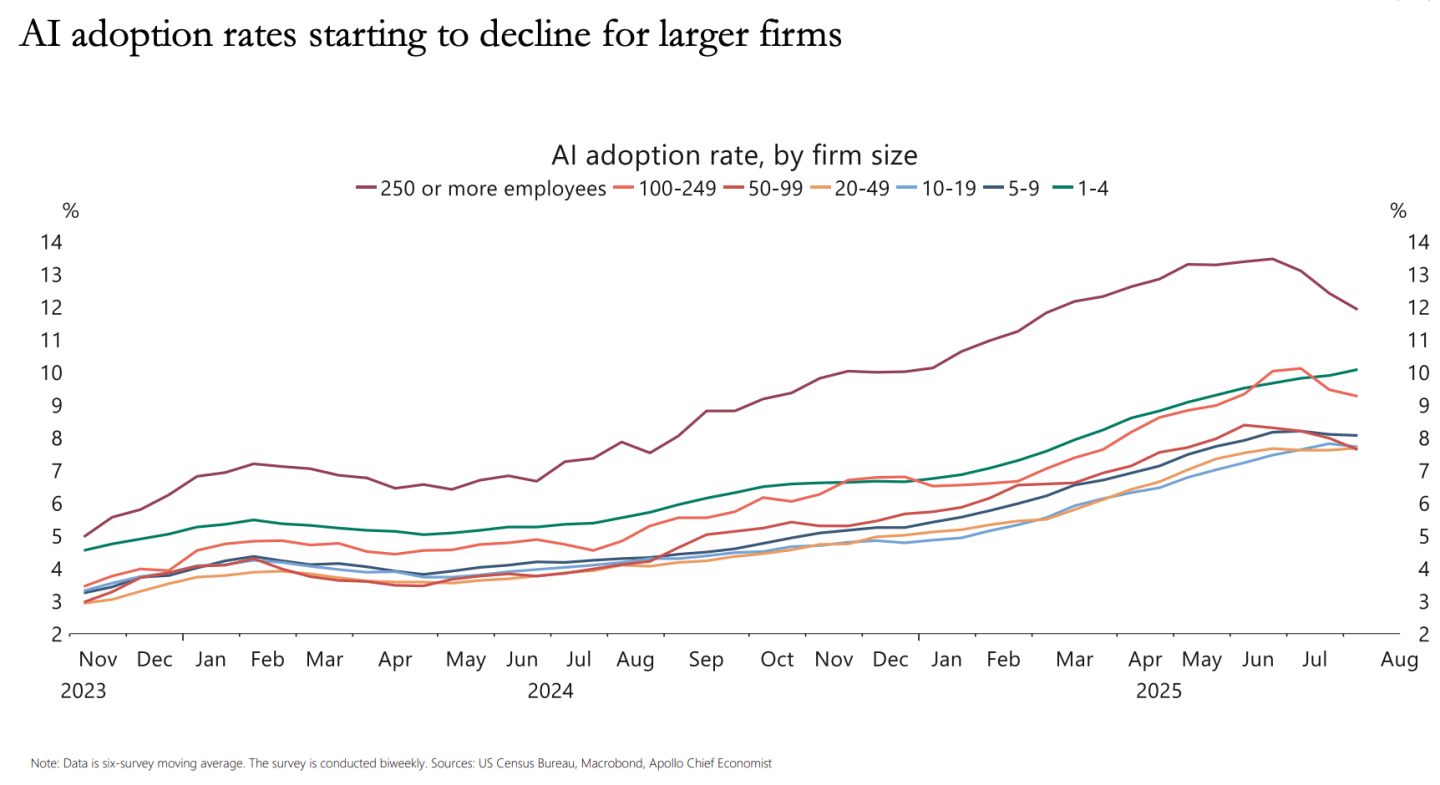
This reversal follows a steep climb over previous quarters, where large firm adoption jumped from 3.7% in September 2023 to 5.7% by December 2024, and reached 9.2% in the second quarter of 2025. Medium-sized firms remain less likely to adopt AI, with maximums around 4.8%, while the smallest businesses, especially those with one to four employees, still report a modest but steady adoption rate of 5.5%.
Apollo Global Management chief economist Torsten Slok notes that one question in the survey is whether a business has used AI tools such as machine learning, natural language processing, virtual agents, or voice recognition to help produce goods or services in the past two weeks. “The bottom line is that the biweekly Census data is starting to show a slowdown in AI adoption for large companies,” Slok wrote in his Daily Spark newsletter on September 7.
Implications for the broader economy
This shift is particularly significant given the outsized role large companies play in shaping technology trends across supply chains and labor markets. Just a year ago, the “AI gold rush” saw firms racing to integrate generative AI and automation solutions, fueled by promises of dramatic cost savings and productivity leaps. Today, the narrative is more cautious—or even skeptical.
There’s also considerable anxiety around what AI is doing to jobs—especially at the entry level, where a first-of-its-kind study by Stanford University economists suggested the beginning of a considerable impact. The research, led by AI thought leader Erik Brynjolfsson, revealed a 13% relative decline in employment for early-career workers aged 22 to 25 in the most AI-exposed jobs since 2022. The Bank of America Institute has pointed out that the unemployment rate for recent graduates started trending ahead of the overall unemployment rate starting at exactly the same time.
To be sure, Monahan said in a separate, clarifying statement provided to Fortune, she thinks the rise of human skills is not simply a reaction to declining AI adoption. “Every major technological shift has reshaped the skill mix by moving people up the value chain,” she said, offering the example of how the ATM didn’t eliminate bank tellers, but elevated their role toward higher-value services that required more interpersonal and problem-solving skills. AI is following a similar pattern, she said. “As automation takes on certain tasks, demand is growing for distinctly human skills—judgment, communication, and contextual understanding.”
Education grapples with AI and human skills
Stanford computer science professor and AI startup co-founder Jure Leskovec told Fortune that the arrival of GPT-3 years ago triggered a sort of “existential crisis” on campus, but that “human expertise matters much more than it ever did.” Leskovec’s students seem to grasp that: They requested that he go from take-home, open-book exams back to a hand-written and hand-graded model, to test human knowledge without AI tools. He called AI an amazingly powerful and “very imperfect” tool that students and professionals alike need to learn how to use, “and we need to be able to both test the humans being able to use the tool and humans being able to think by themselves.”
But are schools preparing students properly for this moment, when AI is raising the bar on entry-level hiring? Monahan said that a key aspect of the “human skills” that are valued at a premium right now is “domain expertise,” or in other words, a human with the skills and knowledge to spot when an AI tool is making a mistake. Just as students need to be entering the job market with this expertise, they are sliding backwards. High school seniors nationwide just recorded their worst reading scores since 1992, with math scores also falling. About a third of them didn’t have basic reading skills, according to the National Assessment of Educational Progress. U.S. universities are also seeing a sharp drop in foreign student enrollment, reducing the size of a group of graduates long relied upon to fill talent gaps in science, technology, and medicine.
Leskovec and Monahan’s experience line up with another study, by the Wharton School, on the long-term likelihood of how AI adoption will play out. While the research estimates that 40% of current labor income is potentially exposed to automation by generative AI, only 23% of actual tasks in those roles will be automated. The study cited an MIT paper that tackled the subject of how many companies would simply choose not to bother with full adoption—and found something like the dip revealed by the Census Bureau.
Monahan said that she doesn’t think people are shying away from using AI necessarily, but she’s not sure that people fully trust AI-generated content, and “this makes human evaluation essential.” She thinks that’s why Upwork’s inaugural Monthly Hiring Report in August showed strong demand for fact-checking, translation, and domain expertise alongside technical AI skills, she added. “The data shows businesses aren’t abandoning AI, but instead are pairing it with uniquely human strengths.”