

• Home
  • Latest
  • Fortune 500
  • Finance
  • Tech
  • Leadership
  • Lifestyle
  • Rankings
  • Multimedia

Trendingnow

1

Egg companies made $1.22 billion in profit off a $6 carton — now they’re buying their way out of a price-fixing case with 53 million donated eggs

2

Meet the Zillennials: The luckiest micro-generation in the workforce, born between 1993 and 1998

3

Economists have found an answer to slowing cognitive decline: Avoid retiring early, study finds

1

Egg companies made $1.22 billion in profit off a $6 carton — now they’re buying their way out of a price-fixing case with 53 million donated eggs

2

Meet the Zillennials: The luckiest micro-generation in the workforce, born between 1993 and 1998

3

Economists have found an answer to slowing cognitive decline: Avoid retiring early, study finds
AIEnergy

More outages, aging infrastructure, and bicoastal dysfunction: BofA warns America’s grid is 30%-46% ‘beyond its useful life’

Nick Lichtenberg
By
Nick Lichtenberg
Nick Lichtenberg
Business Editor
Down Arrow Button Icon
Nick Lichtenberg
By
Nick Lichtenberg
Nick Lichtenberg
Business Editor
Down Arrow Button Icon
August 15, 2025, 12:22 PM ET
Grid
How healthy is the grid?Getty Images
Add Fortune on Google for similar content.

The electrical grid is the backbone of modern America. It powers everything from homes and hospitals to data centers and electric vehicles. But according to a detailed analysis from Bank of America Institute, the grid is straining under the pressures of surging demand, chronically aging infrastructure, and a growing East-West divide, leaving 31% of transmission lines and an even more alarming 46% of distribution infrastructure “beyond its useful life.” The implications are stark: more outages, higher prices, and a heightened risk of dysfunction at both ends of the grid.

Recommended Video

The most alarming fact from BofA’s deep dive is just how much of the grid is overdue for replacement. In 2024, 67% of utility spending on transmission and distribution—$63 billion—went to replacements and upgrades, dwarfing the $32 billion allocated to new lines and substations. This lopsided investment signals a network fighting to keep up, not just with basic maintenance, but with the exponential strain of new users and devices.

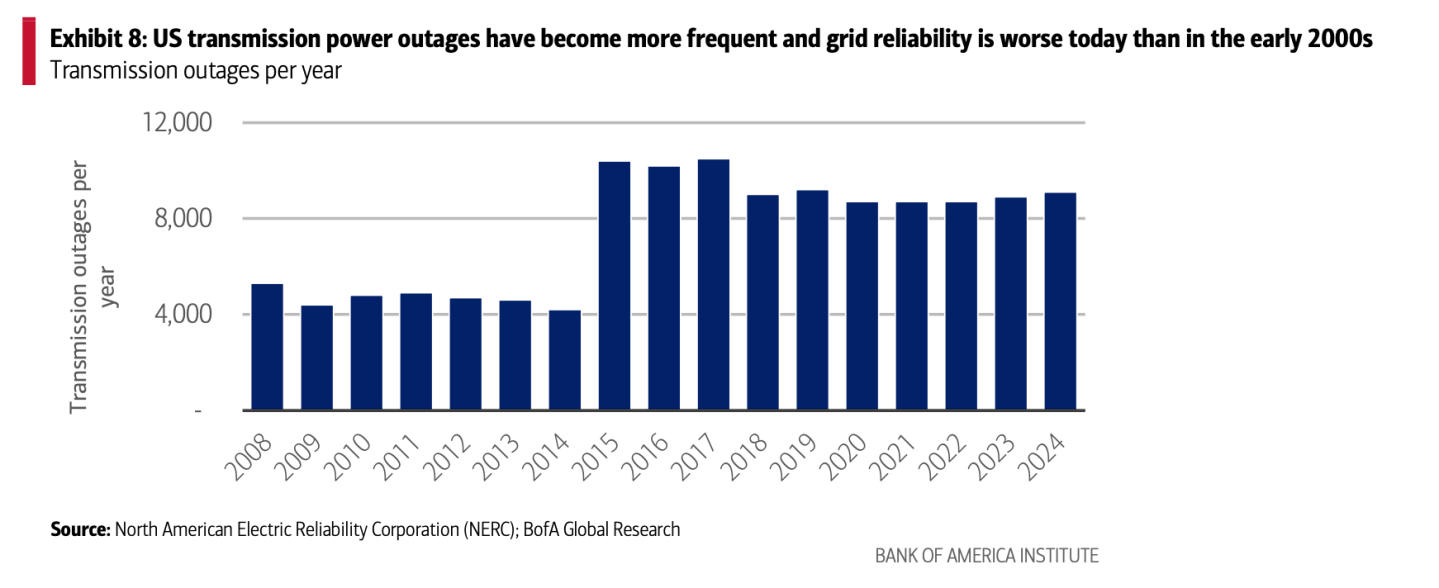
The consequences are already being felt by everyday Americans: Power outages are occurring more frequently, with transmission failures climbing steadily.

Data from the North American Electric Reliability Corp. (NERC) points to a clear decline in grid reliability, leaving many consumers with a system less dependable than the one their parents knew at the start of the millennium. Put simply, BofA says, “Grid reliability is worse today than in the early 2000s.”
A surge in demand—from EVs to AI

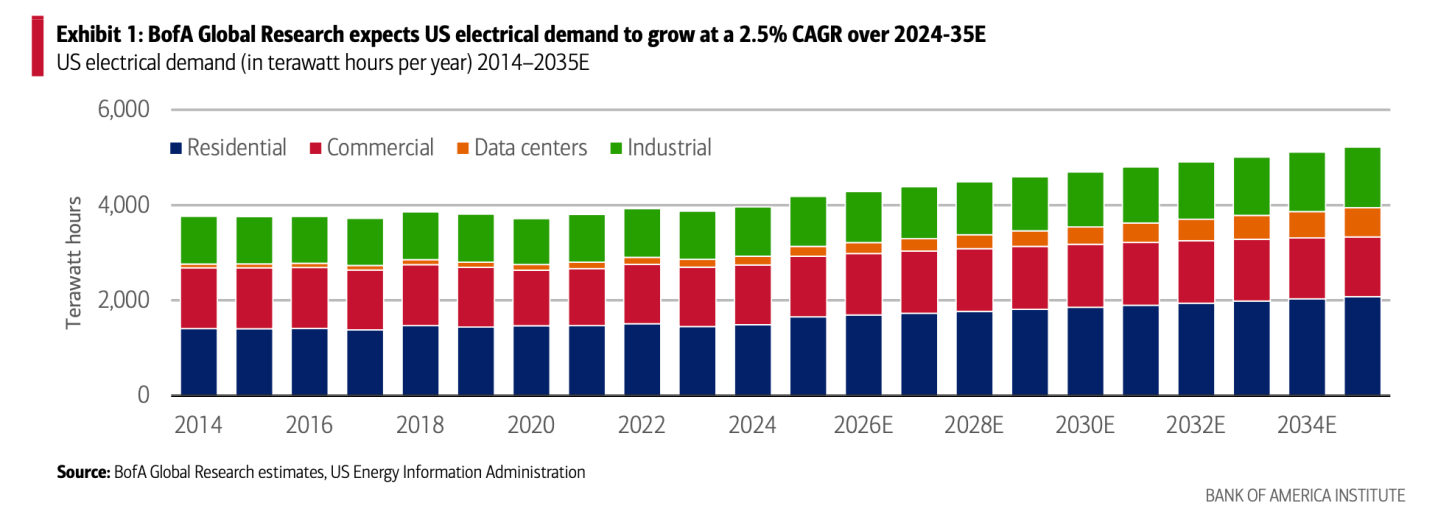
Why is demand rising so sharply? The BofA report identifies four main forces pushing load growth into uncharted territory, projecting that overall U.S. electrical demand will grow at a 2.5% compound annual rate through 2035, far outpacing the 0.5% annual growth seen in the previous decade.

First is building electrification. As cities across states such as California, Massachusetts, and Colorado ban fossil fuels in new construction, homeowners are using far more electricity for heating and hot water.

Second is the boom in data centers, supercharged by the thirsty AI sector. In a world driven by cloud computing, artificial intelligence, and streaming services, data centers are emerging as “super-consumers” of energy. These facilities already account for up to 2% of global electricity, but BofA projects them growing into the 15% to 23% range annually by 2030.
Third, after years of offshoring, American manufacturing is in comeback mode. Driven by state and federal policy support, construction spending on factory infrastructure hit $234 billion in 2024—a 21% jump over the prior year, and double the average of previous years.

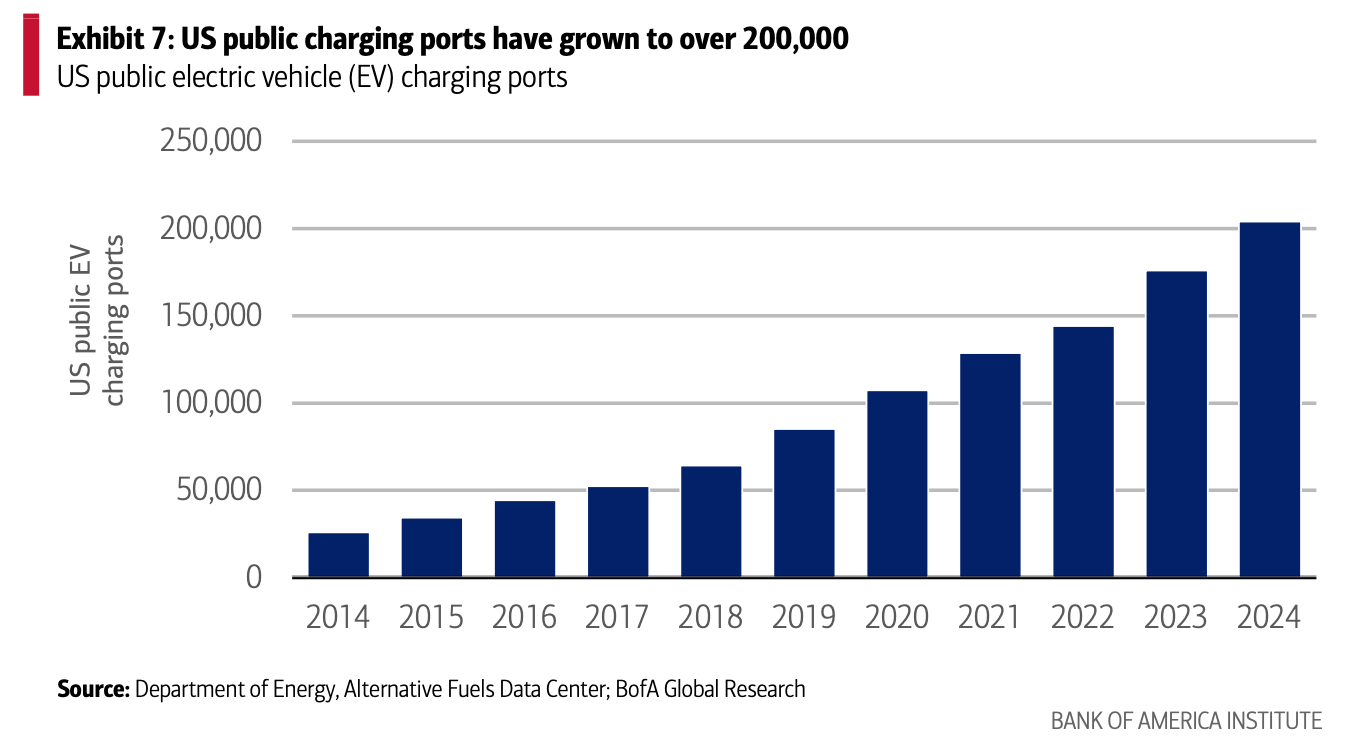
Finally, electric vehicles are changing the game for both residential and public grid demand. Nearly 5 million EVs are already on American roads, a figure that represents 2% of the total passenger vehicle fleet. BofA notes EVs were 9.7% of new vehicle sales in 2024, and even if this figure remains flat, the number of EVs in use will rise at a roughly 15% compound annual growth rate to 22 million on the road by 2030. Not only are these vehicles likely to be charged in residential areas, which have little spare capacity at substations, but BofA notes more public EV charging stations will be needed, and “that will require significant grid investments.”
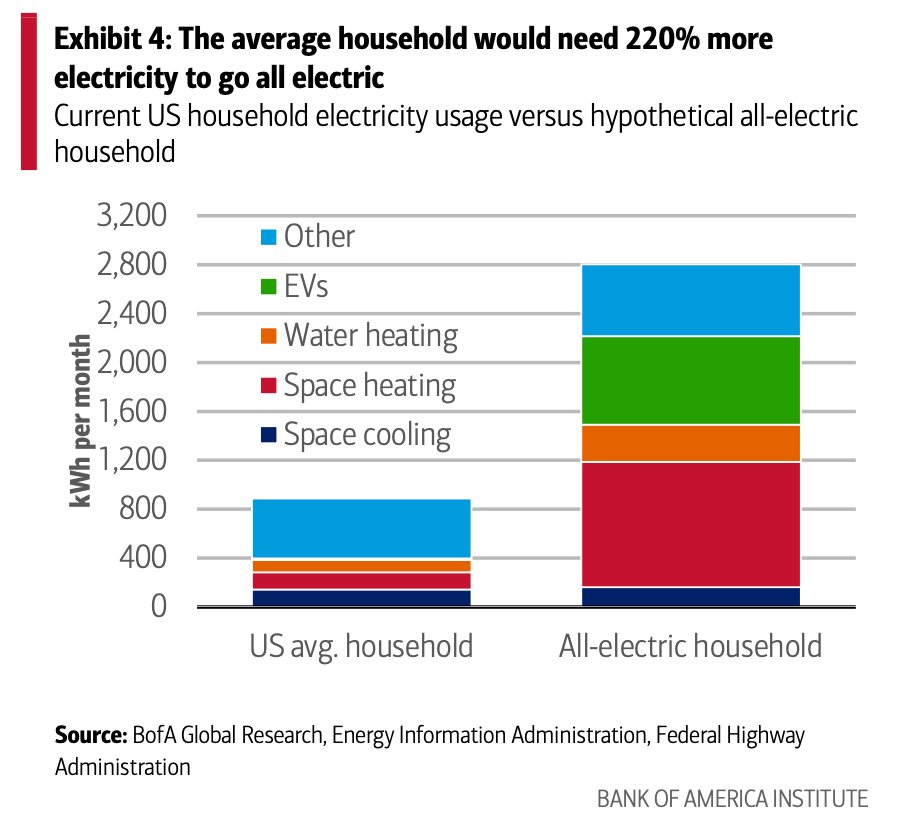
If every U.S. household went “all-electric”—replacing gas-powered heating, hot water, and vehicles—the monthly consumption would triple, from 875 kWh to 2,803 kWh. Such a seismic shift would overwhelm large swaths of the existing grid without massive upgrades.
Geography matters: West makes, East takes

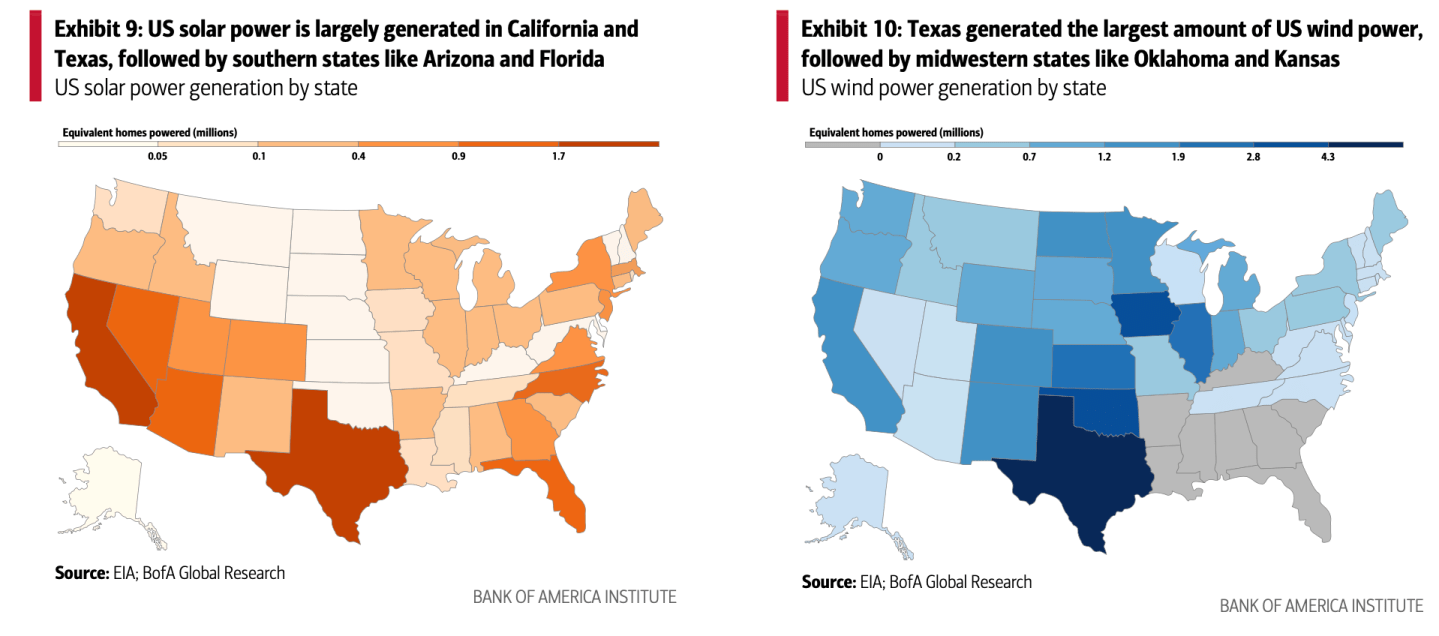
A less-discussed but critical issue is the split in production and consumption between the East Coast, the West Coast, and the Southwest. While the grid is a national asset, its parts don’t always match up with population centers. Most renewable energy is generated in states including Texas, California, and Oklahoma, and their neighbors. These “energy-producing states” deliver over half the country’s wind and solar power, yet the consumption hot spots are overwhelmingly on the East Coast.

This geographic mismatch means long-distance transmission lines are under mounting pressure. Many are aging, and few are being replaced at the pace required. Long-distance, high-voltage transmission lines—already old and unreliable—must bridge this gap, compounding the strain as demand grows.
Outages and reliability: Why Americans should care

The net result of all these factors? More outages and less reliability. Even as utilities invest almost $100 billion a year in basic infrastructure, BofA’s analysis shows customer satisfaction is likely to hit new lows if the current pace of replacement and expansion isn’t accelerated. Transmission outages have become more frequent, and the resiliency of the grid—especially against weather events or cyberattacks—is declining.

Notably, the Department of Energy’s National Transmission Needs Study warns U.S. transmission capacity must grow 64% by 2040 to meet “moderate” load forecasts, assuming the country continues targeting ambitious clean energy adoption.

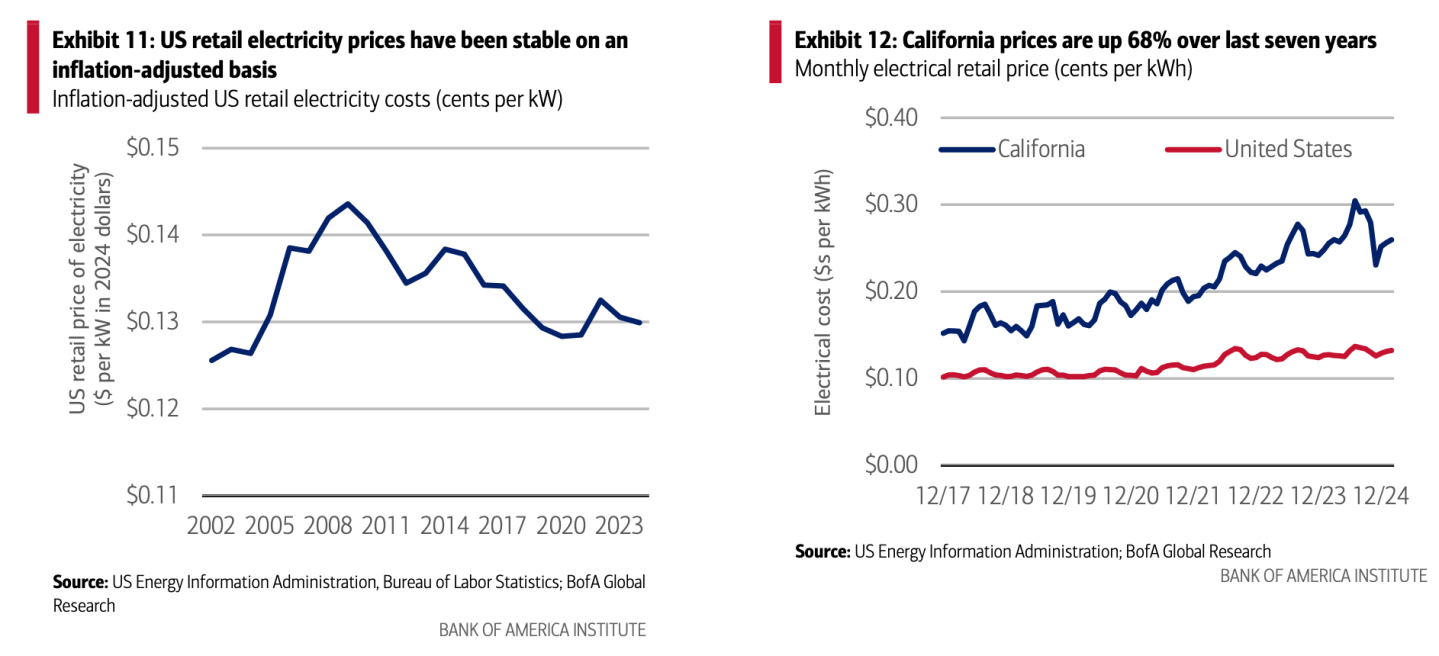
While national prices for electricity have stayed mostly stable after inflation adjustments, California offers a glimpse of what happens when infrastructure stress meets rising costs. Over the past seven years, retail electricity prices in the Golden State have soared by 68%, now averaging nearly twice the national norm. This has led to a 5% drop in demand as consumers and businesses adjust, highlighting the real-world elasticity of energy use in response to price spikes and reliability concerns.
The political response: Deregulation vs. investment

Policymakers are keenly aware of the tightrope the grid is now walking. On the first day of his term, President Trump declared a national energy emergency, aimed at streamlining infrastructure permitting and accelerating grid modernization—especially for traditional energy projects like natural gas. While this marked a pivot from the climate-focused policies of the previous administration, funding for the grid remains bipartisan, in BofA’s view: The Grid Deployment Office, formed under President Biden, awarded $14.5 billion in grants through 2023 and 2024, matched by $36.9 billion in private investment.

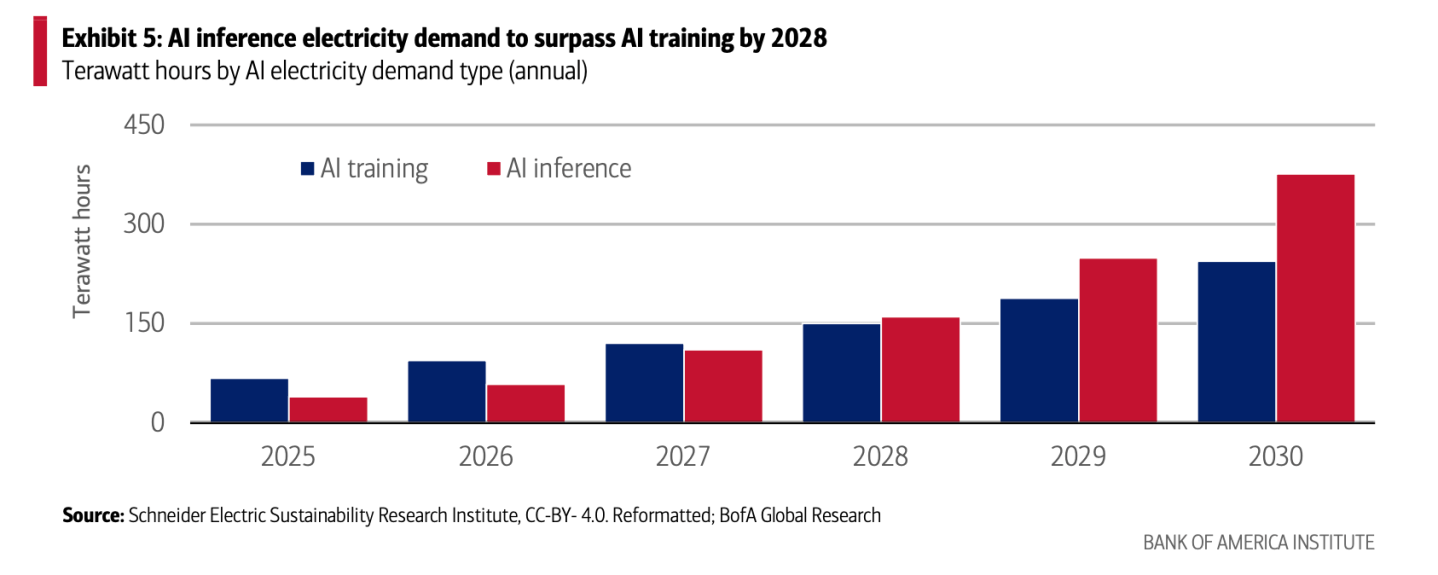
Artificial intelligence, which powers everything from chatbots to autonomous vehicles, poses a unique challenge. The International Energy Agency estimates that AI servers used around 63 TWh of electricity in 2024, or 15% of total data center demand—a number anticipated to surpass 300 TWh by 2030 as the technology scales. But most data up to now has been used on AI training, whereas running models, also known as “AI inference,” or Gen Z’s well-known love of talking to their chatbots all day as a kind of intimate companion, is projected to overtake it in coming years.
The verdict from BofA’s research is clear: Without sweeping upgrades and expansion, America’s grid will buckle under the weight of growing demand and obsolete hardware. “Gigawatt-scale growth” will necessitate increased investment not just in new capacity, but in modernizing transmission and distribution channels. Until then, expect more outages—and a widening gap between where power is produced and where it’s needed most.

For this story, Fortune used generative AI to help with an initial draft. An editor verified the accuracy of the information before publishing. 

Subscribe to Fortune Gulf Brief. Every Tuesday, this new newsletter delivers clear-eyed, authoritative intelligence on the deals, decisions, policies, and power shifts shaping one of the world’s most consequential regions, written for the people who need to act on it. Sign up here.
About the Author
Nick Lichtenberg
By Nick LichtenbergBusiness Editor
LinkedIn icon

Nick Lichtenberg is business editor and was formerly Fortune's executive editor of global news.

See full bioRight Arrow Button Icon
Add Fortune on Google for similar content.

Latest in AI

Finance
Lorem ipsum dolor sit amet, consectetur adipiscing elit, sed do eiusmod tempor incididunt ut labore et dolore magna aliqua. Ut enim ad minim veniam
By Fortune Editors
October 20, 2025
Finance
Lorem ipsum dolor sit amet, consectetur adipiscing elit, sed do eiusmod tempor incididunt ut labore et dolore magna aliqua. Ut enim ad minim veniam
By Fortune Editors
October 20, 2025
Finance
Lorem ipsum dolor sit amet, consectetur adipiscing elit, sed do eiusmod tempor incididunt ut labore et dolore magna aliqua. Ut enim ad minim veniam
By Fortune Editors
October 20, 2025
Finance
Lorem ipsum dolor sit amet, consectetur adipiscing elit, sed do eiusmod tempor incididunt ut labore et dolore magna aliqua. Ut enim ad minim veniam
By Fortune Editors
October 20, 2025
Finance
Lorem ipsum dolor sit amet, consectetur adipiscing elit, sed do eiusmod tempor incididunt ut labore et dolore magna aliqua. Ut enim ad minim veniam
By Fortune Editors
October 20, 2025
Finance
Lorem ipsum dolor sit amet, consectetur adipiscing elit, sed do eiusmod tempor incididunt ut labore et dolore magna aliqua. Ut enim ad minim veniam
By Fortune Editors
October 20, 2025

Most Popular

Finance
Lorem ipsum dolor sit amet, consectetur adipiscing elit, sed do eiusmod tempor incididunt ut labore et dolore magna aliqua. Ut enim ad minim veniam
By Fortune Editors
October 20, 2025
Finance
Lorem ipsum dolor sit amet, consectetur adipiscing elit, sed do eiusmod tempor incididunt ut labore et dolore magna aliqua. Ut enim ad minim veniam
By Fortune Editors
October 20, 2025
Finance
Lorem ipsum dolor sit amet, consectetur adipiscing elit, sed do eiusmod tempor incididunt ut labore et dolore magna aliqua. Ut enim ad minim veniam
By Fortune Editors
October 20, 2025
Finance
Lorem ipsum dolor sit amet, consectetur adipiscing elit, sed do eiusmod tempor incididunt ut labore et dolore magna aliqua. Ut enim ad minim veniam
By Fortune Editors
October 20, 2025
Finance
Lorem ipsum dolor sit amet, consectetur adipiscing elit, sed do eiusmod tempor incididunt ut labore et dolore magna aliqua. Ut enim ad minim veniam
By Fortune Editors
October 20, 2025
Finance
Lorem ipsum dolor sit amet, consectetur adipiscing elit, sed do eiusmod tempor incididunt ut labore et dolore magna aliqua. Ut enim ad minim veniam
By Fortune Editors
October 20, 2025
Fortune Secondary Logo
Rankings
  • 100 Best Companies
  • Fortune 500
  • Global 500
  • Fortune 500 Europe
  • Most Powerful Women
  • World's Most Admired Companies
  • See All Rankings
  • Lists Calendar
Sections
  • Finance
  • Fortune Crypto
  • Features
  • Leadership
  • Health
  • Commentary
  • Success
  • Retail
  • Mpw
  • Tech
  • Lifestyle
  • CEO Initiative
  • Asia
  • Politics
  • Conferences
  • Europe
  • Newsletters
  • Personal Finance
  • Environment
  • Magazine
  • Education
Customer Support
  • Frequently Asked Questions
  • Customer Service Portal
  • Privacy Policy
  • Terms Of Use
  • Single Issues For Purchase
  • International Print
Commercial Services
  • Advertising
  • Fortune Brand Studio
  • Fortune Analytics
  • Fortune Conferences
  • Business Development
  • Group Subscriptions
About Us
  • About Us
  • Press Center
  • Work At Fortune
  • Terms And Conditions
  • Site Map
  • About Us
  • Press Center
  • Work At Fortune
  • Terms And Conditions
  • Site Map
  • Facebook icon
  • Twitter icon
  • LinkedIn icon
  • Instagram icon
  • Pinterest icon

Latest in AI

‘Devin-kun’: Japan embraces agents as legacy code and a shrinking workforce create a perfect market for an AI software engineer 
AsiaAI agents
‘Devin-kun’: Japan embraces agents as legacy code and a shrinking workforce create a perfect market for an AI software engineer 
By Nicholas GordonJuly 3, 2026
16 hours ago
ds
CommentarySoftware
I argued with the father of open source for 2 years. Now the AI fight is the same — only bigger
By David SiegelJuly 3, 2026
1 day ago
ashok
Commentary250 Years of Innovation
The greatest startup in history: What we can learn from America’s founders at today’s AI frontier
By Ashok N. SrivastavaJuly 3, 2026
1 day ago
Microsoft’s next big bet isn’t on a model but on becoming the Swiss Army knife of enterprise AI
AIMicrosoft
Microsoft’s next big bet isn’t on a model but on becoming the Swiss Army knife of enterprise AI
By Sheryl Estrada and Sebastian HerreraJuly 3, 2026
1 day ago
z
AIdisruption
Meet the Zillennials: The luckiest micro-generation in the workforce, born between 1993 and 1998
By Nick LichtenbergJuly 3, 2026
1 day ago
A man in an orange vest opens door to a cargo truck.
AIData centers
Organized crime is building an AI hardware cargo theft economy: ‘The economics have become just crazy from the criminal opportunistic perspective’
By Sasha RogelbergJuly 3, 2026
1 day ago

Most Popular

Egg companies made $1.22 billion in profit off a $6 carton — now they’re buying their way out of a price-fixing case with 53 million donated eggs
Law
Egg companies made $1.22 billion in profit off a $6 carton — now they’re buying their way out of a price-fixing case with 53 million donated eggs
By Wyatte Grantham-Philips and The Associated PressJuly 2, 2026
2 days ago
Meet the Zillennials: The luckiest micro-generation in the workforce, born between 1993 and 1998
AI
Meet the Zillennials: The luckiest micro-generation in the workforce, born between 1993 and 1998
By Nick LichtenbergJuly 3, 2026
1 day ago
Economists have found an answer to slowing cognitive decline: Avoid retiring early, study finds
Economy
Economists have found an answer to slowing cognitive decline: Avoid retiring early, study finds
By Sasha RogelbergJuly 2, 2026
2 days ago
On Wall Street, analysts increasingly don’t believe the U.S. government’s 'misleading' job numbers
Economy
On Wall Street, analysts increasingly don’t believe the U.S. government’s 'misleading' job numbers
By Jim EdwardsJuly 3, 2026
1 day ago
$25 billion CEO says one-hour interviews are a waste of time—he puts candidates through six hours of tests and wants them to order wine at lunch
Success
$25 billion CEO says one-hour interviews are a waste of time—he puts candidates through six hours of tests and wants them to order wine at lunch
By Orianna Rosa RoyleJuly 3, 2026
1 day ago
In Iran, regime officials who survived the war intended to kill them appear in public for dayslong funeral of the late Supreme Leader Khamenei
Politics
In Iran, regime officials who survived the war intended to kill them appear in public for dayslong funeral of the late Supreme Leader Khamenei
By Nasser Karimi, Jon Gambrell and The Associated PressJuly 3, 2026
1 day ago

© 2026 Fortune Media IP Limited. All Rights Reserved. Use of this site constitutes acceptance of our Terms of Use and Privacy Policy | CA Notice at Collection and Privacy Notice | Do Not Sell/Share My Personal Information
FORTUNE is a trademark of Fortune Media IP Limited, registered in the U.S. and other countries. FORTUNE may receive compensation for some links to products and services on this website. Offers may be subject to change without notice.