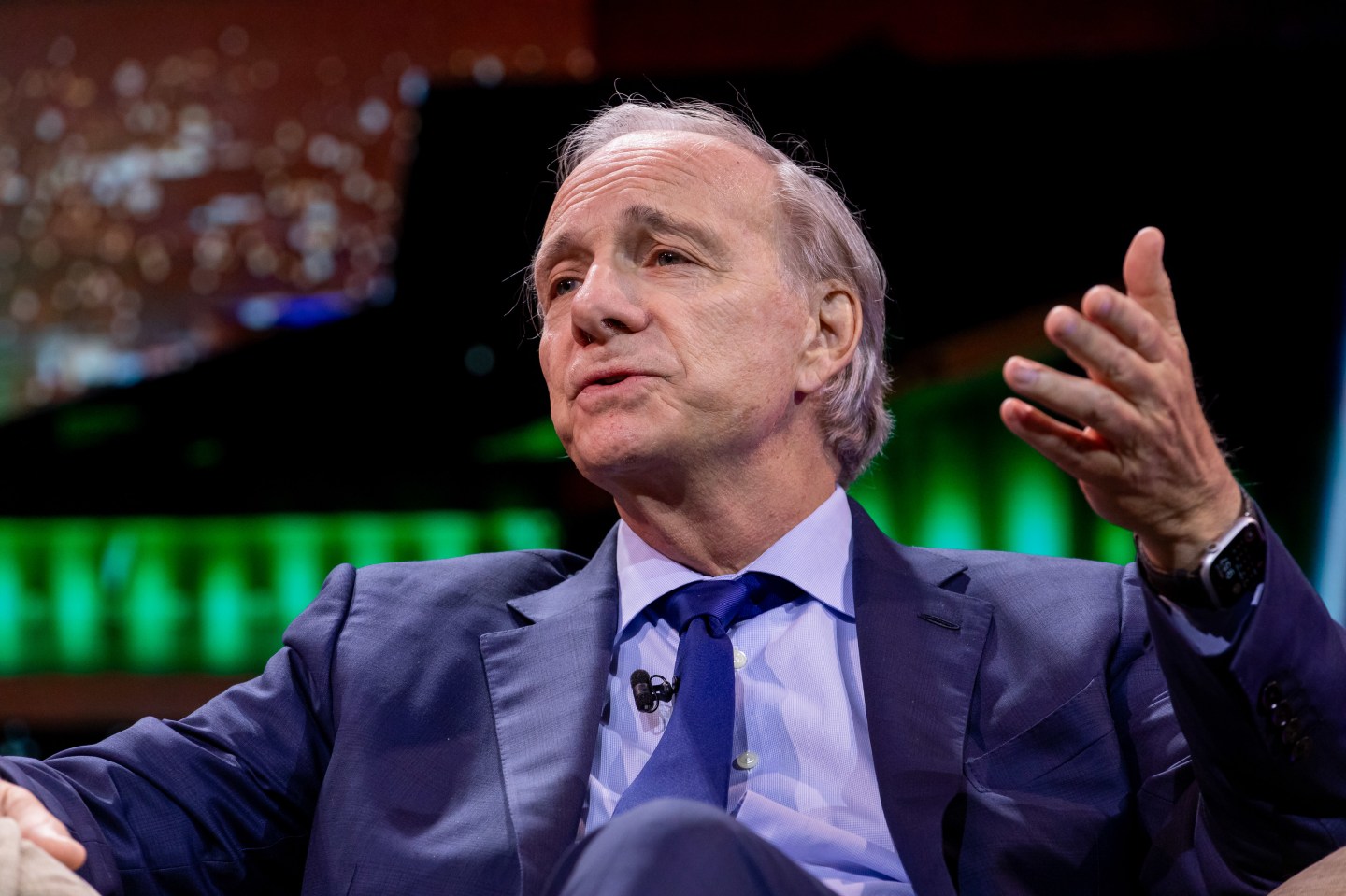
Greg Davis visited Fortune this month dressed like a Wall Street titan—and bearing a very un-Wall-Street message about a tepid future for U.S. stocks.
On July 11, Davis––the president and chief investment officer of Vanguard Group––came to our offices in Manhattan’s Financial District for a chat with this reporter. Though Davis works from Vanguard’s mother ship (its buildings are all named for British vessels from the Napoleonic wars) in the quiet Philadelphia suburb of Malvern, he arrived attired in a tailored gray suit and purple silk tie combo that would have fit right in with the most formal of the investment banking cadre and portfolio managers headquartered nearby.
Yet Davis’s message couldn’t have been more contrary to the fashionable view among the neighborhood’s rosy prognosticators.
The 25-year Vanguard veteran’s outlook contradicts the prevailing position advanced by the big banks, research firms, and TV pundits that despite serial years of big gains, U.S. stocks remain a great buy. That bull case rests mainly on optimism that the Big Beautiful Bill’s deregulatory agenda and tax cuts will spur the economy, and that the AI revolution promises a new world of efficiencies that will shift earnings to super-fast track going forward. The powerful momentum that has driven the Nasdaq and S&P 500 to all time highs this week bolster their argument for more to come.
Davis follows the Vanguard mindset that, arguably more than any other, revolutionized the investing world over the past half-century. The company’s founder, John Bogle, created the first index funds for ordinary investors in 1975, following the conviction that funds choosing individual stocks regularly fail to beat their benchmarks after fees, and that a pallet of diversified index funds, and later ETFs, that hold expenses to an absolute minimum, provide the best platform for achieving superior gains over the long-term.
The top testament to the enduring validity of the Vanguard model: Over 80% of its ETFs and indexed mutual fund beat their peer-group averages over the past 10 years, measured by LSEG Lipper, largely courtesy of those super-tight expense ratios. The Vanguard model’s won such overwhelming favor that it now manages 28% of the combined U.S. mutual fund and ETF universe, and it’s gained 7 points in market share in the past decade. At $10 trillion in AUM, it ranks second only to BlackRock among all U.S. asset managers.
Besides offering over 400 super-low-cost funds worldwide, Vanguard also provides investment advice as a firm, and through its army of financial advisers. A big part of the Vanguard formula: Periodically rebalancing from securities that get extremely pricey by historical standards into areas that are undervalued versus their norms. In our discussion, Davis provided a master class on how the dollars in profits you’re getting for each $100 you’re paying for a stock influences future returns, and why now is such a crucial time to shift from what’s highly, even dangerously expensive into safe areas that look like screaming buys.
Put simply, Davis argues that U.S. equities are a victim of their own success. For Davis, the fabulous ride in recent years virtually guarantees that future returns will prove extremely disappointing versus outsized, double-digit gains investors have gotten used to, and that the investment pros predict will persist. The reason is simple: U.S. stocks have simply gotten so costly that their forward progress is destined to radically slow. “Our investment strategy group’s projection is that U.S. equity market returns are going to be much more muted in the future,” Davis warns. “Over the past ten years, the S&P returned an average of 12.4% annually. We’re predicting the figure to drop to between 3.8% and 5.8% (midpoint of 4.8%) over the next decade.”
The basic market math, he contends, points to that outcome. Davis notes that the official price-to-earnings multiple on the S&P now stands at an extremely lofty 29.3. And when Vanguard uses a preferred gauge based on Nobel Prize-winning economist Robert Shiller’s Cyclically Adjusted Price-to-Earnings multiple, or CAPE––a measure that adjusts the PE by normalizing for spikes and valleys in earnings––it concludes that US stocks hover 49% over the top end of the group’s fair value range.
Davis also points out that corporate profits are now extremely high by historical levels, and hence won’t grow nearly as fast from here as their jackrabbit pace of recent years. In other words, don’t count on an EPS explosion to solve the valuation problem. In fact, this reporter notes that contrary to what we’re constantly hearing about forthcoming double-digit increases in profits, the sprint has already slowed to a stroll. From Q4 of 2021 to Q1 of this year, S&P 500 EPS grew from $198 to $217, or 9.6% in over three years, a puny pace that doesn’t even match inflation.
Huge gains have knocked portfolios out of balance
Davis explained how the longstanding bull market has wildly distorted the standard “60-40” portfolio. That classic construction of 60% stocks and 40% bonds has worked well in many periods, he notes. But today, folks who started at 60-40 a decade ago, and didn’t rebalance into bonds as equity prices swelled year after year, are now banking far too heavily on those richly-valued U.S. equities. “In the past 10 years, interest rates have mainly been very low, so bonds returned only around 2% a year, or 10% less than stocks,” declares Davis. “So the stock portion kept compounding at a high rate and getting bigger, and the bond portion kept shrinking as a share of the total. As a result, what started as a 60-40 mix is now 80-20 in favor of stocks.”
To make matters worse, says Davis, “U.S. stocks outperformed international equities by 6 percentage points a year in the past decade. So 10 years ago, if you started with the standard split 70% U.S. and 30% foreign, you’d now be at 80% U.S. and 20% foreign.” Hence, sans rebalancing, an investor’s overall share of U.S. stocks would have gone from 42% to around two-thirds, a gigantic leap.
Those weightings, he says, are lopsided in the wrong direction, in two ways—by holding far too big a percentage of stocks and not enough bonds, and within the equity portion, not owning enough foreign shares. “If you look at the bond market today and the way yields have risen, we’re projecting that you’re going to pick up very similar returns in a mix of U.S. and foreign bonds as you’ll get in U.S. equities, or also 4% to 5%. So the expectations are comparable, but you’ll have much less volatility on the bond side,” avows Davis, adding, “What’s the big advantage to betting on risky stocks when you can get 4.3% on three-month Treasuries?”
Hence, Davis makes a daring recommendation: Investors should reverse the classic blend and go with 60% bonds and 40% stocks. For the fixed income portion, he notes, Vanguard’s Total World Bond ETF (BNDW) offers a blend of domestic and international fixed income, encompassing government bonds, corporates, agencies, mortgages, and asset backed securities.
In addition, Vanguard projects that foreign shares over the next ten years will generate average returns of 7%, waxing the 5% or so for U.S. equities. Hence, Davis recommends that in the 40% dedicated to stocks, investors lean heavily to the international side by splitting the allocation evenly, or 20% and 20%, between stateside and international stocks. The Vanguard FTSE All World ex US ETF (VEU) would fit the slot reserved for the international allotment.
In summary, Davis is advising a radical rebalancing for folks who let their U.S. stocks swallow a bigger and bigger part of their portfolios as bonds and international shares underperformed year after year. So here’s are allocations he’d recommend for the decade ahead: 60% fixed income, 20% international equities, and—gulp—just 20% in U.S. stocks. Once again, that number compares to the around two-thirds you’d hold in U.S. equities if you’d started at 60-40 ten years ago and just let your gains on U.S. stocks rip without any rebalancing.
I ran some numbers on the returns you’d garner in the two scenarios: First, if you don’t rejigger and keep holding two-thirds of your portfolio in U.S. stocks, and second, if you do what Davis advocates and put 60% in bonds, and park more of the equity share abroad. In both cases, the projected future return is just over 5% yearly. No big difference in returns over the next decade.
So why choose the Davis formula? The edge in making the big shift: The path will be much smoother, predictable, and less nerve-rattling that sticking with a huge over-weighting in U.S. stocks. Of course, Davis recommends rebalancing gradually, and funding as much of it as possible with fresh savings and reinvestment of dividends and high interest payments from fixed income assets.
Davis is no fan of cryptocurrencies
Davis isn’t recommending crypto investing as a means of boosting your returns at a time when U.S. stocks won’t come close to matching their past performance. “I got into this business around the time of the dot.com era,” he told me. “Anything with a dot.com behind it went to the moon. Some were actually really good businesses, however the majority were not. Good things can come out of crypto like blockchain, and that technology can reduce costs in the financial sector and improve speed, so we think there are some good fundamental components to it. But to us investing in Bitcoin is speculation.”
For Davis, Bitcoin offers none of the advantages of traditional investments that generate interest payments, or earnings that feed capital gains and dividends. “It’s not investing in a cash flow generating business, it’s not investing in bonds where you have a commitment to getting a coupon payment every six months, then principal at maturity,” he explains. “It’s basically looking to sell to someone willing to pay more than you did. And the whole idea that a limited supply of Bitcoin will drive up its value is questionable when you consider that there’s an unlimited supply of new types of crypto that could be created. So I personally don’t get it. Vanguard won’t launch a Bitcoin fund. We just don’t see it as a core part of an investment portfolio.”
Davis grew up on an Army base near Nuremberg, Germany, the child of a father in an Airborne division and a German mother. As a kid, he mainly spoke German, including with his grandmother, and didn’t live in the U.S. until age 7. “When I go to Germany and speak the language, people can tell I’ve kept the Bavarian dialect,” he declares. He started at Penn State pursuing aeronautical engineering, but lack of skill in mechanical drawing forced him to switch—to a major in insurance. “Penn State was one of the few schools that offered that unusual major,” he says. Davis went on to get an MBA at Wharton, and after a brief stint in a Merrill Lynch training program, got an offer from Vanguard that would require a move from Wall Street to the sleepy suburbs of Philly.
Davis took the job in part because Vanguard was then a fast-growing shop, where he figured his chances of advancement would be better than at a huge bank or brokerage. He was especially attracted to Vanguard’s highly unusual “cooperative” model, where the funds––meaning the investors––are the shareholders. “So because we have economies of scale where over time our revenues grow faster than expenses, we can rebate that money back to investors by lowering fees,” he says. Davis proudly notes that Vanguard has made 2,000 such reductions in its history, and especially that in February it announced the biggest decrease ever—a cut of $350 million across 68 mutual funds and ETFs in equities and fixed income.
Vanguard’s whole approach where the objective is to constantly lower fees is highly un-Wall Street. So is Davis’s contrarian counsel to follow what the valuations and history tells us, to shift from stocks that are extremely expensive and whose prices can’t grow to the sky, despite what the bulls are saying. It’s a sobering, cautionary tale. But it’s one that makes eminent sense.