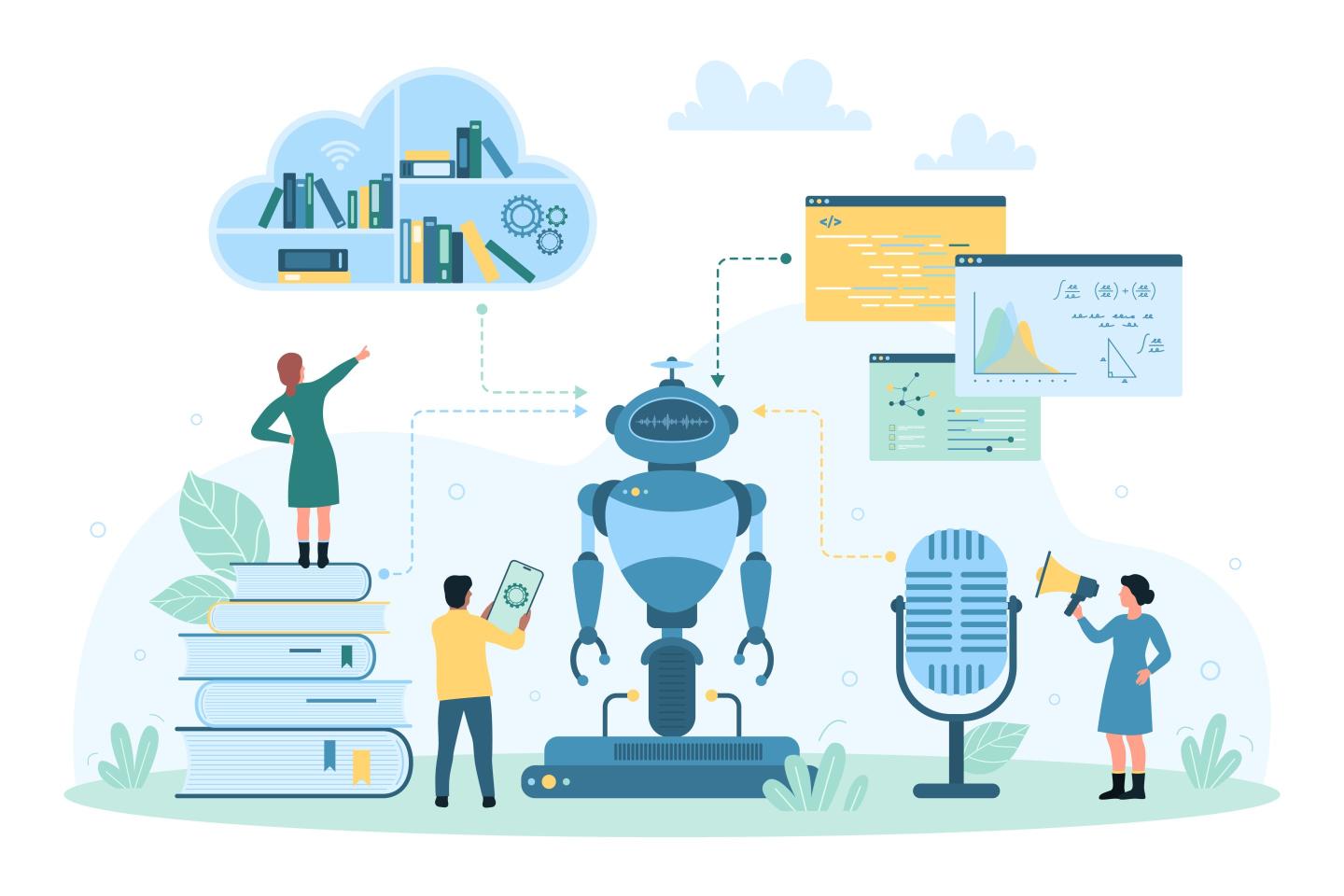
Organizations are complex systems composed of people who come and go, much like biological organisms are made up of individual cells that die and regenerate. But unlike biological systems, where each cell carries the organism’s full genetic code, institutional knowledge in organizations is fragmented: No single individual has the complete picture. For this reason, organizations invent mechanisms to capture, retain, and transmit knowledge, ensuring continuity, even as individuals cycle in and out. Lew Platt, former CEO of Hewlett-Packard, was right to lament: “If only HP knew what HP knows, we’d be three times more productive.”
It is no surprise then that the “knowledge management” market is projected to reach $2.5 trillion by 2030. This explosion in prospective value is due, in part, to the potential and progress of generative AI as a tool to excavate buried data and tacit knowledge, recontextualize it, and offer organizations not just a better understanding of their past, but a more coherent strategic vision of their future.
Today’s standard approaches to knowledge management in organizations are constrained by two limitations. First, they often fail to capture what may end up mattering most: The vast repositories of tacit knowledge that individuals seldom translate into neat, “final” documents. The reasoning behind key decisions, the context of near-misses and past actions, and the instincts that shaped an institution’s culture—these are the kinds of insights that quietly disappear, eroding an organization’s ability to learn from itself. Second, traditional systems are built on an assumption that organizations can anticipate what knowledge will be needed or useful in the future.
A recent artistic project led by our co-author, Zoé Vayssières, with Harvard University’s Digital Data Design Institute on the use of GenAI to uncover and inscribe Harvard’s early “memories” (based only on raw data, like salary records, not existing historical accounts) provides a powerful illustration of how technology can not only resurface institutional intelligence, but recontextualize it—making memory dynamic, discoverable, and usable in unpredictable, varying contexts.
This shift from static knowledge management to dynamic “memory management” unlocks new possibilities for complex organizations. Rather than relying on predefined categories, GenAI enables organizations to classify information at the point of retrieval, surfacing relevant insight based on the questions being asked, not the assumptions made at the time of storage. That responsiveness makes memory not just easier to access, but more actionable. This is not simply a technological shift, but a strategic one: For the first time, organizations can treat memory not just as something to preserve, but a resource to activate—turning accumulated experience into competitive advantage.
What memory is—and why organizations lose it
Organizational memory is often mistaken for record-keeping. But true memory is not just an archive of the past—it is the mechanism by which an institution gains coherence, speed, and resilience. It captures the values that influenced leadership and the drivers of critical decisions, and shortens the learning curve for new talent. Without it, companies can suffer “strategic amnesia”: repeating past mistakes and drifting culturally with every leadership change.
And yet, for all its importance, memory remains fragile. Unlike individual humans, organizations don’t remember “centrally”: Their memories must be constructed based on knowledge scattered across email threads, retired systems, untagged folders, and the minds of people who leave without being asked what they know. What gets recalled in an organization is often shaped by the structure of systems (e.g., performance metrics) built for documentation, not for understanding. At the same time, the softer forms of insight tend to vanish.
Ironically, the more data modern organizations generate, the more difficult it has become to retrieve meaningful insight: Companies are flooded with information yet starved for clarity. The real challenge is not lack of data, but the absence of context and the difficulty of purpose-specific recollection.
GenAI makes better institutional memory possible
Generative AI changes what is possible by unlocking what already exists, enabling organizations to interact with their unstructured archives at scale and ultimately remember more—unearthing forgotten insight, reconnecting scattered information, and exposing buried patterns.
In this sense, GenAI for memory management functions less like an organizational historian and more like a personalized corporate archaeologist: not recording something new from scratch but excavating what was already there. In doing this recovery and recontextualization, GenAI can provide a deeper understanding of the context of the relevant facts, going back to the “origin” of the data, or a decision, while also leaving it free to be reinterpreted in the future, based on the new context of that time. In the artistic project involving Harvard’s archives, GenAI models were used to analyze over 200 years of institutional records—some of them handwritten, inconsistent, or only partially digitized. The models surfaced overlooked institutional rules, social roles, and emotional registers that would have been challenging for even historians to uncover.
For example, an analysis of raw historical salary data revealed how organizational priorities can shift both suddenly and gradually. In 1752, Harvard’s president earned nearly two times more than the steward, charged with managing residential operations. But by 1779, amid wartime upheaval and soaring inflation, the steward’s salary had more than tripled while the president’s had declined—reflecting a shift in priorities during crisis.
Across a broader timespan, salary patterns also revealed the evolving value placed on different academic disciplines, with the sciences gradually overtaking theology in compensation—signaling a deeper transformation in the institution’s mission. For business leaders, these patterns offer a powerful reminder: In periods of transformation, it is often the informal shifts—rather than formal declarations—that reveal where influence resides, especially at first. GenAI can surface these hidden dynamics, helping organizations understand how they’ve historically adapted under pressure, and where culture and power may diverge from structure.
Another example: The resurfacing of women whose roles were instrumental in Harvard’s early development but are largely absent from traditional historical accounts. These contributions were not lost, rather they were historically deprioritized because they did not reflect what earlier generations sought to highlight. But when prompted with today’s context, GenAI surfaced rich detail about more than 10 key women (including Squaw Sachem, Anne Dudley Bradstreet, and Elizabeth Glover Dunster) whose influence had long gone unrecognized. The GenAI-enabled retrieval of these contributions challenges assumptions about who holds critical knowledge and what roles they play. In corporate settings, the same blind spots exist. GenAI enables organizations to revisit their own histories with fresh eyes and contemporary understanding, surfacing undervalued individuals, overlooked functions, or informal systems that quietly sustained performance.
Memory as a strategic use case for GenAI
While much of the attention around GenAI today has focused on automation and productivity, it has critical long-term value for operationalizing institutional memory as well. GenAI can power onboarding, strategy development, risk management, and more, with wide-ranging applications: surfacing overlooked experiments that may now make sense under new market conditions, connecting fragmented threads between business units, and identifying repeated but undocumented workarounds. In leadership transitions or onboarding, it can preserve informal know-how—not just how systems work, but how things get done.
A telling example comes from the French electrical distribution company Rexel, where an AI-powered sales tool designed to recommend next-best offers quickly became more than just a productivity enhancer. Newer employees relied on it for guidance, while experienced vendors used it to train the system—confirming or refining its suggestions. In doing so, each individual embedded their tacit knowledge into a tool that could support others. Over time, the platform evolved from a recommendation engine into a memory system, capturing expertise that might otherwise have walked out the door.
A similar dynamic is playing out in software development, where the AI agent CODAY—developed by Whoz—captures engineers’ tacit, undocumented problem-solving techniques and coding styles. As Whoz CEO Jean-Philippe Couturier explains, “By turning individual intuition into collective, reusable knowledge, CODAY transforms the most intangible aspects of expertise into organizational memory.” Put another way, the AI agent doesn’t just recover insight—it scales it.
When GenAI is used adroitly, organizations are able to reconstruct, reinforce, and project forward their core DNA. It can surface recurring instincts in decision-making, consistent tones in communication, and embedded values that have shaped the organization over time. By making legacy wisdom accessible, without idealizing it, GenAI can turn memory from a fixed repository into a dynamic, strategic asset: a platform for future action that helps organizations move forward with greater coherence and confidence.
A foundation for faster, smarter change
In periods of rapid transformation, organizations don’t just need to change—they need to change coherently. That coherence ensures that change is not only executed, but absorbed, aligned with the institution’s underlying culture, values, and strategic intent. As BCG research has shown, transformations frequently falter when they fail to account for the informal norms and shared assumptions that govern how work is truly done. In this context, memory becomes essential. It is the connective tissue that enables decisions to be fast, yet aligned with long-term values—reducing duplication, confusion, and drift. Without it, companies are left reacting in fragmented ways, losing sight not just of where they’ve been, but of who they are.
For leaders navigating change, this is both a powerful asset and a shift in context: the CEO is no longer the sole steward of the past or the lone narrator of the future. With institutional memory more accessible across the enterprise, leadership becomes less about carrying the full weight of continuity, and more about drawing from a shared source of insight. In this context, decisions gain traction not because they are imposed, but because they resonate with what the organization already knows and remembers. When employees understand the reasoning behind prior decisions, and how their organization has evolved, they engage not just with their role, but with the institution itself. Strategic memory becomes a tool for organizational cohesion, reducing informational asymmetries, fostering trust, and creating the conditions for more confident, aligned action at every level.
The value of GenAI as a “corporate archeologist” is not about looking backward. It’s about building strategic memory as infrastructure—no less critical than a CRM or data warehouse—which requires embedding memory into onboarding, leadership development, and decision-making. In an age of constant reinvention, memory is what ensures each reinvention is coherent. Strategic memory, therefore, isn’t just a record of the past, it’s an investment in the quality of future decisions, a critical source of competitive advantage.
Read other Fortune columns by François Candelon.
Some of the companies mentioned in this column are past or present clients of the authors’ employers.