• Home
  • Latest
  • Fortune 500
  • Finance
  • Tech
  • Leadership
  • Lifestyle
  • Rankings
  • Multimedia
EconomyTariffs and trade

NY Federal Reserve finds a ‘significant share’ of companies saying they raised prices on goods not affected by tariffs

Sasha Rogelberg
By
Sasha Rogelberg
Sasha Rogelberg
Reporter
Down Arrow Button Icon
Sasha Rogelberg
By
Sasha Rogelberg
Sasha Rogelberg
Reporter
Down Arrow Button Icon
June 5, 2025, 2:49 PM ET
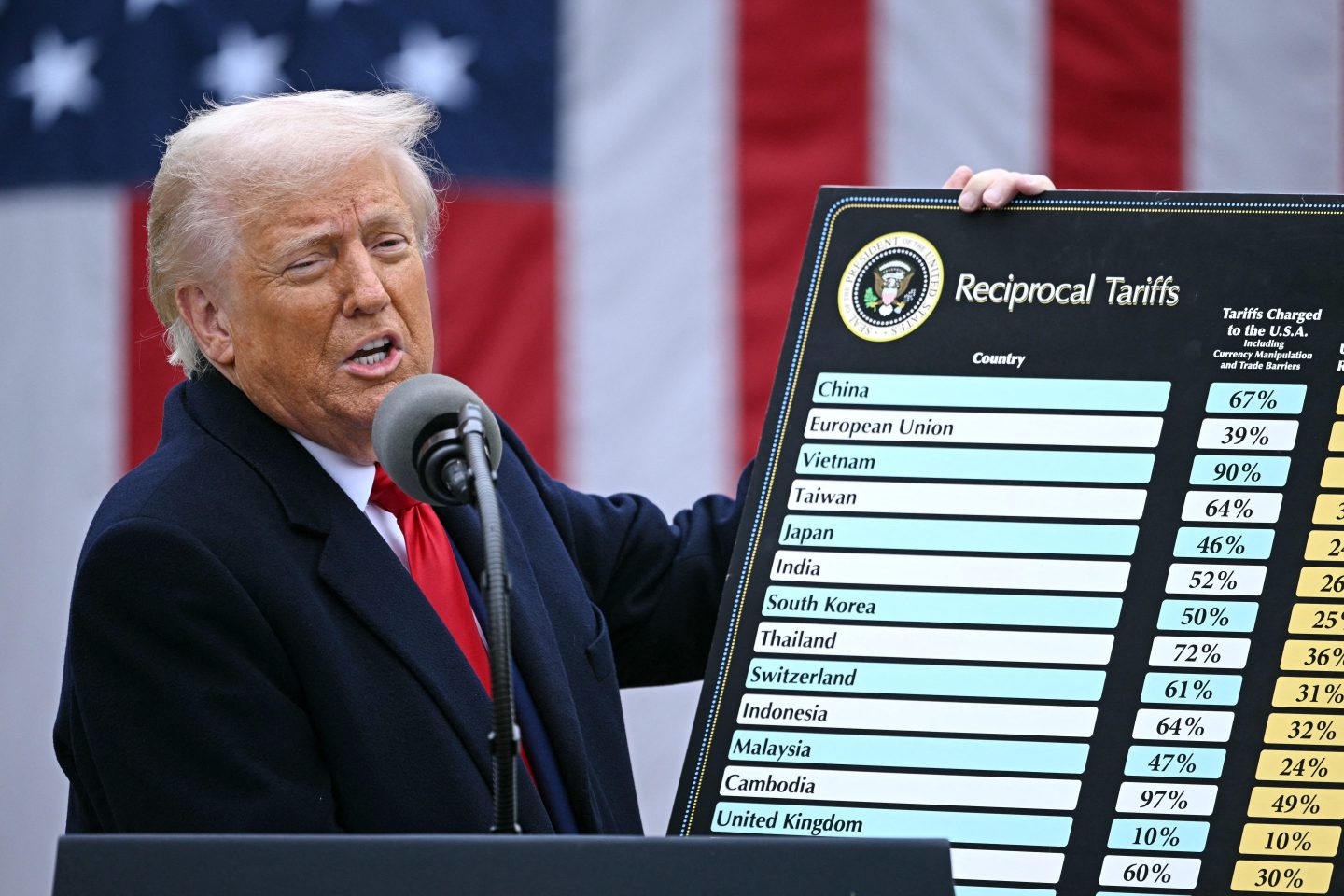
Trump speaks behind a podium while holding up a sign listing reciprocal tariffs.
A New York Federal Reserve survey finds most companies have passed down tariff-induced costs to consumers in some form.BRENDAN SMIALOWSKI/AFP—Getty Images
  • As businesses pass down the cost of tariffs to consumers in the form of raised prices, the New York Federal Reserve found that as of last month, many businesses were also raising prices on products unaffected by the levies. Economists said these pricing choices are taking advantage of the uncertainty of unpredictable tariffs, but could worsen the potential for inflation. 

Not only are companies ratcheting up prices of imported products to offset the cost of tariffs, they’re also raising the cost of goods unaffected by those taxes, a New York Federal Reserve survey and Beige Book report released Wednesday found.

Recommended Video

​​The survey was administered to about 110 manufacturers and more than 200 service firms in New York and New Jersey between May 2 and May 9. At the time, Trump had not yet reduced tariffs on China from 145% to 30%. An increase on levies for steel and aluminum from 25% to 50% went into effect on Wednesday.

The Trump administration is also preparing for a Supreme Court showdown on the constitutionality of the tariffs, following a U.S. court back-and-forth on whether the president had the authority to impose the taxes.

A “significant share” of companies surveyed by the Fed in early May said they increased prices of products not impacted by President Donald Trump’s sweeping levies, part of a strategy to brace for the wider impact of the taxes.

“A heavy construction equipment supplier said they raised prices on goods unaffected by tariffs to enjoy the extra margin before tariffs increased their costs,” the Beige Book report said.

Economists largely expected the tariffs to result in price hikes for businesses that are unable or unwilling to take a hit to profit margins, choosing instead to pass down the increased cost to customers, a tactic the Congressional Budget Office warned could be inflationary. 

The NY Federal Reserve survey confirmed companies’ pricing intentions, with “most businesses” passing down at least some of the tariff costs in the form of higher prices, and about one-third of manufacturers and 45% of service companies “fully passing along” the price increases. 

Price increases under the “cover of uncertainty“

Economists warn the strategy of increasing prices across the board, even on products unaffected by tariffs, could be an indication of companies feeling the pressure to manage continued economic uncertainty.

“[It could be] generic unpredictability. Taking advantage of a general inflationary environment could be another reason,” Susan Ariel Aaronson, research professor at George Washington University’s Elliott School of International Affairs, told Fortune. “No one knows what Trump is going to raise tariffs on or other trade barriers tomorrow. There is no consistency or predictability to his approach to trade, and the approach is not transparent, nor is it really motivated by market conditions.”

When companies feel the need to raise prices of a wider range of products in response to tariffs, “it’s making the potential of inflation ever greater,” Aaronson added.

Companies considering price increases will do so under this “cover of uncertainty,” according to Rebecca Homkes, lecturer at the London Business School and faculty at Duke Corporate Executive Education. 

“We are going to see some companies try to do some stuff that maybe they’ve been sitting on,” she told Fortune. “Maybe you’re going to do layoffs, maybe you’re going to cut a product, maybe you’re going to raise the price on something you were just a little bit hesitant about.” 

With so much uncertainty—and companies only able to make so many price changes per year—part of the decision to hike prices on a wide array of products may also have to do with trying to predict what products future tariffs could be imposed on, Homkes said. In other cases, businesses will consider what products customers order together. If one of those products is tariffed, but another isn’t, that company may still choose to raise the price of both products.

Homkes argues these price increases, though a hit to consumers, are a last resort for companies and take place only after a company has exhausted other options like absorbing costs.

“You have to pass these costs through,” Homkes said. “If they don’t pass these costs through, what does that lead to? That leads to less inputs, less hiring, including the need to lay off. So they’re taking all these variables into account.”


Join us at the Fortune Workplace Innovation Summit May 19–20, 2026, in Atlanta. The next era of workplace innovation is here—and the old playbook is being rewritten. At this exclusive, high-energy event, the world’s most innovative leaders will convene to explore how AI, humanity, and strategy converge to redefine, again, the future of work. Register now.
About the Author
Sasha Rogelberg
By Sasha RogelbergReporter
LinkedIn iconTwitter icon

Sasha Rogelberg is a reporter and former editorial fellow on the news desk at Fortune, covering retail and the intersection of business and popular culture.

See full bioRight Arrow Button Icon

Latest in Economy

BankingHousing
Why Jerome Powell’s latest rate cut still won’t help you get a lower mortgage rate
By Sydney LakeDecember 11, 2025
8 hours ago
Rich couple making a toast with champagne glasses while eating aboard a private jet.
SuccessWealth
What it takes to be wealthy in America: $2.3 million, Charles Schwab says
By Sydney LakeDecember 11, 2025
9 hours ago
Sarandos
CommentaryAntitrust
Netflix’s takeover of Warner Brothers is a nightmare for consumers
By Ike BrannonDecember 11, 2025
10 hours ago
Powell
EconomyFederal Reserve
Trump slams Fed’s third-straight rate cut as ‘too small,’ saying he wishes it was twice as large
By Christopher Rugaber and The Associated PressDecember 11, 2025
10 hours ago
senate
EconomyCongress
Senate fails to save millions from skyrocketing ACA premiums in new year, with Republicans never meaningfully engaging
By Mary Clare Jalonick and The Associated PressDecember 11, 2025
12 hours ago
Trump
Economyaffordability
Less than a third of Americans approve of Trump’s handling of the economy, lowest in either term
By Linley Sanders, Will Weissert and The Associated PressDecember 11, 2025
12 hours ago

Most Popular

placeholder alt text
Success
At 18, doctors gave him three hours to live. He played video games from his hospital bed—and now, he’s built a $10 million-a-year video game studio
By Preston ForeDecember 10, 2025
2 days ago
placeholder alt text
Economy
‘Be careful what you wish for’: Top economist warns any additional interest rate cuts after today would signal the economy is slipping into danger
By Eva RoytburgDecember 10, 2025
1 day ago
placeholder alt text
Politics
Exclusive: U.S. businesses are getting throttled by the drop in tourism from Canada: ‘I can count the number of Canadian visitors on one hand’
By Dave SmithDecember 10, 2025
1 day ago
placeholder alt text
Investing
Baby boomers have now 'gobbled up' nearly one-third of America's wealth share, and they're leaving Gen Z and millennials behind
By Sasha RogelbergDecember 8, 2025
3 days ago
placeholder alt text
Success
Netflix–Paramount bidding wars are pushing Warner Bros CEO David Zaslav toward billionaire status—he has one rule for success: ‘Never be outworked’
By Preston ForeDecember 10, 2025
1 day ago
placeholder alt text
Uncategorized
Transforming customer support through intelligent AI operations
By Lauren ChomiukNovember 26, 2025
15 days ago
Rankings
  • 100 Best Companies
  • Fortune 500
  • Global 500
  • Fortune 500 Europe
  • Most Powerful Women
  • Future 50
  • World’s Most Admired Companies
  • See All Rankings
Sections
  • Finance
  • Leadership
  • Success
  • Tech
  • Asia
  • Europe
  • Environment
  • Fortune Crypto
  • Health
  • Retail
  • Lifestyle
  • Politics
  • Newsletters
  • Magazine
  • Features
  • Commentary
  • Mpw
  • CEO Initiative
  • Conferences
  • Personal Finance
  • Education
Customer Support
  • Frequently Asked Questions
  • Customer Service Portal
  • Privacy Policy
  • Terms Of Use
  • Single Issues For Purchase
  • International Print
Commercial Services
  • Advertising
  • Fortune Brand Studio
  • Fortune Analytics
  • Fortune Conferences
  • Business Development
About Us
  • About Us
  • Editorial Calendar
  • Press Center
  • Work At Fortune
  • Diversity And Inclusion
  • Terms And Conditions
  • Site Map

© 2025 Fortune Media IP Limited. All Rights Reserved. Use of this site constitutes acceptance of our Terms of Use and Privacy Policy | CA Notice at Collection and Privacy Notice | Do Not Sell/Share My Personal Information
FORTUNE is a trademark of Fortune Media IP Limited, registered in the U.S. and other countries. FORTUNE may receive compensation for some links to products and services on this website. Offers may be subject to change without notice.