• Home
  • Latest
  • Fortune 500
  • Finance
  • Tech
  • Leadership
  • Lifestyle
  • Rankings
  • Multimedia
FinanceBanks

Banks are sitting on $500 billion in unrealized losses, and stagflation could cause another Silicon Valley Bank-like crisis

By
Greg McKenna
Greg McKenna
News Fellow
Down Arrow Button Icon
By
Greg McKenna
Greg McKenna
News Fellow
Down Arrow Button Icon
May 14, 2025, 1:05 PM ET
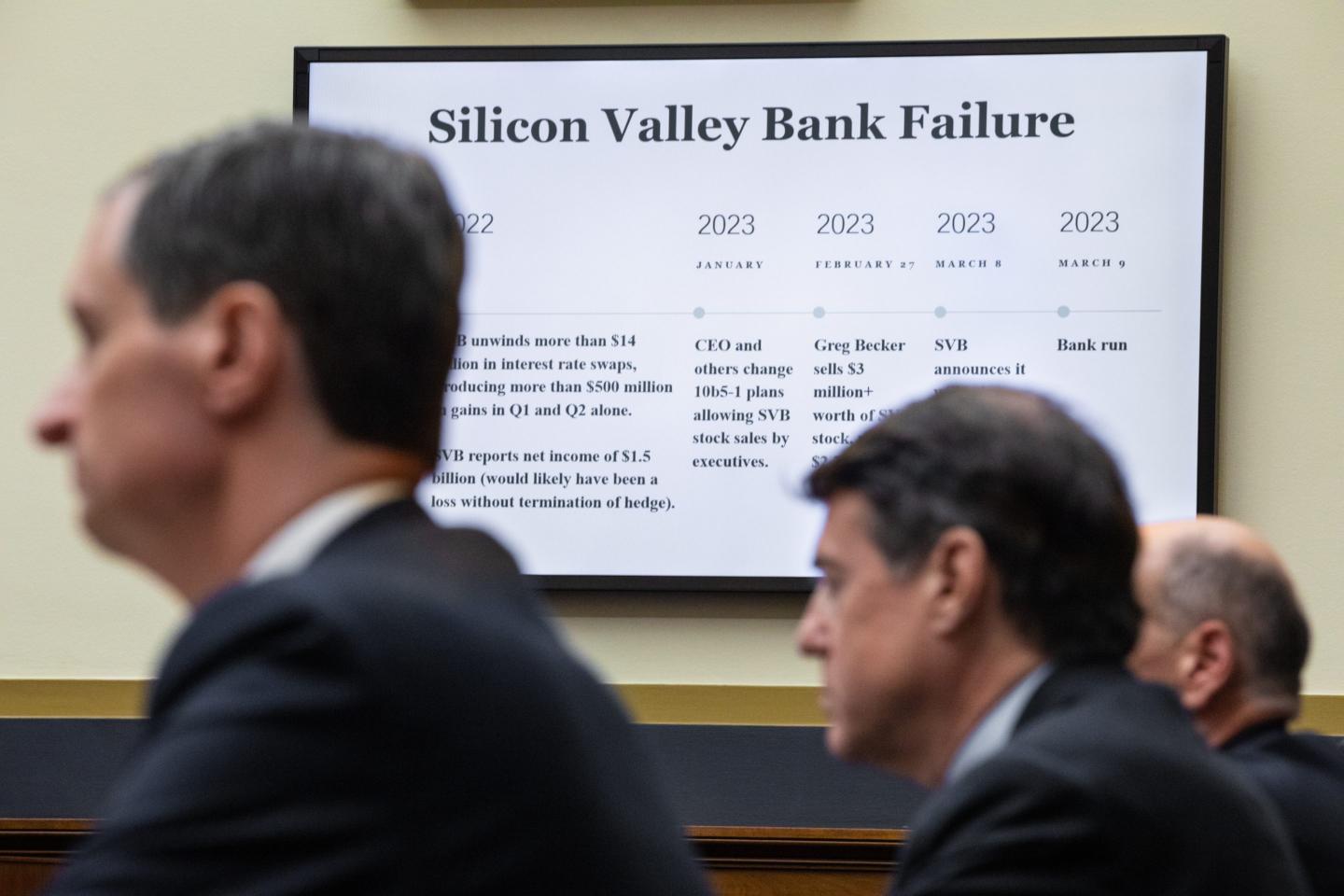
A timeline depicting the failure of Silicon Valley Bank displayed during a House Financial Services Committee hearing in Washington, DC, US, on Wednesday, May 17, 2023.
The failure of Silicon Valley Bank drew intense scrutiny on Capitol Hill. Anna Rose Layden—Bloomberg via Getty Images
  • Banks got caught “chasing yield” and took big losses when the Federal Reserve dramatically hiked interest rates to fight inflation. Those losses are still hanging around, and several experts told Fortune many core issues from the 2023 banking crisis pose a continued threat to the system if economic conditions deteriorate.

Just over two years after the collapse of Silicon Valley Bank and First Republic, banks are still taking big losses thanks to high interest rates. That’s cause for major concern, several experts told Fortune, especially if President Donald Trump’s tariffs lead to the dreaded combination of “stagflation,” or rising inflation coupled with slowing growth, putting further pressure on lenders.

Recommended Video

U.S. banks held $482.4 billion in total unrealized losses on securities investments at the end of 2024, according to Federal Deposit Insurance Corporation data, an increase of $118 billion, or 32.5%, from the previous quarter. That number had risen to $515 billion when SVB fell victim to a bank run in March 2023 and peaked at $684 billion later that year. Data for the first quarter of 2025 is expected later this week, but April’s spike in bond yields means any reprieve in the first three months of the year was likely short-lived.  

These unrealized losses don’t show up on a bank’s income statement unless the assets are sold, but they represent a looming threat to liquidity if depositors get spooked, said Rebel Cole, a finance professor at Florida Atlantic University who worked for a decade in the Federal Reserve System.

“All it takes is one bad news story about any of these banks, and we could have another banking crisis like we had in March of [2023],” Cole, who has served as a special adviser to the International Monetary Fund and World Bank, told Fortune. “I’m amazed we haven’t had one since then.”

There’s an easy explanation for the chart above: When long-term interest rates spike, the value of assets like similarly long-dated U.S. debt or residential mortgage-backed securities declines.

Bank losses essentially have been fluctuating with the benchmark 10-year Treasury yield, Cole said, which has been on a wild ride in 2025 amid the Trump administration’s chaotic tariff rollout. It currently sits above 4.5%, approaching its high in the fourth quarter.

At that level, the banking system starts “seeing serious problems,” Amit Seru, a finance professor at the Stanford Graduate School of Business, said in an email statement to Fortune.

“It becomes quite bad at 5%,” added Seru, a senior fellow at the university’s Hoover Institution, a conservative-leaning think tank.

Cole said that would equate to roughly $600 billion to $700 billion in unrealized investment losses.

As the chart shows, many of those securities are designated as being “held-to-maturity.” Since they are not intended to be sold, changes in their market value are not reflected directly on the banks’ financial statements and are instead disclosed in balance sheet notes.

However, if lenders are forced to offload some of those investments, Cole said, then the entire portfolio must be marked to market. That means these technically liquid assets become, for the banks’ purposes, exactly the opposite.

“It’s like a rock hanging over the neck of the banks,” Cole said.

Meanwhile, losses on securities deemed “available-for-sale” are recorded on the financial statements, but do not hit earnings unless assets are sold. For Cole, the distinction makes little difference. The rapid demise of SVB, he noted, came after the bank announced it would take a $2 billion loss on the sale of available-for-sale securities.

“Three days later, they were closed,” Cole said.

Next banking crisis just needs ‘one spark’

The failure of the tech industry’s preeminent lender sent shockwaves through the financial system and symbolized the folly of crudely “chasing yield.” When interest rates went to zero during the COVID-19 pandemic, holding a portion of deposits in short-term U.S. Treasury bills provided little return.

In search of a bit more upside, banks looked further down the yield curve, pumping more than $2 trillion into investment securities like long-term U.S. Treasuries (considered “risk-free” assets, if held to full repayment), mortgage-backed securities, and similar assets.

In 2022, the Fed first insisted it would only raise interest rates slightly to address what it deemed to be “transitory” inflation. Instead, price growth surged to four-decade highs, and the central bank was forced to dramatically hike the federal funds rate from roughly 0% in March 2022 to more than 4.5% a year later.

SVB, which had invested more than 90% of its held-to-maturity portfolio in mortgage-backed securities, municipal bonds, and Treasuries with maturities of more than 10 years, became the second-largest bank to fail in U.S. history. Less than two months later, First Republic would overtake SVB on that list.

Despite Fed intervention to make uninsured depositors whole and the acquisitions of both banks, the scars of the crisis and its ripple effects still linger.

SVB’s fragility snuck up on regulators. They’ve since become much more attuned to problems related to interest-rate risk and depositor flight, Seru said. But many of the core issues persist, he added, as capital requirements still largely ignore unrealized losses on securities and loans, while hedging strategies remain limited across much of the banking system.

“So while we may not see another crisis exactly like SVB’s, the ingredients for stress are still present—especially if macroeconomic conditions deteriorate,” Seru wrote.

And as long as interest rates remain high, losses banks accumulated during the crisis are still hanging around.

“In a stagflation scenario, the risk is that rates will be higher for longer and credit losses will begin to accumulate, in particular for lenders to tech, growth, and [venture capital], where borrowers are characterized by having no earnings and low coverage ratios,” Torsten Sløk, chief economist at private equity giant Apollo Global Management, wrote in a note Monday.  

Cole, meanwhile, said he sees additional pressure coming from a looming crisis in commercial real estate, leaving banks increasingly vulnerable if investment losses put them under pressure. He said he’s especially worried about regional and super-regional banks with $10 billion to $200 billion in assets, many of which are public companies with major exposure to depositors with holdings above the FDIC’s $250,000 limit for insurance.

“They can’t meet one of those runs if they have any unrealized losses on their securities portfolio,” Cole said. “Then they’ll have to mark that to market, and the regulators will close them.”

In short, banks face a “nightmare scenario” and are sitting on a “tinderbox.”

“And it’s just going to take one spark,” Cole said.

Join us at the Fortune Workplace Innovation Summit May 19–20, 2026, in Atlanta. The next era of workplace innovation is here—and the old playbook is being rewritten. At this exclusive, high-energy event, the world’s most innovative leaders will convene to explore how AI, humanity, and strategy converge to redefine, again, the future of work. Register now.
About the Author
By Greg McKennaNews Fellow
LinkedIn icon

Greg McKenna is a news fellow at Fortune.

See full bioRight Arrow Button Icon

Latest in Finance

Finance
Lorem ipsum dolor sit amet, consectetur adipiscing elit, sed do eiusmod tempor incididunt ut labore et dolore magna aliqua. Ut enim ad minim veniam
By Fortune Editors
October 20, 2025
Finance
Lorem ipsum dolor sit amet, consectetur adipiscing elit, sed do eiusmod tempor incididunt ut labore et dolore magna aliqua. Ut enim ad minim veniam
By Fortune Editors
October 20, 2025
Finance
Lorem ipsum dolor sit amet, consectetur adipiscing elit, sed do eiusmod tempor incididunt ut labore et dolore magna aliqua. Ut enim ad minim veniam
By Fortune Editors
October 20, 2025
Finance
Lorem ipsum dolor sit amet, consectetur adipiscing elit, sed do eiusmod tempor incididunt ut labore et dolore magna aliqua. Ut enim ad minim veniam
By Fortune Editors
October 20, 2025
Finance
Lorem ipsum dolor sit amet, consectetur adipiscing elit, sed do eiusmod tempor incididunt ut labore et dolore magna aliqua. Ut enim ad minim veniam
By Fortune Editors
October 20, 2025
Finance
Lorem ipsum dolor sit amet, consectetur adipiscing elit, sed do eiusmod tempor incididunt ut labore et dolore magna aliqua. Ut enim ad minim veniam
By Fortune Editors
October 20, 2025

Most Popular

Finance
Lorem ipsum dolor sit amet, consectetur adipiscing elit, sed do eiusmod tempor incididunt ut labore et dolore magna aliqua. Ut enim ad minim veniam
By Fortune Editors
October 20, 2025
Finance
Lorem ipsum dolor sit amet, consectetur adipiscing elit, sed do eiusmod tempor incididunt ut labore et dolore magna aliqua. Ut enim ad minim veniam
By Fortune Editors
October 20, 2025
Finance
Lorem ipsum dolor sit amet, consectetur adipiscing elit, sed do eiusmod tempor incididunt ut labore et dolore magna aliqua. Ut enim ad minim veniam
By Fortune Editors
October 20, 2025
Finance
Lorem ipsum dolor sit amet, consectetur adipiscing elit, sed do eiusmod tempor incididunt ut labore et dolore magna aliqua. Ut enim ad minim veniam
By Fortune Editors
October 20, 2025
Finance
Lorem ipsum dolor sit amet, consectetur adipiscing elit, sed do eiusmod tempor incididunt ut labore et dolore magna aliqua. Ut enim ad minim veniam
By Fortune Editors
October 20, 2025
Finance
Lorem ipsum dolor sit amet, consectetur adipiscing elit, sed do eiusmod tempor incididunt ut labore et dolore magna aliqua. Ut enim ad minim veniam
By Fortune Editors
October 20, 2025
Fortune Secondary Logo
Rankings
  • 100 Best Companies
  • Fortune 500
  • Global 500
  • Fortune 500 Europe
  • Most Powerful Women
  • World's Most Admired Companies
  • See All Rankings
  • Lists Calendar
Sections
  • Finance
  • Fortune Crypto
  • Features
  • Leadership
  • Health
  • Commentary
  • Success
  • Retail
  • Mpw
  • Tech
  • Lifestyle
  • CEO Initiative
  • Asia
  • Politics
  • Conferences
  • Europe
  • Newsletters
  • Personal Finance
  • Environment
  • Magazine
  • Education
Customer Support
  • Frequently Asked Questions
  • Customer Service Portal
  • Privacy Policy
  • Terms Of Use
  • Single Issues For Purchase
  • International Print
Commercial Services
  • Advertising
  • Fortune Brand Studio
  • Fortune Analytics
  • Fortune Conferences
  • Business Development
  • Group Subscriptions
About Us
  • About Us
  • Press Center
  • Work At Fortune
  • Terms And Conditions
  • Site Map
  • About Us
  • Press Center
  • Work At Fortune
  • Terms And Conditions
  • Site Map
  • Facebook icon
  • Twitter icon
  • LinkedIn icon
  • Instagram icon
  • Pinterest icon

Latest in Finance

ExxonMobil CEO Darren Woods, far right, listens as U.S. President Donald Trump,left, speaks during a meeting with oil company executives in the East Room of the White House on Jan. 9. President Trump is aiming to convince oil executives to support his plans in Venezuela, a country whose energy resources he says he expects to control for years to come. US forces seized Venezuelan president Nicolas Maduro in a sweeping military operation on January 3, with Trump making no secret that control of Venezuela's oil was at the heart of his actions.
EnergyIran
Exxon Mobil CEO sees ‘more to come’ on price spikes from Iran war as Exxon, Chevron beat on earnings despite plunging profits
By Jordan BlumMay 1, 2026
60 minutes ago
trump
PoliticsIran
Trump on Iran: ‘They want to make a deal, I’m not satisfied with it, so we’ll see what happens’
By Toqa Ezzidin, Munir Ahmed, Collin Binkley and The Associated PressMay 1, 2026
3 hours ago
infantino
North AmericaWorld Cup
Fifa’s Infantino predicted sellouts and ‘1,000 years of World Cups at once,’ but fans aren’t biting
By James Robson and The Associated PressMay 1, 2026
3 hours ago
cox
C-SuiteWealth
Billionaires have a problem money can’t solve: They don’t know how to talk to their kids
By Nick LichtenbergMay 1, 2026
3 hours ago
trump
EconomyTariffs
Trump says he’ll hike EU auto tariffs to 25%, jolting a world economy that really didn’t need it
By Josh Boak and The Associated PressMay 1, 2026
3 hours ago
male engineer working under pylon
EnergyElectricity
Utility CEOs pocket $626 million as American energy bills hit record highs
By Tristan BoveMay 1, 2026
3 hours ago

Most Popular

Scott Bessent on financial literacy: 'it drives me crazy' to see young men in blue-collar construction jobs playing the lottery
Personal Finance
Scott Bessent on financial literacy: 'it drives me crazy' to see young men in blue-collar construction jobs playing the lottery
By Fatima Hussein and The Associated PressMay 1, 2026
9 hours ago
China dominates the world's lithium supply. The U.S. just found 328 years' worth in its own backyard
North America
China dominates the world's lithium supply. The U.S. just found 328 years' worth in its own backyard
By Jake AngeloApril 30, 2026
1 day ago
The U.S. economy is booming — just not where 50 million Americans live
Commentary
The U.S. economy is booming — just not where 50 million Americans live
By Derek KilmerMay 1, 2026
13 hours ago
Accenture's Julie Sweet blew up 50 years of company history. She says the hardest part is still ahead
Conferences
Accenture's Julie Sweet blew up 50 years of company history. She says the hardest part is still ahead
By Nick LichtenbergApril 29, 2026
2 days ago
Apple cofounder Ronald Wayne—whose stake would be worth up to $400 billion had he not sold it in 1976—says that at 91, he has no regrets
Success
Apple cofounder Ronald Wayne—whose stake would be worth up to $400 billion had he not sold it in 1976—says that at 91, he has no regrets
By Preston ForeApril 27, 2026
4 days ago
Exclusive: America's largest Black-owned bank launches podcast with mission to unlock hidden shame holding back generational wealth
Banking
Exclusive: America's largest Black-owned bank launches podcast with mission to unlock hidden shame holding back generational wealth
By Nick LichtenbergApril 29, 2026
2 days ago

© 2026 Fortune Media IP Limited. All Rights Reserved. Use of this site constitutes acceptance of our Terms of Use and Privacy Policy | CA Notice at Collection and Privacy Notice | Do Not Sell/Share My Personal Information
FORTUNE is a trademark of Fortune Media IP Limited, registered in the U.S. and other countries. FORTUNE may receive compensation for some links to products and services on this website. Offers may be subject to change without notice.