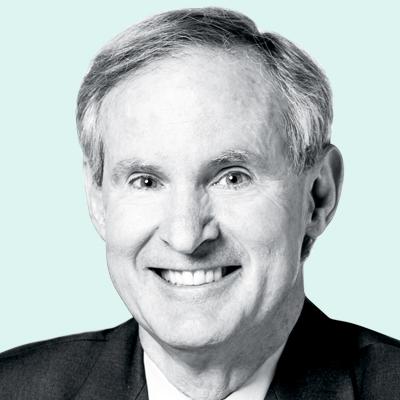

Larry Summers was not assuaged by Trump’s tariff pause.
The former Treasury secretary under Bill Clinton has a history of making prescient calls on the economy, and his views have always carried great weight with policymakers. Over two wide-ranging interviews with Fortune, he spoke candidly about President Trump’s recent moves and what he sees happening in the economy. Put simply, the issues he raises should alarm anyone who owns stocks or bonds, frets over spiking grocery prices, or is shopping for a home loan.
“Even with the pullback of the reciprocal tariffs, we have the highest tariffs in 100 years. The incremental tariffs are 10x those in Trump’s first administration,” Summers told me. He added that the tariff offensive is making the U.S. a far less welcoming place for foreign investment—a status that we must maintain to finance our capital spending and federal borrowing at low interest costs. “If you thought you’d wait until things settle down before investing in the U.S., nothing that happened [on April 9] would talk you out of that view,” he said.
Here are some excerpts from our spirited conversation which included everything from madness in the bond market to whether DOGE will work.
On the bond market
A big red flag for Summers is the turmoil in the bond market that started the day before Trump made his retreat. “I do think that the aberrant pattern in which long-term Treasuries were moving speaks to a very concerning situation in which the U.S. assets are trading more like those of an emerging market nation than those of nation with the world’s reserve currency,” Summers told me. “The fact that when they perceive more risk people are moving out of instead of into U.S. long-term bonds raises substantial concerns, and raises possibility of a [negative] government funding episode.”
On the first signs of recession
Summers noted that we’re already seeing the first signals of a possible recession. “Confidence indicators are declining quite sharply,” he stated. “And we see businesses sharply delaying investment because of uncertainty.”
Summers hammered home that the downturn would be both self-inflicted and probably severe, adding: “This is our first ‘iatrogenic’ recession. That’s an illness that occurs when you go to the hospital and get sick from the hospital, not from a preexisting condition, and avoiding it is a preoccupation of medical people. In the past, we’ve seen meltdowns from the failure of particular firms like Lehman Brothers, or from external events such as the Asian financial crisis or that have come from business cycle dynamics, such as in the 1929 market drop and onset of the Depression.
“This is the first time where sharp market downturns are the direct result of statements that the U.S. federal government in general and the president in particular have made. You can track very clearly over the past few days that every time people sense that tariffs will stay on, the market goes down, and every time people sense that the [government] is relenting, the market goes up.”
On what he sees as deep contradictions in the Trump tariff plan
Treasury Secretary Scott Bessent has said that the Trump tariffs are like a “melting ice cube” that would gradually decline as protections strengthen U.S. manufacturing and create new jobs. That dynamic, he said, would create a surge in tax revenues that, “in symmetry,” could replace funds from tariffs.
Summers is baffled by that thinking. “I have been exposed to a lot of economic theories in my time,” he declared. “I have not been able to relate much of what Bessent and his colleagues are saying to any school of economic thought. The administration’s arguments suggesting that tariffs can somehow be simultaneously a crowbar and a revenue source are very hard for me to understand. If the tariffs are not permanent, why will any business relocate a long-term facility to the U.S.? I am struck by this substantial contradiction. You can’t credibly promise to remove them with concessions. That’s the tension at the heart of the program. And if they are permanent won’t they be a lasting burden in terms of higher prices for American consumers?”
Summers also doubts that the Trump tariff blueprint, not to mention its high toll on the overall economy, will do much to achieve its stated goal of raising employment in manufacturing. “In today’s economy, manufacturing is so capital intensive and the productivity of manufacturing is so high that any employment impacts are likely to be small [and won’t justify the cost of tariffs]. Only 4% of U.S. workers are doing production work in manufacturing. That number is trending rapidly downwards, not just in the U.S. but also in huge manufacturing surplus countries like Germany. To say it can be lifted to 6% is a chimera.”
Summers takes a dim view of the way the administration determined the level of “reciprocal” tariffs to impose on its trading partners. The formula appears to hinge on adding to the existing tariffs a large percentage based on the size of our trade deficits with each nation; the administration hasn’t explained how those numbers relate to the cost of “indirect trade barriers” the added duties are supposed to represent and “reciprocate” for. “I find that any notion you can engage in a reciprocal formula that pays no attention to the tariffs of the countries you’re reciprocating against to be extraordinarily bizarre,” says Summers. “No external economist sees logic in the president’s approach.”
He went on to blast the so-called Mar-a-Lago Accord—designed to simultaneously impose tariffs and devalue the dollar—that many are calling the ideological bedrock of the Trump approach to trade. “I find the Mar-a-Lago Accord a bizarre conceit, a narcissistic conceit, rather than a serious policy approach that other countries might subscribe to,” stated Summers.
The confusion, he adds, extends to the three-way duel among Trump’s top advisors. “I’m struck by the substantial contradiction between what’s said by Peter Navarro, who’s located in the White House and appears to be in a position of substantial influence, and Bessent. They have divergent perspectives, and Musk has another divergent perspective. Gauging whom Trump is listening to is a moving target.”
On Elon Musk’s DOGE campaign
In 2021, Summers strongly advocated for additional Internal Revenue Service enforcement as one of the best ways to raise revenue for the Treasury. The Biden administration subsequently secured large increases in funding for enforcement and hiring new agents. Now, Summers sees another contradiction in Elon Musk’s campaign to cut federal spending and his attack on the IRS.
“Musk’s DOGE will lose more government revenue by attacking the IRS than it’s likely to gain by whatever austerity it achieves,” says Summers. “Whatever austerity it achieves, because it’s not legislated, is likely to be transient. You can’t look to DOGE as a deficit reducer.” Summers also believes that keeping the income tax reductions Trump won in his first term will be another deficit inflator. “I think that the proposals of Republicans in the Senate to call to extend the tax cuts as a non-cost item because they are already in place is Enron-level accounting. They were never paid for when put in place. Now when they’re extended, they won’t be paid for. It’s a passport to fiscal ruin. I don’t see how you can protect entitlements, as the president vows to do, and extend $4 billion of previous Trump tax cuts and enact well over $1 trillion in new Trump tax cuts and strike deals all over on tariffs and not substantially increase the unacceptable federal debt problems.”
On tariffs as a way to raise revenue
On April 8 at a National Republican Congressional Committee dinner in Washington, D.C., President Trump boasted that the newly imposed tariffs are already pouring $2 billion a day into the U.S. Treasury. For Summers, heaping duties on imports are just about the most growth-depressing, average-citizen-gouging of all forms of taxation. “Tariffs are regarded as a terrible source of revenue,” he told me. “They’re regressive, like sales taxes. Consumption relative to income is higher for poorer people. You’re discriminating between producers with different kinds of production models, whether they rely on imported or domestically produced components. Discriminating between the kinds of goods we import and what we do domestically. They distort on far more economic activity than any other kind of tax. Technical advisors from the U.S. advising other governments recommend that they de-emphasize tariffs.”
On free trade
Summers concluded by extolling the advantages of free trade, and spotlighting the fallacy that America’s been badly and naively exploited as Trump claims: “It’s fair to say in general the right project is trying to bring down trade barriers, except in national-security-sensitive areas,” he avowed. “If we do that we’ll maximize people’s productive power. They can buy the cheapest goods and take advantage of the strength of America by selling more abroad.”
“The broad philosophy animating the Trump policy that someone in the US is a major victim of history doesn’t correspond to my sense of reality,” Summers declared. “My experience has been that for economic opportunity, I’d rather have been an American over the last several decades than a European or a Japanese, and that we have a better hand to play than any other nation. Even a terrific hand can be misplayed, and I’m afraid that’s what happened.”