As the price of fuel soared in Ethiopia earlier this year, Awgachew Seleshi decided to buy an electric car. That aligned with the government’s new efforts to phase out gas-powered vehicles. But months later, he’s questioning whether it was the right decision.
He faces a range of issues, from the erratic supply of electricity in Addis Ababa, the capital, to the scarcity of spare parts.
“Charging my car has been a challenge,” the civil servant said. “Spare parts that are imported from China are expensive, few mechanics are able to fix such cars and the resale value of such cars is poor.”
Seleshi’s troubles point to wider challenges for Ethiopia. In January, the East African country became the first in the world to ban the importation of non-electric private vehicles.
The decision eased pressure on authorities who spend scarce foreign currency to subsidize the cost of fuel, but it also reflected growing enthusiasm for electric vehicles as the world demands more green technologies to reduce climate-changing emissions.
Earlier this month, Ethiopia’s government raised the price of fuel by up to 8% as part of a plan to gradually end all fuel subsidies in Africa’s second-most populous country.
Authorities have claimed some success in enforcing the ban on non-electric vehicles entering Ethiopia, and more than 100,000 electric cars are now being imported into the country each month.
The official target is to increase the monthly import figure to 500,000 by 2030. By that time, a big new dam Ethiopia has built on the Nile River is expected to be producing power at full capacity.
Ethiopian Prime Minister Abiy Ahmed, in a televised address earlier this year, said the Grand Renaissance Dam will start generating more than 5,000 megawatts of electric power within a year. Authorities say such capacity would support the transition to electric vehicles.
For now, many in Addis Ababa, a city of more than 5 million people, are doubtful the country can achieve its ambitious goals for electric vehicles without further needed infrastructure and services.
The few garage owners who can fix broken electric cars say they are overwhelmed, while customers say they are being overcharged amid an apparent lack of competition.
“There are two or three garages that can fix new energy vehicles in Ethiopia and many consumers lack awareness on how to take care of such vehicles,” said Yonas Tadelle, a mechanic in Addis Ababa. “As mechanics, we also lack the tools, the spare parts and the know-how to fix such cars.”
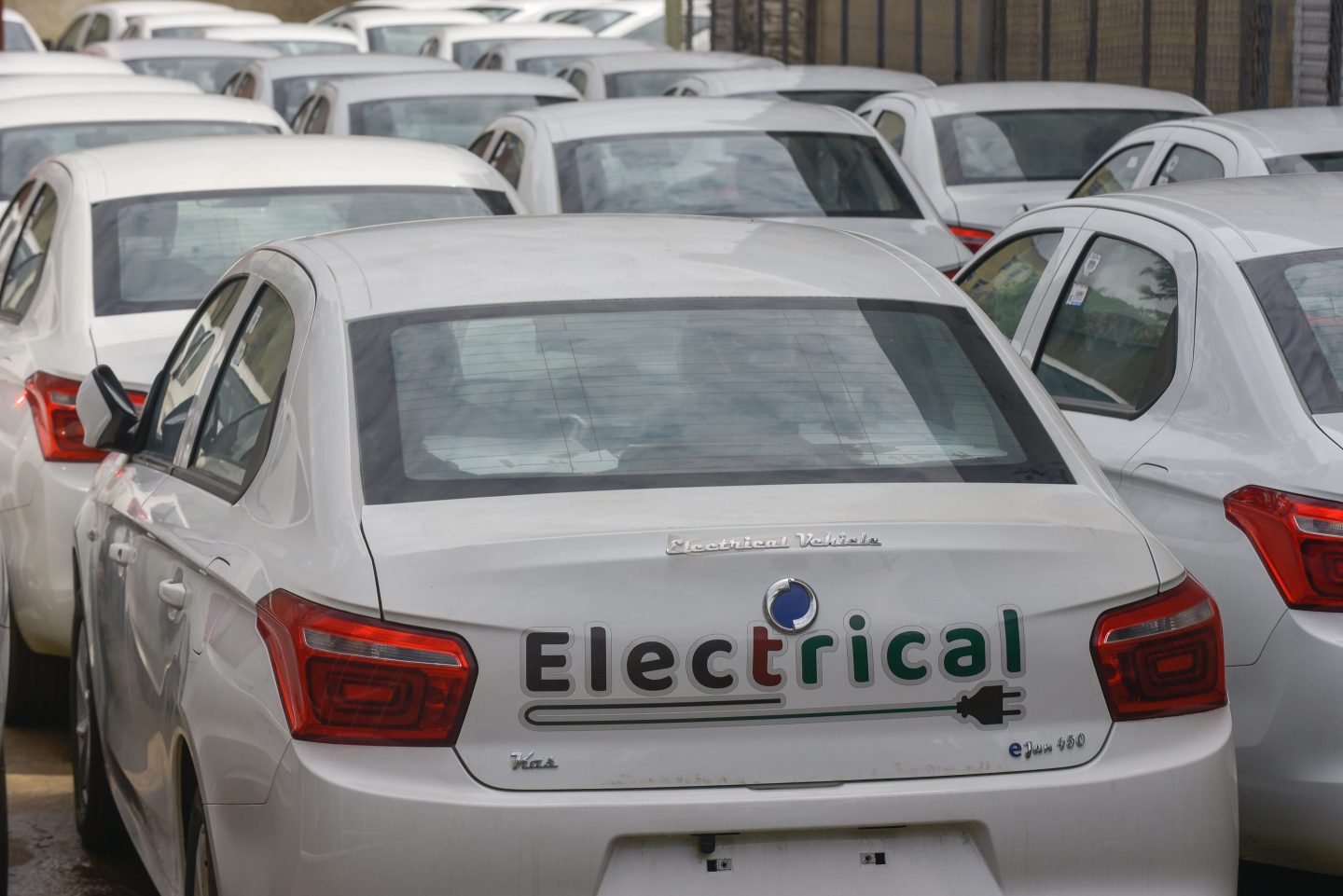
Many EVs are now parked in garages and parking lots awaiting parts expected to come from China.
Ethiopia’s minister in charge of transport, Bareo Hassen Bareo, has said he believes the country can be a model nation with a green economy legacy, with the prioritization of electric vehicles a key component.
The government will invest in public charging stations, he told The Associated Press, and there are plans to create a plant manufacturing EV batteries locally to reduce reliance on imports.
Private efforts have included a collaboration, which has since fizzled, between Olympian Haile Gebreselassie and South Korean carmaker Hyundai to make electric vehicles in Ethiopia. That effort is believed to have collapsed over the sourcing of materials.
Samson Berhane, an economist based in Addis Ababa, said the sudden flood of electric vehicles into the local market despite poor infrastructure is making it difficult for customers to adapt comfortably. Some EVs sell for about $20,000.
“Very few people are willing to take the risk of buying electric cars due to the lack of infrastructure, shortage of mechanics specialized in EV maintenance and the flooding of the market with Chinese brands that have questionable details and long-term visibility,” Berhane said.
But he said he believes that Ethiopia is more than able to provide electricity to the expected 500,000 EV’s there within the next decade while fulfilling its industrial ambitions.
Some Ethiopians are already giving up on electric vehicles, and the secondhand trade in gasoline-powered vehicles continues. There are at least 1.2 million vehicles across Ethiopia, and only a small fraction are electric ones.
Businessman Yared Alemayehu bought a Chinese-made electric vehicle that he had hoped to use for a taxi service. He knew the car had a mechanical defect, but he believed it could be fixed. A mechanic disagreed.
In the end, he sold the car at a loss and bought a Toyota Corolla — a car made in 2007 that he felt was more reliable — for the equivalent of $20,000, a sum that included the hefty taxes imposed on gasoline vehicles. Taxes can be higher than the cost of importing the vehicle.
“In addition to having to charge my old electric car, it frequently broke, and the garage was overcharging, and the lineup at the garage was overwhelming us,” he said.
Taxi driver Dereje Hailu, who had high hopes for his Chinese-made E-Star electric vehicle when he purchased it earlier this year, said his expectations had been dashed.
“With such a car, I fear I might be stuck if I go far from Addis Ababa where there are no charging stations,” he said.