• Home
  • Latest
  • Fortune 500
  • Finance
  • Tech
  • Leadership
  • Lifestyle
  • Rankings
  • Multimedia

Trendingnow

1

Bolt CEO says he let go of his entire HR team for creating problems that didn’t exist: ‘Those problems disappeared when I let them go’ 

2

The Bezos family just donated $100 million to help achieve one of Mayor Zohran Mamdani’s top campaign promises

3

Current price of oil as of May 19, 2026

1

Bolt CEO says he let go of his entire HR team for creating problems that didn’t exist: ‘Those problems disappeared when I let them go’ 

2

The Bezos family just donated $100 million to help achieve one of Mayor Zohran Mamdani’s top campaign promises

3

Current price of oil as of May 19, 2026
PoliticsDonald Trump

How Trump’s 60% tariffs on China imports and up to 20% on everything else would work—and what they would do

By
Paul Wiseman
Paul Wiseman
and
The Associated Press
Down Arrow Button Icon
By
Paul Wiseman
Paul Wiseman
and
The Associated Press
Down Arrow Button Icon
September 27, 2024, 5:32 AM ET
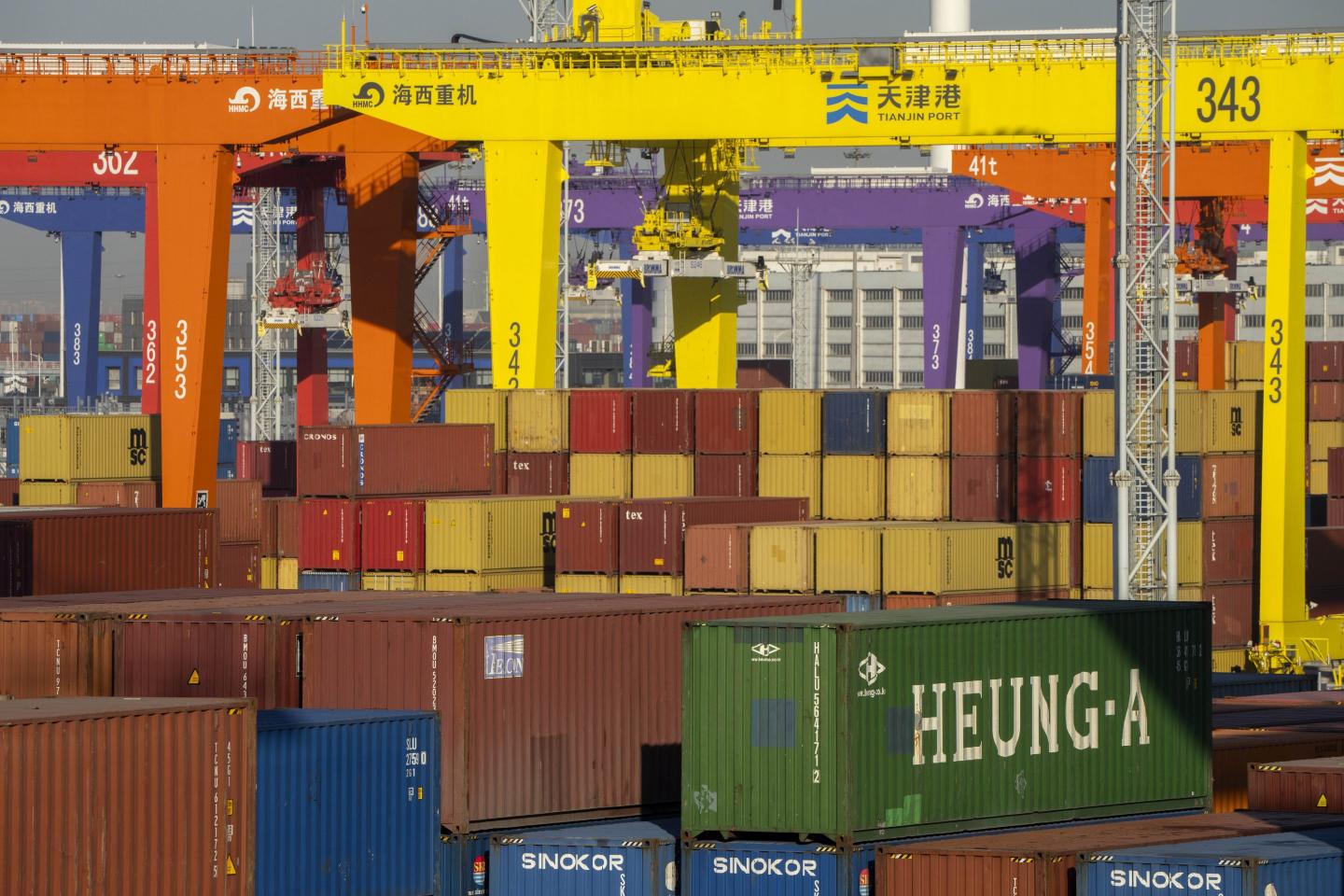
Shipping containers are stacked at a port in Tianjin, China, on Jan. 16, 2023.
Shipping containers are stacked at a port in Tianjin, China, on Jan. 16, 2023.Mark Schiefelbein—AP

Donald Trump has identified what he sees as an all-purpose fix for what ails America: Slap huge new tariffs on foreign goods entering the United States.

Recommended Video

The former president and current Republican nominee asserts that tariffs — basically import taxes — will create more factory jobs, shrink the federal deficit, lower food prices and allow the government to subsidize childcare.

He even says tariffs can promote world peace.

“Tariffs are the greatest thing ever invented,’’ Trump said this month in Flint, Michigan.

As president, Trump imposed tariffs with a flourish — targeting imported solar panels, steel, aluminum and pretty much everything from China.

“Tariff Man,” he called himself.

This time, he’s gone much further: He has proposed a 60% tariff on goods from China — and a tariff of up to 20% on everything else the United States imports.

This week, he raised the ante still higher. To punish the machinery manufacturer John Deere for its plans to move some production to Mexico, Trump vowed to tax anything Deere tried to export back into the United States — at 200%.

And he threatened to hit Mexican-made goods with 100% tariffs, a move that would risk blowing up a trade deal that Trump’s own administration negotiated with Canada and Mexico.

Mainstream economists are generally skeptical of tariffs, considering them a mostly inefficient way for governments to raise money and promote prosperity. They are especially alarmed by Trump’s latest proposed tariffs.

This week, a report from the Peterson Institute for International Economics concluded that Trump’s main tariff proposals – assuming that the targeted countries retaliated with their own tariffs — would slash more than a percentage point off the U.S. economy by 2026 and make inflation 2 percentage points higher next year than it otherwise would have been.

Vice President Kamala Harris has dismissed Trump’s tariff threats as unserious. Her campaign has cited a report that found that Trump’s 20% universal tariff would cost a typical family nearly $4,000 a year.

But the Biden-Harris administration itself has a taste for tariffs. It retained the taxes Trump imposed on $360 billion in Chinese goods. And it imposed a 100% tariff on Chinese electric vehicles.

Indeed, the United States in recent years has gradually retreated from its post-World War II role of promoting global free trade and lower tariffs. That shift has been a response to the loss of U.S. manufacturing jobs, widely attributed to unfettered tree trade and an increasingly aggressive China.

Tariffs are a tax on imports

They are typically charged as a percentage of the price a buyer pays a foreign seller. In the United States, tariffs are collected by Customs and Border Protection agents at 328 ports of entry across the country.

The tariff rates range from passenger cars (2.5%) to golf shoes (6%). Tariffs can be lower for countries with which the United States has trade agreements. For example, most goods can move among the United States, Mexico and Canada tariff-free because of Trump’s US-Mexico-Canada trade agreement.

There’s much misinformation about who actually pays tariffs

Trump insists that tariffs are paid for by foreign countries. In fact, its is importers — American companies — that pay tariffs, and the money goes to U.S. Treasury. Those companies, in turn, typically pass their higher costs on to their customers in the form of higher prices. That’s why economists say consumers usually end up footing the bill for tariffs.

Still, tariffs can hurt foreign countries by making their products pricier and harder to sell abroad. Yang Zhou, an economist at Shanghai’s Fudan University, concluded in a study that Trump’s tariffs on Chinese goods inflicted more than three times as much damage to the Chinese economy as they did to the U.S. economy

Tariffs are intended mainly to protect domestic industries

By raising the price of imports, tariffs can protect home-grown manufacturers. They may also serve to punish foreign countries for committing unfair trade practices, like subsidizing their exporters or dumping products at unfairly low prices.

Before the federal income tax was established in 1913, tariffs were a major revenue driver for the government. From 1790 to 1860, tariffs accounted for 90% of federal revenue, according to Douglas Irwin, a Dartmouth College economist who has studied the history of trade policy.

Tariffs fell out of favor as global trade grew after World War II. The government needed vastly bigger revenue streams to finance its operations.

In the fiscal year that ended Sept. 30, the government is expected to collect $81.4 billion in tariffs and fees. That’s a trifle next to the $2.5 trillion that’s expected to come from individual income taxes and the $1.7 trillion from Social Security and Medicare taxes.

Still, Trump wants to enact a budget policy that resembles what was in place in the 19th century.

He has argued that tariffs on farm imports could lower food prices by aiding America’s farmers. In fact, tariffs on imported food products would almost certainly send grocery prices up by reducing choices for consumers and competition for American producers.

Tariffs can also be used to pressure other countries on issues that may or may not be related to trade. In 2019, for example, Trump used the threat of tariffs as leverage to persuade Mexico to crack down on waves of Central American migrants crossing Mexican territory on their way to the United States.

Trump even sees tariffs as a way to prevent wars.

“I can do it with a phone call,’’ he said at an August rally in North Carolina.

If another country tries to start a war, he said he’d issue a threat:

“We’re going to charge you 100% tariffs. And all of a sudden, the president or prime minister or dictator or whoever the hell is running the country says to me, ‘Sir, we won’t go to war.’ ”

Economists generally consider tariffs self-defeating

Tariffs raise costs for companies and consumers that rely on imports. They’re also likely to provoke retaliation.

The European Union, for example, punched back against Trump’s tariffs on steel and aluminum by taxing U.S. products, from bourbon to Harley-Davidson motorcycles. Likewise, China responded to Trump’s trade war by slapping tariffs on American goods, including soybeans and pork in a calculated drive to hurt his supporters in farm country.

A study by economists at the Massachusetts Institute of Technology, the University of Zurich, Harvard and the World Bank concluded that Trump’s tariffs failed to restore jobs to the American heartland. The tariffs “neither raised nor lowered U.S. employment’’ where they were supposed to protect jobs, the study found.

Despite Trump’s 2018 taxes on imported steel, for example, the number of jobs at U.S. steel plants barely budged: They remained right around 140,000. By comparison, Walmart alone employs 1.6 million people in the United States.

Worse, the retaliatory taxes imposed by China and other nations on U.S. goods had “negative employment impacts,’’ especially for farmers, the study found. These retaliatory tariffs were only partly offset by billions in government aid that Trump doled out to farmers. The Trump tariffs also damaged companies that relied on targeted imports.

If Trump’s trade war fizzled as policy, though, it succeeded as politics. The study found that support for Trump and Republican congressional candidates rose in areas most exposed to the import tariffs — the industrial Midwest and manufacturing-heavy Southern states like North Carolina and Tennessee.

The CEO-in-Chief speaks. Fortune sits down with President Trump on tariffs, the Intel stake, Boeing's record orders, and what the markets should expect next. Read the interview
About the Authors
By Paul Wiseman
See full bioRight Arrow Button Icon
By The Associated Press
See full bioRight Arrow Button Icon

Latest in Politics

Finance
Lorem ipsum dolor sit amet, consectetur adipiscing elit, sed do eiusmod tempor incididunt ut labore et dolore magna aliqua. Ut enim ad minim veniam
By Fortune Editors
October 20, 2025
Finance
Lorem ipsum dolor sit amet, consectetur adipiscing elit, sed do eiusmod tempor incididunt ut labore et dolore magna aliqua. Ut enim ad minim veniam
By Fortune Editors
October 20, 2025
Finance
Lorem ipsum dolor sit amet, consectetur adipiscing elit, sed do eiusmod tempor incididunt ut labore et dolore magna aliqua. Ut enim ad minim veniam
By Fortune Editors
October 20, 2025
Finance
Lorem ipsum dolor sit amet, consectetur adipiscing elit, sed do eiusmod tempor incididunt ut labore et dolore magna aliqua. Ut enim ad minim veniam
By Fortune Editors
October 20, 2025
Finance
Lorem ipsum dolor sit amet, consectetur adipiscing elit, sed do eiusmod tempor incididunt ut labore et dolore magna aliqua. Ut enim ad minim veniam
By Fortune Editors
October 20, 2025
Finance
Lorem ipsum dolor sit amet, consectetur adipiscing elit, sed do eiusmod tempor incididunt ut labore et dolore magna aliqua. Ut enim ad minim veniam
By Fortune Editors
October 20, 2025

Most Popular

Finance
Lorem ipsum dolor sit amet, consectetur adipiscing elit, sed do eiusmod tempor incididunt ut labore et dolore magna aliqua. Ut enim ad minim veniam
By Fortune Editors
October 20, 2025
Finance
Lorem ipsum dolor sit amet, consectetur adipiscing elit, sed do eiusmod tempor incididunt ut labore et dolore magna aliqua. Ut enim ad minim veniam
By Fortune Editors
October 20, 2025
Finance
Lorem ipsum dolor sit amet, consectetur adipiscing elit, sed do eiusmod tempor incididunt ut labore et dolore magna aliqua. Ut enim ad minim veniam
By Fortune Editors
October 20, 2025
Finance
Lorem ipsum dolor sit amet, consectetur adipiscing elit, sed do eiusmod tempor incididunt ut labore et dolore magna aliqua. Ut enim ad minim veniam
By Fortune Editors
October 20, 2025
Finance
Lorem ipsum dolor sit amet, consectetur adipiscing elit, sed do eiusmod tempor incididunt ut labore et dolore magna aliqua. Ut enim ad minim veniam
By Fortune Editors
October 20, 2025
Finance
Lorem ipsum dolor sit amet, consectetur adipiscing elit, sed do eiusmod tempor incididunt ut labore et dolore magna aliqua. Ut enim ad minim veniam
By Fortune Editors
October 20, 2025
Fortune Secondary Logo
Rankings
  • 100 Best Companies
  • Fortune 500
  • Global 500
  • Fortune 500 Europe
  • Most Powerful Women
  • World's Most Admired Companies
  • See All Rankings
  • Lists Calendar
Sections
  • Finance
  • Fortune Crypto
  • Features
  • Leadership
  • Health
  • Commentary
  • Success
  • Retail
  • Mpw
  • Tech
  • Lifestyle
  • CEO Initiative
  • Asia
  • Politics
  • Conferences
  • Europe
  • Newsletters
  • Personal Finance
  • Environment
  • Magazine
  • Education
Customer Support
  • Frequently Asked Questions
  • Customer Service Portal
  • Privacy Policy
  • Terms Of Use
  • Single Issues For Purchase
  • International Print
Commercial Services
  • Advertising
  • Fortune Brand Studio
  • Fortune Analytics
  • Fortune Conferences
  • Business Development
  • Group Subscriptions
About Us
  • About Us
  • Press Center
  • Work At Fortune
  • Terms And Conditions
  • Site Map
  • About Us
  • Press Center
  • Work At Fortune
  • Terms And Conditions
  • Site Map
  • Facebook icon
  • Twitter icon
  • LinkedIn icon
  • Instagram icon
  • Pinterest icon

Latest in Politics

Dr. Bernice A. King
Workplace CultureFortune Workplace Innovation
Dr. Bernice King on why companies that walked back DEI were never truly committed: ‘If you retreat that quick…that reveals who you really are’
By Preston ForeMay 19, 2026
15 hours ago
Photo of Donald Trump (left) with Mark Cuban
PoliticsDonald Trump
Trump and Mark Cuban end war of words to tag-team America’s drug pricing crisis: ‘Democrats want cheaper medications, too’
By Catherina GioinoMay 19, 2026
15 hours ago
U.S. President Donald Trump speaking at a podium flanked by signs that say "Winning the AI Race."
NewslettersEye on AI
The times they are a-changin’: Washington suddenly warms to regulating AI
By Jeremy KahnMay 19, 2026
16 hours ago
Environmental advocates and progressive lawmakers hold a rally in support of legislation that would put a moratorium on new data centers in the state on Wednesday, May 13, 2026, at the Capitol in Albany, N.Y.
AIData centers
Americans’ AI hate wave might just be gathering steam: Data centers could hike power costs in some states over 50% by 2030
By Tristan BoveMay 19, 2026
1 day ago
Donald Trump smiles
LawDonald Trump
Trump creates $1.7 billion ‘Anti-Weaponization Fund’ to compensate allies as part of his IRS lawsuit settlement
By Fatima Hussein, Eric Tucker, Alanna Durkin Richer and The Associated PressMay 18, 2026
2 days ago
hochul
Economyremote work
New York governor pleads for remote work during massive rail strike: ‘regular commuters who can work from home … please do so’
By Philip Marcelo, Michael R. Sisak and The Associated PressMay 18, 2026
2 days ago

Most Popular

Bolt CEO says he let go of his entire HR team for creating problems that didn’t exist: ‘Those problems disappeared when I let them go’ 
Workplace Culture
Bolt CEO says he let go of his entire HR team for creating problems that didn’t exist: ‘Those problems disappeared when I let them go’ 
By Preston ForeMay 19, 2026
13 hours ago
The Bezos family just donated $100 million to help achieve one of Mayor Zohran Mamdani’s top campaign promises
Politics
The Bezos family just donated $100 million to help achieve one of Mayor Zohran Mamdani’s top campaign promises
By Jake AngeloMay 12, 2026
8 days ago
Current price of oil as of May 19, 2026
Personal Finance
Current price of oil as of May 19, 2026
By Joseph HostetlerMay 19, 2026
21 hours ago
Employers are quietly pausing 401(k) matches again. The last time this happened was the 2008 recession and Covid
Personal Finance
Employers are quietly pausing 401(k) matches again. The last time this happened was the 2008 recession and Covid
By Courtney Vinopal and HR BrewMay 18, 2026
2 days ago
Current price of silver as of Monday, May 18, 2026
Personal Finance
Current price of silver as of Monday, May 18, 2026
By Joseph HostetlerMay 18, 2026
2 days ago
While Trump insisted the Iran war would end ‘soon,’ an account in his name was buying millions in oil, defense, and gold
Economy
While Trump insisted the Iran war would end ‘soon,’ an account in his name was buying millions in oil, defense, and gold
By Eva RoytburgMay 18, 2026
2 days ago

© 2026 Fortune Media IP Limited. All Rights Reserved. Use of this site constitutes acceptance of our Terms of Use and Privacy Policy | CA Notice at Collection and Privacy Notice | Do Not Sell/Share My Personal Information
FORTUNE is a trademark of Fortune Media IP Limited, registered in the U.S. and other countries. FORTUNE may receive compensation for some links to products and services on this website. Offers may be subject to change without notice.