• Home
  • Latest
  • Fortune 500
  • Finance
  • Tech
  • Leadership
  • Lifestyle
  • Rankings
  • Multimedia
FinanceChina

China has a ‘near monopoly’ on many critical minerals. JPMorgan says it could be the next battleground with the U.S.

Will Daniel
By
Will Daniel
Will Daniel
Down Arrow Button Icon
Will Daniel
By
Will Daniel
Will Daniel
Down Arrow Button Icon
June 10, 2024, 3:19 PM ET
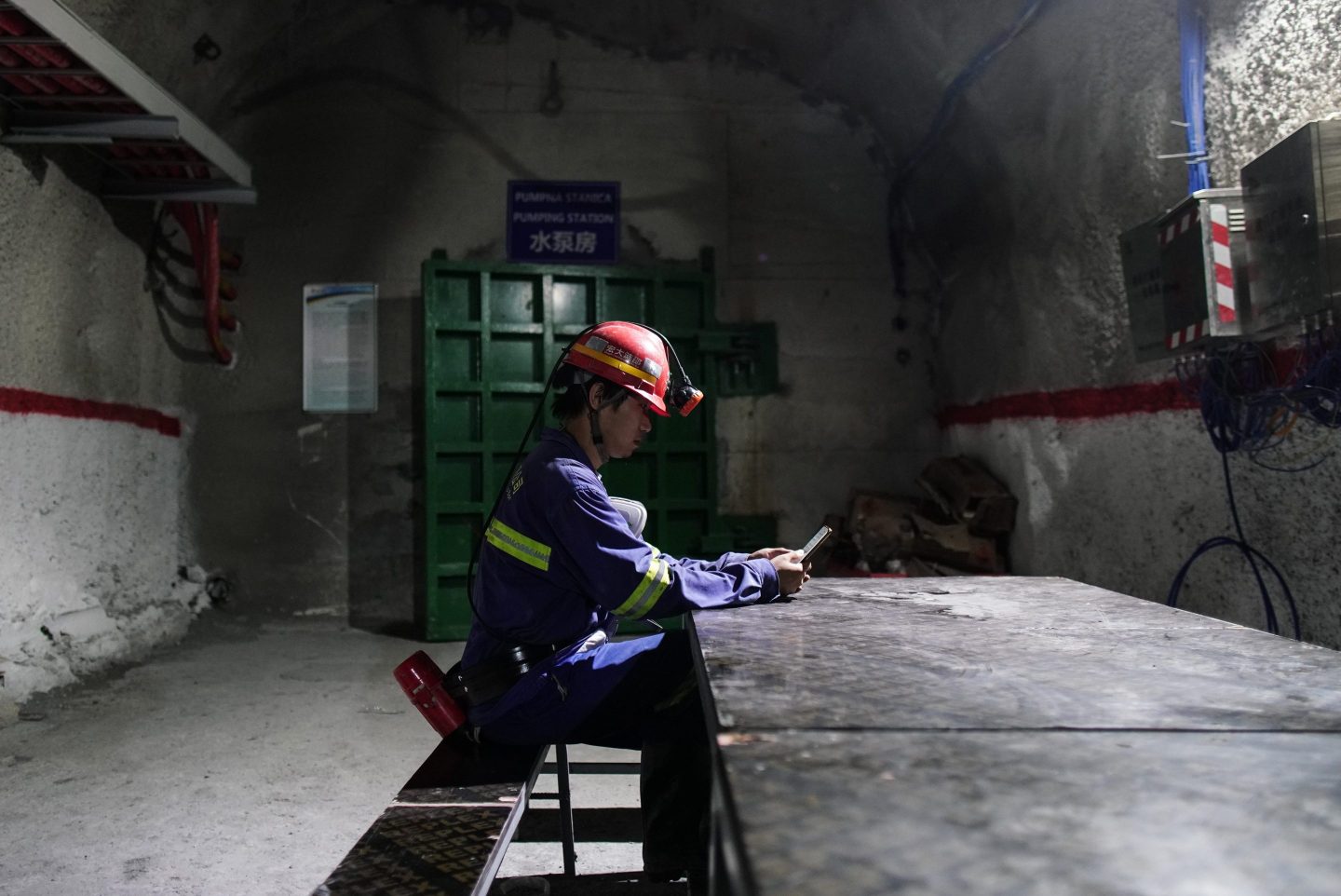
A miner browses a smartphone in a rest room underground at the Cukaru Peki copper and gold mine, operated by Zijin Mining Group Co., in Bor, Serbia, on Friday, Aug. 25, 2023.
A miner browses a smartphone in a rest room underground at the Cukaru Peki copper and gold mine, operated by Zijin Mining Group Co., in Bor, Serbia, on Friday, Aug. 25, 2023.Photographer: Oliver Bunic/Bloomberg via Getty Images

China has a “near monopoly” on the mining of many raw materials that are critical for the production of semiconductors and other technologies, JPMorgan said Monday, highlighting the importance of key minerals in the escalating U.S.-China trade war.

Recommended Video

President Biden upped the ante in the ongoing spat with China last month when he targeted Chinese products including solar cells, EVs, batteries, steel, aluminum, medical equipment, and more with a raft of new tariffs.

“The Biden administration’s latest tariff announcement on $18 billion of Chinese imports has elevated the debate on whether China’s dominance in the critical minerals supply chain will emerge as the latest battleground for U.S.-China strategic competition,” wrote JPMorgan’s executive director of strategic research, Amy Ho, and global head of research, Joyce Chang, in a note to clients.

In 2022, China produced 68% of the world’s rare earth minerals, which are used for things like magnets and batteries, and 70% of its graphite, which is used in lubricants, electric motors, and even nuclear reactors.

However, China’s real dominance lies in its mineral processing capabilities, according to JPMorgan. China processed 100% of the world’s graphite supply in 2022, 90% of rare earths, and 74% of cobalt (another critical mineral for batteries).

“Increasing dependence on critical minerals, which are key inputs to semiconductors, EVs, military weapons etc., has raised concerns that China could use its dominance in this supply chain to retaliate against U.S. industrial policy,” Ho and Chang warned.

The U.S. and China’s tit-for-tat trade war began in 2018, when then-President Donald Trump slapped tariffs on a range of Chinese goods and commodities, including solar panels and steel, citing the country’s intellectual property (IP) theft and unfair trade practices. Since then, tensions between the world’s two largest superpowers have only escalated, with a high-stakes battle over semiconductor IP and manufacturing taking center stage amid the AI boom. 

Import-only minerals

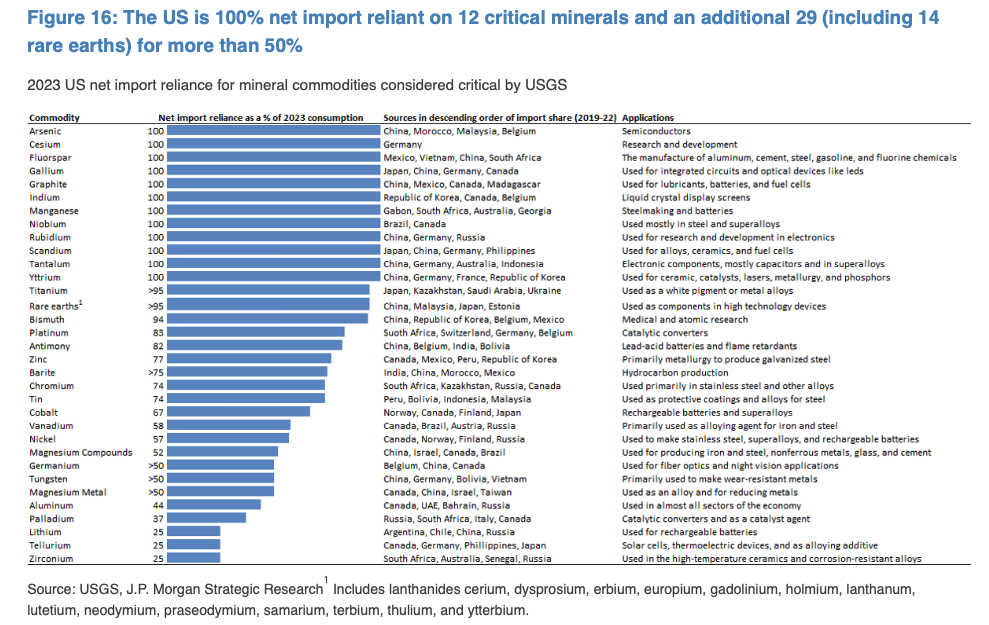
Of the minerals that the U.S. Geological Survey has identified as critical to the U.S. economy and national security, the U.S. was 100% reliant on imports for 12 of them. 

1. Arsenic

Top source: China

Applications: Semiconductors

2. Cesium

Top source: Germany

Applications: Research and development

3. Fluorspar

Top source: Mexico

Applications: Manufacturing of fuel, foams, refrigerants, and more

4. Gallium

Top source: Japan

Applications: Integrated circuits and optical devices

5. Graphite

Top source: China

Applications: Lubricants, batteries, and fuel cells

6. Indium

Top source: South Korea

Applications: Liquid crystal display screens

7. Manganese

Top source: Gabon

Applications: Manufacturing of steel and batteries

8. Niobium

Top source: Brazil

Applications: Manufacturing of superalloys

9. Rubidium

Top source: China

Applications: Electronics research and development

10. Scandium

Top source: Japan

Applications: Manufacturing of alloys, ceramics, and fuel cells

11. Tantalum

Top source: China

Applications: Manufacturing of electronic components, capacitors, and superalloys

12. Yttrium

Top source: China

Applications: Manufacturing of ceramics and lasers

China is the top source for five out of 12 of these critical minerals, and the second or third top source for an additional three: Fluorspar, Galium, and Scandium. But China isn’t the only nation the U.S. relies on for key minerals. Mexico, Japan, and Korea are among the other top sources. 

The U.S. relies on imports for 50% or more of its supply of an additional 29 minerals beyond the dozen listed above. This includes a 90% plus net import reliance for titanium, 14 rare earths, and bismuth.
Will China weaponize its ‘near monopoly’ on critical minerals?

With the U.S.-China trade war heating up, minerals could prove an exploitable weak point for Beijing. In a worst-case scenario where China increases export restrictions for key minerals or implements a full ban, the electronics, oil refining, defense, and EV sectors would be especially at risk, JPMorgan’s Ho and Chang noted.

Still, for now, JPMorgan’s strategists don’t foresee a serious mineral turf war taking place. “There are growing concerns that China will weaponize its position, but we expect China’s response to remain proportionate and limited based on past actions,” they wrote Monday, adding that the U.S. can also look to alternative suppliers and substitutes.

The pair offered a few recommendations for how the U.S. can stabilize its supply of critical minerals to protect the defense industry, support the EV transition, and prevent economic fallout from a potential commodity trade war. 

First, Ho and Chang noted that creating new U.S. mining capacity isn’t an option to fix the U.S.’s reliance on mineral imports. New mining operations take years to start, come with environmental risks, and regulatory approval in the U.S. is often uncertain. It takes 16.5 years, on average, for a mining project to move from discovery to production in the U.S., according to the International Energy Agency. And securing a permit for a mine alone takes an average of seven to 10 years.

Instead of new mining operations, Ho and Chang recommended the diversification of mineral sourcing, the implementation of new mineral mining technologies, and strategic stockpiling of key minerals. They estimated that technological innovation and recycling could reduce demand by 20% to 40%, while material substitution could alleviate strains on supply and reduce costs over the next few decades. In addition, strategic stockpiling by the US government and corporations could act as a buffer against sudden supply chain disruptions.

“More opportunities exist to diversify critical mineral suppliers than there are for oil, and the countries that are in the process of broadening their mining and process capabilities include allies such as Canada, Australia, the EU, and Japan,” they added. “The U.S. should remain optimistic.”


Join us at the Fortune Workplace Innovation Summit May 19–20, 2026, in Atlanta. The next era of workplace innovation is here—and the old playbook is being rewritten. At this exclusive, high-energy event, the world’s most innovative leaders will convene to explore how AI, humanity, and strategy converge to redefine, again, the future of work. Register now.
About the Author
Will Daniel
By Will Daniel
LinkedIn iconTwitter icon
See full bioRight Arrow Button Icon

Latest in Finance

Finance
Lorem ipsum dolor sit amet, consectetur adipiscing elit, sed do eiusmod tempor incididunt ut labore et dolore magna aliqua. Ut enim ad minim veniam
By Fortune Editors
October 20, 2025
Finance
Lorem ipsum dolor sit amet, consectetur adipiscing elit, sed do eiusmod tempor incididunt ut labore et dolore magna aliqua. Ut enim ad minim veniam
By Fortune Editors
October 20, 2025
Finance
Lorem ipsum dolor sit amet, consectetur adipiscing elit, sed do eiusmod tempor incididunt ut labore et dolore magna aliqua. Ut enim ad minim veniam
By Fortune Editors
October 20, 2025
Finance
Lorem ipsum dolor sit amet, consectetur adipiscing elit, sed do eiusmod tempor incididunt ut labore et dolore magna aliqua. Ut enim ad minim veniam
By Fortune Editors
October 20, 2025
Finance
Lorem ipsum dolor sit amet, consectetur adipiscing elit, sed do eiusmod tempor incididunt ut labore et dolore magna aliqua. Ut enim ad minim veniam
By Fortune Editors
October 20, 2025
Finance
Lorem ipsum dolor sit amet, consectetur adipiscing elit, sed do eiusmod tempor incididunt ut labore et dolore magna aliqua. Ut enim ad minim veniam
By Fortune Editors
October 20, 2025

Most Popular

Finance
Lorem ipsum dolor sit amet, consectetur adipiscing elit, sed do eiusmod tempor incididunt ut labore et dolore magna aliqua. Ut enim ad minim veniam
By Fortune Editors
October 20, 2025
Finance
Lorem ipsum dolor sit amet, consectetur adipiscing elit, sed do eiusmod tempor incididunt ut labore et dolore magna aliqua. Ut enim ad minim veniam
By Fortune Editors
October 20, 2025
Finance
Lorem ipsum dolor sit amet, consectetur adipiscing elit, sed do eiusmod tempor incididunt ut labore et dolore magna aliqua. Ut enim ad minim veniam
By Fortune Editors
October 20, 2025
Finance
Lorem ipsum dolor sit amet, consectetur adipiscing elit, sed do eiusmod tempor incididunt ut labore et dolore magna aliqua. Ut enim ad minim veniam
By Fortune Editors
October 20, 2025
Finance
Lorem ipsum dolor sit amet, consectetur adipiscing elit, sed do eiusmod tempor incididunt ut labore et dolore magna aliqua. Ut enim ad minim veniam
By Fortune Editors
October 20, 2025
Finance
Lorem ipsum dolor sit amet, consectetur adipiscing elit, sed do eiusmod tempor incididunt ut labore et dolore magna aliqua. Ut enim ad minim veniam
By Fortune Editors
October 20, 2025
Rankings
  • 100 Best Companies
  • Fortune 500
  • Global 500
  • Fortune 500 Europe
  • Most Powerful Women
  • Future 50
  • World’s Most Admired Companies
  • See All Rankings
Sections
  • Finance
  • Leadership
  • Success
  • Tech
  • Asia
  • Europe
  • Environment
  • Fortune Crypto
  • Health
  • Retail
  • Lifestyle
  • Politics
  • Newsletters
  • Magazine
  • Features
  • Commentary
  • Mpw
  • CEO Initiative
  • Conferences
  • Personal Finance
  • Education
Customer Support
  • Frequently Asked Questions
  • Customer Service Portal
  • Privacy Policy
  • Terms Of Use
  • Single Issues For Purchase
  • International Print
Commercial Services
  • Advertising
  • Fortune Brand Studio
  • Fortune Analytics
  • Fortune Conferences
  • Business Development
About Us
  • About Us
  • Editorial Calendar
  • Press Center
  • Work At Fortune
  • Diversity And Inclusion
  • Terms And Conditions
  • Site Map

Latest in Finance

An elderly man prepares ingredients, grating carrots on a plate in a home setting, emphasizing independence and routine.
North Americaaging
More Americans will die than be born in 2030, CBO predicts—leaving immigrants as the only source of population growth
By Eva RoytburgJanuary 7, 2026
10 hours ago
Delta plane flying
North AmericaAir Travel
These are the 10 most on-time airlines in the world, and only one American company made the cut
By Jacqueline MunisJanuary 7, 2026
12 hours ago
corner office
Future of WorkJobs
AI layoffs are looking more and more like corporate fiction that’s masking a darker reality, Oxford Economics suggests
By Nick LichtenbergJanuary 7, 2026
13 hours ago
Real EstateHousing
Trump threatens to ban Wall Street from buying the house next door, saying ‘American Dream is increasingly out of reach for far too many people’
By Nick LichtenbergJanuary 7, 2026
13 hours ago
trump
Economynational debt
The $38 trillion national debt is one thing 82% of Americans agree on: ‘Voters are understandably concerned,’ watchdog says
By Nick LichtenbergJanuary 7, 2026
13 hours ago
Real EstateHousing
Americans missed out on a ‘once-in-a-lifetime’ chance to buy a house—the 3 shifts it would take to make housing affordable are ‘very unlikely’
By Sydney LakeJanuary 7, 2026
14 hours ago

Most Popular

placeholder alt text
Law
Amazon is cutting checks to millions of customers as part of a $2.5 billion FTC settlement. Here's who qualifies and how to get paid
By Sydney LakeJanuary 6, 2026
2 days ago
placeholder alt text
Economy
Mark Cuban on the $38 trillion national debt and the absurdity of U.S. healthcare: we wouldn't pay for potato chips like this
By Nick LichtenbergJanuary 6, 2026
2 days ago
placeholder alt text
Future of Work
'Employers are increasingly turning to degree and GPA' in hiring: Recruiters retreat from ‘talent is everywhere,’ double down on top colleges
By Jake AngeloJanuary 6, 2026
2 days ago
placeholder alt text
Personal Finance
Janet Yellen warns the $38 trillion national debt is testing a red line economists have feared for decades
By Eva RoytburgJanuary 5, 2026
3 days ago
placeholder alt text
Personal Finance
Current price of silver as of Tuesday, January 6, 2026
By Joseph HostetlerJanuary 6, 2026
2 days ago
placeholder alt text
Success
The college-to-office path is dead: CEO of the world’s biggest recruiter says Gen Z grads need to consider trade and hospitality jobs that don't even require degrees
By Orianna Rosa RoyleJanuary 6, 2026
2 days ago

© 2025 Fortune Media IP Limited. All Rights Reserved. Use of this site constitutes acceptance of our Terms of Use and Privacy Policy | CA Notice at Collection and Privacy Notice | Do Not Sell/Share My Personal Information
FORTUNE is a trademark of Fortune Media IP Limited, registered in the U.S. and other countries. FORTUNE may receive compensation for some links to products and services on this website. Offers may be subject to change without notice.