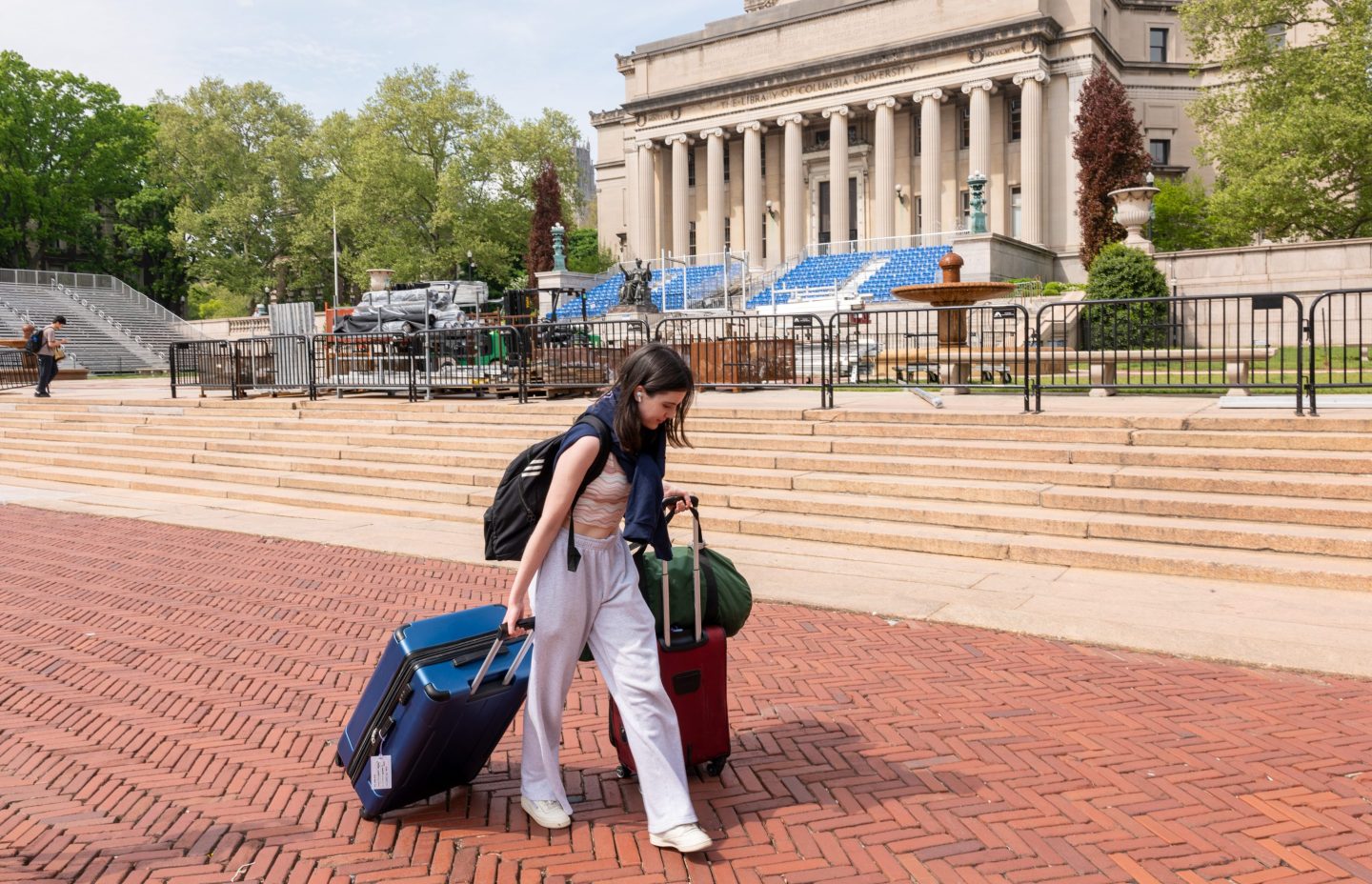
The early months of summer on college campuses are usually bustling with proud parents ready to celebrate students’ years-long efforts to obtain a college degree.
But this year, many college campuses look very different—and some are eerily empty—as thousands of students and even faculty members established tent encampments on the lawns of nearly 100 campuses in protest of institutional investment in weapons, equipment, and technology that undergird and support the Israeli military campaign in Gaza. Protesting students want their universities to sever partnerships and financial programs connected to the Israeli government and military.
Faced with student protestors’ demands, educational institutions are finding themselves between a rock and a hard place. Divestment can be seen as taking sides when universities aim to stay apolitical, and more critically, it can reduce the financial returns that universities rely on to support their operations and activities. For student protestors, the view is that their university— a moral authority—is profiting from a military campaign they vehemently disagree with. For universities, the view is not nearly as clear cut. The situation means many schools are navigating how to respond to students’ demands and protests, along with the interests of their network of donors—while also managing how their reputations will be affected by each move they make.
Antisemitism is also a serious concern, given that the basis for the protests arose after the deadliest day for Jews since the Holocaust. Some Jewish students have reported that Pro-Palestinian encampments make them feel less safe on campus, pointing out that some of the chants protestors have adopted are antisemitic and have been co-opted by Hamas to call for the murder of Jews. Although the chant is being used rampantly, for activists, it’s taken on a different meaning, but for some Jews it’s a threat.
It’s an especially complex decision for schools that have large endowments or networks of donors who can influence the investments and financial decisions of an institution. And making it even more difficult, the aggressive crackdown many schools deployed to dismantle student encampments, including police equipped with riot gear and military grade weapons, has spurred national criticism on the handling of protests on campus. The aftermath of these responses is both sizable and expensive: Thousands of people have been arrested in relation to campus protests; hundreds of student activists have been suspended or expelled; and several schools opted to cancel commencement ceremonies.
Archon Fung, a professor who teaches political science and citizenship at Harvard Kennedy School, told Fortune, “civil disobedience is, by definition, breaking the rules,” adding that such acts have “an important place in democracy.” Fung cited Columbia University’s student protests of 1968 in opposition to the Vietnam War and the school’s expansion into Harlem.
Fung explained that historically, student protest encampments have helped successfully end wars and global occupations that many experts now agree were injustices, like the war in Vietnam and South African apartheid. Fung also recalled how administration responded to student dissent over South African apartheid at his own undergraduate university, Massachusetts Institute of Technology, which he attended in the late 1980s.
At the time, he said, the main acts of civil disobedience were calls for “divestments from South Africa, and occupying buildings, as well as pitching tents, was one of the techniques.” Police were sometimes called to clear those demonstrations, he recalled, but added that administration at the time was more open to dialogues with protestors and that the level of aggression against student demonstrators today is notably more intense.
“It’s hard for me to imagine any university president having an open debate with a representative of the pro-Palestinian cause, but I do miss that because I think the university should be a place of reason and the exchange of arguments back and forth.”
In the past several months, hundreds of students have established “Gaza Solidarity Encampments” at more than 60 college campuses—and while the protestors’ demands vary at each institution, they largely focus on divestment from Israel, financial transparency, and granting amnesty to students who face disciplinary action over campus activism.
Colleges have been rife with student dissent since the brutal Oct. 7 Hamas attack on Southern Israel, which killed over 1,200 people. Israel’s response, a catastrophic military campaign that killed more than 36,000 Palestinians, is now entering its ninth month. The encampment students also aim to show solidarity with millions of Palestinian civilians enduring the highest civilian casualty rate of any war in the 21st century. As Israel continues its military campaign, which is seen as the most destructive in recent history, Palestinians are suffering calamitous levels of disaster, including famine and disease outbreaks, and a crisis, in which at least a thousand children have lost limbs and over 19,000 children have been orphaned because of indiscriminate bombing in the war.
The most aggressive campus responses to encampments include authorizing police to mass arrest students and suspending, expelling, and evicting student activists. More than 4,000 people have been arrested so far on college campuses across the country, and incidents of disciplinary action are rampant, too. At least 53 students have been suspended and evicted from Columbia University this year due to participation in “Gaza Solidarity Encampments,” according to Columbia Spectator, the university’s publication. The University of Southern California barred a Muslim valedictorian, who graduated with a minor in resistance to genocide, from delivering the role’s trademark commencement speech.
The University of Southern California declined Fortune’s request for comment.
According to Donald Saleh, who has worked as an enrollment planning strategist and consultant for many universities for the past several decades, many institutions will need to consider how their reputations have been impacted by their response to student demonstrations—especially in terms of retaining incoming prospective students.
Saleh told Fortune, “a number of institutions that are in the headlines right now about these protests have large enrollments of international students.” They often travel thousands of miles to attend schools and want “to make sure they’re going to be someplace safe.”
“When the police are coming in on these campuses to break up the protests and take down the encampments, they don’t do that without consultation with the leadership of the campus,” Saleh said. “The reputational concern is that College X or University Y could not manage this without having police come in, make arrests, and physically remove people from the campus.”
These responses could be a cause of “big financial concern,” he said, if incoming prospective students decide to attend school elsewhere, which he said could be a common scenario.
At the very least, the protests have been affecting how schools engage with admitted students. The University of California, San Diego canceled campus tours for at least two days in May after students established encampments; student protestors at Washington University in St. Louis interrupted a packed admitted students event in the university chapel, unfurling a banner that read ‘Divest from Palestininan Genocide,’ on April 13; and at New York University, tours were rerouted to avoid student encampments.
“I would be taking more students off the waitlist to protect against the possibility that some of those students who have already committed are going to leave,” Saleh said, adding that dwindling enrollment numbers can have a financial impact on a university.
Many colleges across the country balance their budgets on a year-to-year basis, he explained, and use the operating plans to predict how many students to enroll and award financial aid packages. When those estimates are “disrupted in a negative way by events on your campus,” he said, “missing your target by just 2% or 3% has budgetary implications that ripple through at least for one year, often for more.”
Another cause of reputational concern for institutions, he said, is how the donors of an institution may respond to how they handle student demonstrations.
“If I’m a donor and I have an affiliation with groups of students who now feel that the campus environment is threatening to them or unsafe for them,” Saleh explained, “my inclination to donate to that campus is going to be significantly less than it might have been four months ago.” Saleh told Fortune he believes this reputational effect is something college administrators, fundraising staff, and alumni affairs employees will be “very concerned about,” especially as it relates to donors.
At Columbia University, for example, more than 200 students were arrested during two police raids on April 18 and April 30, the latter of which, coincidentally, is the same day 700 students were arrested for protesting the divisive Vietnam War and Columbia’s expansion into Harlem more than 50 years ago. As it turns out, Columbia restructured how its administration makes decisions, like police authorization, after those infamous protests—and in authorizing the police on campus this spring, broke those rules explicitly.
A Columbia University spokesperson told Fortune a small group of academic leaders had been in dialogue with student organizers to find a path that would result in the dismantling of the encampment, but they were not able to come to an agreement.
When asked specifically about violating the 1969 pact, a Columbia spokesperson did not respond to several of Fortune’s requests for comment.
Fung, the Harvard professor, told Fortune, “having been on campuses for 20 years and seeing a lot of different campaigns of civil disobedience, I don’t recall anything nearly like this level of police response in the post-Vietnam era.”
The level of aggression in school’s responses is also made more egregious considering the student demonstrations have largely been nonviolent and peaceful in nature.
Roosevelt Montás, a professor who specializes in American citizenship and has been teaching at Columbia for 30 years, told Fortune that “reports of violence and intimidation,” by the student protestors are “isolated and very much a minority,” and that many colleges are responding to concerns of safety subjectively, rather than through “documentation of incidents.”
All things considered, Fung insists that the right for students to peacefully—which means nonviolently—protest is important. “Civil disobedience is saying, look, the ordinary democratic channels are blocked up. We can’t get a hearing for this great injustice. So we’re going to break the law,” he said. “Sometimes, it moves society forward.”
It’s an opinion Montás shares, too. “Students are often ahead of the curve on social and cultural issues,” he said. “This might be one of those issues.”
Several of the world’s largest international organizations have been sounding alarms about the humanitarian crisis caused by Israel’s military campaign in Gaza—the secretary of United Nations has been urging a cease-fire, and the International Criminal Court’s prosecutor announced on May 20 that he has requested arrest warrants for Israeli Prime Minister Benjamin Netanyahu, along with his defense chief and three Hamas leaders over alleged war crimes.
Many European countries, including France, Belgium, and Germany, announced their governments would enforce the arrest warrants if it becomes issued by the international court.