
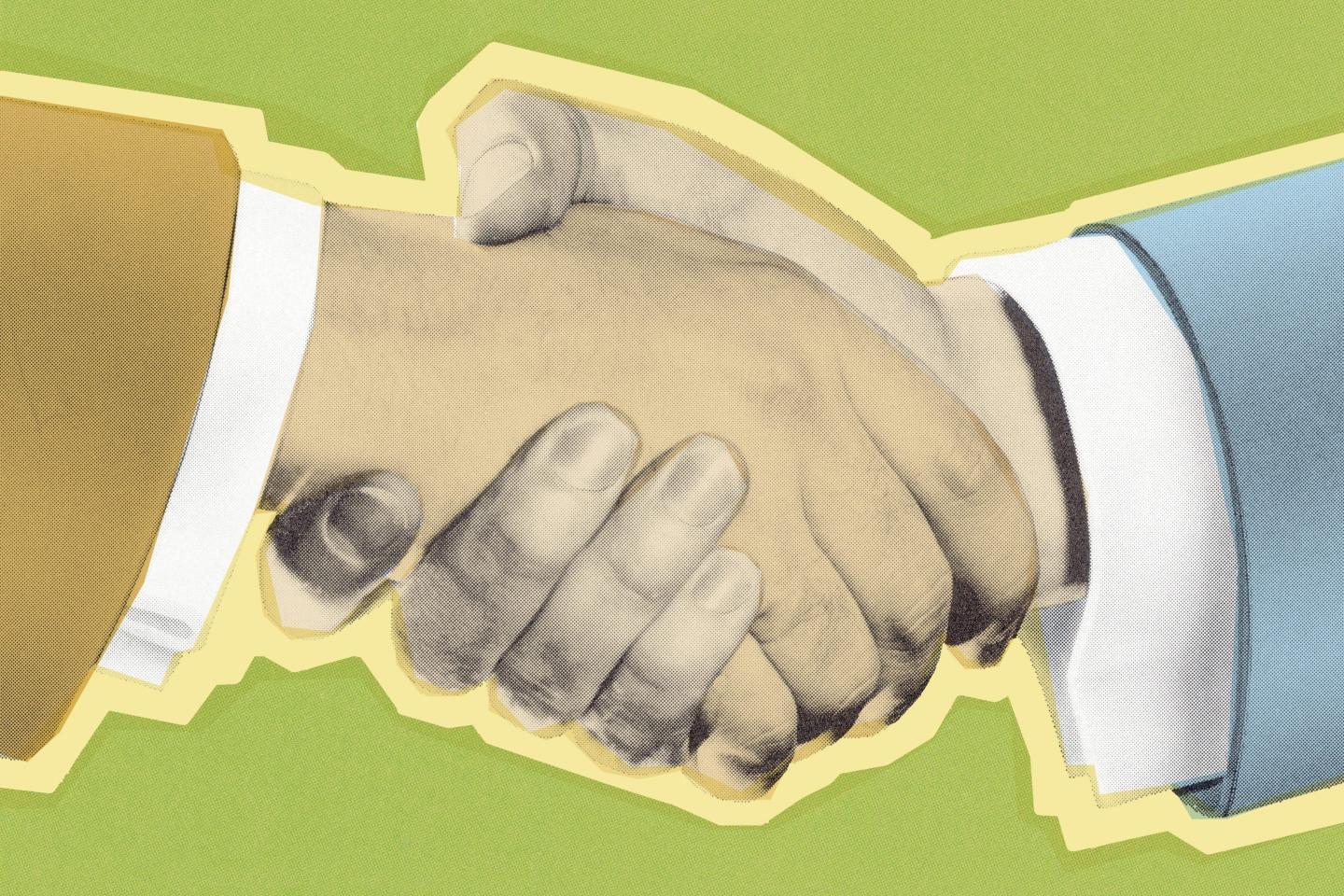
Spurred by the pandemic, the workplace has changed drastically. There’s been a shift from fully in-office work to a less rigid hybrid model. Team meetings that previously took place in conference rooms have moved to Zoom, and relationships between colleagues have entered a different phase as well.
Some argue that the new remote-first way of work has eroded office friendships, drastically decreasing the amount of time people spend in-person socializing and building connections. We’re used to relying on work as a crucial part of our social lives, but since the physical workplace has lost its luster, it may be worth reevaluating and redefining the role colleagues play in our lives and reconsider whether intimate relationships with coworkers are as beneficial as we’ve been led to believe.
That change already seems to be accelerating. Just two in 10 respondents to a 2022 Gallup poll said they have a best friend at work, representing a three percentage point drop compared to 2019. There’s admittedly a case to be made for work friends because humans are social creatures. The average person spends more than 81,000 hours, or nine years, at work, according to Gallup. That tracks with the roughly 90,000 hours author Jessica Pryce-Jones calculated in her 2010 book Happiness at Work. It’s no wonder, then, that the office has been the No. 1 place Americans make friends, surpassing school, church, and neighborhood haunts, according to the Survey Center on American Life.
But there are potential downsides to work friendships as well, and they can bring unnecessary complexities to the workforce. Work friendships can create an us vs. them mentality, encourage gossiping and drama, lead organizations to misread loyalty to a close colleague as loyalty to the company, hinder career mobility, and cause companies to rely on interpersonal connections for employee job satisfaction rather than improve office environments, according to workplace experts and organizational psychologists Fortune spoke to and years of research.
What’s more, we’re spending less time working than before the pandemic, further supporting the argument that we need to look beyond the office for deep social connection. The number of hours people spent working fell by the equivalent of 33 hours a year per person between 2019 and 2022, according to the National Bureau of Economic Research. “It’s a good thing for people to refigure out their relationship with work because we work like crazy in the United States,” says Jeff Hall, a professor of communication studies at the University of Kansas, where he focuses on relationships and social interaction. But doing so, he says, means acknowledging the impact decentralized work could have on loneliness.
Who is a work friend?
In many U.S. offices, employees have misconstrued the role work friends are meant to play in their lives—likely the result of our need for social connectivity plus the popularity of boundaryless TV relationships featured in workplace dramas and sitcoms like The Office and Grey’s Anatomy. Amy Cooper Hakim, workplace consultant and author of Working With Difficult People, suggests differentiating between genuine friends and what she terms as friendlies.
A true friend, Hakim says, is someone who fully supports and champions your personal and professional growth, with whom you share your full self, and with whom you invest emotional time outside the office. However, in a professional setting, it’s crucial to remember that maintaining boundaries is vital. Organizations often pitch their ideal culture as one that’s familial or, more recently, one where you can bring your authentic self to work. But that shouldn’t be the expectation, nor is it true.
Though you might want to, you typically can’t fire or lay off a family member.
A better approach, says Hakim, is to categorize colleagues with whom you’re closest as friendlies. These are the coworkers who are supportive, trustworthy, and contribute to a cordial and fulfilling working environment. They are not your true friends, but they make your work life enjoyable and less stressful.
“When we think about it at that level, we’re able to be much more pragmatic,” Hakim says. “If [a true friendship] happens, beautiful, but it shouldn’t be the expectation.”
However, she cautions that true friendships are few and far between in the workplace. People might think they have that kind of relationship at work until there’s internal competition for a promotion or big project. Another reason deep friendships are hard to maintain in the office is that in many ways, the conditions needed for friendship are at odds with the workplace.
Julianna Pillemer, now an assistant professor at the NYU Stern School of Business, wrote a 2018 paper exploring the downsides of workplace friendships. In it, she laid out four defining features of friendship (informality, voluntariness, communal norms, and socio-emotional goals) and four features necessary for successful organizational life (formal roles, involuntary constraints, exchange norms, and instrumental goals). Those differing features are in conflict with one another, she says.
“There can be some degree of informality at work, but because there are these formal roles, and your roles in these organizations define you, you’re never just you,” says Pillemer. It’s hard to build something genuine behind the professional facade of work and vice versa. What’s required of individuals in professional settings doesn’t often lend itself to open and vulnerable friendships.
Beyond those foundational differences, Pillemer says work friendships can often be seen as cliquey by other employees, which infracts the sense of belonging and overarching team culture companies chase. Furthermore, employees who rely on their close relationships at work are less likely to seek out knowledge and points of view from other people in the organization, she says. It’s also likely those employees will pay more attention to and put more social and emotional energy into those friends over work, according to Pillemer.
Too often, Hakim says, when she enters an organization to help improve communication, workflow, and productivity, the first thing out of employees’ mouths is gossip and accusations about coworkers.
“We don’t need to have someone we can gossip with about whatever behind somebody else’s back,” she says. While workplace friendships can breed increased employer loyalty and higher retention, the work culture can suffer if one leaves, prompting a series of additional exits. What’s more, having a friend in the workplace can influence employees to forgo other career opportunities, internally or externally, to continue working with people they like.
“One of the things that [companies] can get away with when you have a great tight-knit culture is paying people less and relying on them to stay longer because they simply enjoy being there,” she says. “Taken to the limit, of course, that starts to feel culty and abusive.”
The one where work isn’t about friends
It’s irrefutable, Hakim says, that “when we have social connections, at whatever level, we feel happier.” That’s a simple truth.
Researchers at Harvard University spent more than 70 years following more than 700 young men—and later, their spouses and children—in one of the longest in-depth studies to learn what makes people flourish. Relationships, particularly their quality and closeness, were the biggest predictors of happiness.
Generally speaking, the number and depth of friendships among Americans have declined substantially. Roughly half of Americans lost touch with a friend during the pandemic, and the number of close friendships has declined in the last few decades, according to the Survey Center on American Life. Last year, U.S. Surgeon General Vivek Murthy warned of the “significant health consequences of loneliness and isolation,” calling the rise of loneliness in the U.S. an epidemic. Much of the concern now has been directed at Gen Z and their struggles to make and maintain deep friendships.
“Gen Z is starting to say, ‘Why would I need this?’” Pillemer says. They could be miscalculating the importance of social interaction in the workplace, she says, or they might be onto something. Employees can feel happy, engaged, and satisfied at work through friendly yet surface-level social interactions with coworkers without the pressure or expectation that they are best friends.
As Americans, especially younger generations, decenter the workplace in their lives, it may be time to minimize its social importance too. “Stepping outside of the workplace to look for social relationships is really ideal,” Hakim says. “When we’re no longer searching or longing for that relationship, which likely isn’t going to be what we hope it is, we allow ourselves to have that emotional freedom and spend the time looking for the true relationships outside of the office.”