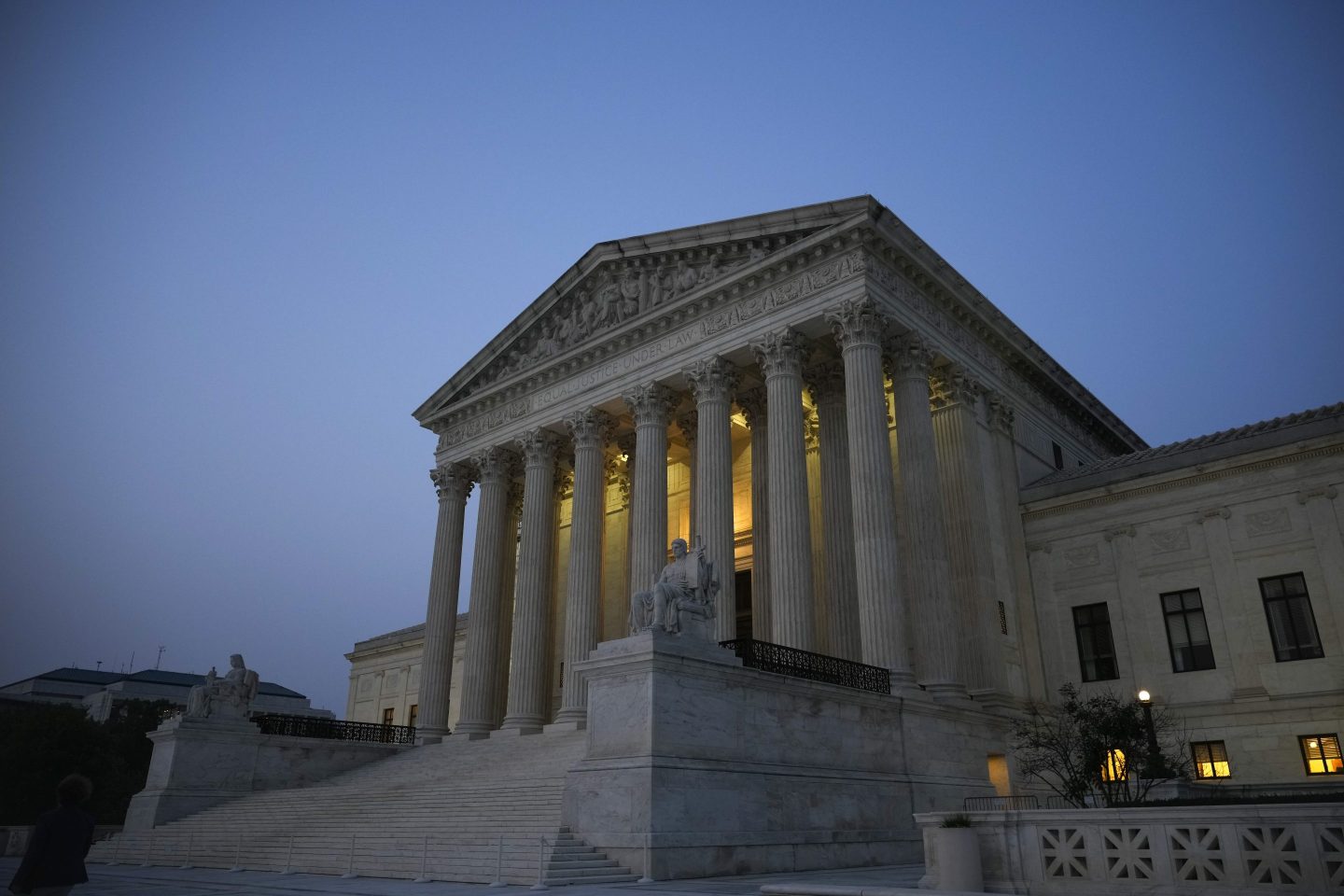
The Supreme Court just delivered a big win for workers and workplace equality–but conservatives are trying to cast the Court’s decision as a blow to workplace equality and inclusion efforts. We can’t let them.
For several years now, right-wing advocacy groups and politicians have had employer diversity, equity, and inclusion programs in their crosshairs. These voices have been especially loud since the Supreme Court’s decision in Students for Fair Admission v. Harvard, which held race-conscious admission practices at Harvard and the University of North Carolina to be unlawful.
Although Students for Fair Admission does not affect the legality of private employer DEI programs, as the U.S. Equal Opportunity Employment Commission (the federal agency charged with enforcing civil rights laws at the workplace) and many state Attorneys General have explained, organizations like America First Legal have seized on the college admissions ruling as an opportunity to file more legal challenges seeking to dismantle employer DEI programs by claiming they are discriminatory. So far, they have met with little success–and rightly so.
Recently, DEI opponents set their sights on another Supreme Court case, Muldrow v. City of St. Louis. On its face, the case might seem an unlikely fit because it does not involve DEI programs at all: Plaintiff Jatonya Muldrow claimed she was transferred to a different position because she is a woman. The new position had less prestige, a worse schedule, and fewer perks, but a court dismissed her claim outright because the transfer, even if discriminatory, did not affect her pay or rank in the police department.
Ultimately, the Supreme Court has sided with Muldrow, resolving a circuit split among the federal courts and holding that Title VII of the Civil Rights Act bars employers from discriminating in decisions like transfers even when they do not rise to the level of “significant” harm, such as being fired or having a reduction in pay.
An intended chilling effect
Employment lawyers have closely watched the case because its impact is enormous: Workers with meritorious cases have too often been screened out by courts that set an arbitrarily high bar to bring suit, often requiring that employment actions be “materially” or “significantly” adverse words that are found nowhere in the text of Title VII. For example, a federal appeals court recently dismissed a case where Black employees were forced to work outside in extreme heat without access to water while white employees were allowed to work in an air-conditioned room with regular water breaks. Courts have also dismissed cases where employees alleged that they were assigned undesirable schedules or placed on probation because of discrimination. Last August, the ACLU filed an amicus brief along with the Constitutional Accountability Center explaining that a legal standard dismissing cases that arise from discriminatory decisions about transfers, schedules, and other working conditions could not be reconciled with the text and mandate of the statute. In today’s decision, the Supreme Court agreed. It is a huge victory for workers.
But much of the coverage on Muldrow in recent months has focused on a different question: Whether a decision in the plaintiff’s favor could spark a rush of new challenges to workplace DEI training and initiatives. In other words, by expanding the range of employment decisions that meet the threshold for unlawful discrimination, does the decision spell doom for employer diversity programs? This fearmongering is misguided and unjustified. It sows unnecessary confusion about what is at stake in this case and the likely impact of the Supreme Court’s decision. It serves to chill employers’ commitment to and investment in efforts to make the workplace fairer and more equitable. We should not let it.
Muldrow has no effect on DEI programs
It is important to understand that DEI efforts have long been lawful under Title VII. EEOC guidelines provide that employers “should take voluntary action to correct the effects of past discrimination and to prevent present and future discrimination.” The Supreme Court has agreed on several occasions, holding that an employer can use race-conscious practices in hiring and promotion, like setting targets for representation in the workforce or in management, to correct the effects of past discrimination or eliminate manifest imbalances. Lower courts have also rejected challenges to more general DEI programs that address pipeline issues, such as those that set diversity goals or modify eligibility criteria that disproportionately penalize historically disadvantaged groups.
Indeed, most DEI programs focus not on any individual employment decision, but rather on improving the process by which decisions–whether hiring, promotion, transfer, scheduling, or assignment of certain desirable or undesirable duties–are made. Training for managers to reduce bias in the hiring and promotion process or the employer’s recruitment efforts in historically Black colleges and universities to expand the hiring pool, for example, do not change the terms or conditions of work for any particular employee or applicant. They do not place one employee at a disadvantage compared to another.
Muldrow does not change any of this. The decision simply means that employers may not make decisions about transfers and the like based on race, sex, or other protected characteristics. That is already the law in several jurisdictions throughout the country. Under the decision, employees alleging discrimination are still required to show that they experienced some disadvantage compared to their colleagues resulting from an employment decision about a term, condition, or privilege of work. Plaintiffs challenging DEI programs would be very unlikely to meet this basic threshold.
First, as discussed, many DEI programs target the decision-making process, not any particular employment decision. More fundamentally, programs and policies designed to expand opportunities to employees who have been historically marginalized in the workplace do not discriminate. They do precisely the opposite by closing the gaps in opportunities among workers and equalizing the terms and conditions of employment. Opponents of DEI seek to conflate the important differences between ensuring that employees are not deprived of advancement opportunities because of their race, sex, disability status, or cultural background and limiting those opportunities to a particular group.
We should also not forget that DEI programs are meant, in large part, to redress and prevent unlawful discrimination. Employers that pull back on these efforts may be allowing discriminatory practices–some that have been festering for decades if not centuries–to go unremedied. They risk facing greater legal consequences in addition to loss of talent and clientele.
Advancing equity for historically marginalized workers remains as important and as legal today as it was before this latest cycle of attacks on DEI programs. We must resist the calls for alarmism with each new “reverse discrimination” case that is filed or anti-DEI article that is published. This onslaught is nothing new. Both workers and employers successfully fought back against similar attempts to destroy employer diversity programs decades ago. Many of the voices stoking fear want us to second-guess our commitment to ending workplace discrimination–that is one of the reasons we should double down.
Ming-Qi Chu is the deputy director of the Women’s Rights Project at the American Civil Liberties Union.
More must-read commentary published by Fortune:
- Dow CEO: My company is a major plastic producer. We must end plastic pollution
- We analyzed 46 years of consumer sentiment data–and found that today’s ‘vibecession’ is just men starting to feel as bad about the economy as women historically have
- 90% of homebuyers have historically opted to work with a real estate agent or broker. Here’s why that’s unlikely to change, according to the National Association of Realtors
- Intel CEO: ‘Our goal is to have at least 50% of the world’s advanced semiconductors produced in the U.S. and Europe by the end of the decade’
The opinions expressed in Fortune.com commentary pieces are solely the views of their authors and do not necessarily reflect the opinions and beliefs of Fortune.