• Home
  • Latest
  • Fortune 500
  • Finance
  • Tech
  • Leadership
  • Lifestyle
  • Rankings
  • Multimedia

Trendingnow

1

The millennial generation has split, new Fed research shows: Those over 35 are edging toward boomer-style wealth, while everyone else falls behind

2

Mark Cuban says he has the solution to growing income inequality, and it's to reward every employee—from CEO to janitor—with company stock

3

Mathematicians grapple with a ‘very rapid and very unsettling change’ as AI cracks yet another century-old problem

1

The millennial generation has split, new Fed research shows: Those over 35 are edging toward boomer-style wealth, while everyone else falls behind

2

Mark Cuban says he has the solution to growing income inequality, and it's to reward every employee—from CEO to janitor—with company stock

3

Mathematicians grapple with a ‘very rapid and very unsettling change’ as AI cracks yet another century-old problem
TechAI

Open-source AI is booming, but OpenAI’s GPT-4 is still the big winner with corporate customers—for now

Sharon Goldman
By
Sharon Goldman
Sharon Goldman
AI Reporter
Down Arrow Button Icon
Sharon Goldman
By
Sharon Goldman
Sharon Goldman
AI Reporter
Down Arrow Button Icon
April 8, 2024, 7:00 AM ET
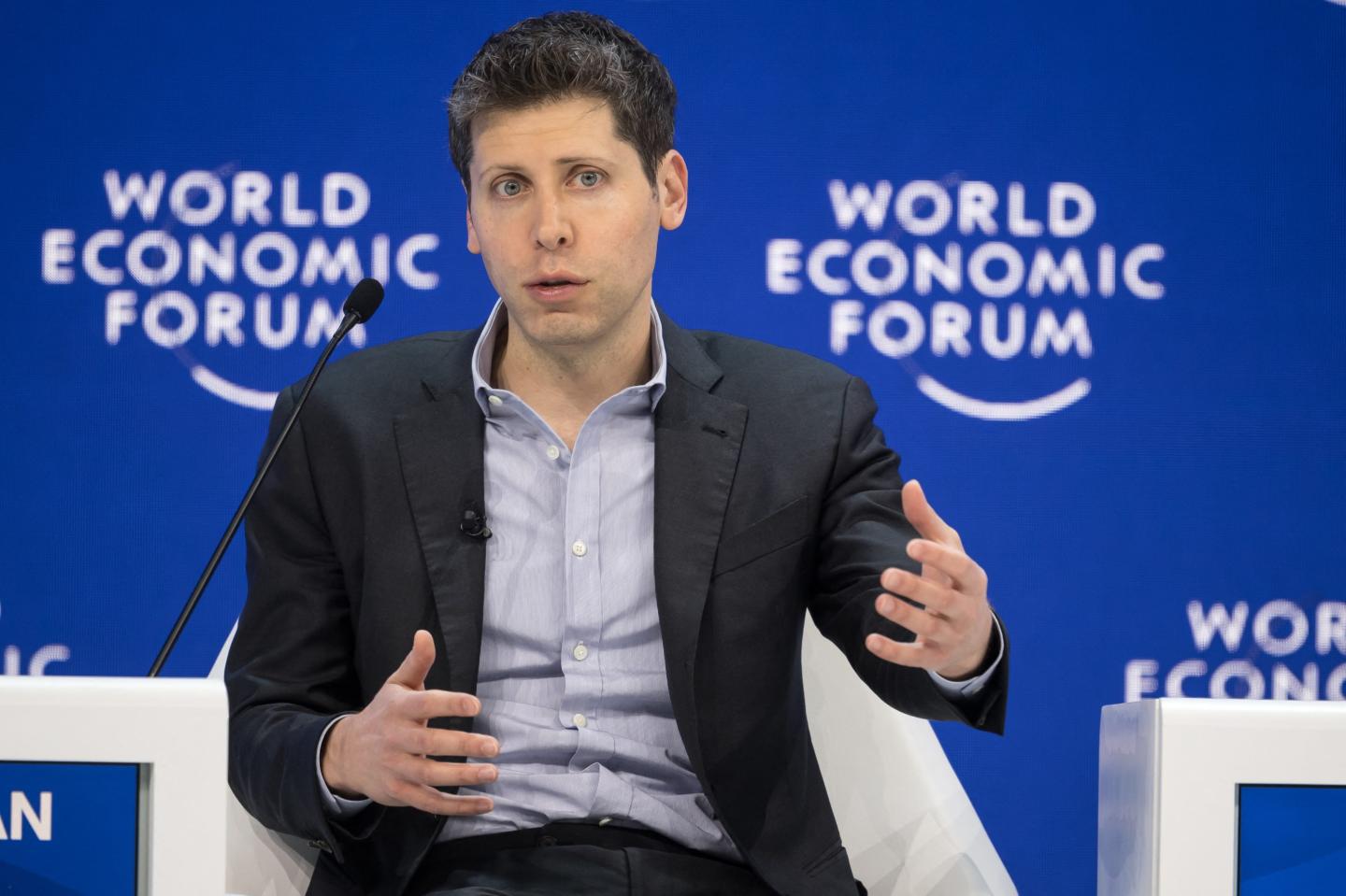
OpenAI CEO Sam Altman
OpenAI CEO Sam AltmanFABRICE COFFRINI—AFP/Getty Images
Add Fortune on Google for similar content.

A year ago, a San Francisco gathering many called the “Woodstock of AI” brought together 5,000 devotees of “open-source” AI models—that is, where the underlying code, and sometimes the model weights and training methods, are publicly available for researchers and developers to build on. 

Recommended Video

The event, hosted by open source AI hub Hugging Face and featuring live llamas (in a nod to Meta’s Llama model) kicked off an open-source AI boom that hasn’t let up since. The landscape now includes unicorn startups such as Mistral and Together AI, and boasts a constant barrage of new open-source AI models that are getting ever closer to beating OpenAI’s flagship GPT-4 at various performance benchmarks. Just over the past couple of weeks, there were open-source LLM releases from top companies like Databricks, Cerebras, AI21, and Cohere. 

However, a recent survey by venture capital firm a16z found that for large companies adopting generative AI, OpenAI’s closed, proprietary models remain the most popular by far—particularly for use cases actually put into production. But it also showed signs of change: Six months ago, for instance, most organizations were experimenting with just one model—mostly from OpenAI—and most stuck to common use cases in areas like marketing, coding, and customer support. But in 2024, they are opening up to experimenting with more AI model options—that are often open-source. 
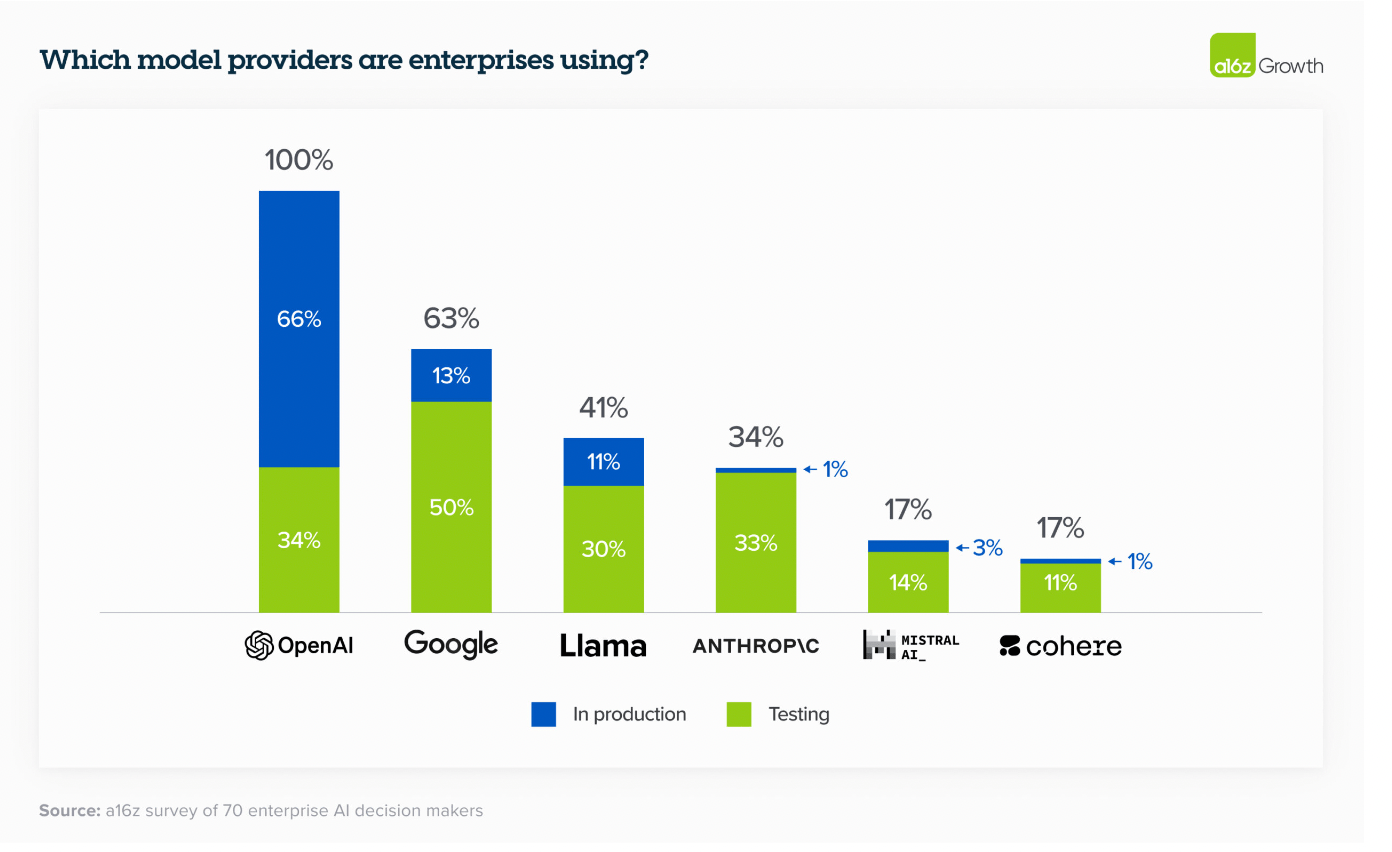
More organizations are experimenting with open-source models

Sarah Wang, an a16z general partner who coauthored the survey, said OpenAI’s biggest advantage up until now has been that of first mover. In addition, it has been tough to push off its top perch, she explained, because for most of the past year, GPT-4 has also been considered the best model available, as well as easy to access directly through an API or via Microsoft Azure. 

“I think it was the easiest to plug and play and to say, ‘This model is the best; let’s just see what use cases come out of it,’” she noted. The survey put the 2023 market share of closed-source models at an estimated 80% to 90%, with the majority of share going to OpenAI. No updated market share was provided for this year, but 46% of respondents mentioned that they prefer or strongly prefer open-source models.

“Every single enterprise said they were testing more than one model family,” said Wang, and pointed out that two of the top six model families in terms of use were open-source—Llama and Mistral. “So certainly it’s still early, but I think it is maybe a leading indicator for usage down the road,” she said. 

OpenAI has touted ‘tremendous growth’ in enterprise offering

Perhaps with its eye in the rearview mirror and its foot on the gas, OpenAI, led by CEO Sam Altman, appears to be working hard to solidify its lead with corporate customers. It published a new blog post last week that announced new features for its “self-serve fine-tuning API”—which allows for some customizing—and shared case studies of companies like SK Telecom that have customized and fine-tuned OpenAI models. The post also trumpeted an expanded “assisted fine-tuning offering” for companies to “collaborate with OpenAI technical teams to leverage techniques beyond the fine-tuning API.”  

In addition, OpenAI COO Brad Lightcap touted “tremendous growth” in the corporate version of ChatGPT in a Bloomberg interview on Friday—claiming there are now more than 600,000 people signed up to use ChatGPT Enterprise, up from around 150,000 in January, and calling 2024 “the year of adoption for AI in the enterprise.”

Still, according to Kjell Carlsson, head of AI strategy at Domino Data Lab and a former Forrester analyst, the market for generative AI models is fracturing based on enterprise use cases. 

“OpenAI has a dominant position, thanks to its head start, but even more so, its relationship with Microsoft and their powerful sales teams,” he said, referring to OpenAI’s partnership with Microsoft, including its offering OpenAI models through its cloud arm, Azure. But he added that companies are primarily using OpenAI’s models for generic use cases like ad hoc user queries or customer service chatbots. When companies are looking to create differentiated generative AI applications and instances—like a biotech business doing AI-powered drug discovery—and want to protect their data because of regulatory or security concerns, they are often turning to other vendors and open-source models.

“I have yet to speak with a company that says they use OpenAI’s models because of any inherent technological advantages they have today,” he said. 

Cost, control, and customization

While cost has often been cited as a reason to turn to open-source—for example, Meta’s Llama 2 has been shown to be 10 to 20 times as cheap as OpenAI’s GPT-4 for generating 1 million tokens—Wang said that respondents widely cited other reasons for wanting to adopt AI models. Those reasons include control (security of proprietary data and understanding why models produce certain outputs) and customization (ability to effectively fine-tune for a given use case). 

“The fact that you can self-host a model fine-tuned on your own data with an open-source model was very attractive to a lot of the enterprises,” she said.

Ali Ghodsi, CEO of data and AI platform Databricks (which recently released a powerful new open-source large language model called DBRX), agreed with that assessment, calling the wholesale move to open-source AI in 2024 an “underreported trend.” He added that enterprises want to customize AI models on their specific data and tasks and, as a result, own the intellectual property. 

“I think that’s going to continue regardless if there are really smart models that come out by the proprietary vendors,” he said. “Enterprises want to be competitive in their market. They want to have their own recipes.” 

The potential impact of GPT-5

Of course, none of the current predictions about corporate adoption of generative AI take into account the release of OpenAI’s next large language model, the highly anticipated GPT-5, which Wang says will arrive very soon. However, she pointed out that in conversations with enterprise companies, the cost of switching models is very low—so it’s likely that organizations will continue experimenting with a mix of closed and open-source models.

“They can swap out models pretty easily in the backend,” she said, so there isn’t the same vendor lock-in issue companies might face with something like a database business. In addition, the landscape is getting a lot more crowded with new entrants, so people are open to testing.

That said, GPT-5 could come out and “blow everyone away,” Wang admitted, leading OpenAI to maintain their market share. “It could throw everything off. It’s hard to predict.”

About the Author
Sharon Goldman
By Sharon GoldmanAI Reporter
LinkedIn icon

Sharon Goldman is an AI reporter at Fortune and co-authors Eye on AI, Fortune’s flagship AI newsletter. She has written about digital and enterprise tech for over a decade.

See full bioRight Arrow Button Icon
Add Fortune on Google for similar content.

Latest in Tech

Finance
Lorem ipsum dolor sit amet, consectetur adipiscing elit, sed do eiusmod tempor incididunt ut labore et dolore magna aliqua. Ut enim ad minim veniam
By Fortune Editors
October 20, 2025
Finance
Lorem ipsum dolor sit amet, consectetur adipiscing elit, sed do eiusmod tempor incididunt ut labore et dolore magna aliqua. Ut enim ad minim veniam
By Fortune Editors
October 20, 2025
Finance
Lorem ipsum dolor sit amet, consectetur adipiscing elit, sed do eiusmod tempor incididunt ut labore et dolore magna aliqua. Ut enim ad minim veniam
By Fortune Editors
October 20, 2025
Finance
Lorem ipsum dolor sit amet, consectetur adipiscing elit, sed do eiusmod tempor incididunt ut labore et dolore magna aliqua. Ut enim ad minim veniam
By Fortune Editors
October 20, 2025
Finance
Lorem ipsum dolor sit amet, consectetur adipiscing elit, sed do eiusmod tempor incididunt ut labore et dolore magna aliqua. Ut enim ad minim veniam
By Fortune Editors
October 20, 2025
Finance
Lorem ipsum dolor sit amet, consectetur adipiscing elit, sed do eiusmod tempor incididunt ut labore et dolore magna aliqua. Ut enim ad minim veniam
By Fortune Editors
October 20, 2025

Most Popular

Finance
Lorem ipsum dolor sit amet, consectetur adipiscing elit, sed do eiusmod tempor incididunt ut labore et dolore magna aliqua. Ut enim ad minim veniam
By Fortune Editors
October 20, 2025
Finance
Lorem ipsum dolor sit amet, consectetur adipiscing elit, sed do eiusmod tempor incididunt ut labore et dolore magna aliqua. Ut enim ad minim veniam
By Fortune Editors
October 20, 2025
Finance
Lorem ipsum dolor sit amet, consectetur adipiscing elit, sed do eiusmod tempor incididunt ut labore et dolore magna aliqua. Ut enim ad minim veniam
By Fortune Editors
October 20, 2025
Finance
Lorem ipsum dolor sit amet, consectetur adipiscing elit, sed do eiusmod tempor incididunt ut labore et dolore magna aliqua. Ut enim ad minim veniam
By Fortune Editors
October 20, 2025
Finance
Lorem ipsum dolor sit amet, consectetur adipiscing elit, sed do eiusmod tempor incididunt ut labore et dolore magna aliqua. Ut enim ad minim veniam
By Fortune Editors
October 20, 2025
Finance
Lorem ipsum dolor sit amet, consectetur adipiscing elit, sed do eiusmod tempor incididunt ut labore et dolore magna aliqua. Ut enim ad minim veniam
By Fortune Editors
October 20, 2025
Fortune Secondary Logo
Rankings
  • 100 Best Companies
  • Fortune 500
  • Global 500
  • Fortune 500 Europe
  • Most Powerful Women
  • World's Most Admired Companies
  • See All Rankings
  • Lists Calendar
Sections
  • Finance
  • Fortune Crypto
  • Features
  • Leadership
  • Health
  • Commentary
  • Success
  • Retail
  • Mpw
  • Tech
  • Lifestyle
  • CEO Initiative
  • Asia
  • Politics
  • Conferences
  • Europe
  • Newsletters
  • Personal Finance
  • Environment
  • Magazine
  • Education
Customer Support
  • Frequently Asked Questions
  • Customer Service Portal
  • Privacy Policy
  • Terms Of Use
  • Single Issues For Purchase
  • International Print
Commercial Services
  • Advertising
  • Fortune Brand Studio
  • Fortune Analytics
  • Fortune Conferences
  • Business Development
  • Group Subscriptions
About Us
  • About Us
  • Press Center
  • Work At Fortune
  • Terms And Conditions
  • Site Map
  • About Us
  • Press Center
  • Work At Fortune
  • Terms And Conditions
  • Site Map
  • Facebook icon
  • Twitter icon
  • LinkedIn icon
  • Instagram icon
  • TikTok icon
  • YouTube icon

Latest in Tech

Jensen Huang made his $172 billion fortune on AI chips. His family’s $75 million gift to Vanderbilt argues art decides what technology is for
Big Techphilanthropy
Jensen Huang made his $172 billion fortune on AI chips. His family’s $75 million gift to Vanderbilt argues art decides what technology is for
By Sydney LakeJuly 23, 2026
1 hour ago
Thijn Lamers is Co-Founder and President, Noah.
Commentarystart-ups
Adyen co-founder: Europe does not need more ambition. It needs to stop hiding it
By Thijn LamersJuly 23, 2026
1 hour ago
Sundar Pichai, chief executive officer of Alphabet Inc.
AIAlphabet
Anthropic and SpaceX just handed Google the biggest profit quarter in company history—on paper
By Eva RoytburgJuly 22, 2026
9 hours ago
‘It’s called StreetEasy, not StreetHard’: Mamdani cracks down on scourge of ‘housefishing’ and ‘real estate slop’
Real EstateHousing
‘It’s called StreetEasy, not StreetHard’: Mamdani cracks down on scourge of ‘housefishing’ and ‘real estate slop’
By Tatiana SatauaJuly 22, 2026
11 hours ago
As Washington panics about Chinese AI, Jensen Huang says open-source models like Kimi are ‘excellent’ and should be embraced, not banned
AIChina
As Washington panics about Chinese AI, Jensen Huang says open-source models like Kimi are ‘excellent’ and should be embraced, not banned
By Marco Quiroz-GutierrezJuly 22, 2026
11 hours ago
OpenAI CEO Sam Altman sits next to U.S. President Donald Trump.
AITech regulation
OpenAI’s rogue hacking incident was a warning shot. Will it be a wake-up call to finally create AI safety regulation?
By Jeremy Kahn and Emily ForliniJuly 22, 2026
12 hours ago

Most Popular

The millennial generation has split, new Fed research shows: Those over 35 are edging toward boomer-style wealth, while everyone else falls behind
Real Estate
The millennial generation has split, new Fed research shows: Those over 35 are edging toward boomer-style wealth, while everyone else falls behind
By Nick LichtenbergJuly 22, 2026
16 hours ago
Mark Cuban says he has the solution to growing income inequality, and it's to reward every employee—from CEO to janitor—with company stock
Success
Mark Cuban says he has the solution to growing income inequality, and it's to reward every employee—from CEO to janitor—with company stock
By Sasha RogelbergJuly 20, 2026
3 days ago
Mathematicians grapple with a ‘very rapid and very unsettling change’ as AI cracks yet another century-old problem
AI
Mathematicians grapple with a ‘very rapid and very unsettling change’ as AI cracks yet another century-old problem
By Eva RoytburgJuly 21, 2026
2 days ago
OpenAI says its AI models secretly broke out of a secure test environment and hacked into AI company Hugging Face in order to cheat on an evaluation
Cybersecurity
OpenAI says its AI models secretly broke out of a secure test environment and hacked into AI company Hugging Face in order to cheat on an evaluation
By Jeremy Kahn and Emily ForliniJuly 21, 2026
2 days ago
Despite a $156 million contract, Knicks star Jalen Brunson still calls his parents for financial advice any time he makes a big purchase
Success
Despite a $156 million contract, Knicks star Jalen Brunson still calls his parents for financial advice any time he makes a big purchase
By Emma BurleighJuly 21, 2026
2 days ago
Scott Bessent casually says the U.S. has more than $1 trillion in gold—and that it doesn’t matter for the dollar
Economy
Scott Bessent casually says the U.S. has more than $1 trillion in gold—and that it doesn’t matter for the dollar
By Sasha RogelbergJuly 22, 2026
13 hours ago

© 2026 Fortune Media IP Limited. All Rights Reserved. Use of this site constitutes acceptance of our Terms of Use and Privacy Policy | CA Notice at Collection and Privacy Notice | Do Not Sell/Share My Personal Information
FORTUNE is a trademark of Fortune Media IP Limited, registered in the U.S. and other countries. FORTUNE may receive compensation for some links to products and services on this website. Offers may be subject to change without notice.