• Home
  • News
  • Fortune 500
  • Tech
  • Finance
  • Leadership
  • Lifestyle
  • Rankings
  • Multimedia
TechApple

Apple’s regulatory battle with Europe offers a preview of what’s coming for American consumers

By
Kelvin Chan
Kelvin Chan
and
The Associated Press
Down Arrow Button Icon
By
Kelvin Chan
Kelvin Chan
and
The Associated Press
Down Arrow Button Icon
March 22, 2024, 5:41 AM ET
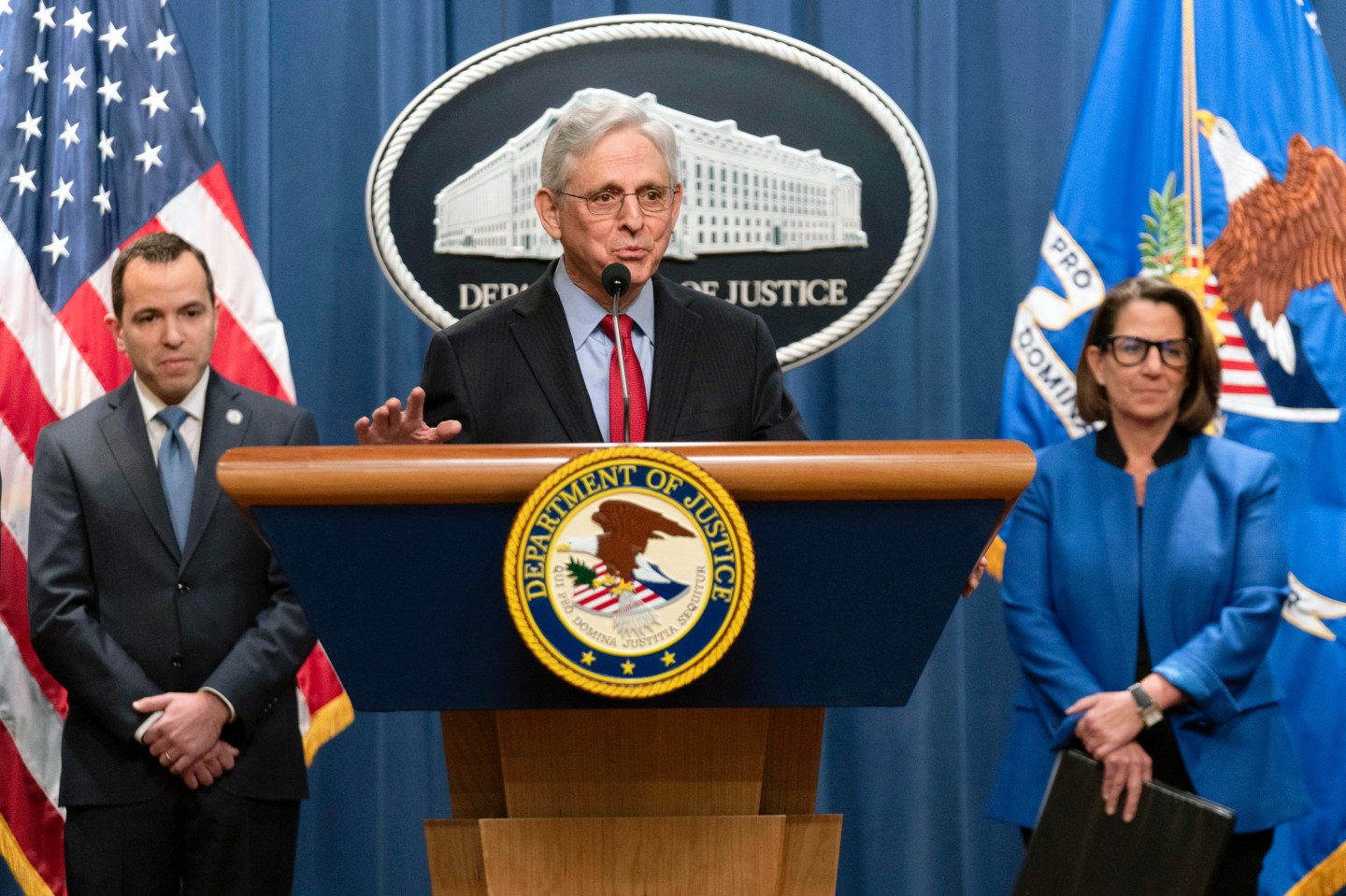
Attorney General Merrick Garland accompanied by New Jersey Attorney General Matthew Platkin and Deputy Attorney General Lisa Monaco, speaks during a news conference at the Department of Justice headquarters in Washington, on March 21, 2024. The Justice Department on Thursday announced a sweeping antitrust lawsuit against Apple.
Attorney General Merrick Garland accompanied by New Jersey Attorney General Matthew Platkin and Deputy Attorney General Lisa Monaco, speaks during a news conference at the Department of Justice headquarters in Washington, on March 21, 2024. The Justice Department on Thursday announced a sweeping antitrust lawsuit against Apple. Jose Luis Magana—AP

It’ll likely take years before the U.S. government’s massive antitrust lawsuit against Apple is resolved — but the iPhone maker’s troubles with European regulators offer a glimpse of what changes American customers may see down the line.

Recommended Video

The U.S. lawsuit seeks to stop Apple from undermining technologies that compete with its own apps in areas such as streaming, messaging and digital payments. The Department of Justice also wants to prevent the tech giant from building language into its contracts with developers, accessory makers and consumers that lets it obtain or keep a monopoly.

These are similar to themes that the European Commission, the bloc’s executive arm and top antitrust enforcer, and Apple have been wrangling over for years.

EU antitrust watchdogs have launched multiple antitrust cases accusing Apple of violating the 27-nation bloc’s competition laws, while also imposing tough digital rules aimed at stopping tech companies from cornering digital markets.

Brussels’ efforts will soon start to have an impact on the way the company does business and the experience iPhone users have in Europe. And the changes could signal what’s to come for U.S. Apple users — if the Justice Department has its way, at least.

Here’s a closer look:

Music streaming

Music streaming users typically weren’t able to pay for their Spotify subscriptions directly through their iPhone apps. They couldn’t even be informed by email of subscription prices, promos and offers by Spotify or other music streaming services. That’s because Apple puts tight restrictions on apps that compete with its own Apple Music service.

But when Spotify complained to the European Union, antitrust regulators opened a yearslong investigation that resulted in an order for Apple to stop such behavior and came with a whopping 1.8 billion euro ($2 billion) fine aimed at deterring the company from doing it again.

Margrethe Vestager, the European Commission’s competition chief, said Apple’s practices were “illegal” and “impacted millions of European consumers who were not able to make a free choice as to where, how and at what price to buy music streaming subscriptions.”

Payments

Apple tried to resolve a second EU antitrust case by proposing to let third party mobile wallet and payment service providers access the tap and go payment function on its iOS operating system.

Apple offered the concession to the European Commission, the bloc’s executive arm and top antitrust enforcer, after it accused the company in 2022 of abusing its dominant position by limiting access to its mobile payment technology.

The commission had been examining whether Apple Pay’s rules require online shops to make it the preferred or default option, effectively shutting out rival payment systems. It had also been investigating concerns that it limits access for rival payment systems to the contactless payment function on iPhones.

The commission is still mulling the offer. It has been seeking feedback from “interested parties” on the proposals before making a decision on the case.

App stores

Apple has long maintained that there can be only one app marketplace — its own — on iPhones and other iOS devices. But a sweeping set of new EU regulations that recently took effect has forced the company to open up its so-called “walled garden” and allow third-party app stores to compete.

The EU’s Digital Markets Act is a broad rulebook that targets Big Tech “gatekeeper” companies with a set of do’s and don’ts that they’ll have to abide by. One of its goals is to break up closed tech ecosystems that lock consumers into one company’s products or services.

Under the DMA, tech companies won’t be able to stop consumers from connecting with businesses outside their platforms. So Apple has been forced to allow people in Europe to download iPhone apps from stores not operated by the U.S. tech giant — a move it’s long resisted.

In a sign of that reluctance, EU regulators said they wanted to question Apple over accusations that it blocked video game company Epic Games from setting up its own app store. But Apple later reversed course and cleared the way for Fortnite maker Epic to set up its rival app store.

Fortune Brainstorm AI returns to San Francisco Dec. 8–9 to convene the smartest people we know—technologists, entrepreneurs, Fortune Global 500 executives, investors, policymakers, and the brilliant minds in between—to explore and interrogate the most pressing questions about AI at another pivotal moment. Register here.
About the Authors
By Kelvin Chan
See full bioRight Arrow Button Icon
By The Associated Press
See full bioRight Arrow Button Icon

Latest in Tech

NewslettersTerm Sheet
How Anthropic grew—and what the $183 billion giant faces next
By Allie GarfinkleDecember 4, 2025
11 minutes ago
Andrew Ross Sorkin and Alex Karp speak onstage during The New York Times DealBook Summit 2025 at Jazz at Lincoln Center on December 03, 2025 in New York City.
C-Suitepalantir
Palantir CEO Alex Karp defends being an ‘arrogant prick’—and says more CEOs should be, too
By Eva RoytburgDecember 4, 2025
1 hour ago
Apple head of user interface design Alan Dye speaking in a video for the company's 2025 WWDC event. (Courtesy Apple)
NewslettersFortune Tech
Meta poaches Apple interface design chief Alan Dye
By Andrew NuscaDecember 4, 2025
1 hour ago
InnovationBrainstorm Design
Should form always follow function? Architect Ole Scheeren isn’t sure: ‘We think of buildings as living organisms’
By Christina PantinDecember 4, 2025
6 hours ago
satellite
AIData centers
Google’s plan to put data centers in the sky faces thousands of (little) problems: space junk
By Mojtaba Akhavan-TaftiDecember 3, 2025
15 hours ago
Mark Zuckerberg, chief executive officer of Meta Platforms Inc., during the Meta Connect event in Menlo Park, California, US, on Wednesday, Sept. 25, 2024.
AIMeta
Inside Silicon Valley’s ‘soup wars’: Why Mark Zuckerberg and OpenAI are hand-delivering soup to poach talent
By Eva RoytburgDecember 3, 2025
16 hours ago

Most Popular

placeholder alt text
North America
Jeff Bezos and Lauren Sánchez Bezos commit $102.5 million to organizations combating homelessness across the U.S.: ‘This is just the beginning’
By Sydney LakeDecember 2, 2025
2 days ago
placeholder alt text
Economy
Ford workers told their CEO 'none of the young people want to work here.' So Jim Farley took a page out of the founder's playbook
By Sasha RogelbergNovember 28, 2025
6 days ago
placeholder alt text
North America
Anonymous $50 million donation helps cover the next 50 years of tuition for medical lab science students at University of Washington
By The Associated PressDecember 2, 2025
2 days ago
placeholder alt text
C-Suite
MacKenzie Scott's $19 billion donations have turned philanthropy on its head—why her style of giving actually works
By Sydney LakeDecember 2, 2025
2 days ago
placeholder alt text
Innovation
Google CEO Sundar Pichai says we’re just a decade away from a new normal of extraterrestrial data centers
By Sasha RogelbergDecember 1, 2025
3 days ago
placeholder alt text
Economy
Scott Bessent calls the Giving Pledge well-intentioned but ‘very amorphous,’ growing from ‘a panic among the billionaire class’
By Nick LichtenbergDecember 3, 2025
18 hours ago
Rankings
  • 100 Best Companies
  • Fortune 500
  • Global 500
  • Fortune 500 Europe
  • Most Powerful Women
  • Future 50
  • World’s Most Admired Companies
  • See All Rankings
Sections
  • Finance
  • Leadership
  • Success
  • Tech
  • Asia
  • Europe
  • Environment
  • Fortune Crypto
  • Health
  • Retail
  • Lifestyle
  • Politics
  • Newsletters
  • Magazine
  • Features
  • Commentary
  • Mpw
  • CEO Initiative
  • Conferences
  • Personal Finance
  • Education
Customer Support
  • Frequently Asked Questions
  • Customer Service Portal
  • Privacy Policy
  • Terms Of Use
  • Single Issues For Purchase
  • International Print
Commercial Services
  • Advertising
  • Fortune Brand Studio
  • Fortune Analytics
  • Fortune Conferences
  • Business Development
About Us
  • About Us
  • Editorial Calendar
  • Press Center
  • Work At Fortune
  • Diversity And Inclusion
  • Terms And Conditions
  • Site Map

© 2025 Fortune Media IP Limited. All Rights Reserved. Use of this site constitutes acceptance of our Terms of Use and Privacy Policy | CA Notice at Collection and Privacy Notice | Do Not Sell/Share My Personal Information
FORTUNE is a trademark of Fortune Media IP Limited, registered in the U.S. and other countries. FORTUNE may receive compensation for some links to products and services on this website. Offers may be subject to change without notice.