• Home
  • Latest
  • Fortune 500
  • Finance
  • Tech
  • Leadership
  • Lifestyle
  • Rankings
  • Multimedia

Trendingnow

1

The U.S. spent $30 billion to ditch textbooks for laptops and tablets: The result is the first generation less cognitively capable than their parents

2

Current price of oil as of July 13, 2026

3

Current price of silver as of Monday, July 13, 2026

1

The U.S. spent $30 billion to ditch textbooks for laptops and tablets: The result is the first generation less cognitively capable than their parents

2

Current price of oil as of July 13, 2026

3

Current price of silver as of Monday, July 13, 2026
CommentaryLabor

Trump and Biden may be ignoring America’s 130 million nonunion workers–but these voters will be seeking a champion to elect in November

By
Desirée LeClercq
Desirée LeClercq
Down Arrow Button Icon
By
Desirée LeClercq
Desirée LeClercq
Down Arrow Button Icon
February 28, 2024, 6:09 AM ET
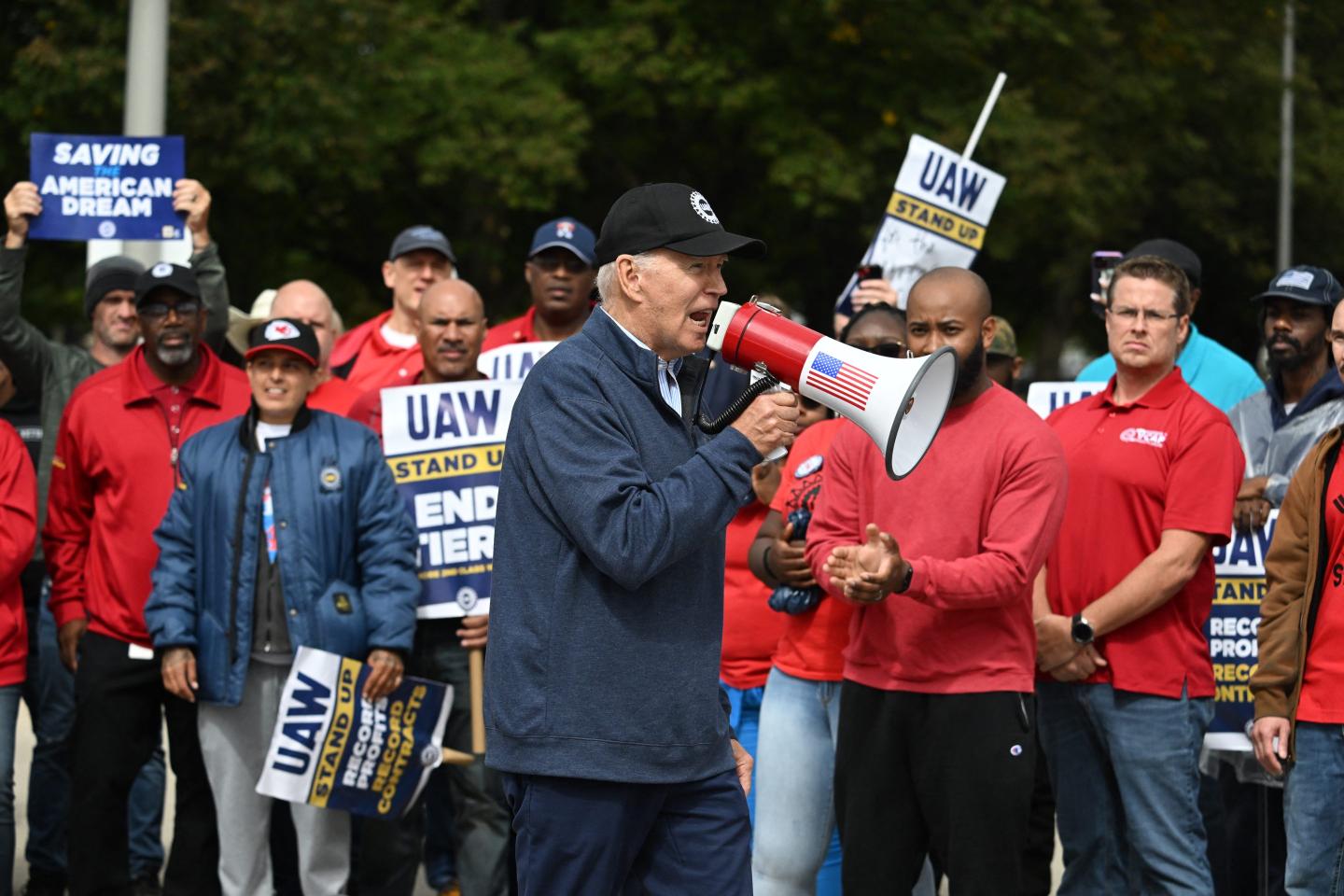
President Joe Biden addresses striking members of the United Auto Workers (UAW) union at a picket line outside a General Motors Service Parts Operations plant in Belleville, Michigan, on Sep. 26.
President Joe Biden addresses striking members of the United Auto Workers (UAW) union at a picket line outside a General Motors Service Parts Operations plant in Belleville, Michigan, on Sep. 26.Jim Watson—AFP/Getty Images
Add Fortune on Google for similar content.

Following decisive wins in the Iowa, New Hampshire, and South Carolina primaries, Donald Trump is rapidly emerging as the likely Republican nominee for the 2024 presidential elections. With another Trump-Biden contest increasingly solidified, voters are once again comparing two leading candidates who are vastly different, both ideologically and politically. But there is one area where the two candidates converge: industrial and trade policies.

The Biden administration proclaims itself the most “pro-union” presidency ever. Meanwhile, Trump claims to champion America’s blue-collar workers. The two sides recently squabbled over who would support the striking auto unions in Michigan and raced to visit their picket lines.

Billions of U.S. dollars have gone to ushering in new union jobs. The Biden administration’s CHIPS and Science Act invests heavily in construction and manufacturing jobs. Both administrations strategically increased tariffs or imposed quotas on steel and aluminum imports to drive domestic demand. Both administrations aggressively enforced labor rights abroad, nearly exclusively in the auto sector, where U.S. jobs have waned.

The beneficiaries under both administrations’ policies are union workers in manufacturing, steel, and aluminum. They are among the 10% of unionized workers, a total of 14.3 million workers out of 141.6 million. While the two sides battle over “America’s workers,” they jointly leave the vast majority of workers who are not represented by unions vulnerable to policy preferences and resource priorities decided without them.

Nonunion workers–130 million of them–will decide how to cast their votes in November. If they were to vote on labor policy alone, it’s easy to see how they might feel disillusioned. These workers are not represented, do not hold political capital, and, consequently, do not have a seat at the policymaking table. Yet, as my work shows, federal labor laws currently make it nearly impossible for those workers to aggregate and build their power.

Union workers enjoy several advantages. Not only are their wages generally higher and the benefits more plentiful, but they are also neatly organized by sectors and affiliations, ensuring easy access and strategic political presence. Both administrations have regularly consulted with union leaders. Both administrations have shared confidential developments concerning trade policy with union leaders before opening discussions to the general public. Unions owe their fee-paying members a fiduciary duty to advance their interests and protect them.

Most labor advocates will point out that the labor departments under the Biden administration have removed longstanding barriers to unionization (although we could quibble), but that view neglects the majority of workers who either elect not to unionize or work in states, mainly in the South, hostile to unionization.

However, this blind spot also represents a huge opportunity for the candidate who can offer non-union workers a seat at the table. Joe Biden or Donald Trump could do so by consulting with representatives from nonunion sectors, such as the auto sector in Alabama or domestic workers in Texas. Worker centers and other union alternatives already have established connections among those workers. They’ve fought and lost battles with legislators unwilling to protect them and clashed with large unions unwilling to affiliate with small, impoverished, and otherwise marginalized communities. Those representatives stand ready and willing to facilitate participation.

The candidates can also offer nonunion workers an equal opportunity to participate in federal advisory committees, such as the Labor Advisory Committee for Trade Negotiations and Trade Policy, currently composed exclusively of union leaders advocating for their members’ interests. And both candidates have ample staff across the states capable of visiting nonunion workplaces to engender conversations that expose the unique needs of America’s workers around the country. Those consultative processes will need to be reflected in executive and administrative orders to guarantee that nonunion workers matter in the long term, after their November votes.

Of course, by supporting big unions, both administrations indirectly support nonunion workers. After all, when unions raise wages, many nonunion workers benefit. When unions allocate their resources to advance politicians prepared to divert resources into public services and benefits, Americans–union members or not–in need of those services benefit. We are certainly better off with unions than without them.

In a world of scarce resources and priorities, however, nonunion workers bear the costs of current industrial and trade policies. Many work in downstream sectors that rely on affordable inputs and exports that rely on reciprocity and global demand.

The disparate treatment of nonunion workers calls for a new approach to federal policymaking carried out in the name of workers. We do not need to close the door to unions. But if we hope to see fair and equitable industrial and trade policies post-election–whichever direction the pendulum swings–those policies must reflect consultations across all workers, not just the relatively privileged.

Desirée LeClercq is an assistant professor of Labor Law at Cornell University’s School of Industrial and Labor Relations. Prior to joining the law faculty at Cornell, she worked as a director for labor affairs at the United States Trade Representative, as a legal officer at the International Labor Organization, and as a staff attorney for the Chairman of the National Labor Relations Board.

More must-read commentary published by Fortune:

  • Here’s how the U.S., Europe, and China are faring in the post-pandemic race for economic growth
  • Global trade is at a critical juncture–and we can’t take it for granted, WTO meeting chair warns
  • Boeing is shaking up its ‘good ole boys’ culture–but the company still has a long way to go before it gets its production and financials right
  • The anti-DEI movement has gone from fringe to mainstream. Here’s what that means for corporate America

The opinions expressed in Fortune.com commentary pieces are solely the views of their authors and do not necessarily reflect the opinions and beliefs of Fortune.

About the Author
By Desirée LeClercq
See full bioRight Arrow Button Icon
Add Fortune on Google for similar content.

Latest in Commentary

Finance
Lorem ipsum dolor sit amet, consectetur adipiscing elit, sed do eiusmod tempor incididunt ut labore et dolore magna aliqua. Ut enim ad minim veniam
By Fortune Editors
October 20, 2025
Finance
Lorem ipsum dolor sit amet, consectetur adipiscing elit, sed do eiusmod tempor incididunt ut labore et dolore magna aliqua. Ut enim ad minim veniam
By Fortune Editors
October 20, 2025
Finance
Lorem ipsum dolor sit amet, consectetur adipiscing elit, sed do eiusmod tempor incididunt ut labore et dolore magna aliqua. Ut enim ad minim veniam
By Fortune Editors
October 20, 2025
Finance
Lorem ipsum dolor sit amet, consectetur adipiscing elit, sed do eiusmod tempor incididunt ut labore et dolore magna aliqua. Ut enim ad minim veniam
By Fortune Editors
October 20, 2025
Finance
Lorem ipsum dolor sit amet, consectetur adipiscing elit, sed do eiusmod tempor incididunt ut labore et dolore magna aliqua. Ut enim ad minim veniam
By Fortune Editors
October 20, 2025
Finance
Lorem ipsum dolor sit amet, consectetur adipiscing elit, sed do eiusmod tempor incididunt ut labore et dolore magna aliqua. Ut enim ad minim veniam
By Fortune Editors
October 20, 2025

Most Popular

Finance
Lorem ipsum dolor sit amet, consectetur adipiscing elit, sed do eiusmod tempor incididunt ut labore et dolore magna aliqua. Ut enim ad minim veniam
By Fortune Editors
October 20, 2025
Finance
Lorem ipsum dolor sit amet, consectetur adipiscing elit, sed do eiusmod tempor incididunt ut labore et dolore magna aliqua. Ut enim ad minim veniam
By Fortune Editors
October 20, 2025
Finance
Lorem ipsum dolor sit amet, consectetur adipiscing elit, sed do eiusmod tempor incididunt ut labore et dolore magna aliqua. Ut enim ad minim veniam
By Fortune Editors
October 20, 2025
Finance
Lorem ipsum dolor sit amet, consectetur adipiscing elit, sed do eiusmod tempor incididunt ut labore et dolore magna aliqua. Ut enim ad minim veniam
By Fortune Editors
October 20, 2025
Finance
Lorem ipsum dolor sit amet, consectetur adipiscing elit, sed do eiusmod tempor incididunt ut labore et dolore magna aliqua. Ut enim ad minim veniam
By Fortune Editors
October 20, 2025
Finance
Lorem ipsum dolor sit amet, consectetur adipiscing elit, sed do eiusmod tempor incididunt ut labore et dolore magna aliqua. Ut enim ad minim veniam
By Fortune Editors
October 20, 2025
Fortune Secondary Logo
Rankings
  • 100 Best Companies
  • Fortune 500
  • Global 500
  • Fortune 500 Europe
  • Most Powerful Women
  • World's Most Admired Companies
  • See All Rankings
  • Lists Calendar
Sections
  • Finance
  • Fortune Crypto
  • Features
  • Leadership
  • Health
  • Commentary
  • Success
  • Retail
  • Mpw
  • Tech
  • Lifestyle
  • CEO Initiative
  • Asia
  • Politics
  • Conferences
  • Europe
  • Newsletters
  • Personal Finance
  • Environment
  • Magazine
  • Education
Customer Support
  • Frequently Asked Questions
  • Customer Service Portal
  • Privacy Policy
  • Terms Of Use
  • Single Issues For Purchase
  • International Print
Commercial Services
  • Advertising
  • Fortune Brand Studio
  • Fortune Analytics
  • Fortune Conferences
  • Business Development
  • Group Subscriptions
About Us
  • About Us
  • Press Center
  • Work At Fortune
  • Terms And Conditions
  • Site Map
  • About Us
  • Press Center
  • Work At Fortune
  • Terms And Conditions
  • Site Map
  • Facebook icon
  • Twitter icon
  • LinkedIn icon
  • Instagram icon
  • Pinterest icon

Latest in Commentary

b
CommentaryWorld Cup
Columbia Business School professors: What the Balogun red card can teach us about AI and judgment
By Oded Netzer, Christopher Frank and Paul MagnoneJuly 13, 2026
15 hours ago
usa
Commentary250 Years of Innovation
For 250 years, work defined American identity. That era Is ending
By Keith Ferrazzi and Wendy SmithJuly 11, 2026
3 days ago
m
Commentarymedicine
America’s bone health is quietly headed for a $19 billion crisis
By Matthew T. DrakeJuly 9, 2026
5 days ago
t
CommentaryEducation
AI is about to disrupt millions of jobs. A century ago, America’s answer was to build a new high school
By Tim KnowlesJuly 8, 2026
6 days ago
amit
CommentaryVenture Capital
Physical AI’s $50 trillion opportunity requires long-term conviction, but the payoff is huge 
By Amit ChaturvedyJuly 8, 2026
6 days ago
heat
Commentaryclimate change
McKinsey Global Institute: Climate planning has prioritized floods. Heat demands equal attention
By Sylvain Johansson, Mekala Krishnan, Kanmani Chockalingam and Annabel FarrJuly 7, 2026
7 days ago

Most Popular

The U.S. spent $30 billion to ditch textbooks for laptops and tablets: The result is the first generation less cognitively capable than their parents
Innovation
The U.S. spent $30 billion to ditch textbooks for laptops and tablets: The result is the first generation less cognitively capable than their parents
By Sasha RogelbergJuly 12, 2026
2 days ago
Current price of oil as of July 13, 2026
Personal Finance
Current price of oil as of July 13, 2026
By Joseph HostetlerJuly 13, 2026
20 hours ago
Current price of silver as of Monday, July 13, 2026
Personal Finance
Current price of silver as of Monday, July 13, 2026
By Joseph HostetlerJuly 13, 2026
20 hours ago
Trump embraces Australian retirement system backed by Larry Fink
Personal Finance
Trump embraces Australian retirement system backed by Larry Fink
By Brianna Sosa and BloombergJuly 12, 2026
1 day ago
How Pete Hegseth's DEI order just put Scouting America's future at stake
North America
How Pete Hegseth's DEI order just put Scouting America's future at stake
By Seth T. Kannarr, Derek H. Alderman and The ConversationJuly 13, 2026
11 hours ago
Ex-PepsiCo CEO Indra Nooyi worked from midnight until 5 a.m. as a receptionist to pay for her Yale degree—and she says ‘respect went up’ because of it
Success
Ex-PepsiCo CEO Indra Nooyi worked from midnight until 5 a.m. as a receptionist to pay for her Yale degree—and she says ‘respect went up’ because of it
By Preston ForeJuly 6, 2026
8 days ago

© 2026 Fortune Media IP Limited. All Rights Reserved. Use of this site constitutes acceptance of our Terms of Use and Privacy Policy | CA Notice at Collection and Privacy Notice | Do Not Sell/Share My Personal Information
FORTUNE is a trademark of Fortune Media IP Limited, registered in the U.S. and other countries. FORTUNE may receive compensation for some links to products and services on this website. Offers may be subject to change without notice.