Inflation has changed the way many Americans shop. Now, those changes in consumer habits are helping bring down inflation.
Fed up with prices that remain about 19%, on average, above where they were before the pandemic, consumers are fighting back. In grocery stores, they’re shifting away from name brands to store-brand items, switching to discount stores or simply buying fewer items like snacks or gourmet foods.
More Americans are buying used cars, too, rather than new, forcing some dealers to provide discounts on new cars again. But the growing consumer pushback to what critics condemn as price-gouging has been most evident with food as well as with consumer goods like paper towels and napkins.
In recent months, consumer resistance has led large food companies to respond by sharply slowing their price increases from the peaks of the past three years. This doesn’t mean grocery prices will fall back to their levels of a few years ago, though with some items, including eggs, apples and milk, prices are below their peaks. But the milder increases in food prices should help further cool overall inflation, which is down sharply from a peak of 9.1% in 2022 to 3.1%.
Public frustration with prices has become a central issue in President Joe Biden’s bid for re-election. Polls show that despite the dramatic decline in inflation, many consumers are unhappy that prices remain so much higher than they were before inflation began accelerating in 2021.
Biden has echoed the criticism of many left-leaning economists that corporations jacked up their prices more than was needed to cover their own higher costs, allowing themselves to boost their profits. The White House has also attacked “shrinkflation,” whereby a company, rather than raising the price of a product, instead shrinks the amount inside the package. In a video released on Super Bowl Sunday, Biden denounced shrinkflation as a “rip-off.”
Consumer pushback against high prices suggests to many economists that inflation should further ease. That would make this bout of inflation markedly different from the debilitating price spikes of the 1970s and early 1980s, which took longer to defeat. When high inflation persists, consumers often develop an inflationary psychology: Ever-rising prices lead them to accelerate their purchases before costs rise further, a trend that can itself perpetuate inflation.
“That was the fear — that everybody would tolerate higher prices,” said Gregory Daco, chief economist at EY, a consulting firm, who notes that it hasn’t happened. “I don’t think we’ve moved into a high inflation regime.”
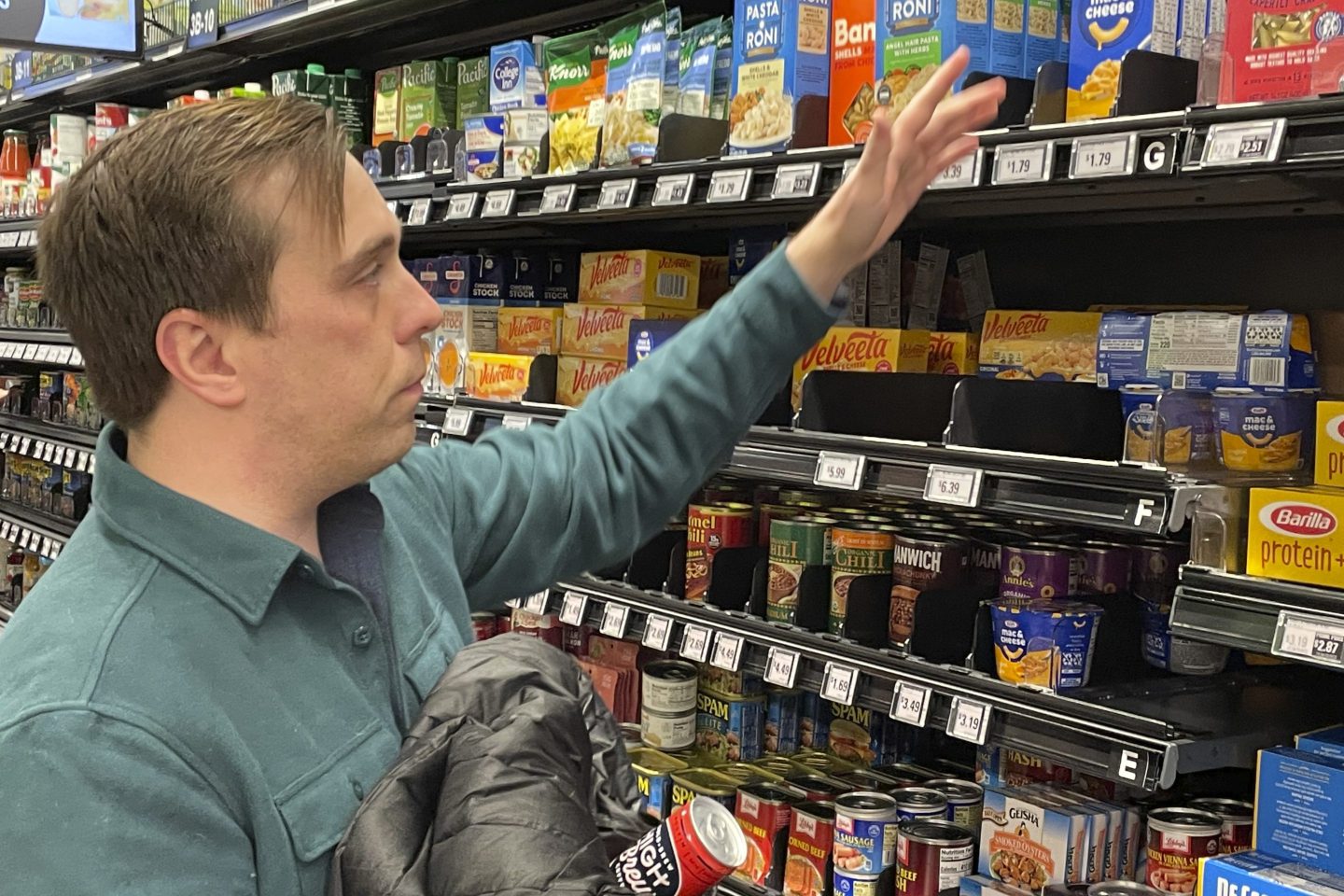
Instead, this time many consumers have reacted like Stuart Dryden, a commercial underwriter at a bank who lives in Arlington, Virginia. On a recent trip to his regular grocery store, Dryden, 37, pointed out big price disparities between Kraft Heinz-branded products and their store-label competitors, which he now favors.
Dryden, for example, loves cream cheese and bagels. A 12-ounce tub of Kraft’s Philadelphia cream cheese costs $6.69. The store brand, he noted, is just $3.19.
A 24-pack of Kraft single cheese slices is $7.69; the store label, $2.99. And a 32-ounce Heinz ketchup bottle is $6.29, while the alternative is just $1.69. Similar gaps existed with mac-and-cheese and shredded cheese products.
“Just those five products together already cost nearly $30,” Dryden said. The alternatives were less than half that, he calculated, at about $13.
“I’ve been trying private-label options, and the quality is the same and it’s almost a no-brainer to switch from the products I used to buy a ton of to just the private label,” Dryden said.
Alex Abraham, a spokesman for Kraft Heinz, said that its costs rose 3% in the final three months of last year but that the company raised its own prices only 1%.
“We are doing everything possible to find efficiencies in our factories and other parts of our business to offset and mitigate further price increases,” Abraham said.
Last week, Kraft Heinz said sales fell in the final three months of last year as more consumers traded down to cheaper brands.
Dryden has taken other steps to save money: A year ago, he moved into a new apartment after his previous landlord jacked up his rent by about 50%. His former apartment had been next to a relatively pricey grocery store, Whole Foods. Now, he shops at a nearby Amazon Fresh and has started visiting the discount grocer Aldi every couple of weeks.
Samuel Rines, an investment strategist at Corbu, says that PepsiCo, Kimberly-Clark, Procter & Gamble and many other consumer food and packaged goods companies exploited the rise in input costs stemming from supply-chain disruptions and Russia’s invasion of Ukraine to dramatically raise their prices — and increase their profits — in 2021 and 2022.
A contributing factor was that millions of Americans enjoyed solid wage gains and received stimulus checks and other government aid, making it easier for them to pay the higher prices.
Still, some decried the phenomenon as “greedflation.” And in a March 2023 research paper, the economist Isabella Weber at the University of Massachusetts, Amherst, referred to it as “seller’s inflation.”
Yet beginning late last year, many of the same companies discovered that the strategy was no longer working. Most consumers have now long since spent the savings they built up during the pandemic.
Lower-income consumers, in particular, are running up credit card debt and falling behind on their payments. Americans overall are spending more cautiously. Daco notes that overall sales during the holiday shopping season were up just 4% — and most of it reflected higher prices rather than consumers actually buying more things.
As an example, Rines points to Unilever, which makes, among other items, Hellman’s mayonnaise, Ben & Jerry’s ice cream and Dove soaps. Unilever jacked up its prices 13.3% on average across its brands in 2022. Its sales volume fell 3.6% that year. In response, it raised prices just 2.8% last year; sales rose 1.8%.
“We’re beginning to see the consumer no longer willing to take the higher pricing,” Rines said. “So companies were beginning to get a little bit more skeptical of their ability to just have price be the driver of their revenues. They had to have those volumes come back, and the consumer wasn’t reacting in a way that they were pleased with.”
Unilever itself recently attributed poor sales performance in Europe to “share losses to private labels.”
Other businesses have noticed, too. After their sales fell in the final three months of last year, PepsiCo executives signaled that this year they would rein in price increases and focus more on boosting sales.
“In 2024, we see … normalization of the cost, normalization of inflation,” CEO Ramon Laguarta said. “So we see everything trending back to our long-term” pricing trends.
Jeffrey Harmening, CEO of General Mills, which makes Cheerios, Chex Cereal, Progresso soups and dozens of other brands, has acknowledged that his customers are increasingly seeking bargains.
And McDonald’s executives have said that consumers with incomes below $45,000 are visiting less and spending less when they do visit and say the company plans to highlight its lower-priced items.
“Consumers are more wary — and weary — of pricing, and we’re going to continue to be consumer-led in our pricing decisions,” Ian Borden, the company’s chief financial officer, told investors.
Officials at the Federal Reserve, the nation’s primary inflation-fighting institution, have cited consumers’ growing reluctance to pay high prices as a key reason why they expect inflation to fall steadily back to their 2% annual target.
“Firms are telling us that price sensitivity is very much higher now,” Mary Daly, president of the Federal Reserve Bank of San Francisco and a member of the Fed’s interest-rate setting committee, said last week. “Consumers don’t want to purchase unless they’re seeing a 10% discount. … This is a serious improvement in the role that consumers play in bridling inflation.”
Surveys by the Fed’s regional banks have found that companies across all industries expect to impose smaller price increases this year. The New York Fed says companies in its region plan to raise prices an average of about 3% this year, down from about 5% in 2023 and as much as 7% to 9% in 2022.
Such trends suggest that companies were well on their way to slowing their price hikes before Biden’s most recent attacks on price gouging.
Claudia Sahm, founder of SAHM Consulting and a former Fed economist, said, “consumers are more powerful than President Biden.”