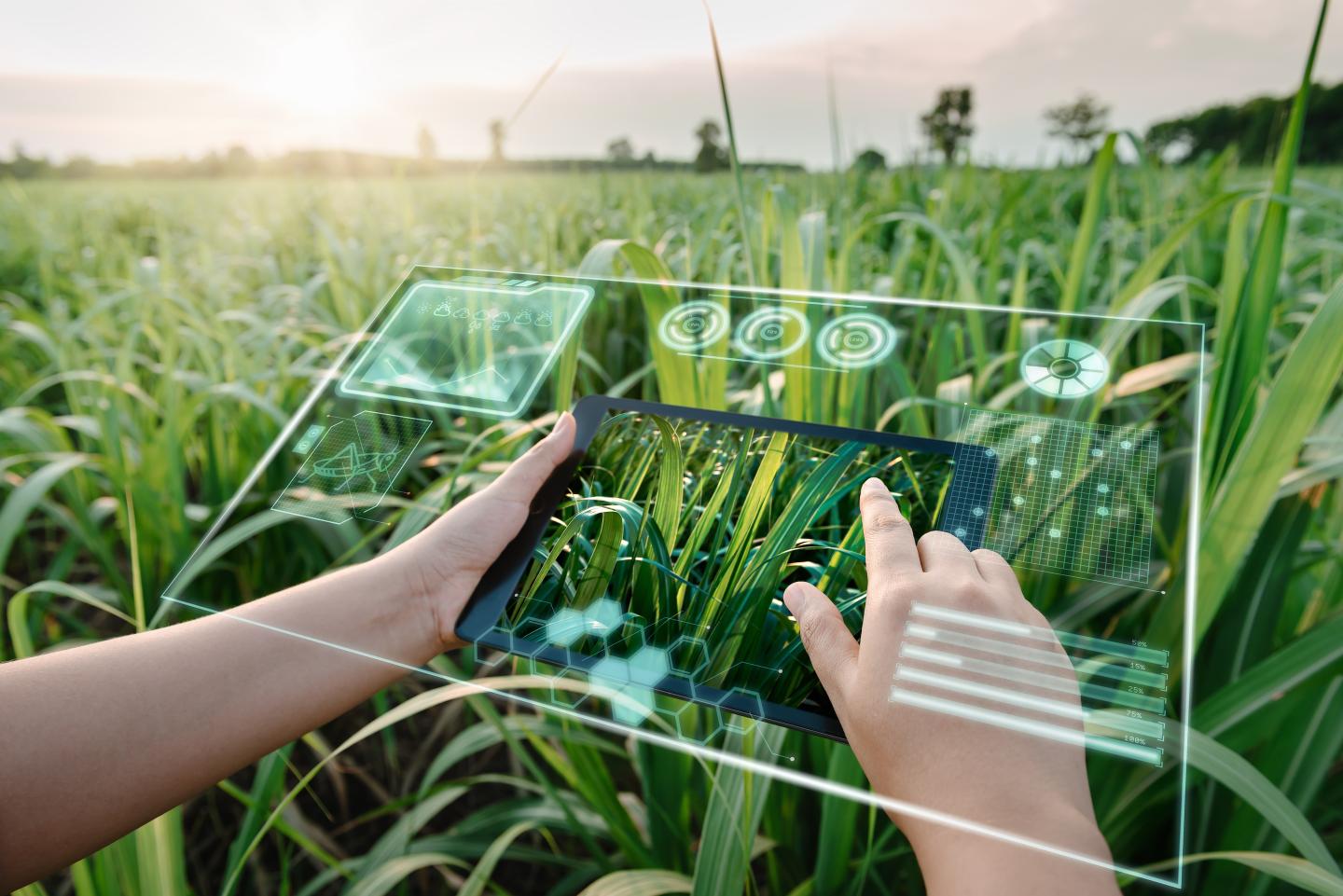
For farmers, using Verdant Robotics’ Model 3 Smart Sprayer to tackle weeds is hardly a chore.
The AI-powered machine clips onto any tractor, says Verdant founder and CEO Gabe Sibley, noting that it comes in 20- and 40-foot versions to match the standard vehicle sizes in his company’s native California. “It’s like the intelligent agronomist sharpshooter that rides along on the back.”
The aimable sprayer, which is equipped with a camera and combines crop application with data analytics, targets weeds 20 times more accurately than its nearest competitor. “It goes from something that could be a few inches down to a millimeter, in terms of precision and accuracy,” says Sibley, who launched Silicon Valley startup Verdant in 2018 after working on autonomous vehicles. “If you’ve got dense crops like garlic, carrots, onions, you can get in between and deliver organic herbicides without touching any of the crops.”
Because the Smart Sprayer uses up to 96% less herbicide than its traditional counterpart, switching to organic becomes economical. “That obviously opens up a much higher-margin product for the grower, at a cost that’s approaching conventional costs,” says Sibley, whose company aims to help build a sustainable and profitable agriculture system. “That’s good for their pocketbook, and also good for us consumers and good for the land.”
Verdant belongs to a crop of agricultural technology companies that use AI in their products and services. Elsewhere, AI might provoke fear and worry, but it’s a force for good in agtech, where applications include robotics, plant breeding, and weather forecasting. By helping farmers grow better food more efficiently, the technology plays an increasingly vital role in feeding the world’s growing population and shrinking agriculture’s vast environmental footprint.
Investors in Verdant include AgFunder, a Silicon Valley venture capital firm specializing in agtech and foodtech. Rob Leclerc and Michael Dean founded AgFunder in 2013 after launching a short-lived food and agriculture business in West Africa.
“Our thesis was that technology around one of the largest, most important industries, particularly the kind of technologies coming out of Silicon Valley, was going to be quite transformative and important,” recalls Leclerc, whose five degrees include a Ph.D. in computational biology from Yale and a master’s in AI.
Finding that potential limited partners were more interested in Uber or the next Airbnb, Leclerc and Dean generated interest by launching AgFunder News, which they modeled as the TechCrunch of food and agriculture. Besides building widespread brand recognition, that platform helped connect them to investors, Leclerc says.
“Another key difference from traditional firms is we build our own technology and try to use those as superpowers,” he adds. To that end, AgFunder hired an AI expert who developed a system that now sources about three-quarters of its early-stage investment opportunities.
Since launching its first venture funds in 2017, AgFunder has grown to about $200 million in assets under management, making it probably the second most active VC player in its space, Leclerc says. The firm, which invests in startups worldwide, has an early-stage accelerator in Singapore in addition to its core portfolio of about 70 companies. About 30% to 40% of those businesses leverage AI in some form, Leclerc reckons: “We’re certainly the most active ag robotics investor anywhere in the world.”
Asked what drew him to agriculture, Leclerc observes that it’s one of the least digitized industries but also one of the biggest. “How do you bring technology to really move this forward in a meaningful way, and bring the Silicon Valley venture capital model to try to make progress in an extremely rapid and meaningful way?”
The technology is bleeding-edge, Leclerc says, spanning synthetic biology and satellites as well as robotics. “It’s way ahead, in many ways, of consumer products.”
He also argues that unlike, say, Facebook or Snapchat, food and agriculture are indispensable. “The impact that has on the environment, health, economies, individuals—it’s really hard to see [another] industry where you could have as much personal impact.”
For a startup like Verdant, strong ties to the agriculture industry and top-level technical expertise are competitive advantages.
Sibley founded the company with COO Curtis Garner, who formerly headed operations for the world’s largest tomato grower: “We could never have done it without his experience as a farmer and his relationships, his ability to connect us through to growers.”
Verdant, which has a core engineering team of about 40, has been “stupendously fortunate to attract great people,” Sibley says. They include alumni of Google’s now-defunct X team and autonomous driving outfit Waymo, as well as the former software lead for the Curiosity Mars rover. Sibley, who has a Ph.D. in computer science, previously launched Zippy, a specialist in sidewalk delivery robotics that he sold to General Motors in 2018.
“There’s a lot of people that were tired of not shipping in Silicon Valley—you know, self-driving cars—and people wanting to…have an impact sooner,” he says. “[Agtech] has a massive impact on not just the farmer’s pocketbook but on growers’ land, the sustainability of their land, the health of our watershed and the planet more broadly.”
Late last year, Verdant closed $46.5 million in Series A funding from AgFunder and other investors. But the agrifoodtech industry faces growing pains. Globally, funding totaled $29.6 billion in 2022, according to AgFunder’s latest investment report. That’s seven times more than a decade earlier. However, it’s also 44% below the record $51.7 billion total for 2021.
War, inflation, and supply-chain disruptions helped bring tech valuations back down to earth in 2022, the report notes. As part of a massive pullback, the generalist venture capital investors who dominate agtech funding are retreating to their core competencies, Leclerc says. Also, “VCs have traditionally avoided investing in the world of atoms in favor of software” because the margins are higher, he adds. “There’s certainly going to be winners still in the space. But I think it’s going to be far, far, far more difficult than we predicted it would be going back a few years.”
Across the country in St. Louis, Jason Bull is chief technology officer at Benson Hill. The agtech firm, founded in 2012, deploys AI to breed high-protein, high-yield soybeans and yellow peas.
Benson Hill focuses on using genetics to drive innovation because it’s a proven lever in agriculture and hasn’t really been applied with the end consumer in mind, Bull explains.
“That then gives us a knock-on effect in terms of producing more protein per acre,” says the Australian expat, who has a Ph.D. in quantitative genetics and statistics and previously spent 20 years at biotech giant Monsanto, where his team introduced machine learning. More protein means fewer processing steps too. “It also means less additives in the final product. So we get a lot of knock-on effects which are very environmentally advantageous, which is important to us.”
Of the roughly 200 people who work in research and development at Benson Hill, everyone interacts with machine learning in some way, Bull says.
So how does the breeding process work? Machine learning lends itself well to plant breeding because it lets you design and optimize for a desired outcome, Bull notes. Starting with the product it wants to create for consumers, Benson Hill inputs genomic, human-trial, and other data into its cloud-based machine learning interface, called CropOs.
Unlike GMO breeding, which requires introducing foreign genes, Benson Hill’s process relies on the plant’s own genome. As it narrows down the breeding selection from several thousand choices to a handful of high-value options, the algorithm also factors in operational details like budget and lab capacity, Bull says. “It takes all that into consideration, which then gives us a prescription for how we do our breeding, a very optimized script.”
Adoption of Benson Hill products by farmers has been strong, Bull says, with the company’s soybeans used on more than 300,000 acres so far. “We’ve been selling into aquaculture and into the food industry for two or three years now,” he adds. “We’re seeing the sort of signals we want to see in terms of receptivity and uplift.”
Back at Verdant Robotics, CEO Sibley points out that his company’s Smart Sprayer is a game-changing tool for agronomists as well as growers. Using its camera, the device can digitize a field in a minute level of detail. “You build the digital twin of the farm, down to every single plant,” Sibley says. “And you’re tracking it over time.”
This spatial and temporal model, which reveals the state of each plant, lets an agronomist search for better growing policies, he explains: “You can sweep chemistries and concentrations, temperatures, pressures, environmental conditions, and systematically go after what works.”
That opens the door to outcome-based pricing. “Instead of just selling lots and lots of chemistry and having a business model that’s based on volume, you can have a business model that’s based on outcomes for the grower,” Sibley says. “So your interests are aligned with the grower. And that’s a pretty transformational thing that you really only get if you’re digitizing the crop and then acting on that digital model at that type of specificity.”
There’s so much interest in the Smart Sprayer that Verdant must scale up to meet demand. Agriculture is a $55 billion spend in California alone, says Sibley, noting that the industry has a great need for efficiencies. “We take something that may cost the grower $3,000 an acre, and we help them do it for closer to $30 an acre. And that type of step change in value, it’s unimpeachable. Water flows downhill.”
Looking ahead, what potential does AI hold to keep transforming agtech?
Benson Hill’s Bull highlights predictive analytics. “Breeding and the GMO technologies account for probably the vast majority of what we see in our food crops,” he says. Increasingly, they’re being driven by AI.
“Which genes do I want to add? Well, that’s predicted by AI,” Bull says. “Which genes do I want to put together? Well, that’s predicted by AI. Which molecule is going to be the best to give resistance to this herbicide or this insect? Well, again, AI is playing a larger and larger role.”
For his part, Sibley cites the wide variety of robotics systems on display at trade shows. “It’s kind of the pre-Cambrian explosion of agtech,” he says. “You’re going to see a lot more before it starts to thin down to successful approaches.”
So far, agtech companies have only peripherally taken advantage of foundation and large-language AI models, Sibley adds. “The irony is that it’s doing white-collar jobs first, and it’s the hard physical stuff that’s going to take longer to come to fruition. Physical robotics is still the hard problem. We used to always think it was the dull, dangerous, dirty stuff that would be automated first, but it turns out it’s not. That’s going last.”