• Home
  • Latest
  • Fortune 500
  • Finance
  • Tech
  • Leadership
  • Lifestyle
  • Rankings
  • Multimedia
CommentaryCybersecurity

A quiet cybersecurity revolution is touching every corner of the economy as U.S., allies ‘pull all the levers’ to face new threats

By
Eric Noonan
Eric Noonan
Down Arrow Button Icon
By
Eric Noonan
Eric Noonan
Down Arrow Button Icon
December 20, 2023, 7:36 AM ET
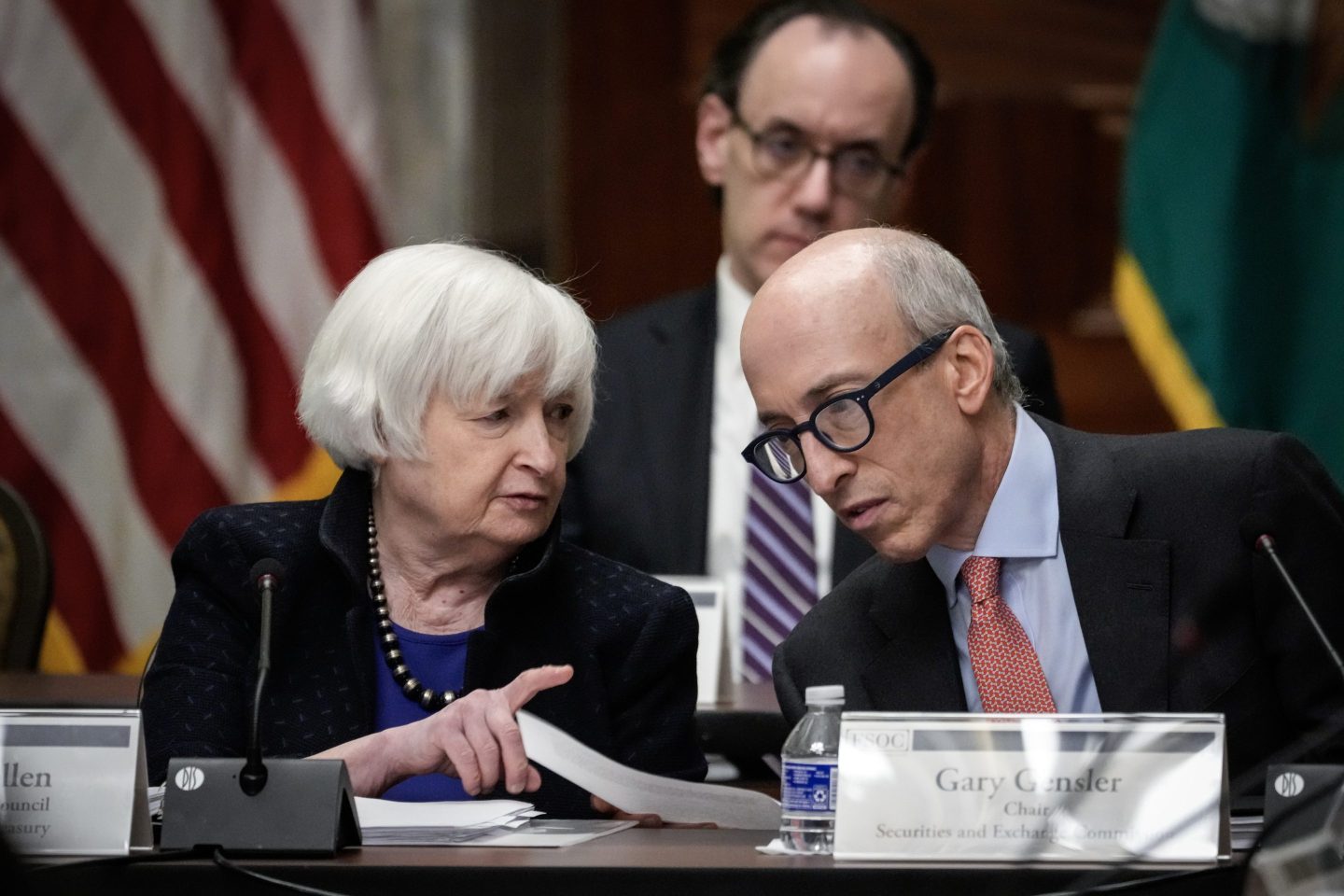
U.S. Treasury Secretary Janet Yellen speaks with U.S. Securities and Exchange Commission (SEC) chairman Gary Gensler during a meeting of the Financial Stability Oversight Council at the U.S. Department of Treasury on Dec. 14. The group has published their 2023 annual report, which takes a look at the past year in climate, banking, cybersecurity, artificial intelligence, cryptocurrency, and other issues.
U.S. Treasury Secretary Janet Yellen speaks with U.S. Securities and Exchange Commission (SEC) chairman Gary Gensler during a meeting of the Financial Stability Oversight Council at the U.S. Department of Treasury on Dec. 14. The group has published their 2023 annual report, which takes a look at the past year in climate, banking, cybersecurity, artificial intelligence, cryptocurrency, and other issues.Drew Angerer - Getty Images

On Dec. 15, the Securities and Exchange Commission’s (SEC’s) expanded cybersecurity rules came into effect, requiring public companies to disclose incidents within four business days. That means headline-grabbing breaches–such as the one that affected all Okta customer support system users or the 23andMe hack that included the information of nearly 7 million customers–will have even greater consequences than whatever data was compromised. And the SEC rules are only the tip of the iceberg of changes to regulatory compliance.

With little fanfare and largely unnoticed by the press, institutional investors, or anyone else, the federal government is quietly directing a seismic shift in the economy by mandating stringent cybersecurity compliance across all 16 critical infrastructure sectors.

These sectors include well-known and highly relegated markets such as the defense industrial base, financial services, and energy–regulated by the Department of Defense (DoD), SEC, and Department of Energy (DoE), respectively. However, often overlooked are the subsectors beneath those 16 sectors, which essentially combine to comprise nearly every company and component of our economy, making nearly every business in scope for the emerging cybersecurity compliance regulations flowing down across the federal government at an increasingly rapid pace. The commercial facilities sector, for instance, consists of eight subsectors, including real estate, retail, sports leagues, and entertainment venues. There is no place to hide from cybersecurity regulation and mandatory minimum cybersecurity requirements.

A boon for the industry

While some argue government overreach, it’s clear why these regulations are coming fast and furious. Russia poses a tremendous cyber threat–it even breached the DoE–and intelligence officials have warned of potential threats from China.

This heightened cybersecurity revolution began last year with the White House’s executive order and unfolds as a movement that transcends borders. A dozen nations have aligned with the U.S. cybersecurity efforts, reflecting a collective endeavor toward a fortified global digital economy.

We’re heading toward a burgeoning market for cybersecurity compliance, with the ripple effects resonating through legal corridors as fraudulent cybersecurity claims come under the judicial scanner. Proper security controls will no longer be a choice, but a legal and economic imperative, marking a new epoch of digital resilience and a reinforced economic structure.

This is already required for DoD contractors through the Defense Federal Acquisition Regulation Supplement (DFARS), and soon the Cybersecurity Maturity Model Certification (CMMC) 2.0 program. Within a few years, it’s likely government contractors outside of defense efforts will also be required to meet mandatory minimum cybersecurity requirements as a condition of being awarded any federal contract.

The executive order calls for mandatory baseline standards for all federal contractors to replace the patchwork of inconsistent and unenforced agency-specific policies that exist today. Individual departments and agencies are not waiting for that day to come and are furiously issuing their own regulatory requirements.

We’ve already seen the Transportation Security Administration (TSA) issue new requirements for airport and aircraft operators, the Department of Homeland Security (DHS) act to protect controlled unclassified information (CUI), the Environmental Protection Agency (EPA) aim to safeguard the water sector, and the Cyber Incident Reporting for Critical Infrastructure Act of 2022 (CIRCIA).

Pulling all the levers

The government is pulling every regulatory lever available to quietly define and enforce mandatory cybersecurity minimums on the entire economy in the same way it mandates seatbelts, airbags, and other safety features in automobiles. 

This addressable market expansion doesn’t stop at the border: Canada recently adopted CMMC for its defense industrial base, and Japan will also require government contractors to meet U.S. cybersecurity rules.

The pressure to meet mandatory cybersecurity minimums isn’t just about winning federal contracts. The Department of Justice is actively looking for fraud by using the False Claims Act to pursue cybersecurity-related fraud by government contractors and grant recipients. Cases have begun piling up as whistleblower employees come forward to collect large rewards.

Last October, Pennsylvania State University was sued by a former chief information officer (CIO) for allegedly failing to safeguard CUI and falsifying security compliance reports. The case is ongoing, but there’s already precedent. Last July, Aerojet Rocketdyne agreed to pay $9 million to resolve a similar case. More than $2.2 billion was paid out in settlements and judgments in False Claims Act cases last year–and over $1.7 billion was related to the healthcare industry.

To further cement the government’s resolve to put teeth to these regulations, it has begun suing individual companies and employees for defrauding investors by misleading them about cyber vulnerabilities as it did SolarWinds and its former vice president of security, Tim Brown.

Every sector of the economy is under a transformative directive to fortify its digital defenses. Security posture has evolved from a superlative to a crucial factor that affects the bottom line. This isn’t just a policy change–it’s a paradigm shift, making cybersecurity compliance a legal imperative because its implications are more far-reaching than ever before.

Eric Noonan served with the United States Marine Corps, Central Intelligence Agency, and is the CEO of CyberSheath.

More must-read commentary published by Fortune:

  • Economic pessimists’ bet on a 2023 recession failed. Why are they doubling down in 2024?
  • COVID-19 v. Flu: A ‘much more serious threat,’ new study into long-term risks concludes
  • Access to modern stoves could be a game-changer for Africa’s economic development–and help cut the equivalent of the carbon dioxide emitted by the world’s planes and ships
  • The U.S.-led digital trade world order is under attack–by the U.S.

The opinions expressed in Fortune.com commentary pieces are solely the views of their authors and do not necessarily reflect the opinions and beliefs of Fortune.
Join us at the Fortune Workplace Innovation Summit May 19–20, 2026, in Atlanta. The next era of workplace innovation is here—and the old playbook is being rewritten. At this exclusive, high-energy event, the world’s most innovative leaders will convene to explore how AI, humanity, and strategy converge to redefine, again, the future of work. Register now.
About the Author
By Eric Noonan
See full bioRight Arrow Button Icon

Latest in Commentary

Finance
Lorem ipsum dolor sit amet, consectetur adipiscing elit, sed do eiusmod tempor incididunt ut labore et dolore magna aliqua. Ut enim ad minim veniam
By Fortune Editors
October 20, 2025
Finance
Lorem ipsum dolor sit amet, consectetur adipiscing elit, sed do eiusmod tempor incididunt ut labore et dolore magna aliqua. Ut enim ad minim veniam
By Fortune Editors
October 20, 2025
Finance
Lorem ipsum dolor sit amet, consectetur adipiscing elit, sed do eiusmod tempor incididunt ut labore et dolore magna aliqua. Ut enim ad minim veniam
By Fortune Editors
October 20, 2025
Finance
Lorem ipsum dolor sit amet, consectetur adipiscing elit, sed do eiusmod tempor incididunt ut labore et dolore magna aliqua. Ut enim ad minim veniam
By Fortune Editors
October 20, 2025
Finance
Lorem ipsum dolor sit amet, consectetur adipiscing elit, sed do eiusmod tempor incididunt ut labore et dolore magna aliqua. Ut enim ad minim veniam
By Fortune Editors
October 20, 2025
Finance
Lorem ipsum dolor sit amet, consectetur adipiscing elit, sed do eiusmod tempor incididunt ut labore et dolore magna aliqua. Ut enim ad minim veniam
By Fortune Editors
October 20, 2025

Most Popular

Finance
Lorem ipsum dolor sit amet, consectetur adipiscing elit, sed do eiusmod tempor incididunt ut labore et dolore magna aliqua. Ut enim ad minim veniam
By Fortune Editors
October 20, 2025
Finance
Lorem ipsum dolor sit amet, consectetur adipiscing elit, sed do eiusmod tempor incididunt ut labore et dolore magna aliqua. Ut enim ad minim veniam
By Fortune Editors
October 20, 2025
Finance
Lorem ipsum dolor sit amet, consectetur adipiscing elit, sed do eiusmod tempor incididunt ut labore et dolore magna aliqua. Ut enim ad minim veniam
By Fortune Editors
October 20, 2025
Finance
Lorem ipsum dolor sit amet, consectetur adipiscing elit, sed do eiusmod tempor incididunt ut labore et dolore magna aliqua. Ut enim ad minim veniam
By Fortune Editors
October 20, 2025
Finance
Lorem ipsum dolor sit amet, consectetur adipiscing elit, sed do eiusmod tempor incididunt ut labore et dolore magna aliqua. Ut enim ad minim veniam
By Fortune Editors
October 20, 2025
Finance
Lorem ipsum dolor sit amet, consectetur adipiscing elit, sed do eiusmod tempor incididunt ut labore et dolore magna aliqua. Ut enim ad minim veniam
By Fortune Editors
October 20, 2025
Rankings
  • 100 Best Companies
  • Fortune 500
  • Global 500
  • Fortune 500 Europe
  • Most Powerful Women
  • Future 50
  • World’s Most Admired Companies
  • See All Rankings
Sections
  • Finance
  • Leadership
  • Success
  • Tech
  • Asia
  • Europe
  • Environment
  • Fortune Crypto
  • Health
  • Retail
  • Lifestyle
  • Politics
  • Newsletters
  • Magazine
  • Features
  • Commentary
  • Mpw
  • CEO Initiative
  • Conferences
  • Personal Finance
  • Education
Customer Support
  • Frequently Asked Questions
  • Customer Service Portal
  • Privacy Policy
  • Terms Of Use
  • Single Issues For Purchase
  • International Print
Commercial Services
  • Advertising
  • Fortune Brand Studio
  • Fortune Analytics
  • Fortune Conferences
  • Business Development
About Us
  • About Us
  • Editorial Calendar
  • Press Center
  • Work At Fortune
  • Diversity And Inclusion
  • Terms And Conditions
  • Site Map
  • Facebook icon
  • Twitter icon
  • LinkedIn icon
  • Instagram icon
  • Pinterest icon

Most Popular

placeholder alt text
Success
In 2026, many employers are ditching merit-based pay bumps in favor of ‘peanut butter raises’
By Emma BurleighFebruary 2, 2026
2 days ago
placeholder alt text
Economy
Trump may have shot himself in the foot at the Fed, as Powell could stay on while Miran resigns from White House post
By Eleanor PringleFebruary 4, 2026
10 hours ago
placeholder alt text
Cybersecurity
Top AI leaders are begging people not to use Moltbook, a social media platform for AI agents: It’s a ‘disaster waiting to happen’
By Eva RoytburgFebruary 2, 2026
2 days ago
placeholder alt text
Investing
Tech stocks go into free fall as it dawns on traders that AI has the ability to cut revenues across the board
By Jim EdwardsFebruary 4, 2026
15 hours ago
placeholder alt text
North America
Gates Foundation doubles down on foreign aid as U.S. government largely withdraws
By Thalia Beaty and The Associated PressFebruary 3, 2026
2 days ago
placeholder alt text
Politics
Meet the Palm Beach billionaire who paid $2 million for a private White House visit with Trump
By Tristan BoveFebruary 3, 2026
1 day ago

© 2026 Fortune Media IP Limited. All Rights Reserved. Use of this site constitutes acceptance of our Terms of Use and Privacy Policy | CA Notice at Collection and Privacy Notice | Do Not Sell/Share My Personal Information
FORTUNE is a trademark of Fortune Media IP Limited, registered in the U.S. and other countries. FORTUNE may receive compensation for some links to products and services on this website. Offers may be subject to change without notice.


Latest in Commentary

disney
CommentaryDisney
Disney’s new D’Amaro-land:  a dream team succession saga comes to life
By Jeffrey Sonnenfeld and Stephen HenriquesFebruary 4, 2026
9 hours ago
minnesota
CommentaryMinnesota
I’ve studied nonviolent resistance in war zones for 20 years and Minnesota reminds me of Colombia, the Philippines and Syria
By Oliver Kaplan and The ConversationFebruary 3, 2026
1 day ago
MagazineLetter from London
Oracle billionaire Larry Ellison’s next big bet: Redefining how long–and how well–we live
By Kamal AhmedFebruary 3, 2026
1 day ago
davos
CommentaryCareers
While elites debate geopolitics, Americans are rethinking college in the search for economic mobility
By Ed MitzenFebruary 3, 2026
1 day ago
american dream
CommentaryCapitalism
We need more capitalists, not necessarily more capitalism
By Seth Levine and Elizabeth MacBrideFebruary 3, 2026
2 days ago
pretti
CommentaryLeadership
What should business leaders say about Alex Pretti’s death?
By Deepak MalhotraFebruary 3, 2026
2 days ago