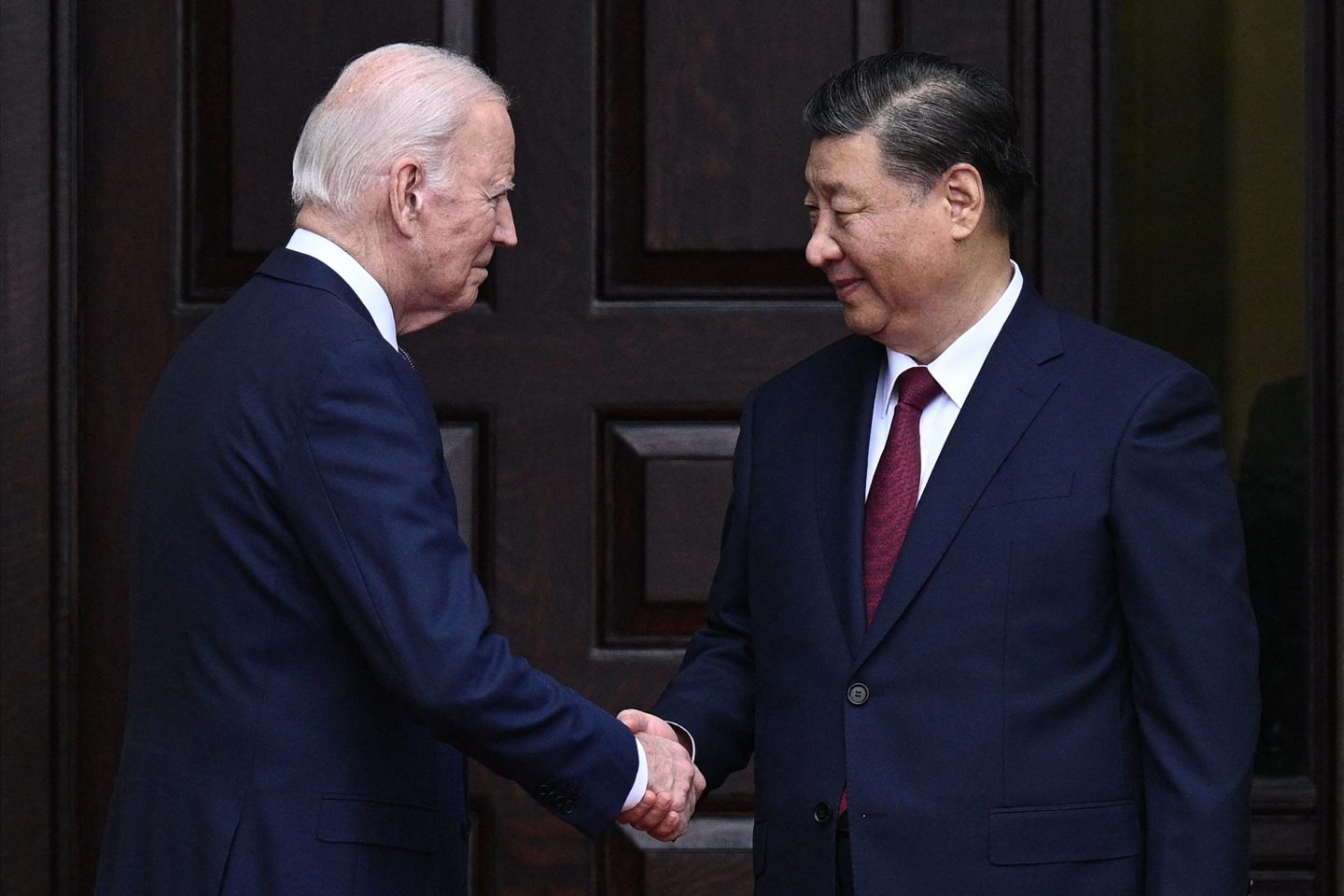
Three standing ovations from American CEOs. A four-hour discussion with President Biden. Promises of cooperation on policy issues and enticements to foreign companies and investment. Chinese President Xi Jinping’s visit to America was certainly eventful.
But what did it really accomplish? Direct communication between the two world leaders is a positive, but nothing on the economic front got resolved. The fact is that the economic war between these two superpowers has only intensified in the past 12 months—and the stakes are only rising.
The CCP has declared as its primary objectives China’s own security and economic growth. But en route to those objectives, it has taken countless actions that also serve the purpose of upending America’s economic dominance. Such an outcome would essentially destroy the long-held, rules-based economic world order. Losing this competition would mean the U.S. losing its national security along with its economic primacy, and even putting democracy in general at risk.
In this conflict, U.S. companies are the front-line combatants, whether they realize it or not (and all too often, they don’t). That’s why it’s urgent that the Biden administration mobilize and unify the U.S. business community, before the tide of the conflict turns irreversibly. U.S. companies need to develop sound plans and have support as they execute those plans—up to and including, for many companies, disengaging from China.
Little meaningful recourse
Business leaders who trust that China will change by drawing closer to Western norms are gullible or gamblers. (Many have been gullible for 25 years!) They should know that they operate at the mercy of the CCP and the legal system it controls.
Sharing technology and know-how with Chinese companies, as the CCP demands you do, gives you temporary favor. When the Chinese company you shared it with becomes competitive, you are no longer needed. You will be marginalized, become unprofitable, and your market share will dwindle. That’s when you will see the virtue of phasing out of China or selling the business to Chinese owners, though the price will be depressed by then.
Signs of the CCP’s economic aggression are staring us in the face. The Chinese government’s partial ban on iPhones in September wiped out $200 billion in Apple’s market value. No surprise that Tim Cook immediately flew to Beijing!
But other companies have suffered deeper, longer-lasting wounds. Two Western technology jewels, along with two large consulting firms, built Huawei‘s world dominance in telecom infrastructure. America’s Lucent (which later became Nokia through mergers involving Alstom and Siemens) and Sweden’s Ericsson suffered market share declines, cut their R&D, and lost their technology edge. They got mauled in China. Huawei, meanwhile, now has a commanding telecom market share in almost all developing countries. This has troubled U.S. officials for years: Telecom infrastructure controlled by an ardent opponent is a major national security issue.
The pattern persists with the unwitting help of U.S. corporations. America’s current technology behemoths have lobbied Washington to soften the bans on selling their wares to China, for fear of losing scale advantage and hurting shareholder value.
To replace today’s complacency with a strategy that will win the economic conflict with China, we need only to look back to the lessons of a far bigger conflict: World War II. That conflict created a model of Washington and corporate America working together toward one goal, and that’s what we need now.
The FDR model
At the outbreak of World War II, President Franklin Roosevelt ordered private manufacturers to shift their production to weapons and supplies for the fight in Europe. The government provided all the help these companies needed, and many came out stronger post-war.
Washington must ensure that America’s business engine is fully deployed in what should be fought as a nation-to-nation competition, not company-to-nation. Businesses can supply the technology and expertise needed to maintain dominance over China. We’ll need to ensure that our technology in fields such as artificial intelligence, quantum computing, biotech, and semiconductors is always ahead of China and doesn’t leak across the Pacific.
Such an effort is recently picking up speed at the Department of Commerce and bodies such as the interagency Committee on Foreign Investment in the United States (CFIUS). But the progress is uncoordinated and still lacks gravitas. The Commerce Department has restricted the sale of technology to certain Chinese firms. But too many transfers are getting around the ban.
The Biden administration has also moved to block U.S. firms and individuals from investing in Chinese entities that are likely to create technology relevant to military and national security. The Treasury Department is charged with implementation. On October 31st the House select committee on China formally urged the department to hurry up.
The edge that America has over China is shrinking and its debt to China is huge and growing at a fast clip, especially since the renminbi has been devalued by 20%. To fight back, America must step up, be bold, and be strategic on several other fronts beyond the restriction of technology transfers.
This begins with defining precisely the objectives of both opponents. It means both clarifying U.S. objectives and getting into the heads of China’s decision-makers. In armed conflicts, the generals study the psychology of the opponents, and their staffs generate military moves by practicing war games. Secretary Raimondo has the right experience to lead the economic version of these war games.
Next, the administration should pull together the pivotal 100 or so American companies that are foundational to global competition. The administration and its partners should build a robust analytical framework that connects the consequential trade and investment-flows issues that most affect these companies.
The tax code should be adjusted to enable American companies to withstand the serious adverse effects of the tit-for-tat during transition. They should be allowed to write down the losses they realize from disengaging from China, as well as any penalties China might impose on them.
Start with a phased approach that incentivizes voluntary compliance by U.S. companies, since it will take time to disengage from investments in China.
Secretary Raimondo is now in the first phase of action. She is forming working groups among U.S. and Chinese companies to focus on trade and investment issues of common goods and services. Those dialogues will build trust and make it easier to tackle more difficult issues around dumping, selling below cost, subsidies, artificial exchange rates, and compliance to deliver promised actions.
In the long run, more decisive steps should follow, including:
* Gradually replacing Chinese imports with American goods in toys, games, furniture, footwear, and apparel, but over a two-year timespan. Instead of sending $100 billion to China for these items combined, keep the money in U.S. hands.
* Granting a five-year window of tax credits and low-cost loans to businesses in critical industries and appoint a commission to oversee the process.
* Garnering support from our allies in Europe, Australia, New Zealand, Japan, and South Korea to impose similar bans on technology transfers, foreign direct investment, and product dumping. The latter is a growing threat because of China’s enormous excess capacity and ability to incur negative cash flow. Brazil is already banning dumping, and other nations should follow suit.
In short, what’s needed is timely decoupling of American business from China, not merely derisking. Remember that decoupling was started by China, not by the United States, in the first place. To win will require transformative action from both Washington and corporate America. Both parties should get the public on board and make it happen now before it’s too late.
_____________________________
Ram Charan is an adviser to CEOs and boards of directors worldwide, and a member of corporate boards in several countries. He has written 36 books and numerous articles in Harvard Business Review. His next book is titled: The Confrontation: How to End the U.S. vs. China Economic War to Save Democracy.
The opinions expressed in Fortune.com commentary pieces are solely the views of their authors and do not necessarily reflect the opinions and beliefs of Fortune.