• Home
  • News
  • Fortune 500
  • Tech
  • Finance
  • Leadership
  • Lifestyle
  • Rankings
  • Multimedia
CommentaryFinance

The U.S. economy could face ‘a perfect storm’ if Basel III Endgame goes into effect. Here’s why

By
Kevin Fromer
Kevin Fromer
Down Arrow Button Icon
By
Kevin Fromer
Kevin Fromer
Down Arrow Button Icon
December 6, 2023, 9:04 AM ET
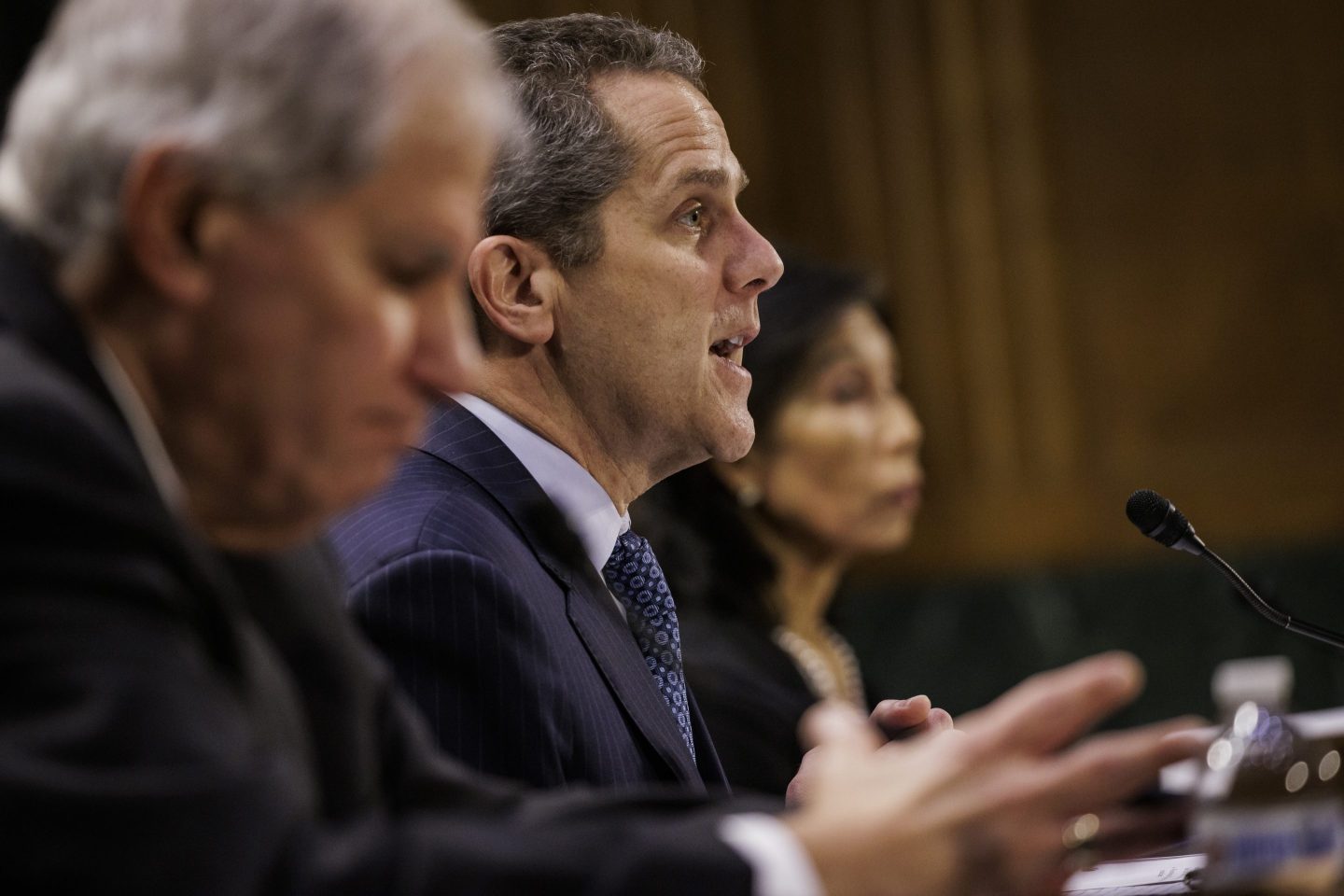
Michael Barr, vice chair for supervision at the U.S. Federal Reserve, speaks during a Senate Banking, Housing, and Urban Affairs Committee hearing with Martin Gruenberg, chairman of the Federal Deposit Insurance Corp., left, and Nellie Liang, under secretary for domestic finance at the U.S. Treasury, right, on Mar. 28. Congressional committees' probing the collapse of Silicon Valley Bank and Signature Bank heralded a clash over the role of financial regulations in the second-largest bank failure in U.S. history.
Michael Barr, vice chair for supervision at the U.S. Federal Reserve, speaks during a Senate Banking, Housing, and Urban Affairs Committee hearing with Martin Gruenberg, chairman of the Federal Deposit Insurance Corp., left, and Nellie Liang, under secretary for domestic finance at the U.S. Treasury, right, on Mar. 28. Congressional committees' probing the collapse of Silicon Valley Bank and Signature Bank heralded a clash over the role of financial regulations in the second-largest bank failure in U.S. history.Samuel Corum—Bloomberg/Getty Images

The past three years of economic volatility have exacted a profound toll on many Americans, testing the resilience of households and businesses alike. During this period, the largest banks, fundamentally strengthened by a series of changes, have served as a source of support by extending enormous amounts of credit, helping customers navigate uncertainty, and stabilizing the broader banking sector at a critical moment. Now, as the CEOs of these banks gather on Capitol Hill, Congress must ask itself if proposed regulations on capital jeopardize the essential work of these institutions.

The capital regulation plan known as Basel III Endgame will increase capital requirements by 20% or more for the eight largest U.S. banks. This is an excessive move, considering the tripling of high-quality capital for these banks over the past 15 years. Higher capital requirements, as noted by Federal Reserve Chair Jerome Powell, raise the cost of–and reduce access to–credit.

The plan will certainly compound the burden of higher post-pandemic interest rates, particularly for those with lower incomes. Americans will have a harder time getting a loan, securing a mortgage, or saving for their retirement or a child’s college education.

The impact isn’t limited to individual consumers. Small businesses relying on credit and farmers needing funds for operations and equipment will face difficulty securing much-needed capital.

A chorus of voices from the left and the right have come out against this proposed rule. Bipartisan consensus is rare these days, so the growing coalition of policymakers, advocacy groups, and community leaders warning against the negative impacts of stricter capital requirements is not something to take lightly. Senator Mark Warner (D-Va.) has emphasized the potential compounding effect of tougher capital standards, high interest rates, and disruptions in the commercial real estate market as a “perfect storm.” Senator John Tester (D-Mont.) stated that he is worried about how this will impact working Americans, explaining he has “some concerns about the proposed changes, and what its impact will be on workers and households, small businesses, access to credit, and the overall vibrancy of our capital markets.” In a letter to regulators, 39 Senate Republicans, led by Senator Tim Scott (R-S.C.), highlighted the resilience of the well-capitalized U.S. banking system and argued the proposal would negatively impact the economy while making credit costlier and more difficult to obtain for millions of Americans.

Given these concerns, it is fair to ask why capital increases of this size are necessary. But no one seems equipped to provide an answer. On the contrary, the predominant official assessment of the banking sector, and the largest banks in particular, has been laudatory. As a matter of fact, every hypothesized loss the proposal aims to address has been experienced under real-life stress tests such as the pandemic, and the largest U.S. banks have continued to support the economy despite those losses under current capital requirements.

Reflecting on the years of reform under the Dodd-Frank Act and Basel III, Chair Powell highlighted improvements in the banking system’s resilience, stating, “The large banks in the United States are very strong, well-capitalized, a lot of liquidity and they’ve been a source of strength, I think, through the last couple of events.”

The future path of the U.S. economy is far from certain and hardworking Americans will pay a price if regulators demand new, unjustified capital requirements. Policymakers must demand extensive changes to the Basel III Endgame proposal so the banking sector can continue its essential role in the U.S. economy–and to avoid taxing consumers and businesses for no appreciable benefit to financial stability.

Kevin Fromer is the president and CEO of Financial Services Forum.

More must-read commentary published by Fortune:

  • Amazon’s $26 billion delivery business runs on exhausted, sweat-soaked drivers running door to door. Now we’re on strike
  • Merit-based flexibility could be the future of work as return-to-office mandates fail to prop up productivity
  • China’s export restrictions on critical minerals are threatening the viability of EV makers–and forcing them to innovate
  • Melinda French Gates: ‘It’s time to change the face of power in venture capital’

The opinions expressed in Fortune.com commentary pieces are solely the views of their authors and do not necessarily reflect the opinions and beliefs of Fortune.

Join us at the Fortune Workplace Innovation Summit May 19–20, 2026, in Atlanta. The next era of workplace innovation is here—and the old playbook is being rewritten. At this exclusive, high-energy event, the world’s most innovative leaders will convene to explore how AI, humanity, and strategy converge to redefine, again, the future of work. Register now.
About the Author
By Kevin Fromer
See full bioRight Arrow Button Icon

Latest in Commentary

jobs
Commentaryprivate equity
There is a simple fix for America’s job-quality crisis: actually give workers a piece of the business 
By Pete StavrosDecember 9, 2025
12 hours ago
Jon Rosemberg
CommentaryProductivity
The cult of productivity is killing us
By Jon RosembergDecember 9, 2025
12 hours ago
Trump
CommentaryTariffs and trade
AI doctors will be good at science but bad at business, and big talk with little action means even higher drugs prices: 10 healthcare predictions for 2026 from top investors
By Bob Kocher, Bryan Roberts and Siobhan Nolan ManginiDecember 9, 2025
12 hours ago
Google.org
CommentaryTech
Nonprofits are solving 21st century problems—they need 21st century tech
By Maggie Johnson and Shannon FarleyDecember 8, 2025
1 day ago
Will Dunham is President and Chief Executive Officer of the American Investment Council
CommentaryRetirement
Private equity is being villainized in the retirement debate — even as it provides diversification and outperforms public markets long-term
By Will DunhamDecember 8, 2025
1 day ago
Justin Hotard, CEO of Nokia
CommentaryGen Z
Nokia CEO: The workforce is becoming AI-native. Leadership has to evolve
By Justin HotardDecember 8, 2025
2 days ago

Most Popular

placeholder alt text
Success
When David Ellison was 13, his billionaire father Larry bought him a plane. He competed in air shows before leaving it to become a Hollywood executive
By Dave SmithDecember 9, 2025
15 hours ago
placeholder alt text
Real Estate
The 'Great Housing Reset' is coming: Income growth will outpace home-price growth in 2026, Redfin forecasts
By Nino PaoliDecember 6, 2025
4 days ago
placeholder alt text
Success
Craigslist founder signs the Giving Pledge, and his fortune will go to military families, fighting cyberattacks—and a pigeon rescue
By Sydney LakeDecember 8, 2025
1 day ago
placeholder alt text
Investing
Baby boomers have now 'gobbled up' nearly one-third of America's wealth share, and they're leaving Gen Z and millennials behind
By Sasha RogelbergDecember 8, 2025
1 day ago
placeholder alt text
Uncategorized
Transforming customer support through intelligent AI operations
By Lauren ChomiukNovember 26, 2025
13 days ago
placeholder alt text
Banking
Jamie Dimon taps Jeff Bezos, Michael Dell, and Ford CEO Jim Farley to advise JPMorgan's $1.5 trillion national security initiative
By Nino PaoliDecember 9, 2025
6 hours ago
Rankings
  • 100 Best Companies
  • Fortune 500
  • Global 500
  • Fortune 500 Europe
  • Most Powerful Women
  • Future 50
  • World’s Most Admired Companies
  • See All Rankings
Sections
  • Finance
  • Leadership
  • Success
  • Tech
  • Asia
  • Europe
  • Environment
  • Fortune Crypto
  • Health
  • Retail
  • Lifestyle
  • Politics
  • Newsletters
  • Magazine
  • Features
  • Commentary
  • Mpw
  • CEO Initiative
  • Conferences
  • Personal Finance
  • Education
Customer Support
  • Frequently Asked Questions
  • Customer Service Portal
  • Privacy Policy
  • Terms Of Use
  • Single Issues For Purchase
  • International Print
Commercial Services
  • Advertising
  • Fortune Brand Studio
  • Fortune Analytics
  • Fortune Conferences
  • Business Development
About Us
  • About Us
  • Editorial Calendar
  • Press Center
  • Work At Fortune
  • Diversity And Inclusion
  • Terms And Conditions
  • Site Map

© 2025 Fortune Media IP Limited. All Rights Reserved. Use of this site constitutes acceptance of our Terms of Use and Privacy Policy | CA Notice at Collection and Privacy Notice | Do Not Sell/Share My Personal Information
FORTUNE is a trademark of Fortune Media IP Limited, registered in the U.S. and other countries. FORTUNE may receive compensation for some links to products and services on this website. Offers may be subject to change without notice.