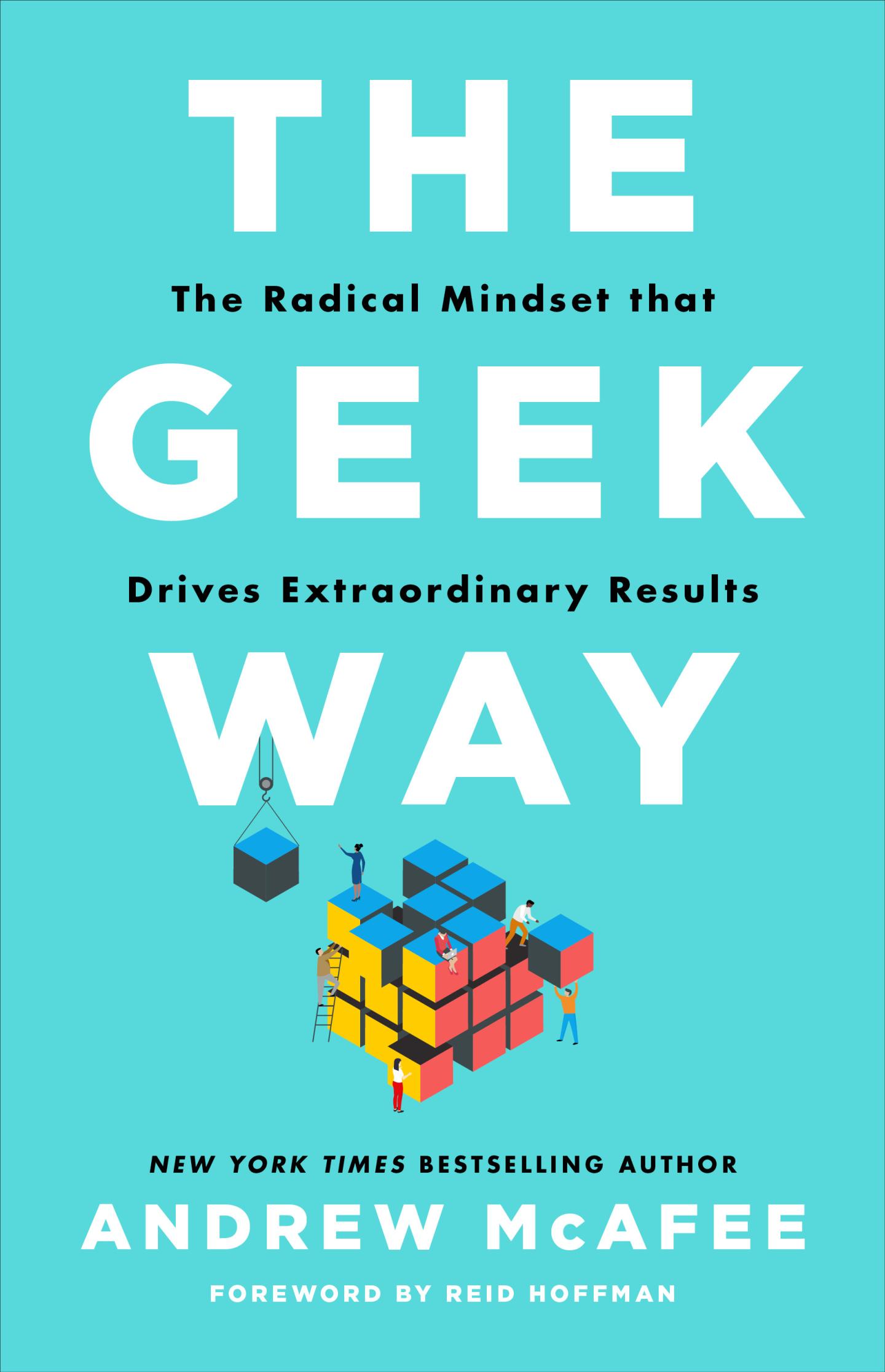
In my new book The Geek Way I make a simple argument: a bunch of geeks concentrated on the West Coast of the US have given the company an upgrade. They’ve iterated and experimented their way into a set of practices and philosophies that enable simultaneous agility, innovation, and execution. Geek companies also provide empowerment and autonomy to their people, and have become some of the most attractive places to work.
What makes geek companies and their cultures radically different from the mainstream of the industrial era? Let me preview all my answers to that fundamental question by describing a great gift my parents gave me. At an early age I became part of an organization founded by the patron saint of geeks. I’m not talking about Nikolai Tesla or Thomas Edison or Steve Jobs. I’m talking about Maria Montessori.
In 2004 journalist Barbara Walters interviewed Google cofounders Larry Page and Sergey Brin. Both of them had parents who were professors and scientists, and Walters asked if this family background was an important part of their success. But both Brin and Page highlighted something else. As Page put it, “We both went to Montessori school, and I think it was part of that training of not following rules and orders, and being self-motivated, questioning what’s going on in the world, doing things a little bit differently.”
I’ll vouch for that. My initiation into geekdom came when my parents enrolled me in a Montessori school at the age of 3.
For those unfamiliar with Montessori, here’s a quick explanation. Montessori classrooms are designed to be self-directed learning labs for children. I remember my first one as a large, light-filled room, parts of which were dedicated to different activities. In one area there were beads strung together on wires to form lines, squares, and cubes (which turns out to be a great way to convey the difference between x, x2, and x3). Another space had cloth letters I could play with to ease me into the concept of reading. Other areas had polygons to trace, 3D shapes to play with, simple abacuses, pens and pencils and paper, and so on.
The gear in the classrooms was great, but what I really loved about my Montessori school was the freedom. There were a few scheduled activities each day — lunch, recess, “circle time,” when teachers and students sat on the floor in a circle and talked about stuff — but most of the time I could do what I wanted. And what I and my classmates wanted wasn’t to break things, run around yelling, or terrorize each other. Instead, we wanted to sit quietly and learn.
One of Montessori’s most radical insights was that even young children are capable of concentration and deep study in the right environment. They’re not inherently wild creatures that have to be penned. Instead, they’re inherent learners. They have reserves of self-discipline that are activated when they’re curious about something. Montessori wrote that “a child who has become master of his acts, . . . and who has been encouraged by the pleasant and interesting activities in which he has been engaged, is a child filled with health and joy and remarkable for his calmness and discipline.” Jeff Bezos had a great deal of this discipline. Like Brin and Page, Bezos was also a Montessori kid as a toddler; according to his mother, he’d get so engrossed in what he was doing in the classroom that his teachers would have to physically pick him up and move him when it was time for a change.
I remember many times as a young child when I experienced that kind of flow state in the classroom. But those experiences came to a halt after third grade, which was as far as my Montessori school went. After that, public school was the only viable option in the Indiana town where I grew up.
I spent the first day of fourth grade in the public elementary school wondering if I’d angered my parents somehow and was being punished. No other explanation made sense. Sitting at the same desk all day? Rotating through subjects according to the clock on the wall, rather than my interests? Covering concepts that I’d mastered years earlier? Doing mind-numbing drills and worksheets? This school didn’t feel like an educational institution; it felt like a reeducation camp designed to break my spirit.
The deepest mystery was why my autonomy and freedom had been replaced with so much pointless hierarchy and structure. It didn’t make any sense. I eventually learned to get along and go along at my new school. But I never learned to like it, or to see the point.
Neither did Maria Montessori. Her schools, the first of which opened its doors in Rome in 1906, did away with daily schedules, teacher-led instruction, grids of desks, grades, and many other standard elements of primary education in the industrialized world. The mainstream view, in her era and our own, has been that these elements are necessary to ensure that children learn necessary skills. The thinking is that letting kids do what they want throughout the school day might make them happy, and might even make them creative, but it won’t make them good at reading, writing, and arithmetic.
Montessori kept proving how wrong that view is. Early in the twentieth century, she demonstrated that disadvantaged children — even those traumatized by World War I — could, through her methods, make remarkable progress in acquiring all the basic skills they needed. Almost a hundred years later, in 2006, a study published in Science by psychologists Angeline Lillard and Nicole Else-Quest found that kids from low- and middle-income families in Milwaukee who were enrolled in Montessori schools did better than their peers in several of the cognitive and social domains evaluated, and worse in none of them.
Montessori is a hero to today’s business geeks for three reasons. First, she was a true geek herself. She immersed herself in a tough and important problem — how do children learn best? — devised unconventional solutions, and then advocated tirelessly for them. Second, her educational methods foster the kinds of innovation and creativity that contribute to success in the business world. After surveying more than five hundred creative professionals, management researchers Hal Gregerson and Jeff Dyer were surprised at how many started off in Montessori schools. This research revealed the importance of curiosity and asking lots of questions. As Gregerson put it,
If you look at 4-year-olds, they are constantly asking questions and wondering how things work. But by the time they are 6½ years old they stop asking questions because they quickly learn that teachers value the right answers more than provocative questions . . . We believe that the most innovative entrepreneurs were very lucky to have been raised in an atmosphere where inquisitiveness was encouraged . . . A number of [them] went to Montessori schools, where they learned to follow their curiosity.
Third, and most important, Maria Montessori showed us something joyous: This can be better. We don’t have to keep educating young children the same way. We can improve on the educational status quo a lot, and those improvements will not come with a lot of downsides. If we give schoolchildren great autonomy we won’t be sacrificing their ability to master basic skills or perform well on standardized tests. They don’t need to be told what, when, and how to study in order to make progress; they do just fine on their own.
It’s hard to overstate how radical Montessori’s approaches were. The pioneers of universal childhood education in the US and elsewhere were heavily influenced by the Prussian primary school system of the mid-nineteenth century. And the Prussian educators were in turn influenced by the philosopher Johann Gottlieb Fichte, who was clear that schooling really should be about breaking children’s spirits. He wrote in 1807:
Education should aim at destroying free will so that after pupils are thus schooled they will be incapable throughout the rest of their lives of thinking or acting otherwise than as their schoolmasters would have wished.
Montessori’s worldview was as far from Fichte’s as one could imagine. And yet her methods educate children as well as, or better than, the free will–destroying methods advocated by Fichte. Montessori demonstrated that the standard educational environment of her time (and, sadly, of ours as well) can be improved simultaneously across every important dimension, and that doing so doesn’t require heroic teachers or massive additional spending. It just requires letting go of some incorrect assumptions and going about things in a different way, even if that way is far from the mainstream. It requires a geek’s radical mindset.
A bunch of geeks are now doing for companies what Maria Montessori did for schools. They’re reimagining them, improving them, and exposing false assumptions. A large and growing cohort of business leaders are now building very different companies — and, not coincidentally, very successful ones.
It’s also not a coincidence that, as we’ll see, the organizations they’re creating are a lot less hierarchical, less rigid, less rules-based, and less top-down than those they’re outpacing. Montessori showed that children can excel without these constraints; today’s business geeks are showing that companies can as well. We overbuilt both classrooms and corporations during the industrial era. The geeks are showing us how much better things work when we remove the excess overhead and structure from both.
Excerpted with permission from The Geek Way by Andrew McAfee. Copyright © 2023 by Andrew McAfee. Used with permission of Little, Brown and Company. New York, NY. All rights reserved.
Andrew McAfee is the cofounder and co-director of the MIT Initiative on the Digital Economy and the inaugural visiting fellow in Google’s Technology and Society group. He is the author of The Geek Way and coauthor with Erik Byrnjoflsson of The Second Machine Age.