
• Home
  • Latest
  • Fortune 500
  • Finance
  • Tech
  • Leadership
  • Lifestyle
  • Rankings
  • Multimedia

Trendingnow

1

Jensen Huang made his $172 billion fortune on AI chips. His family's $75 million gift to Vanderbilt argues art decides what technology is for

2

'The demographic dividend of the last 40 years is ending': J.P. Morgan says the world is running out of the two things that kept interest rates down

3

The $39 trillion U.S. national debt isn’t as high as Japan’s and Singapore’s relative to economy size—and yet it's still worse somehow

1

Jensen Huang made his $172 billion fortune on AI chips. His family's $75 million gift to Vanderbilt argues art decides what technology is for

2

'The demographic dividend of the last 40 years is ending': J.P. Morgan says the world is running out of the two things that kept interest rates down

3

The $39 trillion U.S. national debt isn’t as high as Japan’s and Singapore’s relative to economy size—and yet it's still worse somehow
CommentaryCareers

We analyzed 2 years of performance reviews for 13,000 workers. Here’s the proof that low-quality feedback is driving employee retention down

By
Kieran Snyder
Kieran Snyder
and
Mallun Yen
Mallun Yen
Down Arrow Button Icon
By
Kieran Snyder
Kieran Snyder
and
Mallun Yen
Mallun Yen
Down Arrow Button Icon
October 9, 2023, 12:03 PM ET
Textio's research found that employees who received unhelpful or vague feedback were more likely to leave the organization in the following year.
Textio's research found that employees who received unhelpful or vague feedback were more likely to leave the organization in the following year.Getty Images
Add Fortune on Google for similar content.

While the U.S. economy continues to add jobs, fewer of them are corporate. In this climate, when employees leave, their roles are often not backfilled. Retaining the team you have is more important than ever–and poor feedback practices are a major driver of high employee attrition rates.

At Textio, we investigated what’s driving all this attrition. Our comprehensive report involved surveying corporate employees across industries and looking at the relationship between the feedback they received in formal performance reviews and employee retention.

We clearly established that poor or insufficient feedback leads to employee attrition. Additionally, our finding shows that not all feedback is equal–and that not all employees are equal in the feedback they receive.

Employees who don’t get clear feedback quit

According to this year’s survey, 38% of people are either actively considering leaving their current workplace or have already ventured into interviews elsewhere.

Some 61% of respondents who plan to stay within the organization agree that they understand what their manager expects in order to give them their next promotion. Among people planning to leave their organizations, only 21% do.

While people indicated a variety of reasons for considering new roles, ranging from money to greater flexibility to relocation, several of the most common reasons cited tie directly to the feedback people get on the job. In fact, “insufficient feedback” was specifically named by 17% of respondents as the primary reason they’re looking for other roles. Numerous other participants cited feedback-adjacent reasons, such as “feeling underappreciated” or “lack of growth opportunities.”

Not all feedback is equally effective

The survey data shows a strong connection between the feedback an employee receives and their decision to stay or leave their organization. We also analyzed a performance review data set to see if the same patterns hold. As it turns out, people who received unactionable feedback were significantly less likely to be in the organization a year later.

To explore this, we looked at the performance reviews of a large, international enterprise organization across a variety of roles. The data set contains performance reviews for more than 13,000 employees across two annual review cycles. Because we have two years of data, we can see whether an employee in the Year 1 data set is also included in the Year 2 data set. In other words, for each employee, we can see the quality of their written performance feedback, as well as their retention or attrition outcome the following year.

People who received low-quality feedback were more likely to leave the organization than people who received more actionable feedback. What’s more, this impact is causal, not just correlational: Our analysis controlled for potentially confounding factors such as numerical performance rating and employee tenure. People who received low-quality feedback were 63% more likely to leave their organizations than everyone else. This held true whether they were high, middling, or low performers.

Low-quality, unactionable feedback is particularly problematic when you consider its prevalence: 50% of the people in our data set received at least some feedback that was not actionable.

And that’s not all. Shying away from giving direct feedback also causes employees to quit. Even when feedback is provided, it may be provided in conflict-avoidant and indirect ways. The practice of hedging, where the feedback provider couches their intended feedback in less direct language, is common.
Courtesy of Textio

The use of problematic hedging language is pervasive, with a third of people in this year’s data set receiving this kind of feedback. Consider the difference between telling your report, “You’ll have to finish the rough draft this week,” and, “You might consider finishing the rough draft this week.” When managers use hedging language to make an ask that the employee is meant to understand as a requirement, they dilute the message.

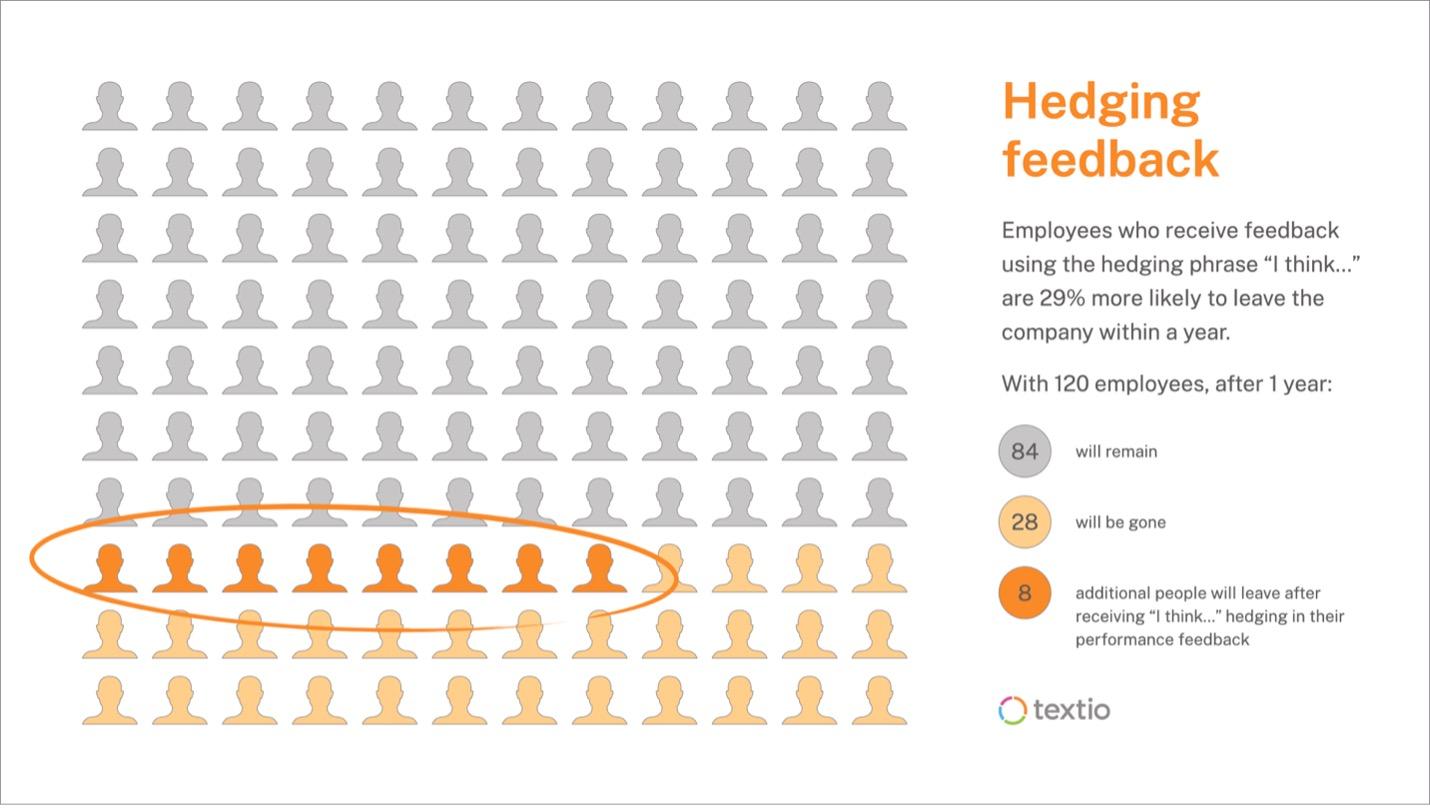
“I think” was by far the most common phrase used in hedging feedback. By introducing feedback with an “I think” statement, the manager is communicating that their point of view might just be a matter of opinion and that they might not be fully committed to it. This is problematic even in positive feedback, as the manager inadvertently communicates doubt about the praise they’re giving. For example, by saying “I think you did a good job on that presentation” rather than just stating that the report did a good job.

It matters. People who get performance reviews containing “I think” hedging statements were 29% more likely to leave the company within a year than everyone else.

High-quality feedback isn’t distributed equally

Feedback matters for employee retention, but not all demographic groups are equally likely to get high-quality feedback. Just as in last year’s report, women of all races and people of color of all genders received lower-quality feedback, and less feedback overall, than everyone else.

For instance:

  • 83% of men said that they understand what’s required to earn their next promotion–in contrast to 71% of women, non-binary, and transgender people.
  • Only 54% of Asian people said they understand what’s required to earn their next promotion.
  • Black employees get 26% more unactionable feedback than non-Black employees, despite only receiving 79% as much feedback overall.

Taken in aggregate, written feedback also reinforces problematic stereotypes. Men were twice as likely as women to be called “ambitious”–and women twice as likely to be deemed “helpful.”

Latinx people were described as “passionate” at double the rate of white people. Meanwhile, white people were twice as likely as Asian people to be described as “easy to work with.”

In other words, the groups with the highest attrition rates from corporate workplaces also systematically receive the lowest-quality feedback. If you don’t invest in growing your people, they leave.

These issues have persisted long enough, with such little improvement, that states and cities are now exploring promotion transparency laws that will require organizations to ensure fairness and equity throughout their employee growth and promotion process.

Good management and feedback processes will soon have the same legislative support that pay transparency has brought workers. And we already know how that is playing out–91% of job seekers, regardless of seniority or industry, now say that including salary ranges in a job post would affect their decision to apply. It’s only a matter of time before employees expect the same transparency in the promotion process.

Kieran Snyder is the CEO of Textio. Mallun Yen is the founder and CEO of the Operator Collective.

More must-read commentary published by Fortune:

  • Return-to-office mandates: See where you fall on the employee disengagement spectrum
  • We love bosses who brag about their accomplishments at work–and loathe colleagues who do the same, surprising new research by INSEAD shows
  • Burnout is attacking our brains and making it harder to excel at work. ‘Deliberate calm’ can help us adapt
  • The U.S.-China trade war is counterproductive–and the Huawei P60’s chip is just one of its many unforeseen ramifications

The opinions expressed in Fortune.com commentary pieces are solely the views of their authors and do not necessarily reflect the opinions and beliefs of Fortune.

About the Authors
By Kieran Snyder
See full bioRight Arrow Button Icon
By Mallun Yen
See full bioRight Arrow Button Icon
Add Fortune on Google for similar content.

Latest in Commentary

Finance
Lorem ipsum dolor sit amet, consectetur adipiscing elit, sed do eiusmod tempor incididunt ut labore et dolore magna aliqua. Ut enim ad minim veniam
By Fortune Editors
October 20, 2025
Finance
Lorem ipsum dolor sit amet, consectetur adipiscing elit, sed do eiusmod tempor incididunt ut labore et dolore magna aliqua. Ut enim ad minim veniam
By Fortune Editors
October 20, 2025
Finance
Lorem ipsum dolor sit amet, consectetur adipiscing elit, sed do eiusmod tempor incididunt ut labore et dolore magna aliqua. Ut enim ad minim veniam
By Fortune Editors
October 20, 2025
Finance
Lorem ipsum dolor sit amet, consectetur adipiscing elit, sed do eiusmod tempor incididunt ut labore et dolore magna aliqua. Ut enim ad minim veniam
By Fortune Editors
October 20, 2025
Finance
Lorem ipsum dolor sit amet, consectetur adipiscing elit, sed do eiusmod tempor incididunt ut labore et dolore magna aliqua. Ut enim ad minim veniam
By Fortune Editors
October 20, 2025
Finance
Lorem ipsum dolor sit amet, consectetur adipiscing elit, sed do eiusmod tempor incididunt ut labore et dolore magna aliqua. Ut enim ad minim veniam
By Fortune Editors
October 20, 2025

Most Popular

Finance
Lorem ipsum dolor sit amet, consectetur adipiscing elit, sed do eiusmod tempor incididunt ut labore et dolore magna aliqua. Ut enim ad minim veniam
By Fortune Editors
October 20, 2025
Finance
Lorem ipsum dolor sit amet, consectetur adipiscing elit, sed do eiusmod tempor incididunt ut labore et dolore magna aliqua. Ut enim ad minim veniam
By Fortune Editors
October 20, 2025
Finance
Lorem ipsum dolor sit amet, consectetur adipiscing elit, sed do eiusmod tempor incididunt ut labore et dolore magna aliqua. Ut enim ad minim veniam
By Fortune Editors
October 20, 2025
Finance
Lorem ipsum dolor sit amet, consectetur adipiscing elit, sed do eiusmod tempor incididunt ut labore et dolore magna aliqua. Ut enim ad minim veniam
By Fortune Editors
October 20, 2025
Finance
Lorem ipsum dolor sit amet, consectetur adipiscing elit, sed do eiusmod tempor incididunt ut labore et dolore magna aliqua. Ut enim ad minim veniam
By Fortune Editors
October 20, 2025
Finance
Lorem ipsum dolor sit amet, consectetur adipiscing elit, sed do eiusmod tempor incididunt ut labore et dolore magna aliqua. Ut enim ad minim veniam
By Fortune Editors
October 20, 2025
Fortune Secondary Logo
Rankings
  • 100 Best Companies
  • Fortune 500
  • Global 500
  • Fortune 500 Europe
  • Most Powerful Women
  • World's Most Admired Companies
  • See All Rankings
  • Lists Calendar
Sections
  • Finance
  • Fortune Crypto
  • Features
  • Leadership
  • Health
  • Commentary
  • Success
  • Retail
  • Mpw
  • Tech
  • Lifestyle
  • CEO Initiative
  • Asia
  • Politics
  • Conferences
  • Europe
  • Newsletters
  • Personal Finance
  • Environment
  • Magazine
  • Education
Customer Support
  • Frequently Asked Questions
  • Customer Service Portal
  • Privacy Policy
  • Terms Of Use
  • Single Issues For Purchase
  • International Print
Commercial Services
  • Advertising
  • Fortune Brand Studio
  • Fortune Analytics
  • Fortune Conferences
  • Business Development
  • Group Subscriptions
About Us
  • About Us
  • Press Center
  • Work At Fortune
  • Terms And Conditions
  • Site Map
  • About Us
  • Press Center
  • Work At Fortune
  • Terms And Conditions
  • Site Map
  • Facebook icon
  • Twitter icon
  • LinkedIn icon
  • Instagram icon
  • TikTok icon
  • YouTube icon

Latest in Commentary

craig
CommentaryPharmaceutical Industry
Big pharma’s patent cliff meets a new biotech Cold War: We need to outrun China, not outlaw it
By Craig GarthwaiteJuly 24, 2026
11 hours ago
tim
Commentarysmartphones and mobile devices
NYU Stern pricing expert: There’s a hidden ‘AI tax’ hitting Apple, Dell — and your next phone
By Srikanth JagabathulaJuly 24, 2026
12 hours ago
nyse
CommentaryEconomics
AI doesn’t end scarcity. It relocates it
By François Candelon, Paul-Louis Andres and Augustin ManchonJuly 24, 2026
13 hours ago
Can Bangkok future-proof itself against the heat?
CommentaryThailand
Can Bangkok future-proof itself against the heat?
By Curtis S. Chin and Ella TanJuly 23, 2026
1 day ago
mm
CommentaryLeadership
Michael Muthukrishna: The ‘lone genius’ myth is wrong and it’s holding back your business
By Michael MuthukrishnaJuly 23, 2026
1 day ago
Paul Keary (L) and Mike Sutcliff (R).
CommentaryAI agents
Teneo & Thoughtworks CEOs: the AI race will be won with governance, not speed 
By Paul Keary and Mike SutcliffJuly 23, 2026
1 day ago

Most Popular

Jensen Huang made his $172 billion fortune on AI chips. His family's $75 million gift to Vanderbilt argues art decides what technology is for
Big Tech
Jensen Huang made his $172 billion fortune on AI chips. His family's $75 million gift to Vanderbilt argues art decides what technology is for
By Sydney LakeJuly 23, 2026
2 days ago
'The demographic dividend of the last 40 years is ending': J.P. Morgan says the world is running out of the two things that kept interest rates down
Economy
'The demographic dividend of the last 40 years is ending': J.P. Morgan says the world is running out of the two things that kept interest rates down
By Eleanor PringleJuly 24, 2026
16 hours ago
The $39 trillion U.S. national debt isn’t as high as Japan’s and Singapore’s relative to economy size—and yet it's still worse somehow
Economy
The $39 trillion U.S. national debt isn’t as high as Japan’s and Singapore’s relative to economy size—and yet it's still worse somehow
By Sasha RogelbergJuly 23, 2026
1 day ago
The millennial generation has split, new Fed research shows: Those over 35 are edging toward boomer-style wealth, while everyone else falls behind
Real Estate
The millennial generation has split, new Fed research shows: Those over 35 are edging toward boomer-style wealth, while everyone else falls behind
By Nick LichtenbergJuly 22, 2026
2 days ago
Current price of oil as of July 24, 2026
Personal Finance
Current price of oil as of July 24, 2026
By Joseph HostetlerJuly 24, 2026
13 hours ago
Turns out Dead Internet Theory was right: AI agents are eating the Web, growing by nearly 8,000% and rewiring the Internet's business model
AI
Turns out Dead Internet Theory was right: AI agents are eating the Web, growing by nearly 8,000% and rewiring the Internet's business model
By Mia OsmonbekovJuly 23, 2026
1 day ago

© 2026 Fortune Media IP Limited. All Rights Reserved. Use of this site constitutes acceptance of our Terms of Use and Privacy Policy | CA Notice at Collection and Privacy Notice | Do Not Sell/Share My Personal Information
FORTUNE is a trademark of Fortune Media IP Limited, registered in the U.S. and other countries. FORTUNE may receive compensation for some links to products and services on this website. Offers may be subject to change without notice.