
• Home
  • Latest
  • Fortune 500
  • Finance
  • Tech
  • Leadership
  • Lifestyle
  • Rankings
  • Multimedia
LeadershipAI

A top economist who studies AI says it will double productivity in the next decade: ‘You need to embrace this technology and not resist it’

Geoff Colvin
By
Geoff Colvin
Geoff Colvin
Senior Editor-at-Large
Down Arrow Button Icon
Geoff Colvin
By
Geoff Colvin
Geoff Colvin
Senior Editor-at-Large
Down Arrow Button Icon
September 26, 2023, 8:00 AM ET
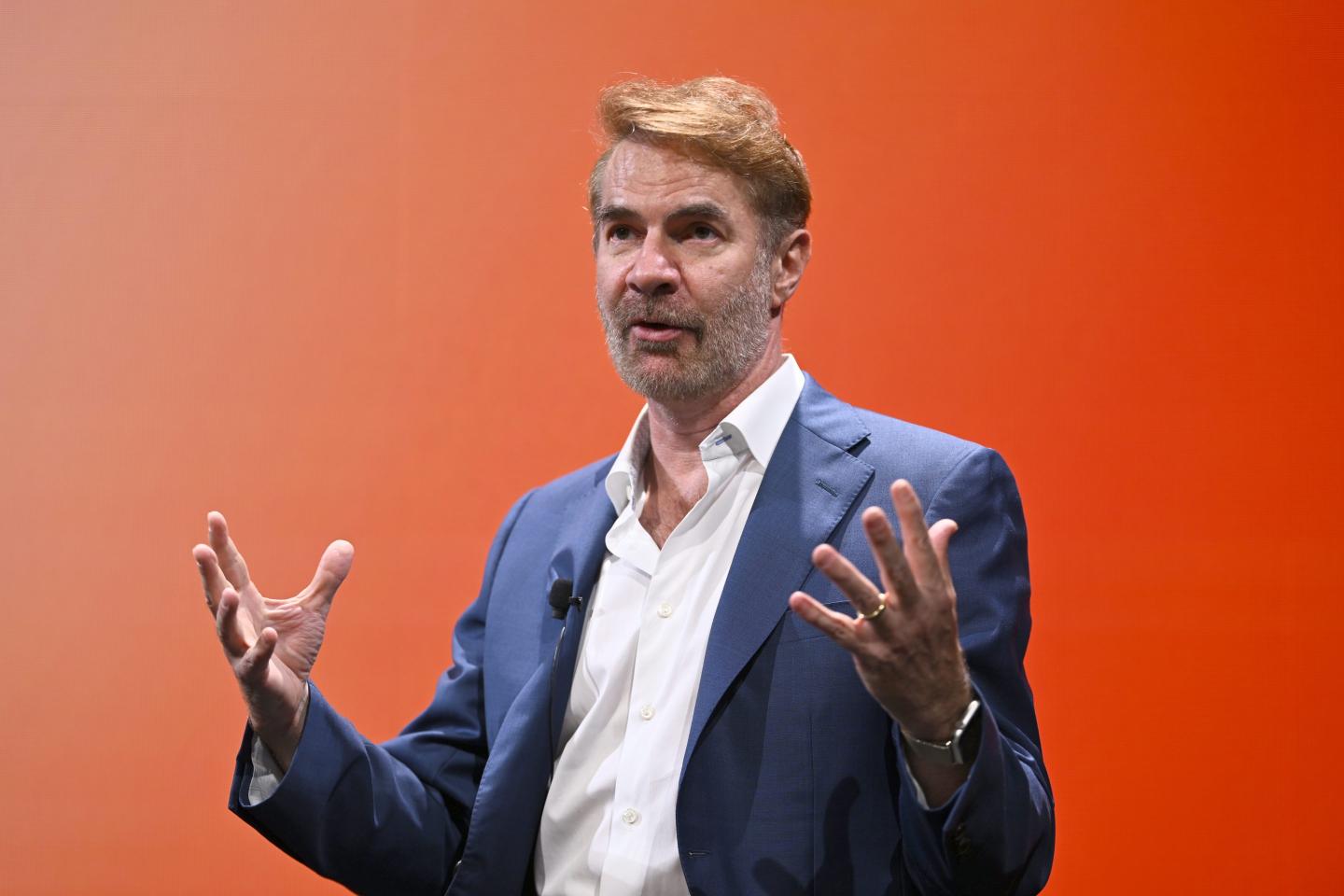
Erik Brynjolfsson participates in the panel "Digital Governance and the State of Democracy: Why Does It Matter?" during Unfinished Live 2022 in New York City.
Erik Brynjolfsson participates in the panel "Digital Governance and the State of Democracy: Why Does It Matter?" during Unfinished Live 2022 in New York City.Roy Rochlin—Getty Images

Years before Open AI’s ChatGPT startled the world in 2022, Erik Brynjolfsson was studying the questions that have since made AI a red-hot topic: Will the technology spark mass unemployment? Which companies will thrive or wither as AI advances? Will rapidly improving AI be good or bad for the economy?

Recommended Video

Brynjolfsson is well equipped to answer such questions. He’s a professor at Stanford University, director of its Digital Economy Lab, and an economist who moved his office to a different building “to be in the middle of all the computer scientists.” 

Unlike many others, Brynjolfsson sees AI potentially bringing a bright future for human workers. The key to developing AI is “augmenting humans rather than mimicking them,” he says. From an economist’s perspective, “augmentation creates new capabilities and new products and services, ultimately generating far more value than merely human-like AI.” 

In an interview with Fortune, Brynjolfsson explains how some business leaders are falling behind in adopting AI, why he thinks it will be “an elixir” for the economy, and why bosses should get employees using AI more.

This interview was edited and condensed for clarity.

Fortune: Millions of employees are worried about losing their jobs as AI and other technologies advance. What does your research say?

Colleagues and I looked at how AI and machine learning would affect occupations. We analyzed what types of tasks would be automated—taken over by the technology—and what types of tasks would still be performed by humans augmented by technology. There was no occupation where these technologies just ran the table and could do all the different tasks. In each case there were some tasks like what radiologists do, reading medical images, that technology can do much better. But radiologists actually do about 27 distinct tasks, according to our taxonomy. And there are some tasks—consulting with other doctors, explaining outcomes to patients—where AI is really not the best tool or cannot be used at all. So roles will change a lot, and managers and entrepreneurs will be creative about how they do that. I certainly expect a lot of disruption and change, but not mass unemployment.

What’s an example of AI augmenting rather than replacing a worker?

In a study that colleagues and I conducted, a company with a call center did a phased rollout of a large language model—generative AI—that gave suggestions to some of the workers [as they responded to callers], but not to others. So we got a kind of controlled experiment. The people who had access to the technology were dramatically more productive. It was about 14% on average, but the least experienced workers were about 35% more productive within just a couple of months: a big, big change. They were going up the learning curve so much faster with this tool. We looked at millions of transcripts and found that customer sentiment and customer satisfaction dramatically improved. There were a lot more happy words and a lot fewer angry words in those discussions. The employees seemed happy. They were less likely to quit—much less turnover. It was really a win for every group. This is an example of a system that was used to augment workers, not replace them. It was still a human talking to the customer, not a machine talking to the customer.

What does this mean for the U.S. economy? Labor productivity has increased only about 1.5% a year since 2005. Can AI improve that?

I see a coming productivity boom. I see about a doubling of productivity growth in the coming decade as a result of these technologies. It’s not as simple as just buying the software or hardware. General-purpose technologies like electricity, the steam engine, early computers, often take a decade or more to translate into significant productivity gains because of all the changes you have to make in business processes and rescaling. This time it’s definitely happening faster.

Doubling productivity would be really significant.

For a lot of the problems we have—the federal budget; health care; these big, nagging problems—productivity is like an elixir that makes all those problems much more solvable.

Some business leaders are ordering their employees not to use ChatGPT for data security reasons. Are they making a mistake?

You need to embrace this technology and not resist it. Some of my fellow teachers and professors tell their students not to use it. There are some potential security issues that need to be addressed, but I don’t think they’re insurmountable. A number of companies—Cohere, Abacus, others—will train your models locally. OpenAI [creator of ChatGPT] will sign NDAs [non-disclosure agreements]. Certainly people have to be careful about proprietary data not getting into the wrong hands, just as you would when you’re using cloud services or anything else. But I think that’s mostly a bit of a distraction. This is a transformative technology. Every company should be working really hard to figure out how its employees can use it more, not less. Put in security, but don’t miss the forest for the trees.

You teach a course called The AI Awakening. When you taught it last spring, what were the students interested in?

It was way oversubscribed, so we chose the 70 best students. More than half of them were looking to start companies in this space. It’s not a random sample. It’s Stanford.

Join us at the Fortune Workplace Innovation Summit May 19–20, 2026, in Atlanta. The next era of workplace innovation is here—and the old playbook is being rewritten. At this exclusive, high-energy event, the world’s most innovative leaders will convene to explore how AI, humanity, and strategy converge to redefine, again, the future of work. Register now.
About the Author
Geoff Colvin
By Geoff ColvinSenior Editor-at-Large
LinkedIn iconTwitter icon

Geoff Colvin is a senior editor-at-large at Fortune, covering leadership, globalization, wealth creation, the infotech revolution, and related issues.

See full bioRight Arrow Button Icon

Latest in Leadership

Finance
Lorem ipsum dolor sit amet, consectetur adipiscing elit, sed do eiusmod tempor incididunt ut labore et dolore magna aliqua. Ut enim ad minim veniam
By Fortune Editors
October 20, 2025
Finance
Lorem ipsum dolor sit amet, consectetur adipiscing elit, sed do eiusmod tempor incididunt ut labore et dolore magna aliqua. Ut enim ad minim veniam
By Fortune Editors
October 20, 2025
Finance
Lorem ipsum dolor sit amet, consectetur adipiscing elit, sed do eiusmod tempor incididunt ut labore et dolore magna aliqua. Ut enim ad minim veniam
By Fortune Editors
October 20, 2025
Finance
Lorem ipsum dolor sit amet, consectetur adipiscing elit, sed do eiusmod tempor incididunt ut labore et dolore magna aliqua. Ut enim ad minim veniam
By Fortune Editors
October 20, 2025
Finance
Lorem ipsum dolor sit amet, consectetur adipiscing elit, sed do eiusmod tempor incididunt ut labore et dolore magna aliqua. Ut enim ad minim veniam
By Fortune Editors
October 20, 2025
Finance
Lorem ipsum dolor sit amet, consectetur adipiscing elit, sed do eiusmod tempor incididunt ut labore et dolore magna aliqua. Ut enim ad minim veniam
By Fortune Editors
October 20, 2025

Most Popular

Finance
Lorem ipsum dolor sit amet, consectetur adipiscing elit, sed do eiusmod tempor incididunt ut labore et dolore magna aliqua. Ut enim ad minim veniam
By Fortune Editors
October 20, 2025
Finance
Lorem ipsum dolor sit amet, consectetur adipiscing elit, sed do eiusmod tempor incididunt ut labore et dolore magna aliqua. Ut enim ad minim veniam
By Fortune Editors
October 20, 2025
Finance
Lorem ipsum dolor sit amet, consectetur adipiscing elit, sed do eiusmod tempor incididunt ut labore et dolore magna aliqua. Ut enim ad minim veniam
By Fortune Editors
October 20, 2025
Finance
Lorem ipsum dolor sit amet, consectetur adipiscing elit, sed do eiusmod tempor incididunt ut labore et dolore magna aliqua. Ut enim ad minim veniam
By Fortune Editors
October 20, 2025
Finance
Lorem ipsum dolor sit amet, consectetur adipiscing elit, sed do eiusmod tempor incididunt ut labore et dolore magna aliqua. Ut enim ad minim veniam
By Fortune Editors
October 20, 2025
Finance
Lorem ipsum dolor sit amet, consectetur adipiscing elit, sed do eiusmod tempor incididunt ut labore et dolore magna aliqua. Ut enim ad minim veniam
By Fortune Editors
October 20, 2025
Rankings
  • 100 Best Companies
  • Fortune 500
  • Global 500
  • Fortune 500 Europe
  • Most Powerful Women
  • Future 50
  • World’s Most Admired Companies
  • See All Rankings
Sections
  • Finance
  • Leadership
  • Success
  • Tech
  • Asia
  • Europe
  • Environment
  • Fortune Crypto
  • Health
  • Retail
  • Lifestyle
  • Politics
  • Newsletters
  • Magazine
  • Features
  • Commentary
  • Mpw
  • CEO Initiative
  • Conferences
  • Personal Finance
  • Education
Customer Support
  • Frequently Asked Questions
  • Customer Service Portal
  • Privacy Policy
  • Terms Of Use
  • Single Issues For Purchase
  • International Print
Commercial Services
  • Advertising
  • Fortune Brand Studio
  • Fortune Analytics
  • Fortune Conferences
  • Business Development
About Us
  • About Us
  • Editorial Calendar
  • Press Center
  • Work At Fortune
  • Diversity And Inclusion
  • Terms And Conditions
  • Site Map
  • Facebook icon
  • Twitter icon
  • LinkedIn icon
  • Instagram icon
  • Pinterest icon

Latest in Leadership

Lemley and Kauf pose for photos while holding their skis and American flags.
Personal FinanceOlympics
Every U.S. Olympian was promised a $200,000 payout, but how much they actually keep depends on where they live
By Jacqueline MunisFebruary 11, 2026
10 hours ago
jobs
EconomyJobs
Turns out the U.S. economy didn’t create half a million jobs last year. It was just 181,000
By Paul Wiseman and The Associated PressFebruary 11, 2026
11 hours ago
SuccessGen Z
The Gen Z job nightmare is so bad that even billionaires are worried their kids won’t be able to keep a job, says wealth advisor to the 0.1%
By Sydney LakeFebruary 11, 2026
12 hours ago
Suburban homes
EconomyLabor
The 45-year decline of the middle class costs you $12,000 a year
By Jake AngeloFebruary 11, 2026
13 hours ago
SuccessCareers
At 22, Olympic skier Eileen Gu is worth over $20 million. She’s juggling brand deals and sports with school. And she urges Gen Z not to wait until they’re ‘older’ to start
By Preston ForeFebruary 11, 2026
15 hours ago
rich
Arts & EntertainmentOlympics
‘I’m not the dad, and I’m not the coach’: Meet the 54-year-old personal injury attorney stealing America’s hearts at the Olympics
By Nick LichtenbergFebruary 11, 2026
15 hours ago

Most Popular

placeholder alt text
Economy
America borrowed $43.5 billion a week in the first four months of the fiscal year, with debt interest on track to be over $1 trillion for 2026
By Eleanor PringleFebruary 10, 2026
2 days ago
placeholder alt text
Economy
It turns out that Joe Biden really did crush Americans' dreams for the future. Just look at how the vibe changed 5 years ago
By Jake AngeloFebruary 10, 2026
1 day ago
placeholder alt text
Commentary
Something big is happening in AI — and most people will be blindsided
By Matt ShumerFebruary 11, 2026
17 hours ago
placeholder alt text
Crypto
Bitcoin reportedly sent to wallet associated with Nancy Guthrie’s ransom letter providing potential clue in investigation
By Carlos GarciaFebruary 11, 2026
13 hours ago
placeholder alt text
Law
Law enforcement thought Nancy Guthrie's smart camera was disconnected, but Google Nest still had the tape
By Safiyah Riddle, Michael Liedtke and The Associated PressFebruary 11, 2026
20 hours ago
placeholder alt text
Economy
America’s national debt borrowing binge means interest payments will rocket to $2 trillion a year by 2036, CBO says
By Eleanor PringleFebruary 11, 2026
16 hours ago

© 2026 Fortune Media IP Limited. All Rights Reserved. Use of this site constitutes acceptance of our Terms of Use and Privacy Policy | CA Notice at Collection and Privacy Notice | Do Not Sell/Share My Personal Information
FORTUNE is a trademark of Fortune Media IP Limited, registered in the U.S. and other countries. FORTUNE may receive compensation for some links to products and services on this website. Offers may be subject to change without notice.