• Home
  • Latest
  • Fortune 500
  • Finance
  • Tech
  • Leadership
  • Lifestyle
  • Rankings
  • Multimedia
FinanceTaxes

Gas tax revenues are shrinking because of fuel efficiency and EVs so states are turning to tracking how far people drive

By
Julie Carr Smyth
Julie Carr Smyth
and
The Associated Press
Down Arrow Button Icon
By
Julie Carr Smyth
Julie Carr Smyth
and
The Associated Press
Down Arrow Button Icon
June 27, 2023, 7:52 AM ET
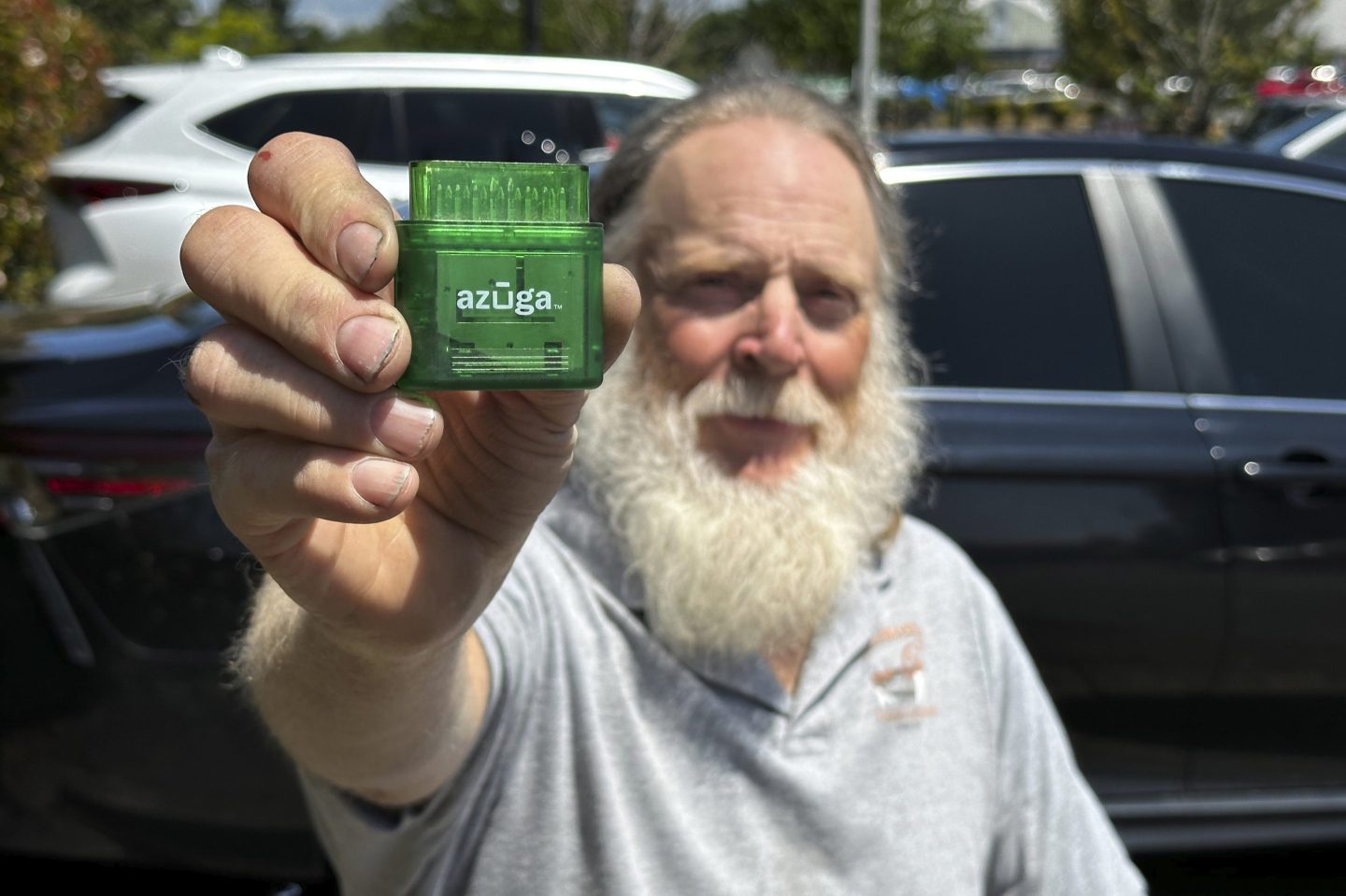
Evan Burroughs, who touts the virtues of an Oregon pilot program that charges motorists by the distance their vehicle travels rather than the gas it uses, displays a tracking device the program uses, in Salem, Ore., on June 21, 2023.
Evan Burroughs, who touts the virtues of an Oregon pilot program that charges motorists by the distance their vehicle travels rather than the gas it uses, displays a tracking device the program uses, in Salem, Ore., on June 21, 2023. Andrew Selsky—AP

Evan Burroughs has spent eight years touting the virtues of an Oregon pilot program charging motorists by the distance their vehicle travels rather than the gas it guzzles, yet his own mother still hasn’t bought in.

Recommended Video

Margaret Burroughs, 85, said she has no intention of inserting a tracking device on her Nissan Murano to record the miles she drives to get groceries or attend needlepoint meetings. She figures it’s far less hassle to just pay at the pump, as Americans have done for more than a century.

“It’s probably a good thing, but on top of everybody else’s stress today, it’s just one more thing,” she said of Oregon’s first-in-the-nation initiative, which is run by the state transportation department where her son serves as a survey analyst.

Burroughs’ reluctance exemplifies the myriad hurdles U.S. states face as they experiment with road usage charging programs aimed at one day replacing motor fuel taxes, whose purchasing power is less each year, in part due to inflation, fuel efficiency and the rise of electric cars.

The federal government is about to pilot its own such program, funded by $125 million from the infrastructure measure President Joe Biden signed in November 2021.

So far, only three states — Oregon, Utah and Virginia — are generating revenue from road usage charges, despite the looming threat of an ever-widening gap between states’ gas tax proceeds and their transportation budgets. Hawaii will soon become the fourth. Without action, the gap could reach $67 billion by 2050 due to fuel efficiency alone, Boston-based CDM Smith estimates.

Many states have implemented stopgap measures, such as imposing additional taxes or registration fees on electric vehicles and, more recently, adding per-kilowatt-hour taxes to electricity accessed at public charging stations.

Last year, Colorado began adding a 27-cent tax to home deliveries from Amazon and other online retailers to help fund transportation projects. Some states also are testing electronic tolling systems.

But road usage charges — also known as mileage-based user fees, distance-based fees or vehicle-miles-traveled taxes — are attracting the bulk of the academic attention, research dollars and legislative activity.

Doug Shinkle, transportation program director at the nonpartisan National Conference of State Legislatures, predicts that after some 20 years of anticipation, more than a decade of pilot projects and years of voluntary participation, making programs mandatory is the next logical step.

“The impetus at this point is less about collecting revenue than about establishing these systems, working out the kinks, getting the public comfortable with it, expanding awareness around it,” he said.

Electric car sales in the U.S. rose from just 0.1% of total car sales in 2011 to 4.6% in 2021, according to the U.S. Bureau of Labor Statistics. S&P Global Mobility forecasts they will make up 40% of the sales by 2030, while other projections are even rosier.

Patricia Hendren, executive director of the Eastern Transportation Coalition, said figuring out how to account for multistate trips is particularly important in the eastern U.S., where states are smaller and closer together than those in the West. Virginia’s program, launched in 2022, is already the largest in the nation and will provide valuable lessons, she said.

Hendren’s organization, a 17-state partnership that researches transportation safety and technology innovations, participated in one of the earliest pilot projects and eight others since. The biggest hurdle, she said, is to inform the public about the diminishing returns from the gas tax that has long paid for roads.

“This is about the relationship between the people who are using our roads and bridges and how we’re paying for it,” Hendren said. “We’ve been doing it one way for 100 years, and that way is not going to work anymore.”

Eric Paul Dennis, a transportation analyst at the Citizens Research Council of Michigan, said the failure of states to convert years of research into even one fully functional, mandatory program by now raises questions about whether road usage charging can really work.

“There’s no program design that I have seen that I think can be implemented at scale in a way that is publicly acceptable,” he said. “That doesn’t mean that a program can’t be designed to do so, but I feel like if you can’t even conceive of the program architecture that seems like something that would work, you probably shouldn’t put too much faith in it.”

Indeed, a chicken-and-egg dispute over how to proceed in Washington state has stymied road usage charging efforts there.

Lawmakers passed a bill in April that would have begun early steps toward a program by allowing collection of motorists’ odometer readings on a voluntary basis. Democratic Gov. Jay Inslee vetoed the measure, though, arguing that Washington needs a program in place before starting to collect citizens’ personal data.

States also must grapple with the social and environmental implications of their plans for replacing the gas tax, said Asha Weinstein Agrawal, director of the National Transportation Finance Center at San Jose State University’s Mineta Transportation Institute.

The institute has conducted national surveys every year since 2010 and found growing support for mileage-based fees, special rates for low-income drivers and rates tied to how much pollution a vehicle generates, she said.

Weinstein Agrawal said public policy, and the way transportation is funded, often fails to reflect states’ growing emphasis on curbing carbon emissions as a way to deal with climate change.

“To switch over to a system that makes it cheaper to drive a gas guzzler and more expensive to drive a Prius,” she said, “seems both symbolically problematic and to be sending, in the most literal way, the wrong economic incentives to people.”

Evan Burroughs said his 85-year-old father, Hank, who drives an electric car, avoids paying significant vehicle registration fees by participating in Oregon’s program, while Burroughs himself has paid an extra dollar or two each month for his Subaru Outback.

“To me, that’s worth it to be part of the experiment,” he said, “and to know I’m paying my fair share for the roads.”

Join us at the Fortune Workplace Innovation Summit May 19–20, 2026, in Atlanta. The next era of workplace innovation is here—and the old playbook is being rewritten. At this exclusive, high-energy event, the world’s most innovative leaders will convene to explore how AI, humanity, and strategy converge to redefine, again, the future of work. Register now.
About the Authors
By Julie Carr Smyth
See full bioRight Arrow Button Icon
By The Associated Press
See full bioRight Arrow Button Icon

Latest in Finance

Finance
Lorem ipsum dolor sit amet, consectetur adipiscing elit, sed do eiusmod tempor incididunt ut labore et dolore magna aliqua. Ut enim ad minim veniam
By Fortune Editors
October 20, 2025
Finance
Lorem ipsum dolor sit amet, consectetur adipiscing elit, sed do eiusmod tempor incididunt ut labore et dolore magna aliqua. Ut enim ad minim veniam
By Fortune Editors
October 20, 2025
Finance
Lorem ipsum dolor sit amet, consectetur adipiscing elit, sed do eiusmod tempor incididunt ut labore et dolore magna aliqua. Ut enim ad minim veniam
By Fortune Editors
October 20, 2025
Finance
Lorem ipsum dolor sit amet, consectetur adipiscing elit, sed do eiusmod tempor incididunt ut labore et dolore magna aliqua. Ut enim ad minim veniam
By Fortune Editors
October 20, 2025
Finance
Lorem ipsum dolor sit amet, consectetur adipiscing elit, sed do eiusmod tempor incididunt ut labore et dolore magna aliqua. Ut enim ad minim veniam
By Fortune Editors
October 20, 2025
Finance
Lorem ipsum dolor sit amet, consectetur adipiscing elit, sed do eiusmod tempor incididunt ut labore et dolore magna aliqua. Ut enim ad minim veniam
By Fortune Editors
October 20, 2025

Most Popular

Finance
Lorem ipsum dolor sit amet, consectetur adipiscing elit, sed do eiusmod tempor incididunt ut labore et dolore magna aliqua. Ut enim ad minim veniam
By Fortune Editors
October 20, 2025
Finance
Lorem ipsum dolor sit amet, consectetur adipiscing elit, sed do eiusmod tempor incididunt ut labore et dolore magna aliqua. Ut enim ad minim veniam
By Fortune Editors
October 20, 2025
Finance
Lorem ipsum dolor sit amet, consectetur adipiscing elit, sed do eiusmod tempor incididunt ut labore et dolore magna aliqua. Ut enim ad minim veniam
By Fortune Editors
October 20, 2025
Finance
Lorem ipsum dolor sit amet, consectetur adipiscing elit, sed do eiusmod tempor incididunt ut labore et dolore magna aliqua. Ut enim ad minim veniam
By Fortune Editors
October 20, 2025
Finance
Lorem ipsum dolor sit amet, consectetur adipiscing elit, sed do eiusmod tempor incididunt ut labore et dolore magna aliqua. Ut enim ad minim veniam
By Fortune Editors
October 20, 2025
Finance
Lorem ipsum dolor sit amet, consectetur adipiscing elit, sed do eiusmod tempor incididunt ut labore et dolore magna aliqua. Ut enim ad minim veniam
By Fortune Editors
October 20, 2025
Fortune Secondary Logo
Rankings
  • 100 Best Companies
  • Fortune 500
  • Global 500
  • Fortune 500 Europe
  • Most Powerful Women
  • Future 50
  • World’s Most Admired Companies
  • See All Rankings
Sections
  • Finance
  • Fortune Crypto
  • Features
  • Leadership
  • Health
  • Commentary
  • Success
  • Retail
  • Mpw
  • Tech
  • Lifestyle
  • CEO Initiative
  • Asia
  • Politics
  • Conferences
  • Europe
  • Newsletters
  • Personal Finance
  • Environment
  • Magazine
  • Education
Customer Support
  • Frequently Asked Questions
  • Customer Service Portal
  • Privacy Policy
  • Terms Of Use
  • Single Issues For Purchase
  • International Print
Commercial Services
  • Advertising
  • Fortune Brand Studio
  • Fortune Analytics
  • Fortune Conferences
  • Business Development
  • Group Subscriptions
About Us
  • About Us
  • Editorial Calendar
  • Press Center
  • Work At Fortune
  • Diversity And Inclusion
  • Terms And Conditions
  • Site Map
Fortune Secondary Logo
  • About Us
  • Editorial Calendar
  • Press Center
  • Work At Fortune
  • Diversity And Inclusion
  • Terms And Conditions
  • Site Map
  • Facebook icon
  • Twitter icon
  • LinkedIn icon
  • Instagram icon
  • Pinterest icon

Latest in Finance

AIdisruption
OpenAI investor Vinod Khosla believes AI will be able to do 80% of all jobs by 2030. Here’s how life could be affordable after mass unemployment
By Nick LichtenbergMarch 6, 2026
34 minutes ago
Startups & VentureVenture Capital
February was the biggest month in venture history, thanks only to OpenAI, Anthropic, and Waymo
By Lily Mae LazarusMarch 6, 2026
59 minutes ago
Future of WorkElectric vehicles
Nearly 1,000 workers laid off at SK Battery plant in Georgia as companies cancel EVs and Trump Admin eliminates auto company incentives
By The Associated Press, Jeff Amy and Alexa St. JohnMarch 6, 2026
1 hour ago
EconomyICE
A Minneapolis Fed report details how much Trump’s immigration crackdown hurt businesses and workers. ‘There are not any people to hire’
By Jason MaMarch 6, 2026
2 hours ago
Scott Bessent, speaking into a microphone, raises one hand next to his face.
EconomyTariffs
CBO highlights the good news in Trump’s lost tariff revenue hiking the deficit by $2 trillion: lower inflation and unemployment—and higher GDP
By Sasha RogelbergMarch 6, 2026
2 hours ago
Saad Sherida al-Kaabi, Qatar's Energy Minister
EnergyGlobal Economy
Iran conflict could ‘bring down the economies of the world,’ warns one of the Middle East’s biggest energy exporters
By Tristan BoveMarch 6, 2026
2 hours ago

Most Popular

placeholder alt text
Economy
The Treasury may need to borrow an extra $1.6 trillion to cover the hole left by tariff ruling and pay a further $400 billion in debt interest
By Eleanor PringleMarch 6, 2026
9 hours ago
placeholder alt text
Success
Chinese billionaire who has fathered more than 100 children hopes to have dozens of U.S.-born boys to one day take over his business
By Emma BurleighMarch 5, 2026
1 day ago
placeholder alt text
AI
OpenAI investor Vinod Khosla predicts today’s 5-year-olds won’t ever need to get jobs thanks to AI
By Sasha RogelbergMarch 4, 2026
2 days ago
placeholder alt text
Politics
Meet Markwayne Mullin, the new multimillionaire head of DHS, who owns a cattle ranch in Oklahoma
By Jacqueline MunisMarch 5, 2026
22 hours ago
placeholder alt text
Success
Uber CEO says his ‘really demanding’ work culture includes expecting employees to answer his emails over the weekend: ‘Don’t come here if you want to coast’
By Emma BurleighMarch 4, 2026
2 days ago
placeholder alt text
Economy
Trump's loss of $1.7 trillion in tariff revenue will send the national debt to $58 trillion by 2036, think tank projects
By Nick LichtenbergMarch 5, 2026
1 day ago

© 2026 Fortune Media IP Limited. All Rights Reserved. Use of this site constitutes acceptance of our Terms of Use and Privacy Policy | CA Notice at Collection and Privacy Notice | Do Not Sell/Share My Personal Information
FORTUNE is a trademark of Fortune Media IP Limited, registered in the U.S. and other countries. FORTUNE may receive compensation for some links to products and services on this website. Offers may be subject to change without notice.