• Home
  • Latest
  • Fortune 500
  • Finance
  • Tech
  • Leadership
  • Lifestyle
  • Rankings
  • Multimedia
PoliticsRailroads

The federal government’s failure to ensure that trains won’t derail and create fiery toxic messes has states rolling up their sleeves and regulating

By
Marc Levy
Marc Levy
,
Josh Funk
Josh Funk
, and
The Associated Press
Down Arrow Button Icon
By
Marc Levy
Marc Levy
,
Josh Funk
Josh Funk
, and
The Associated Press
Down Arrow Button Icon
June 27, 2023, 10:59 AM ET
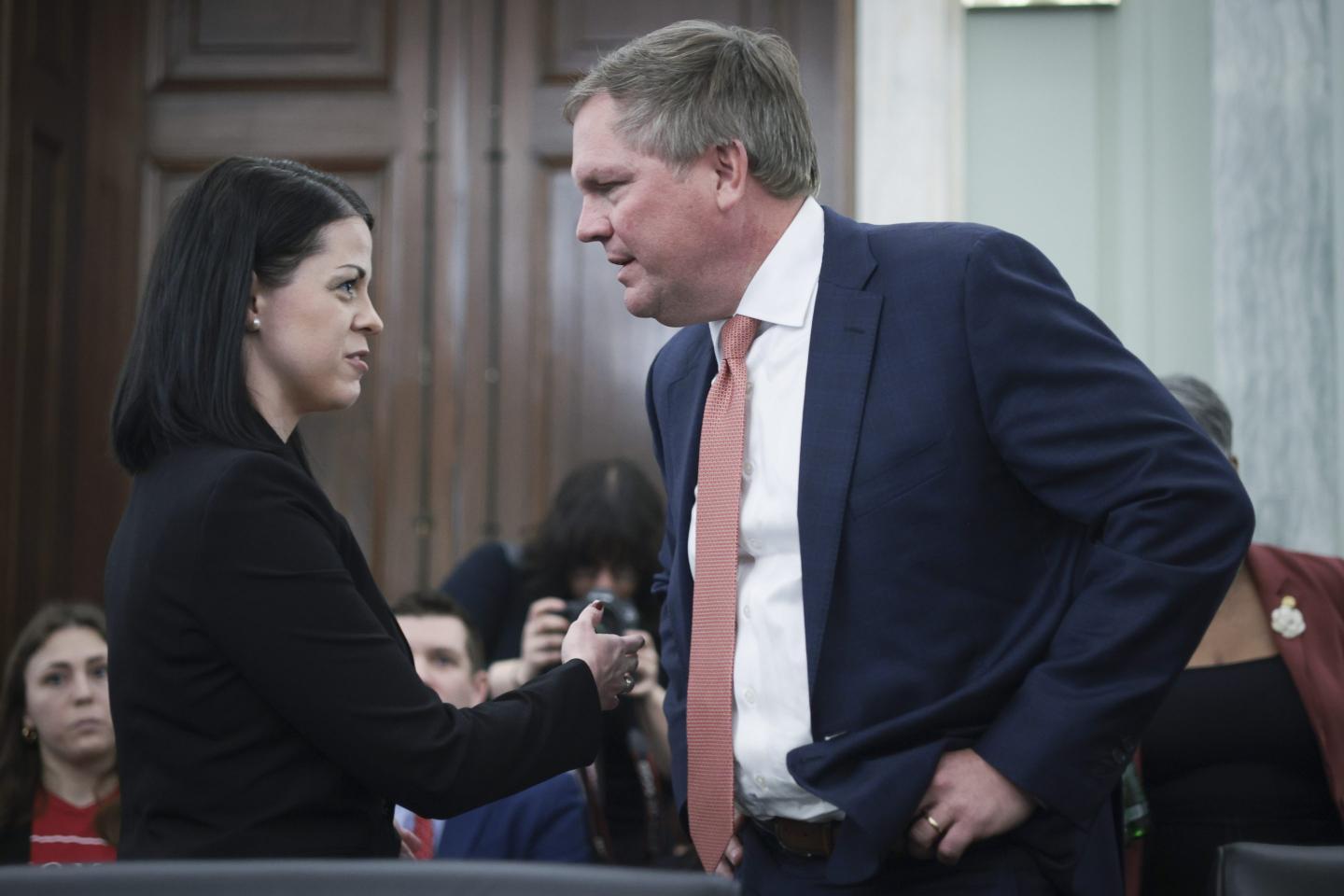
Alan Shaw, Misti Allison
Alan Shaw (R), CEO of Norfolk Southern, talks with East Palestine resident Misti Allison (L) prior to testifying before the Senate Commerce, Science, and Transportation Committee on March 22, 2023 in Washington, DC.Win McNamee—Getty Images

Spurred on by train derailments, some states with busy criss-crossing freight railroads are pursuing their own safety remedies rather than wait for federal action amid industry opposition and questions about whether they even have authority to make the changes.

Recommended Video

The activity comes after a train carrying toxic chemicals derailed on Feb. 3 along the Ohio-Pennsylvania border, prompting new legislation and reviving long-stalled efforts as backers voice skepticism that the federal government is capable of helping.

Legislatures in at least a dozen states have advanced measures in recent weeks, including some in states such as Minnesota that have witnessed disruptive derailments.

Some of the new requirements include provisions long resisted by the railroad industry. It contends it’s capable of making improvements and that its growing efficiency — including significantly longer trains and a much smaller workforce — doesn’t compromise safety.

In large part, states want limits on the length of trains that routinely stretch more than 2 miles long and on how much time trains can block road crossings — which can disrupt traffic and block emergency response vehicles.

They are also pursuing rules to maintain the current standard of two-person crews, bolster the trackside detectors used to identify equipment problems and require more notice to local emergency responders about hazardous freight.

The railroads argue that the industry’s overall safety record has been improving even as trains have grown longer and crew sizes shrank over the decades. So Norfolk Southern CEO Alan Shaw said in an interview that he doesn’t think it makes sense to regulate those areas.

“We’re going to follow the science and we’re going to follow the data,” Shaw said. “We’re looking for investments in safety that are going to drive favorable outcomes.”

And the state efforts to regulate rail are fraught with legal uncertainty over whether only the federal government can enforce such requirements. And Congress and federal regulators are considering similar measures.

Ohio moved quickly, with the Republican-controlled government enacting a new law within two months of the Norfolk Southern train derailment in East Palestine.

The evacuation from the fiery crash extended into Pennsylvania, where the state House of Representatives approved a wide-ranging safety bill in early June.

The sponsor, Rep. Rob Matzie, a Democrat whose western Pennsylvania district is home to a major rail freight handling hub, said he is satisfied with the state’s legal standing.

He said he is sick of hearing that the East Palestine derailment is an isolated incident, that the rail companies are making improvements or that the federal government will order safety improvements.

“It’s now time for this state to act,” Matzie told colleagues during floor arguments. “We can’t wait for federal regulations, which always seem to be in the works, but never quite get done. Or for federal laws that will never ever see the light of day.”

States maintain that Congress long ago gave them the authority to regulate aspects of rail safety that federal regulations don’t cover and that courts require federal law to be clear about when that responsibility rests exclusively with a federal agency.

Railroads, however, argue that federal law broadly gives federal agencies exclusive jurisdiction to regulate rail transportation and that state laws ostensibly aimed at rail safety often do not actually improve safety.

Prior experiences haven’t exactly inspired confidence that the federal government will act quickly.

For instance, a 2008 law requiring the deployment of positive train control systems — equipment designed to prevent train-to-train collisions, over-speed derailments and other accidents — wasn’t fully implemented until almost 2021.

Then in 2018, then-President Donald Trump’s administration dropped a proposed rule that would have required trains hauling highly flammable liquids like crude oil to be fitted with advanced braking systems.

Two rail union officials — Jason Doering and Matt Parker — who have both lobbied for legislation in Nevada for years said it’s important for states to act because they’re not optimistic that Congress will pass meaningful reforms over the strong lobbying of the railroads in a polarized political climate. Plus, they said “the federal government’s approach to rail safety has historically been more reactionary than proactive.”

The Norfolk Southern derailment in East Palestine spurred legislation in Congress that advanced out of committee in the Democratic-controlled Senate, but its future in that chamber — not to mention the Republican-controlled House — is uncertain amid industry opposition.

Sen. Sherrod Brown, an Ohio Democrat who is a lead sponsor, said earlier this month that they are still trying to line up support and predicted “pressure by the rail lobby and, frankly, from some Republican leaders to weaken or kill the bill.”

Even though government data shows that derailments have declined in recent years, there were still 1,049 of them last year — roughly three a day. More than three quarters of them happen at slow speeds in railyards and don’t cause significant damage.

The industry contends that it remains the safest way to transport hazardous materials over land. Norfolk Southern and all the major railroads have announced steps to improve safety— such as by installing more trackside detectors that railroads use to spot problems and prevent derailments — though regulators and lawmakers have urged them to do more.

Investigators are still working to determine exactly what caused the East Palestine derailment. In a preliminary report, they said the likely cause was an overheating bearing on one of the railcars — but wasn’t flagged by a trackside detector early enough to prevent an accident.

Joseph L. Schofer, a retired professor of civil and environmental engineering from Northwestern University, said some rules being proposed at the state and federal level — for instance, minimum crew size — have nothing to do with the East Palestine derailment because that train actually had three people in its crew.

He also said state-to-state rules will result in chaos.

“What one state does to regulate the industry will have impacts on all states,” Schofer said. “Logically we ought to be able to establish a comprehensive, integrated rule set, based on a firm understanding of the rail industry as an integrated whole.”

Some bills were percolating before the East Palestine derailment.

In March, Utah Gov. Spencer Cox signed legislation creating an Office of Rail Safety, with backers citing disputes with railroads over widening roads at hundreds of rail crossings, but also derailments there.

“This is the most substantive state safety bill for my industry in over 50 years,” a union representative, Danny Brewer, told lawmakers at a February hearing.

The new law empowers state employees to take over the safety inspections otherwise performed by federal inspectors, and also to scrutinize rail crossings and seek federal penalties for trains blocking highway crossings without justification.

New York is advancing wide-ranging legislation that includes standards for more safety equipment after Gov. Kathy Hochul called for rail safety measures, citing the East Palestine derailment.

In Minnesota, Gov. Tim Walz signed a bill that requires railroads to promptly provide information to public safety agencies about hazardous materials being transported.

The Kansas Senate approved a bill to limit trains to 8,500 feet, but it is sitting in a House committee at least until the session resumes in January. Gov. Laura Kelly supports it, her office said.

Some measures have hit roadblocks.

In Nevada, Republican Gov. Joe Lombardo vetoed legislation passed by the Democratic-controlled Legislature on party-line votes that would have capped train length at 7,500 feet. Lombardo said in his veto message that the bill was a “policy overreach” and possibly unconstitutional.

In Pennsylvania, the House-approved bill faces doubters in a Republican-controlled Senate where top Republicans suggest that it goes beyond state enforcement powers.

“There’s some concern that what the House passed lacks enforceability,” Senate Majority Leader Joe Pittman, a Republican, said in an interview. “And I don’t think we’re ever well-served to pass bills that can’t have proper enforcement.”

___

On Twitter, follow Marc Levy at @timelywriter and follow Josh Funk at @funkwrite.

___

Associated Press reporter Stephen Groves in Washington contributed to this report. Funk contributed from Atlanta and Omaha, Nebraska.

The Fortune 500 Innovation Forum will convene Fortune 500 executives, U.S. policy officials, top founders, and thought leaders to help define what’s next for the American economy, Nov. 16-17 in Detroit. Apply here.
About the Authors
By Marc Levy
See full bioRight Arrow Button Icon
By Josh Funk
See full bioRight Arrow Button Icon
By The Associated Press
See full bioRight Arrow Button Icon

Latest in Politics

Finance
Lorem ipsum dolor sit amet, consectetur adipiscing elit, sed do eiusmod tempor incididunt ut labore et dolore magna aliqua. Ut enim ad minim veniam
By Fortune Editors
October 20, 2025
Finance
Lorem ipsum dolor sit amet, consectetur adipiscing elit, sed do eiusmod tempor incididunt ut labore et dolore magna aliqua. Ut enim ad minim veniam
By Fortune Editors
October 20, 2025
Finance
Lorem ipsum dolor sit amet, consectetur adipiscing elit, sed do eiusmod tempor incididunt ut labore et dolore magna aliqua. Ut enim ad minim veniam
By Fortune Editors
October 20, 2025
Finance
Lorem ipsum dolor sit amet, consectetur adipiscing elit, sed do eiusmod tempor incididunt ut labore et dolore magna aliqua. Ut enim ad minim veniam
By Fortune Editors
October 20, 2025
Finance
Lorem ipsum dolor sit amet, consectetur adipiscing elit, sed do eiusmod tempor incididunt ut labore et dolore magna aliqua. Ut enim ad minim veniam
By Fortune Editors
October 20, 2025
Finance
Lorem ipsum dolor sit amet, consectetur adipiscing elit, sed do eiusmod tempor incididunt ut labore et dolore magna aliqua. Ut enim ad minim veniam
By Fortune Editors
October 20, 2025

Most Popular

Finance
Lorem ipsum dolor sit amet, consectetur adipiscing elit, sed do eiusmod tempor incididunt ut labore et dolore magna aliqua. Ut enim ad minim veniam
By Fortune Editors
October 20, 2025
Finance
Lorem ipsum dolor sit amet, consectetur adipiscing elit, sed do eiusmod tempor incididunt ut labore et dolore magna aliqua. Ut enim ad minim veniam
By Fortune Editors
October 20, 2025
Finance
Lorem ipsum dolor sit amet, consectetur adipiscing elit, sed do eiusmod tempor incididunt ut labore et dolore magna aliqua. Ut enim ad minim veniam
By Fortune Editors
October 20, 2025
Finance
Lorem ipsum dolor sit amet, consectetur adipiscing elit, sed do eiusmod tempor incididunt ut labore et dolore magna aliqua. Ut enim ad minim veniam
By Fortune Editors
October 20, 2025
Finance
Lorem ipsum dolor sit amet, consectetur adipiscing elit, sed do eiusmod tempor incididunt ut labore et dolore magna aliqua. Ut enim ad minim veniam
By Fortune Editors
October 20, 2025
Finance
Lorem ipsum dolor sit amet, consectetur adipiscing elit, sed do eiusmod tempor incididunt ut labore et dolore magna aliqua. Ut enim ad minim veniam
By Fortune Editors
October 20, 2025
Fortune Secondary Logo
Rankings
  • 100 Best Companies
  • Fortune 500
  • Global 500
  • Fortune 500 Europe
  • Most Powerful Women
  • World's Most Admired Companies
  • See All Rankings
  • Lists Calendar
Sections
  • Finance
  • Fortune Crypto
  • Features
  • Leadership
  • Health
  • Commentary
  • Success
  • Retail
  • Mpw
  • Tech
  • Lifestyle
  • CEO Initiative
  • Asia
  • Politics
  • Conferences
  • Europe
  • Newsletters
  • Personal Finance
  • Environment
  • Magazine
  • Education
Customer Support
  • Frequently Asked Questions
  • Customer Service Portal
  • Privacy Policy
  • Terms Of Use
  • Single Issues For Purchase
  • International Print
Commercial Services
  • Advertising
  • Fortune Brand Studio
  • Fortune Analytics
  • Fortune Conferences
  • Business Development
  • Group Subscriptions
About Us
  • About Us
  • Press Center
  • Work At Fortune
  • Terms And Conditions
  • Site Map
  • About Us
  • Press Center
  • Work At Fortune
  • Terms And Conditions
  • Site Map
  • Facebook icon
  • Twitter icon
  • LinkedIn icon
  • Instagram icon
  • Pinterest icon

Latest in Politics

Apple raises Mac Mini’s starting price to $799 after AI frenzy drains supply
AIChips
Apple raises Mac Mini’s starting price to $799 after AI frenzy drains supply
By Chris Welch, Mark Gurman and BloombergMay 2, 2026
14 minutes ago
Unionized workers form alliance with rich tech giants on AI data centers, pushing back on local opposition and redrawing political lines
AIData centers
Unionized workers form alliance with rich tech giants on AI data centers, pushing back on local opposition and redrawing political lines
By Marc Levy and The Associated PressMay 2, 2026
27 minutes ago
Interest on U.S. debt is becoming a top driver of future deficits, as the sheer size of past borrowing overwhelms the fiscal outlook 
EconomyDebt
Interest on U.S. debt is becoming a top driver of future deficits, as the sheer size of past borrowing overwhelms the fiscal outlook 
By Jason MaMay 2, 2026
3 hours ago
trump
PoliticsWhite House
America’s paying more at the pump. Trump’s new Air Force One jet donated by Qatar is nearly ready
By Jonathan J. Cooper and The Associated PressMay 2, 2026
7 hours ago
Trump flouts lower court rulings in unprecedented display of executive power, and ‘respect for the rule of law is likely to break down’
LawDonald Trump
Trump flouts lower court rulings in unprecedented display of executive power, and ‘respect for the rule of law is likely to break down’
By Sudhin Thanawala and The Associated PressMay 2, 2026
8 hours ago
Pope Leo XIV encourages wealthy U.S. Catholics to keep donating after Papal Foundation approves most grants in its history
PoliticsPope
Pope Leo XIV encourages wealthy U.S. Catholics to keep donating after Papal Foundation approves most grants in its history
By Nicole Winfield and The Associated PressMay 2, 2026
8 hours ago

Most Popular

Scott Bessent on financial literacy: 'it drives me crazy' to see young men in blue-collar construction jobs playing the lottery
Personal Finance
Scott Bessent on financial literacy: 'it drives me crazy' to see young men in blue-collar construction jobs playing the lottery
By Fatima Hussein and The Associated PressMay 1, 2026
1 day ago
A Chick-fil-A worker got fired and then showed up behind the register to allegedly refund himself over $80,000 in mac and cheese
Law
A Chick-fil-A worker got fired and then showed up behind the register to allegedly refund himself over $80,000 in mac and cheese
By Catherina GioinoMay 1, 2026
1 day ago
Current price of oil as of May 1, 2026
Personal Finance
Current price of oil as of May 1, 2026
By Joseph HostetlerMay 1, 2026
1 day ago
China dominates the world's lithium supply. The U.S. just found 328 years' worth in its own backyard
North America
China dominates the world's lithium supply. The U.S. just found 328 years' worth in its own backyard
By Jake AngeloApril 30, 2026
2 days ago
Apple cofounder Ronald Wayne—whose stake would be worth up to $400 billion had he not sold it in 1976—says that at 91, he has no regrets
Success
Apple cofounder Ronald Wayne—whose stake would be worth up to $400 billion had he not sold it in 1976—says that at 91, he has no regrets
By Preston ForeApril 27, 2026
5 days ago
Gen Z is rebelling against the economy with ‘disillusionomics,’ tackling near 6-figure debt by turning life into a giant list of income streams
Economy
Gen Z is rebelling against the economy with ‘disillusionomics,’ tackling near 6-figure debt by turning life into a giant list of income streams
By Jacqueline MunisMay 2, 2026
7 hours ago

© 2026 Fortune Media IP Limited. All Rights Reserved. Use of this site constitutes acceptance of our Terms of Use and Privacy Policy | CA Notice at Collection and Privacy Notice | Do Not Sell/Share My Personal Information
FORTUNE is a trademark of Fortune Media IP Limited, registered in the U.S. and other countries. FORTUNE may receive compensation for some links to products and services on this website. Offers may be subject to change without notice.