• Home
  • Latest
  • Fortune 500
  • Finance
  • Tech
  • Leadership
  • Lifestyle
  • Rankings
  • Multimedia

Trendingnow

1

As CEO of the $96 billion Sam’s Club, Latriece Watkins is testing her mettle at the warehouse retailer that produced CEOs for Walmart, Target, and Walgreens

2

Jeff Bezos wants the bottom half of earners to pay zero income tax—he says nurses making just $75K should save $12K a year

3

As AI slashes white-collar jobs, Salesforce CEO Marc Benioff says almost no one is being hired—except in sales

1

As CEO of the $96 billion Sam’s Club, Latriece Watkins is testing her mettle at the warehouse retailer that produced CEOs for Walmart, Target, and Walgreens

2

Jeff Bezos wants the bottom half of earners to pay zero income tax—he says nurses making just $75K should save $12K a year

3

As AI slashes white-collar jobs, Salesforce CEO Marc Benioff says almost no one is being hired—except in sales
LifestyleScience

Blood residue on caveman weapons over 13,000 years old reveals how humans hunted mammoths, giant sloths and other megafauna during the Ice Age

By
Christopher R. Moore
and
The Conversation
The Conversation
Down Arrow Button Icon
By
Christopher R. Moore
and
The Conversation
The Conversation
Down Arrow Button Icon
June 17, 2023, 9:33 AM ET
David Herskowitz
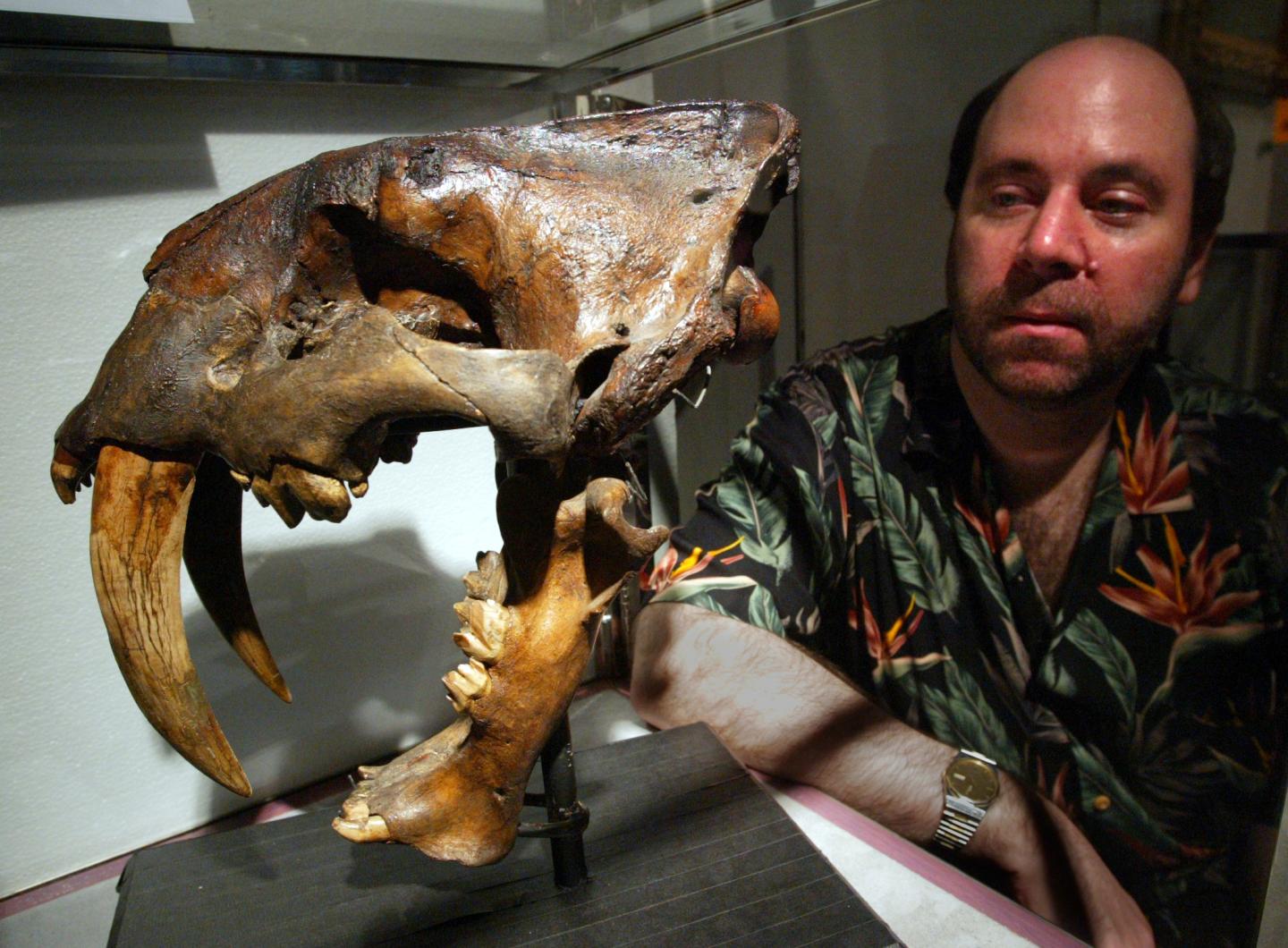
We've long known about sabertooth cats, but not the rest of their world.Bryan Chan/Los Angeles Times via Getty Images

The earliest people who lived in North America shared the landscape with huge animals. On any day these hunter-gatherers might encounter a giant, snarling saber-toothed cat ready to pounce, or a group of elephantlike mammoths stripping tree branches. Maybe a herd of giant bison would stampede past.

Recommended Video

Obviously, you can’t see any of these ice age megafauna now. They’ve all been extinct for about 12,800 years. Mammoths, mastodons, huge bison, horses, camels, very large ground sloths and giant short-faced bears all died out as the huge continental ice sheets disappeared at the end of the ice age. What happened to them?

Scientists have pointed to various potential causes for the extinctions. Some suggest environmental changes happened faster than the animals could adapt to them. Others posit a catastrophic impact of a fragmented comet. Maybe it was overhunting on the part of humans, or some combination of all these factors.

One of my major interests as an archaeologist has been to understand how the earliest Paleo-Americans lived and interacted with megafauna species. Just how implicated should humans be in the extinction of these ice age animals? In a new study, my colleagues and I used a forensic technique more commonly used to identify blood on objects at crime scenes to investigate this question.

Testing stone tools like murder weapons

Archaeologists have uncovered a sparse scattering of stone tools left at the campsites of Paleo-American Clovis hunter-gatherers who lived around the time of the megafauna extinctions.

These include iconic Clovis spearpoints with their distinctive flutes – concave areas left behind by removed stone flakes that extend from the base to the middle of the point. People most likely made the points this way so they could easily affix them to a spear shaft.

Based on sites excavated in the western United States, archaeologists know Paleo-American Clovis hunter-gatherers who lived around the time of the extinctions at least occasionally killed or scavenged ice age megafauna such as mammoths. There they’ve found preserved bones of megafauna together with the stone tools used for killing and butchering these animals. These sites are crucial for understanding the possible role that early Paleo-Americans played in the extinction event.

Unfortunately, many areas in the Southeastern United States lack sites with preserved bone and associated stone tools that might indicate whether megafauna were hunted there by Clovis or other Paleo-American cultures. Without evidence of preserved bones of megafauna, archaeologists have to find other ways to examine this question.

Forensic scientists have used an immunological blood residue analysis technique called immunoelectrophoresis for over 50 years to identify blood residue sticking to objects found at crime scenes. In recent years, researchers have applied this method to identify animal blood proteins preserved within ancient stone tools. They compare aspects of the ancient blood with blood antigens derived from modern relatives of extinct animals.

Residue analysis does not rely on the presence of nuclear DNA, but rather on preserved, identifiable proteins that sometimes survive within the microscopic fractures and flaws of stone tools created during their manufacture and use. Typically, only a small percentage of artifacts produce positive blood residue results, indicating a match between the ancient residue and antiserum molecules from modern animals.

A previous blood residue study of a small number of Paleo-American artifacts in South Carolina and Georgia failed to provide evidence that these people had hunted or scavenged extinct megafauna. The researchers found evidence of bison and other animals such as deer, bear and rabbit, but no evidence of Proboscidean (mammoth or mastodon) or of an extinct species of North American horse.

Identifying ancient prey of human hunters

My colleagues and I realized we needed a much larger sample of Paleo-American stone tools for testing. Since Clovis points and other Paleo-American artifacts are rare, I relied heavily on local museums, private collectors, collections housed at state universities and even military installations to amass a sample of 120 Paleo-American stone tools from all over North Carolina and South Carolina.

Because these artifacts are irreplaceable, I personally carried all 120 Clovis spearpoints and tools inside a protective case on a flight from South Carolina to the blood residue lab in Portland, Oregon. I coordinated in advance with the Transportation Security Administration so my collection of 13,000-year-old weaponry would make it through the screening process.

The blood residue analysis provided unambiguous proof that the tools had had contact with ancient animal blood proteins. The results included the first direct evidence on ancient stone tools of the blood of extinct mammoth or mastodon (Proboscidean) and the extinct North American horse (Equidae) on Paleo-American artifacts in eastern North America. This evidence is significant because it proves that these animals were present in the Carolinas, and they were hunted or scavenged by early Paleo-Americans.

In addition to Proboscidean and horse, bison (Bovidae) blood residues were most common, adding to earlier blood residue research suggesting a focus on bison hunting by Clovis and other Paleo-American cultures. Bison in North America did not go extinct but instead became smaller, most likely as a result of climate change as the last ice age ended and the climate warmed.

So, what do these results suggest for the extinction debate? While this study does not prove humans were responsible for the extinctions, it does show that early Paleo-Americans across the continent likely hunted or scavenged these animals, at least occasionally. The results also indicate that Proboscideans and horses were around when Clovis people were here – only a few hundred years before their eventual extinction in North America.

Another interesting finding is that while Proboscidean blood residues are found on Clovis artifacts, blood residues for horses (Equidae) are found on both Clovis and Paleo-American points that are slightly more recent younger than Clovis. This may suggest the extinction of Proboscidean was complete in the Carolinas by the end of the Clovis period, and the extinction of ice age horse species took longer.

Testing an even larger sample of Paleo-American stone tools from different regions of North America could help pin down the timing and geographic variability in the extinction of megafauna species and provide more clues about why these animals disappeared when they did.

Christopher R. Moore is Research Professor and Director of the Southeastern Paleoamerican Survey (SEPAS) at the South Carolina Institute for Archaeology and Anthropology, University of South Carolina

This article is republished from The Conversation under a Creative Commons license. Read the original article.

About the Authors
By Christopher R. Moore
See full bioRight Arrow Button Icon
By The Conversation
See full bioRight Arrow Button Icon

Latest in Lifestyle

Finance
Lorem ipsum dolor sit amet, consectetur adipiscing elit, sed do eiusmod tempor incididunt ut labore et dolore magna aliqua. Ut enim ad minim veniam
By Fortune Editors
October 20, 2025
Finance
Lorem ipsum dolor sit amet, consectetur adipiscing elit, sed do eiusmod tempor incididunt ut labore et dolore magna aliqua. Ut enim ad minim veniam
By Fortune Editors
October 20, 2025
Finance
Lorem ipsum dolor sit amet, consectetur adipiscing elit, sed do eiusmod tempor incididunt ut labore et dolore magna aliqua. Ut enim ad minim veniam
By Fortune Editors
October 20, 2025
Finance
Lorem ipsum dolor sit amet, consectetur adipiscing elit, sed do eiusmod tempor incididunt ut labore et dolore magna aliqua. Ut enim ad minim veniam
By Fortune Editors
October 20, 2025
Finance
Lorem ipsum dolor sit amet, consectetur adipiscing elit, sed do eiusmod tempor incididunt ut labore et dolore magna aliqua. Ut enim ad minim veniam
By Fortune Editors
October 20, 2025
Finance
Lorem ipsum dolor sit amet, consectetur adipiscing elit, sed do eiusmod tempor incididunt ut labore et dolore magna aliqua. Ut enim ad minim veniam
By Fortune Editors
October 20, 2025

Most Popular

Finance
Lorem ipsum dolor sit amet, consectetur adipiscing elit, sed do eiusmod tempor incididunt ut labore et dolore magna aliqua. Ut enim ad minim veniam
By Fortune Editors
October 20, 2025
Finance
Lorem ipsum dolor sit amet, consectetur adipiscing elit, sed do eiusmod tempor incididunt ut labore et dolore magna aliqua. Ut enim ad minim veniam
By Fortune Editors
October 20, 2025
Finance
Lorem ipsum dolor sit amet, consectetur adipiscing elit, sed do eiusmod tempor incididunt ut labore et dolore magna aliqua. Ut enim ad minim veniam
By Fortune Editors
October 20, 2025
Finance
Lorem ipsum dolor sit amet, consectetur adipiscing elit, sed do eiusmod tempor incididunt ut labore et dolore magna aliqua. Ut enim ad minim veniam
By Fortune Editors
October 20, 2025
Finance
Lorem ipsum dolor sit amet, consectetur adipiscing elit, sed do eiusmod tempor incididunt ut labore et dolore magna aliqua. Ut enim ad minim veniam
By Fortune Editors
October 20, 2025
Finance
Lorem ipsum dolor sit amet, consectetur adipiscing elit, sed do eiusmod tempor incididunt ut labore et dolore magna aliqua. Ut enim ad minim veniam
By Fortune Editors
October 20, 2025
Fortune Secondary Logo
Rankings
  • 100 Best Companies
  • Fortune 500
  • Global 500
  • Fortune 500 Europe
  • Most Powerful Women
  • World's Most Admired Companies
  • See All Rankings
  • Lists Calendar
Sections
  • Finance
  • Fortune Crypto
  • Features
  • Leadership
  • Health
  • Commentary
  • Success
  • Retail
  • Mpw
  • Tech
  • Lifestyle
  • CEO Initiative
  • Asia
  • Politics
  • Conferences
  • Europe
  • Newsletters
  • Personal Finance
  • Environment
  • Magazine
  • Education
Customer Support
  • Frequently Asked Questions
  • Customer Service Portal
  • Privacy Policy
  • Terms Of Use
  • Single Issues For Purchase
  • International Print
Commercial Services
  • Advertising
  • Fortune Brand Studio
  • Fortune Analytics
  • Fortune Conferences
  • Business Development
  • Group Subscriptions
About Us
  • About Us
  • Press Center
  • Work At Fortune
  • Terms And Conditions
  • Site Map
  • About Us
  • Press Center
  • Work At Fortune
  • Terms And Conditions
  • Site Map
  • Facebook icon
  • Twitter icon
  • LinkedIn icon
  • Instagram icon
  • Pinterest icon

Latest in Lifestyle

America finally crushed smoking—then defunded the playbook
HealthTobacco
America finally crushed smoking—then defunded the playbook
By Mike Stobbe and The Associated PressMay 29, 2026
6 hours ago
Reverse Health App Review (2026): Our Honest Thoughts
HealthWorkouts
Reverse Health App Review (2026): Our Honest Thoughts
By Emily PharesMay 29, 2026
8 hours ago
Green Chef Review (2026): Opinions from Testers and Experts
Healthmeal delivery
Green Chef Review (2026): Opinions from Testers and Experts
By Christina SnyderMay 29, 2026
9 hours ago
Conan O'Brien holds up a Harvard sports sweater given to him after he delivered the commencement address at Harvard University
SuccessCareers
Conan O’Brien tells Harvard graduates to play down their $250K Ivy League degree—and instead embrace being humble and ‘bad at things’
By Preston ForeMay 29, 2026
13 hours ago
Former Miami Heat guard Terry Rozier indicted on new bribery charges alleging he left games early to help gamblers cash in on more than $250,00
LawLawsuit
Former Miami Heat guard Terry Rozier indicted on new bribery charges alleging he left games early to help gamblers cash in on more than $250,00
By Rebecca Boone and The Associated PressMay 29, 2026
15 hours ago
National Spelling Bee champion Shrey Parikh spells 32 words correctly in 90 seconds to win in lightning round tie-breaker
Successteenagers
National Spelling Bee champion Shrey Parikh spells 32 words correctly in 90 seconds to win in lightning round tie-breaker
By The Associated Press and Ben NuckolsMay 29, 2026
15 hours ago

Most Popular

As CEO of the $96 billion Sam’s Club, Latriece Watkins is testing her mettle at the warehouse retailer that produced CEOs for Walmart, Target, and Walgreens
Magazine
As CEO of the $96 billion Sam’s Club, Latriece Watkins is testing her mettle at the warehouse retailer that produced CEOs for Walmart, Target, and Walgreens
By Emma HinchliffeMay 27, 2026
3 days ago
Jeff Bezos wants the bottom half of earners to pay zero income tax—he says nurses making just $75K should save $12K a year
Success
Jeff Bezos wants the bottom half of earners to pay zero income tax—he says nurses making just $75K should save $12K a year
By Preston ForeMay 21, 2026
9 days ago
As AI slashes white-collar jobs, Salesforce CEO Marc Benioff says almost no one is being hired—except in sales
Success
As AI slashes white-collar jobs, Salesforce CEO Marc Benioff says almost no one is being hired—except in sales
By Emma BurleighMay 28, 2026
2 days ago
Current price of oil as of May 28, 2026
Personal Finance
Current price of oil as of May 28, 2026
By Joseph HostetlerMay 28, 2026
2 days ago
UBS says Ron DeSantis has a problem with his plan to help 92% of homeowners save on property taxes: His own state's data
Personal Finance
UBS says Ron DeSantis has a problem with his plan to help 92% of homeowners save on property taxes: His own state's data
By Nick LichtenbergMay 28, 2026
2 days ago
Researchers let AI models run a simulated society. Claude was the safest—and Grok committed 180 crimes and went extinct within 4 days
AI
Researchers let AI models run a simulated society. Claude was the safest—and Grok committed 180 crimes and went extinct within 4 days
By Jake AngeloMay 28, 2026
2 days ago

© 2026 Fortune Media IP Limited. All Rights Reserved. Use of this site constitutes acceptance of our Terms of Use and Privacy Policy | CA Notice at Collection and Privacy Notice | Do Not Sell/Share My Personal Information
FORTUNE is a trademark of Fortune Media IP Limited, registered in the U.S. and other countries. FORTUNE may receive compensation for some links to products and services on this website. Offers may be subject to change without notice.