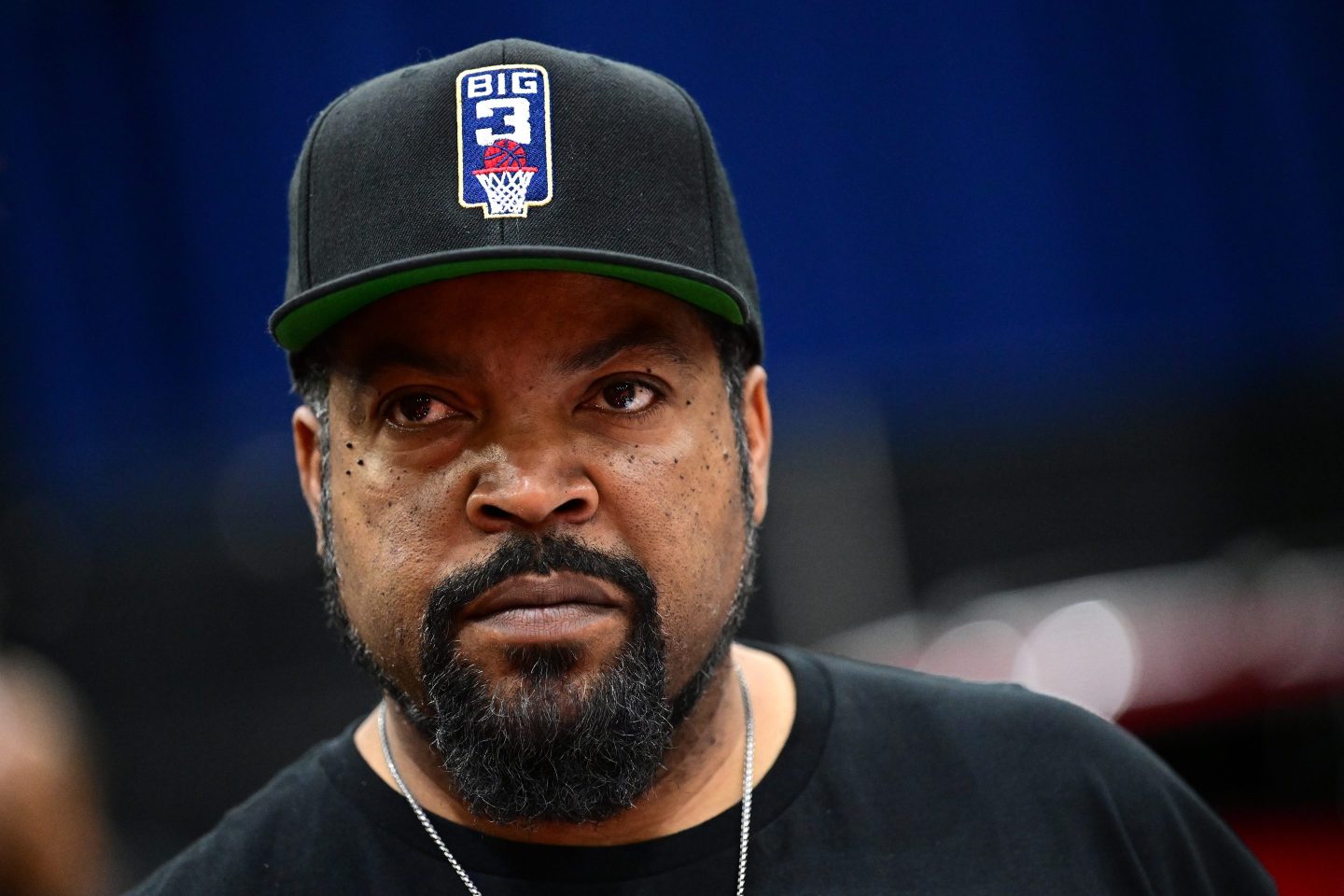
Hip-hop revolutionized pop culture almost exactly 50 years ago, and as it celebrated a half-century it suddenly looks old enough to get disrupted itself. It’s an art form famously based on preexisting material, as the earliest rappers would rhyme over pastiches of vinyl records with certain breaks repeated on a loop. The emergence of generative A.I. is making songs based off unauthorized reproductions of famous artists’ voices and musical styles. Sound familiar? To Ice Cube, the Compton, Calif.-born rapper who is one of the forefathers of modern hip-hop, this is downright “demonic.” He doesn’t want to hear that the two scenarios are comparable.
The rise of creative artificial intelligence is starting to threaten musicians and artists, who are finding themselves in the crossfire of machines capable of generating text, sound, and images. Drake and The Weeknd are just some of the artists who have had to listen to uncanny replicants of their voice generated by A.I., and even if computers haven’t produced a viral fake of his voice yet, Ice Cube already has a verdict on the age of A.I. in rap.
“I think A.I. is demonic,” he said on the Full Send podcast in an interview published last week. “I think there’s gonna be a backlash because of A.I. I think people are gonna want things organic and not artificial.”
A.I. has become all the rage over the past six months, and scammers are taking full advantage. Synthesizing someone else’s voice used to be a difficult technological hurdle, but modern A.I. systems only need a few audio samples to create voice clones of anybody, even celebrities. It gave rise to a spate of musical deepfakes, where even famous artists like Rihanna could find their vocals being used in a song they never recorded.
It sounds a lot like the common practice of sampling in hip-hop’s golden age in the 1970s, ’80s, and ’90s. Sampling is a common practice in the music industry, when one artist completes their work with a digital piece of another sound recording, or a sample, which can be produced by a different artist.
Sampling was foundational to hip-hop in particular, as it allowed artists who maybe didn’t know how to play an instrument but had an ear for a good beat to generate a hit song. Early hip-hop artists created the genre by pulling together samples from jazz, rock, and funk songs. New York City’s Beastie Boys, working with the master samplers the Dust Brothers, released their second album in 1989, Paul’s Boutique, an enduring cult classic that is 95% samples, according to Rolling Stone. The album would likely cost millions under today’s sampling rules, and the flurry of lawsuits it generated turned other artists off wide uses of sampling.
Ice Cube is no stranger to sampling, as his hip-hop group N.W.A notably sampled several oldie funk and soul songs in its debut album Straight Outta Compton. Sampling rules have become stricter over the past few decades after several lawsuits accusing artists of infringing copyright laws. The Beastie Boys were targeted by the Beatles, who alleged unauthorized use of samples in their work. In the ’90s, even Ice Cube was involved in a surprising legal fight over his debut solo album with none other than Mr. Rogers, who claimed that one of Ice Cube’s songs, A Gangsta’s Fairytale, used without permission a sample of the educational children’s show Mister Rogers’ Neighborhood’s opening.
Sampling, A.I., and their intersection with the law are a live issue. A Supreme Court decision this month ruled that artist Andy Warhol infringed on copyright laws when he reworked a photograph of the late musician Prince, a precedent experts say will make it more difficult for artists to borrow others’ work in the future.
But many samplings are still acquired with permission from copyright holders, while even several instances where short samples were taken without permission have been deemed acceptable under fair use laws. In his podcast interview, Ice Cube perhaps surprisingly revealed himself to be a supporter of litigation over unauthorized sampling, and applied this to A.I.
“It’s like a sample. I mean, someone can’t take your original voice and manipulate it without having to pay,” he said. “If I don’t pay for it, that is stealing.”
Ice Cube said that if he were to be targeted by an A.I. voice replicant, he wouldn’t hesitate to sue whoever programmed the A.I. and whoever played his illicitly borrowed voice. Other artists have been on board with A.I.-generated content using their voice—as long as they get paid for it. Pop musician Grimes tweeted last month that she supported “killing copyright” and invited A.I. to use her voice without penalty, setting out terms for “50% royalties on any successful A.I.-generated song that uses my voice.”
But even a royalty windfall might not be enough to get Ice Cube on board with the technologizing music industry, as he set aside time in his interview to criticize artists increasingly resorting to digital crutches in their work.
“The artists are getting lost in Autotune, and now that they have A.I.,” he said, “I think people don’t want a computerized rapper no more. They want to hear their voice. I don’t hear any rappers by their voice no more.”