If the debt crisis roiling Washington were eventually to send the United States crashing into recession, America’s economy would hardly sink alone.
The repercussions of a first-ever default on the federal debt would quickly reverberate around the world. Orders for Chinese factories that sell electronics to the United States could dry up. Swiss investors who own U.S. Treasurys would suffer losses. Sri Lankan companies could no longer deploy dollars as an alternative to their own dodgy currency.
“No corner of the global economy will be spared” if the U.S. government defaulted and the crisis weren’t resolved quickly, said Mark Zandi, chief economist at Moody’s Analytics.
Zandi and two colleagues at Moody’s have concluded that even if the debt limit were breached for no more than week, the U.S. economy would weaken so much, so fast, as to wipe out roughly 1.5 million jobs.
And if a government default were to last much longer — well into the summer — the consequences would be far more dire, Zandi and his colleagues found in their analysis: U.S. economic growth would sink, 7.8 million American jobs would vanish, borrowing rates would jump, the unemployment rate would soar from the current 3.4% to 8% and a stock-market plunge would erase $10 trillion in household wealth.
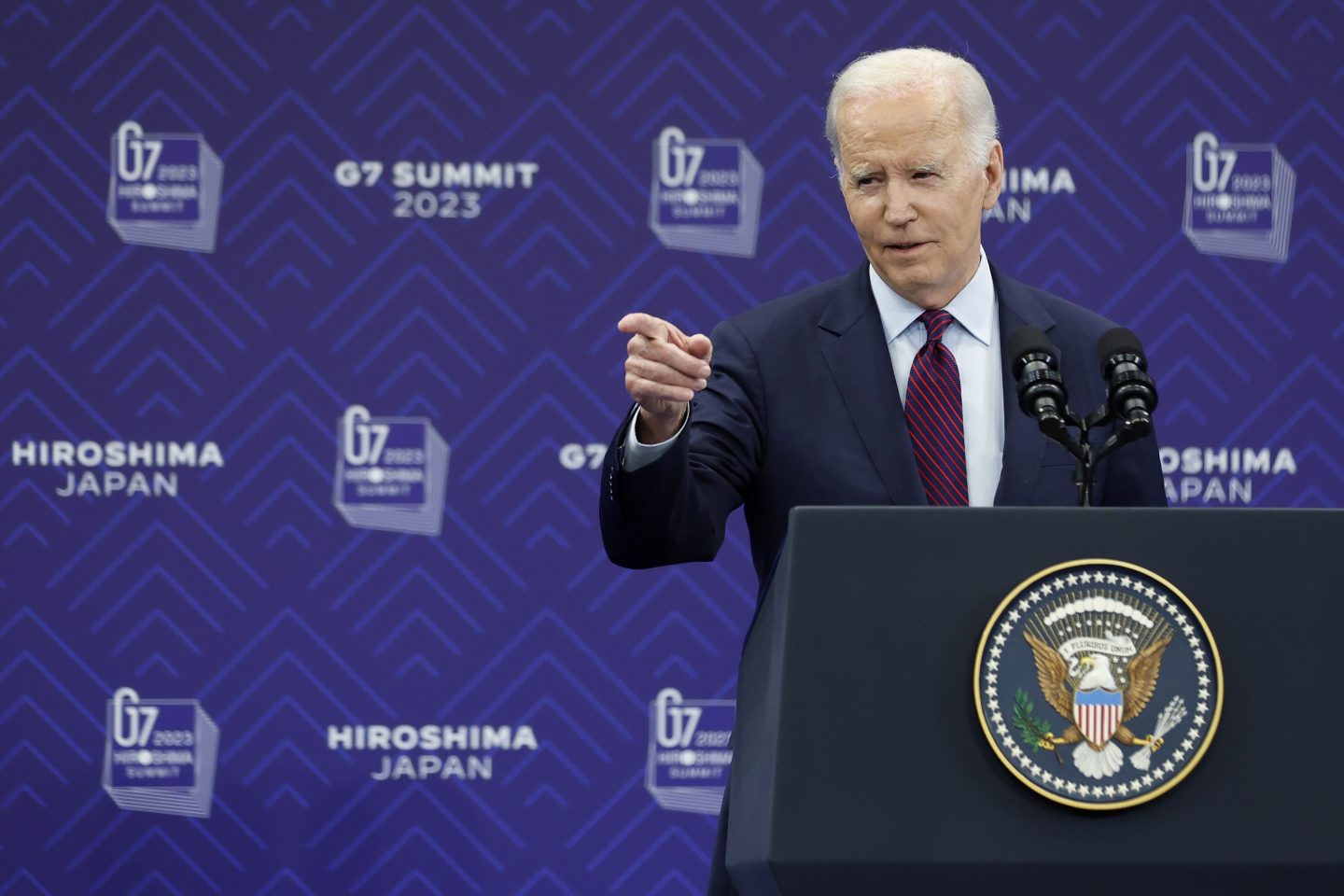
Of course, it might not come to that. The White House and House Republicans, seeking a breakthrough, concluded a round of debt-limit negotiations Sunday, with plans to resume talks Monday. The Republicans have threatened to let the government default on its debts by refusing to raise the statutory limit on what it can borrow unless President Joe Biden and the Democrats accept sharp spending cuts and other concessions.
Feeding the anxiety is the fact that so much financial activity hinges on confidence that America will always pay its financial obligations. Its debt, long viewed as an ultra-safe asset, is a foundation of global commerce, built on decades of trust in the United States. A default could shatter the $24 trillion market for Treasury debt, cause financial markets to freeze up and ignite an international crisis.
“A debt default would be a cataclysmic event, with an unpredictable but probably dramatic fallout on U.S. and global financial markets,” said Eswar Prasad, professor of trade policy at Cornell University and senior fellow at the Brookings Institution.
The threat has emerged just as the world economy is contending with a panoply of threats — from surging inflation and interest rates to the ongoing repercussions of Russia’s invasion of Ukraine to the tightening grip of authoritarian regimes. On top of all that, many countries have grown skeptical of America’s outsize role in global finance.
In the past, American political leaders generally managed to step away from the brink and raise the debt limit before it was too late. Congress has raised, revised or extended the borrowing cap 78 times since 1960, most recently in 2021.
Yet the problem has worsened. Partisan divisions in Congress have widened while the debt has grown after years of rising spending and deep tax cuts. Treasury Secretary Janet Yellen has warned that the government could default as soon as June 1 if lawmakers don’t raise or suspend the ceiling.
“If the trustworthiness of (Treasurys) would become impaired for any reason, it would send shockwaves through the system … and have immense consequences for global growth,’’ said Maurice Obstfeld, senior fellow at the Peterson Institute for International Economics and former chief economist at the International Monetary Fund.
Treasurys are widely used as collateral for loans, as a buffer against bank losses, as a haven in times of high uncertainty and as a place for central banks to park foreign exchange reserves.
Given their perceived safety, the U.S. government’s debts — Treasury bills, bonds and notes — carry a risk weighting of zero in international bank regulations. Foreign governments and private investors hold nearly $7.6 trillion of the debt — roughly 31% of the Treasurys in financial markets.
Because the dollar’s dominance has made it the de facto global currency since World War II, it’s relatively easy for the United States to borrow and finance an ever-growing pile of government debt.
But high demand for dollars also tends to make them more valuable than other currencies, and that imposes a cost: A strong dollar makes American goods pricier relative to their foreign rivals, leaving U.S. exporters at a competitive disadvantage. That’s one reason why the United States has run trade deficits every year since 1975.
Of all the foreign exchange reserves held by the world’s central banks, U.S. dollars account for 58%. No. 2 is the euro: 20%. China’s yuan makes up under 3%, according to the IMF.
Researchers at the Federal Reserve have calculated that from 1999 to 2019, 96% of trade in the Americas was invoiced in U.S. dollars. So was 74% of trade in Asia. Elsewhere outside of Europe, where the euro dominates, dollars accounted for 79% of trade.
So reliable is America’s currency that merchants in some unstable economies demand payment in dollars, instead of their own country’s currency. Consider Sri Lanka, battered by inflation and a dizzying drop in the local currency. Earlier this year, shippers refused to release 1,000 containers of urgently needed food unless they were paid in dollars. The shipments piled up at the docks in Colombo because the importers weren’t able to obtain dollars to pay the suppliers.
“Without (dollars), we can’t do any transaction,” said Nihal Seneviratne, a spokesman for Essential Food Importers and Traders Association. “When we import, we have to use hard currency — mostly the U.S. dollars.”
Likewise, many shops and restaurants in Lebanon, where inflation has raged and the currency has plunged, are demanding payment in dollars. In 2000, Ecuador responded to an economic crisis by replacing its own currency, the sucre, with dollars — a process called “dollarization’’ — and has stuck with it.
Even when a crisis originates in the United States, the dollar is invariably the go-to haven for investors. That’s what happened in late 2008, when the collapse of the U.S. real estate market toppled hundreds of banks and financial firms, including once-mighty Lehman Brothers: The dollar’s value shot up.
“Even though we were the problem — we, the United States — there was still a flight to quality,’’ said Clay Lowery, who oversees research at the Institute of International Finance, a banking trade group. “The dollar is king.”
If the United States were to pierce the debt limit without resolving the dispute and the Treasury defaulted on its payments, Zandi suggests that the dollar would once again rise, at least initially, “because of the uncertainty and the fear. Global investors just wouldn’t know where to go except to where they always go when there’s a crisis and that’s to the United States.”
But the Treasury market would likely be paralyzed. Investors might shift money instead into U.S. money market funds or the bonds of top-flight U.S. corporations. Eventually, Zandi says, growing doubts would shrink the dollar’s value and keep it down.
In a debt-ceiling crisis, Lowery, who was an assistant Treasury secretary during the 2008 crisis, imagines that the United States would continue to make interest payments to bondholders. And it would try to pay its other obligations — to contractors and retirees, for example — in the order that those bills became due and as money became available.
For bills that were due on June 3, for example, the government might pay on June 5. A bit of relief would come around June 15. That’s when government revenue would pour in in as many taxpayers make estimated tax payments for the second quarter.
The government would likely be sued by those who weren’t getting paid — “anybody who lives off veterans’ benefits or Social Security,” Lowery said. And ratings agencies would likely downgrade U.S. debt, even if the Treasury continued to pay interest to bondholders.
The dollar, though it remains dominant globally, has lost some ground in recent years as more banks, businesses and investors have turned to the euro and, to a lesser extent, China’s yuan. Other countries tend to resent how swings in the dollar’s value can hurt their own currencies and economies.
A rising dollar can trigger crises abroad by drawing investment out of other countries and raising their cost of repaying dollar-denominated loans. The United States’ eagerness to use the dollar’s clout to impose financial sanctions against rivals and adversaries is also viewed uneasily by some other countries.
So far, though, no clear alternatives have emerged. The euro lags far behind the dollar. Even more so does China’s yuan; it’s hamstrung by Beijing’s refusal to let its currency trade freely in global markets.
But the debt ceiling drama is sure to heighten questions about the enormous financial power of the United States and the dollar.
“The global economy is in a pretty fragile place right now,” Obstfeld said. “So throwing into that mix a crisis over the creditworthiness of U.S. obligations is incredibly irresponsible.”
______
AP Writer Bharatha Mallawarachi in Colombo, Sri Lanka, contributed to this report.