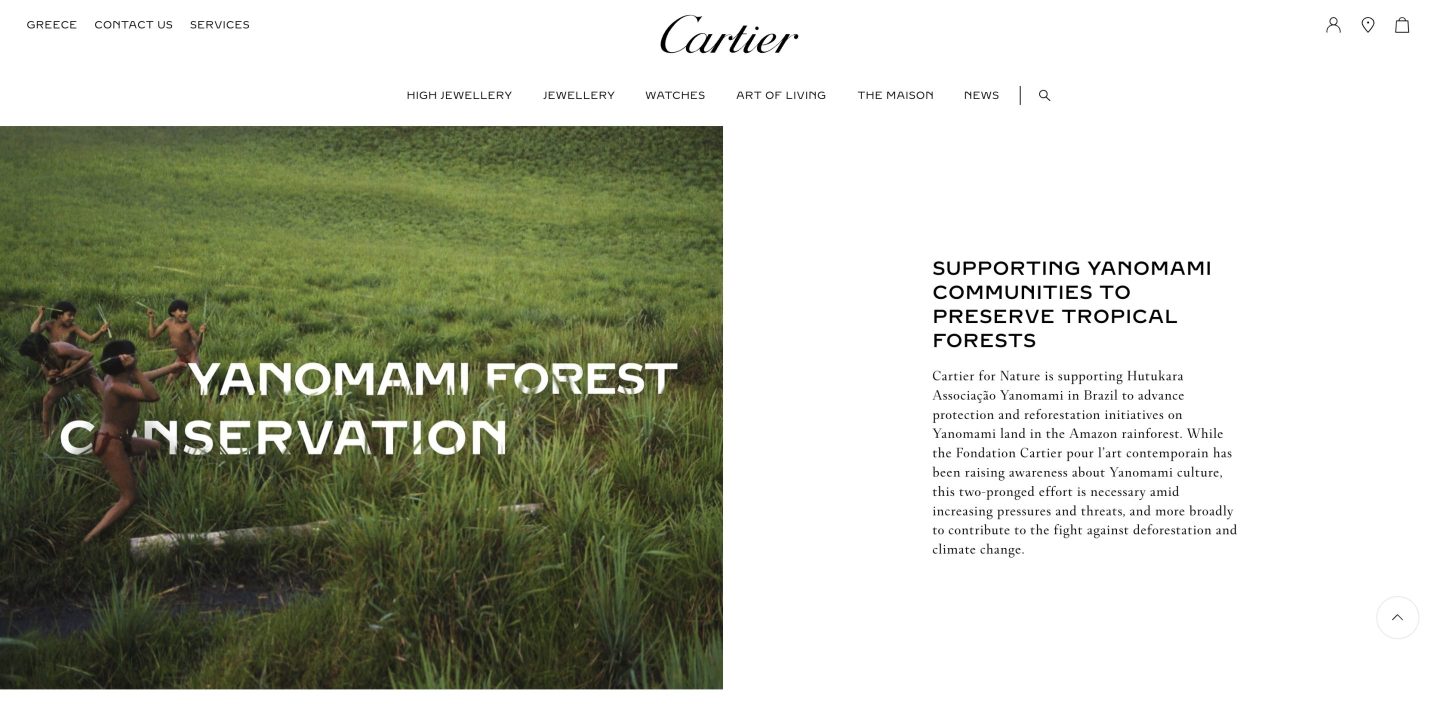
Until two months ago, Cartier’s website showed Yanomami children playing in a green field.
The French luxury jewelry brand said it was working to promote the culture of the Indigenous people and protect the rainforest where they live, in a vast territory straddling Brazil and Venezuela. But the project that the site described protecting the Amazon never took place. And Cartier published the photo without the approval of Yanomami leadership, violating the beliefs of a people who had been living in almost total isolation until they were contacted by outsiders in the 1970s.
Some of the Yanomami and their defenders praise Cartier’s promotion of Yanomami causes. However, advertising by one of the world’s biggest jewelers with images of an Indigenous people devastated by illegal gold mining has some complaining of greenwashing, a corporation promoting its own image by supporting a cause.
“How can a gold jewelry company, which we, the Yanomami people, are against, use the image of the Yanomami?” asked Júnior Hekurari, a member of the Indigenous group and head of the Yanomami’s health council.
Disease, killing and prostitution, fueled by the drugs and alcohol imported by thousands of illegal gold miners, have devastated traditional Yanomami life, and 570 Yanomami children died from malnutrition, diarrhea, and malaria between 2019 and 2022, according to Brazilian statistics. The poisonous mercury used in illegal mining causes birth defects and ravages ecosystems.
Cartier says it does not buy illegally mined gold, but Yanomami leaders have urged people not to buy gold jewelry at all, regardless of its source, because demand for the precious metal drives gold prices up and draws miners into their territory.
Cartier and other jewelry brands that are part of the Swiss conglomerate Richemont had combined sales of 11 billion euros ($11.7 billion) in the fiscal year ending March 31, 2022, according to its annual report. Some of the pieces advertised on its U.S. website cost as much as $341,000.
Cartier’s connection to the roughly 40,000 Yanomami goes back 20 years, primarily through Fondation Cartier, a corporate philanthropy created and funded by the company in 1984.
In the past, few Yanomami or their advocates have publicly criticized Cartier or the foundation, but a growing number have begun expressing concerns.
Cartier’s foundation recently sponsored a finely curated exhibit displaying photographs of Yanomami, along with works by Indigenous artists, in an elegant non-profit Manhattan arts center. The exhibit, previously in Paris, was praised by outlets ranging from The New York Times to Luxury Daily, an influential industry publication whose headline read, “ Fondation Cartier continues push for indigenous justice through art sponsorship.”
Barbara Navarro, a French multimedia artist, saw something very different, as did several other artists, including some Yanomami.
In the multimedia show “ Pas de Cartier, ” or “Not Cartier,” in the village of Nemours, France, Navarro and others critique the luxury brand and the devastation caused by illegal miners in an exhibit that includes sculptures and drawings. In one photo montage, a large gold mine surrounded by the Amazon forest is seen next to a Cartier store.
“The Yanomami are paying the price with their health and their very lives for our society’s relentless avidity for gold,” said Navarro. “For Cartier, sponsorship of the Yanomami represents an opportunity to burnish their brand.”
For many Indigenous groups, a corporation or philanthropy using a photo of them requires formal permission. The photo of the children on the website violated the Yanomami’s right to prior, free, and informed consent, according to the Roraima Indigenous Council, a grassroots umbrella organization, citing the International Labour Organization’s Convention 169 on Indigenous and Tribal Peoples, which Brazil signed.
Hekurari said his people need international cooperation, but his organization would never accept money from a jewelry company.
In his trips along the Yanomami territory, an area the size of Portugal, the Yanomami leader has encountered scores of skeletal children in communities under siege by thousands of illegal miners. In March, his organization, Urihi, launched an online campaign to raise awareness against the gold trade and in a video the Yanomami leader calls on Oscar winners to replace the famous gold-plated statuettes with wooden figures of Omama, a mythical entity.
“When someone buys gold in a jewelry store, he is financing more invasions to destroy Indigenous lands,” he said. “It is not just a matter of extracting gold. It is a matter of reaping lives.”
Cartier declined to comment on the Yanomami’s appeal for people to stop buying gold jewelry but, when contacted by The Associated Press in late March, Cartier removed the picture and the project description. Funds had been allocated to a forest-preservation project but ended up being used to acquire medical equipment to fight COVID-19 among the Yanomami, the company said. A donation worth $74,200 was made in June 2020.
The inaccurate description “was a regrettable oversight on our part, and it was addressed immediately after it was brought to our attention,” the company said.
But the problem is bigger than poor image choices, many say. Dário Kopenawa, vice-president of the Hutukara Yanomami Association, said he believes that, “anyone who buys a gold ring is part of the crime.”
Cartier and its foundation describe their relationship as arms-length. Kopenawa also made a distinction between Cartier and its namesake foundation.
“We know that Cartier buys gold all over the world … but the foundation is different. It is another coordinator, another branch. It supports the protection of the Yanomami,” he said.
In February, Kopenawa even flew to New York to attend “Yanomami Struggle – Art and Activism in the Amazon,” the exhibit sponsored by the Fondation Cartier with photographic portraits of Indigenous people alongside works by Yanomami artists. Kopenawa and other Yanomami participated in the opening ceremony, with U.N. Secretary-General Antonio Guterres among the guests.
Fondation Cartier has a collection of nearly 2,000 works at its Paris headquarters. The foundation “is run by an independent dedicated team of professionals from the art world in charge of defining and implementing the artistic program,” it said.
The foundation is led by Alain Dominique Perrin, a prominent figure in the luxury industry who previously served as Richemont’s top executive. In a 2018 interview with French business magazine Entreprendre, he emphasized the corporate value of arts patronage.
“Patronage is similar to sponsorship: You help an artist to exhibit, to gain recognition and to develop, but in return, the Fondation receives praise from the press, the media and social networks, which necessarily benefits the company,” he said.
The foundation, “will become a focal point for the management and the image of the Cartier brand,” Richemont wrote in its 1994 annual report, when the headquarters was inaugurated with 12,000 square feet of exhibition space.
French anthropologist Bruce Albert has been engaged with the Yanomami for decades, participating in a campaign in the 1990s that secured the tribe’s land demarcation. He connected Fondation Cartier with the Yanomami in 2003. That year, Albert curated the first photo and art exhibit about the Yanomami sponsored by the foundation.
In early February, Albert attended the opening ceremony of the New York exhibition after working on it as a paid consultant, together with Kopenawa and Yanomami artists.
Responding to questions in writing, Albert in February praised Fondation Cartier as independent, and said better control from Brazilian authorities would be more efficient than a gold boycott. Still, Albert criticized the use of the image on Cartier’s website, saying by email in April that the Yanomami hadn’t granted permission for its use, and the jeweler wasn’t funding any reforestation projects.
When it comes to acquiring gold, Cartier says the vast majority is purchased recycled and the company conforms to standards of the Responsible Jewelry Council, which describes itself as the world’s leading sustainability standard-setting organization for the jewelry and watch industry.
With gold, however, it is next to impossible to prove provenance, as much illegal material seeps into global supply chains. And Yanomami leaders have made clear that they believe that gold is at the root of the group’s troubles.
“Is there is a responsibility in the purchase of this gold?” Ivo Makuxi, the lawyer from the Indigenous council, asked about Cartier’s role in an industry that has hurt the Yanomami. “Does the company respect the Indigenous rights?”
___
Associated Press climate and environmental coverage receives support from several private foundations. See more about AP’s climate initiative here. The AP is solely responsible for all content.