• Home
  • Latest
  • Fortune 500
  • Finance
  • Tech
  • Leadership
  • Lifestyle
  • Rankings
  • Multimedia

Trendingnow

1

Analysts expected oil to surge above $200 but China has quietly kept prices half of that—and can’t for much longer

2

Corporate America has been draining the world's water. Matt Damon's new campaign calls on Gap, Starbucks, and Amazon to help give it back

3

Marc Lore’s robots make 500 burrito bowls an hour. A human can make 45

1

Analysts expected oil to surge above $200 but China has quietly kept prices half of that—and can’t for much longer

2

Corporate America has been draining the world's water. Matt Damon's new campaign calls on Gap, Starbucks, and Amazon to help give it back

3

Marc Lore’s robots make 500 burrito bowls an hour. A human can make 45
CommentaryBoeing

Boeing CEO Dave Calhoun has charted a path back to profitability–but ongoing supply chain issues seem plane crazy

By
Jeffrey Sonnenfeld
Jeffrey Sonnenfeld
and
Steven Tian
Steven Tian
Down Arrow Button Icon
By
Jeffrey Sonnenfeld
Jeffrey Sonnenfeld
and
Steven Tian
Steven Tian
Down Arrow Button Icon
April 17, 2023, 11:28 AM ET
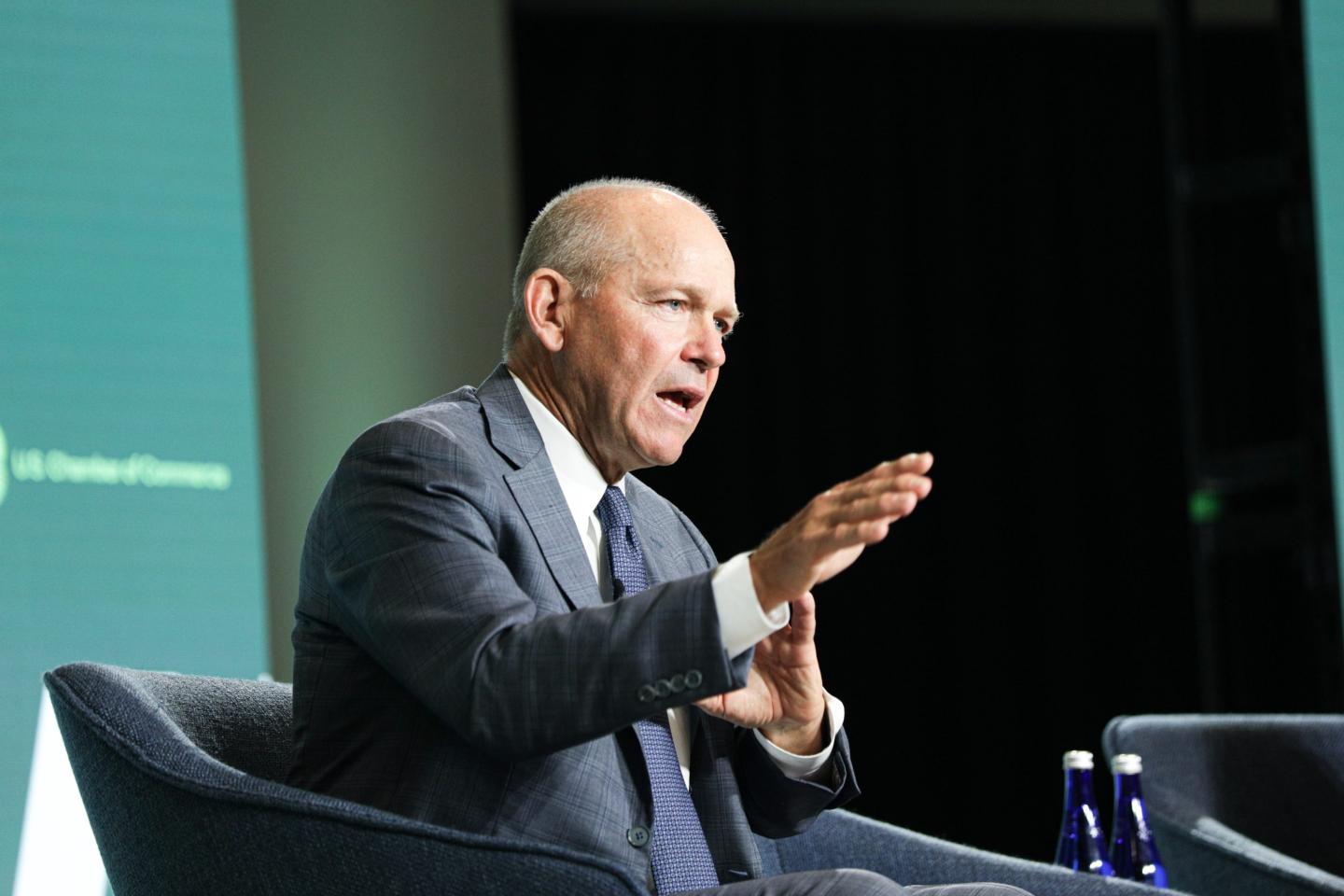
David Calhoun is the president and chief executive officer of the Boeing Co.
David Calhoun is the president and chief executive officer of the Boeing Co.Valerie Plesch—Bloomberg/Getty Images

With more supply chain woes at Boeing–this time, “fuselage” deficiencies from contractor Spirit AeroSystems–making the headlines days before Boeing’s annual meeting this week,  perhaps it is sane to wonder if it is just “plane crazy” that Boeing’s supply chain issues still flare up with alarming regularity four years after the highly publicized 737 MAX crashes that killed 346 passengers.

At the very least, this latest mess turns up the heat for CEO Dave Calhoun, who has absorbed relentless slings and arrows from all corners for problems that largely predate him or are outside his control, including misfires with regulators, COVID shutdowns, order cancellations, and high indebtedness. He deserves tremendous credit for charting a path back to profitability–without needing a single airplane purchase from China. In fact, just last year, we named Calhoun one of our five CEOs of the year, crediting him with finally guiding Boeing to take off after a long tarmac delay.

However, the seemingly unending procession of quality control issues speaks to three specific challenges that are still plaguing Boeing’s supply chain and which threaten to derail Calhoun’s plans mid-flight.

First, as supplier Spirit Aerosystems’ fuselage issue reminds us, Boeing’s supply chain diversification–or lack thereof–makes it unusually vulnerable to singular choke points. Boeing is basically solely dependent on Spirit Aerosystems as its outsourced aerostructure manufacturer. In fact, with Boeing represents a whopping 60% of Spirit’s revenues. This is over three times the dependence of Boeing’s competitors such as Airbus, which makes its own fuselages.

Thus it is hardly surprising that minor problems at Spirit have boomeranged into at least three major Boeing production disruptions, with 787 halts in 2020 and 2021, and now the 737 disruptions this week. With Spirit’s outside analysts such as Bank of America ominously warning that “a significant ramp with a greener work force does not give the greatest comfort on execution,” the fact that Boeing has tried and failed for years to take control over this part of the supply chain casts its own strategic missteps in starker relief.

Spirit had been a part of Boeing since two years after its founding in 1927. Its core role for Boeing has been primary manufacturing of the entire fuselage of the Boeing 737, as well as its nose and forward-cabin sections of most Boeing plans and other parts. It was spun off by Boeing in 2005 to the Canadian private equity firm Onex, which took the company public just a year later, retaining 58% of ownership and 92% of the voting control!

Some voices inside Boeing advocated for Boeing to purchase Spirit to provide direct oversight and capitalization–but senior executives have long reflexively shunned the acquisition, embarrassed by the idea of having to buy back a business, even though the cost would be relatively trivial with Spirit being only 2% of Boeing’s size.

The asset-lightening move may have been intended as financial engineering to appease activist investors or to address the federal government’s concern over the concentration of defense-related businesses.  Whatever the reason, the outcome now appears to be regrettable. Increased oversight and integration, which would have followed such a purchase, would have provided Boeing with a similar advantage to that of Airbus. Additionally, once-promising partnerships with Spirit’s many competitors, such as Embraer, failed to take off due to self-inflicted wounds.

Beyond the lack of supply chain diversification, persistent quality control problems continue to plague Boeing across its entire supply chain. Even though much criticism was levied at former leadership for “turbocharging Boeing’s production rates before the supply chain was ready, compromising quality,” Boeing continues to take billions in write-downs due to egregious cost overruns, while constantly postponing or canceling new product launches, ranging from the much-hyped jumbo 777X to new Air Force One jets, as the aerospace giant struggles to ramp up production and build capacity. Boeing’s customers have resorted to uncharacteristic public protests: One airline CEO compared Boeing execs to “headless chickens,” unable to deliver planes on time, while another lamented that Boeing “lost its way.”

Calhoun has vowed to overcome supply chain challenges “eventually”–but also acknowledged frustration that it feels like a “steady whack-a-mole kind of situation.”

As the largest manufacturing exporter in the U.S. with a workforce of 130,000 employees, Boeing’s persistent quality and culture challenges, unfortunately, trickle down across its entire extended ecosystem of thousands of suppliers. And unlike four years ago, these quality control issues cannot be blamed on excessive profit growth (of which there has been none) or an unseemly focus on boosting the stock price (which has gone nowhere) amidst an aerospace down cycle. 

One cannot help but wonder about accountability across the Boeing supply chain, and why Boeing seemingly covered for its subcontractors instead of sharing the cost of the damage. For example, even though Collins Aerospace manufactured the faulty flight deck software which resulted in the 2018/2019 crashes, Boeing accepted full liability and sole responsibility for the 737 MAX crashes and paid a whopping $2.5 billion to settle criminal probes from the Department of Justice. Has Boeing become too deferential to its supplier base in their earnest efforts to fix relationships after years of relentless cost-cutting and pushing?

The company must not be seen as having its head in the clouds and its planes on the ground. Ultimately, Calhoun has gotten the company back on track by getting its planes back up in the air–but the specter of persistent supply chain woes means more turbulence could be on the horizon. 

Jeffrey Sonnenfeld is the Lester Crown Professor in Management Practice and Senior Associate Dean at Yale School of Management. 

Steven Tian is the director of research at the Yale Chief Executive Leadership Institute and former investment analyst at Rockefeller Capital.  

The opinions expressed in Fortune.com commentary pieces are solely the views of their authors and do not necessarily reflect the opinions and beliefs of Fortune.

More must-read commentary published by Fortune:

  • A recession in 2023 is now inevitable. Layoffs in tech and finance will spread to other sectors
  • Energy analysts have been making gaseous calls since Russia invaded Ukraine. It’s time to clear away the smoke of economic groupthink
  • I am a Starbucks barista who doesn’t qualify for all the wonderful benefits you keep hearing about. We want the ‘different kind of company’ that Howard Schultz promised but failed to deliver
  • The average NFL owner is 75–and not rich enough to hang onto their team
About the Authors
By Jeffrey Sonnenfeld

Jeffrey Sonnenfeld is the Lester Crown Professor in Management Practice and Senior Associate Dean at Yale School of Management.

See full bioRight Arrow Button Icon
By Steven Tian

Steven Tian is the director of research at the Yale Chief Executive Leadership Institute.

See full bioRight Arrow Button Icon

Latest in Commentary

Finance
Lorem ipsum dolor sit amet, consectetur adipiscing elit, sed do eiusmod tempor incididunt ut labore et dolore magna aliqua. Ut enim ad minim veniam
By Fortune Editors
October 20, 2025
Finance
Lorem ipsum dolor sit amet, consectetur adipiscing elit, sed do eiusmod tempor incididunt ut labore et dolore magna aliqua. Ut enim ad minim veniam
By Fortune Editors
October 20, 2025
Finance
Lorem ipsum dolor sit amet, consectetur adipiscing elit, sed do eiusmod tempor incididunt ut labore et dolore magna aliqua. Ut enim ad minim veniam
By Fortune Editors
October 20, 2025
Finance
Lorem ipsum dolor sit amet, consectetur adipiscing elit, sed do eiusmod tempor incididunt ut labore et dolore magna aliqua. Ut enim ad minim veniam
By Fortune Editors
October 20, 2025
Finance
Lorem ipsum dolor sit amet, consectetur adipiscing elit, sed do eiusmod tempor incididunt ut labore et dolore magna aliqua. Ut enim ad minim veniam
By Fortune Editors
October 20, 2025
Finance
Lorem ipsum dolor sit amet, consectetur adipiscing elit, sed do eiusmod tempor incididunt ut labore et dolore magna aliqua. Ut enim ad minim veniam
By Fortune Editors
October 20, 2025

Most Popular

Finance
Lorem ipsum dolor sit amet, consectetur adipiscing elit, sed do eiusmod tempor incididunt ut labore et dolore magna aliqua. Ut enim ad minim veniam
By Fortune Editors
October 20, 2025
Finance
Lorem ipsum dolor sit amet, consectetur adipiscing elit, sed do eiusmod tempor incididunt ut labore et dolore magna aliqua. Ut enim ad minim veniam
By Fortune Editors
October 20, 2025
Finance
Lorem ipsum dolor sit amet, consectetur adipiscing elit, sed do eiusmod tempor incididunt ut labore et dolore magna aliqua. Ut enim ad minim veniam
By Fortune Editors
October 20, 2025
Finance
Lorem ipsum dolor sit amet, consectetur adipiscing elit, sed do eiusmod tempor incididunt ut labore et dolore magna aliqua. Ut enim ad minim veniam
By Fortune Editors
October 20, 2025
Finance
Lorem ipsum dolor sit amet, consectetur adipiscing elit, sed do eiusmod tempor incididunt ut labore et dolore magna aliqua. Ut enim ad minim veniam
By Fortune Editors
October 20, 2025
Finance
Lorem ipsum dolor sit amet, consectetur adipiscing elit, sed do eiusmod tempor incididunt ut labore et dolore magna aliqua. Ut enim ad minim veniam
By Fortune Editors
October 20, 2025
Fortune Secondary Logo
Rankings
  • 100 Best Companies
  • Fortune 500
  • Global 500
  • Fortune 500 Europe
  • Most Powerful Women
  • World's Most Admired Companies
  • See All Rankings
  • Lists Calendar
Sections
  • Finance
  • Fortune Crypto
  • Features
  • Leadership
  • Health
  • Commentary
  • Success
  • Retail
  • Mpw
  • Tech
  • Lifestyle
  • CEO Initiative
  • Asia
  • Politics
  • Conferences
  • Europe
  • Newsletters
  • Personal Finance
  • Environment
  • Magazine
  • Education
Customer Support
  • Frequently Asked Questions
  • Customer Service Portal
  • Privacy Policy
  • Terms Of Use
  • Single Issues For Purchase
  • International Print
Commercial Services
  • Advertising
  • Fortune Brand Studio
  • Fortune Analytics
  • Fortune Conferences
  • Business Development
  • Group Subscriptions
About Us
  • About Us
  • Press Center
  • Work At Fortune
  • Terms And Conditions
  • Site Map
  • About Us
  • Press Center
  • Work At Fortune
  • Terms And Conditions
  • Site Map
  • Facebook icon
  • Twitter icon
  • LinkedIn icon
  • Instagram icon
  • Pinterest icon

Latest in Commentary

Three ways that Asia’s enterprises are adopting AI—and where they are falling behind
CommentaryOracle
Three ways that Asia’s enterprises are adopting AI—and where they are falling behind
By Garrett IlgJune 11, 2026
7 hours ago
gordon
CommentaryVenture Capital
Gordon Ritter: I predicted AI’s learning loop a decade ago. The doomers are still measuring the wrong thing
By Gordon RitterJune 11, 2026
16 hours ago
bessent
CommentarySocial Security
Social Security and Medicare are heading toward insolvency. Congress has 6 years to act
By Steve H. Hanke and David M. WalkerJune 11, 2026
18 hours ago
Digital sovereignty isn’t the same thing as digital isolation. Asia’s governments should be careful
Commentarydata sovereignty
Digital sovereignty isn’t the same thing as digital isolation. Asia’s governments should be careful
By Leonard LimJune 10, 2026
1 day ago
tim
CommentaryAirline industry
Merlin CTO: autonomy can rebuild the foundation of aviation — and national security
By Tim BurnsJune 9, 2026
3 days ago
dewar
CommentaryLeadership
I founded McKinsey’s CEO practice: Here’s why operational excellence is a liability right now
By Carolyn DewarJune 9, 2026
3 days ago

Most Popular

Analysts expected oil to surge above $200 but China has quietly kept prices half of that—and can’t for much longer
Energy
Analysts expected oil to surge above $200 but China has quietly kept prices half of that—and can’t for much longer
By Sasha RogelbergJune 10, 2026
1 day ago
Corporate America has been draining the world's water. Matt Damon's new campaign calls on Gap, Starbucks, and Amazon to help give it back
Environment
Corporate America has been draining the world's water. Matt Damon's new campaign calls on Gap, Starbucks, and Amazon to help give it back
By Catherina GioinoJune 9, 2026
3 days ago
Marc Lore’s robots make 500 burrito bowls an hour. A human can make 45
Innovation
Marc Lore’s robots make 500 burrito bowls an hour. A human can make 45
By Amanda GerutJune 9, 2026
2 days ago
Current price of oil as of June 11, 2026
Personal Finance
Current price of oil as of June 11, 2026
By Joseph HostetlerJune 11, 2026
15 hours ago
Pentagon accuses Alibaba, Baidu and BYD, three of China's biggest companies, of supporting the Chinese military
Asia
Pentagon accuses Alibaba, Baidu and BYD, three of China's biggest companies, of supporting the Chinese military
By Kate O'Keeffe and BloombergJune 8, 2026
3 days ago
Costco CEO Ron Vachris rose from forklift driver to the C-suite without a college degree: ‘Don’t chase a title’ is the career advice that got him there
Success
Costco CEO Ron Vachris rose from forklift driver to the C-suite without a college degree: ‘Don’t chase a title’ is the career advice that got him there
By Preston ForeJune 8, 2026
4 days ago

© 2026 Fortune Media IP Limited. All Rights Reserved. Use of this site constitutes acceptance of our Terms of Use and Privacy Policy | CA Notice at Collection and Privacy Notice | Do Not Sell/Share My Personal Information
FORTUNE is a trademark of Fortune Media IP Limited, registered in the U.S. and other countries. FORTUNE may receive compensation for some links to products and services on this website. Offers may be subject to change without notice.