
In 2016, Linnea Kornehed was 24 and fresh out of university—hardly the age, or the gender, to command respect in the male-dominated auto industry. At the time, she and her future husband, Robert Falck were pitching seed investors their idea for a new business: a company that would create a way for heavy-duty trucks to switch from diesel fuel to electric batteries.
“Honestly, I did not know what I was stepping into,” says Kornehed Falck (as she’s now known), talking with Fortune one recent morning at her office in Stockholm. “The business was very political, with a lot of lobbying.” Trucking industry insiders, she adds, “were making fun of us, saying, ‘This will never work.’”
The auto industry may be just as tough today, but the couple’s company has come to life. Kornehed Falck, now 31, is cofounder and deputy CEO of Einride, a Swedish mobility-software startup for commercial transportation with a particular focus on those heavy-duty trucks. (Her husband is cofounder and CEO.) And this week, they might have gotten the last laugh. In a move that could transform trucking in the U.S.—and provide a major boost for Einride’s business—the U.S. announced sweeping new carbon-emissions limits for automakers and truck manufacturers.
Under the new rules, administered by the U.S. Environmental Protection Agency, about half the new buses and garbage trucks sold in the U.S. from 2032, as well as about 35% of short-haul freight vehicles and one-quarter of long-haul trucks, will need to run on electric batteries—multiple times higher than current numbers. And that could create incentives for more businesses to rely on Einride, which provides an EV option for companies with major shipping needs.
The EPA estimates that transportation accounts for about 27% of all greenhouse-gas emissions in the U.S., and that trucks contribute about 26% of that total, despite representing fewer than 5% of vehicles on American roads. Almost all heavier trucks are powered by diesel, which emits nitrogen oxides, thought to be far more harmful than regular fuel pollutants.
For Kornehed Falck, Wednesday’s decision vindicates Einride, which has argued for years that governments have been sidestepping the pollution problem from heavy trucks. Electrifying truck fleets has long been seen as too daunting to accomplish. Kornehed Falck says when Einride launched, officials and manufacturers repeatedly told them that “electric trucks will never happen, because batteries would be too heavy, you could not make a business case for it.”
Truck batteries indeed remain costly. But Einride’s business model is geared to addressing the biggest hurdles companies face in considering how to switch to electric trucks. The company does not disclose revenue figures, but it says the value of its signed contracts has shot up nearly sevenfold over the past year. Its clients include the shipping giant Maersk, GE Appliances—which also uses Einride’s short-haul, autonomous delivery vehicles—Bridgestone Tires, Electrolux, and others. The company has nearly 600 employees, about 70 of them in the U.S. It also operates in Sweden, Germany, Belgium, the Netherlands, and Luxembourg, and plans to announce other countries this year.
A software-powered electric truck fleet
Einride buys or leases hundreds of electric trucks—most manufactured by China’s BYD—and embeds in those trucks its own A.I.-powered software platform, which has an algorithm known as Saga. The software helps identify which routes are best for electric trucks, and where to charge them; tracks shipments and delays; and determines how to optimize operations.
Einride’s trucks pick up goods from factories and cargo ships, transport and deliver them, with the company managing all the logistics along the way. Uber Freight, which launched in 2017, offers a similar end-to-end platform, but unlike Einride, does not operate only with electric trucks.
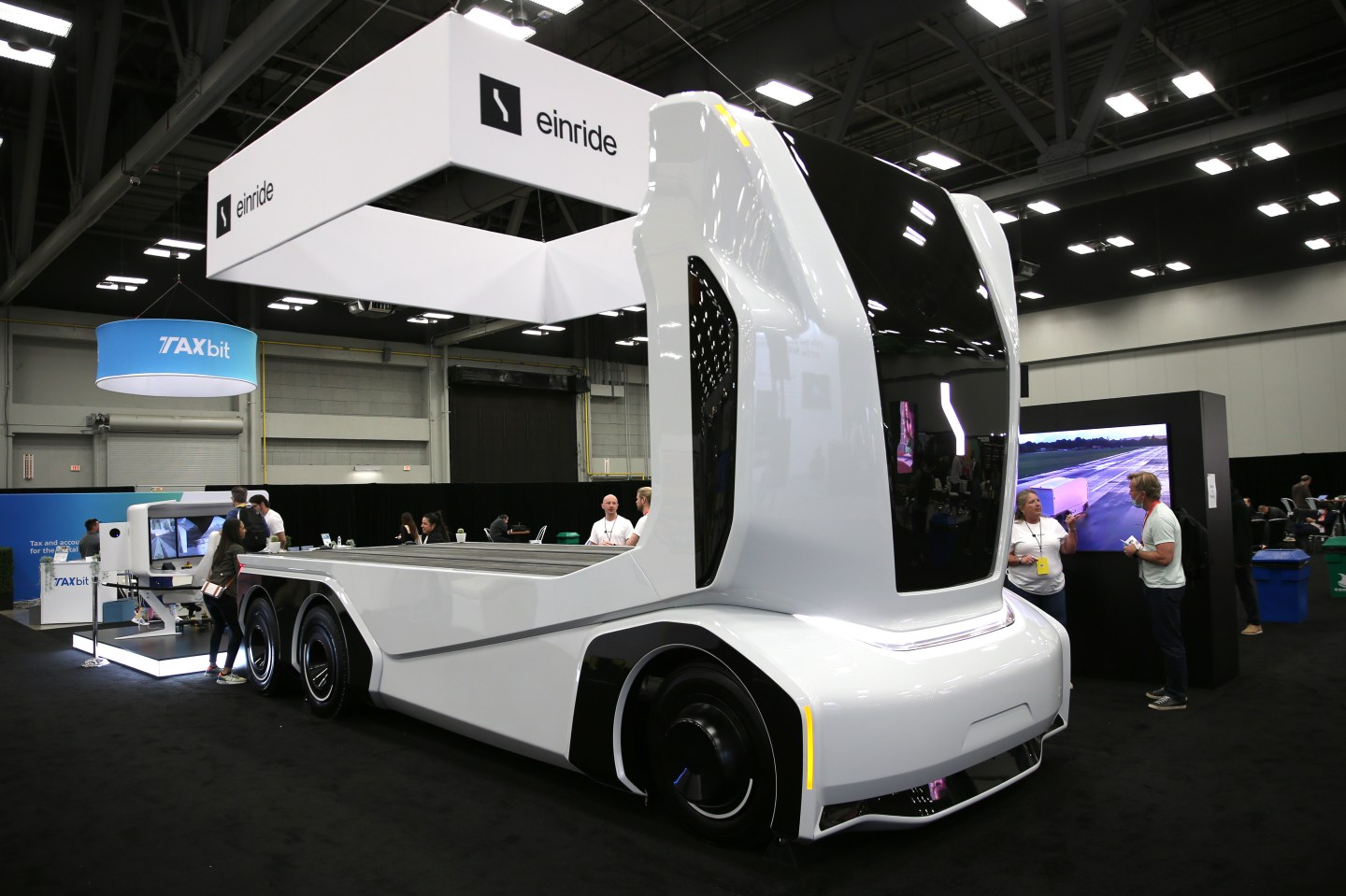
Einride’s business depends on having as few trucks on the road as possible. It helps that the Saga algorithm determines exactly what is being shipped and where, allowing Einride to combine several shippers’ loads in one truck. That’s a sharp contrast with current operations for U.S. shippers. “One client told me he was working with 800 carrier companies,” Kornehed Falck says. “Most of the trucks you see on the roads are running empty. The average filling rate is below 20%.”
But heavy shipping “is really big, predictable, foreseen kind of transport,” Kornehed Falck says. “Shippers know exactly what they’re going to send on a Tuesday. About 80% of commercial vehicles in the world move in a very predictable way. It’s perfect for electric.”
A long road ahead
It will take mammoth amounts of electricity for U.S. truckers to switch out of diesel. By some estimates, that conversion would require about 504 trillion watt-hours, or TWh, a year. That’s about double the entire amount of electricity generated in California in 2021. So far, it is not clear where all of the necessary truck-charging stations will be built, or how to transmit the electricity needed to the right locations.
Those are problems that light passenger EVs don’t face to the same degree. “EVs will proliferate as larger charging networks and cheaper vehicles create a virtuous cycle,” Utility Dive, a news site covering the utility industry, recently wrote. “The path forward is murkier, though, for long-haul trucking.”
But as oil prices have risen, and as companies brace for new environmental regulations, Einride has begun ramping up in the U.S.
The company has leased land near the Port of Los Angeles, and will break ground this summer on a charging hub, where 65 heavy electric trucks can park at a time, charging their vehicles in about two hours. Truckers can book spots in advance, spending the charging time in the Einride refreshment center on-site.
And in March, in Joliet, Ill., Einride deployed 20 all-electric trucks under contract with Maersk; it plans to deploy a total of 300 in the area over the coming months. Will County, southwest of Chicago, in which Joliet sits, has reported a sharp increase in tailpipe emissions over the past decade, after seeing a boom in freight employment. In a region that’s also full of suburban bedroom communities, the health risks of those emissions add to the urgency of Einride’s pitch.
“There is a real end-of-life cost to [high emissions],” says Michelle Avary, Einride’s vice president for governmental affairs in the U.S. “Any politician knows that.”
Even so, Avary says U.S. politicians remain far more focused on passenger EVs than electric trucks. “A lot of my discussion with policymakers is, ‘Please pay attention to heavy-duty trucks,’” she notes. The new EPA rules appear to have answered her plea.