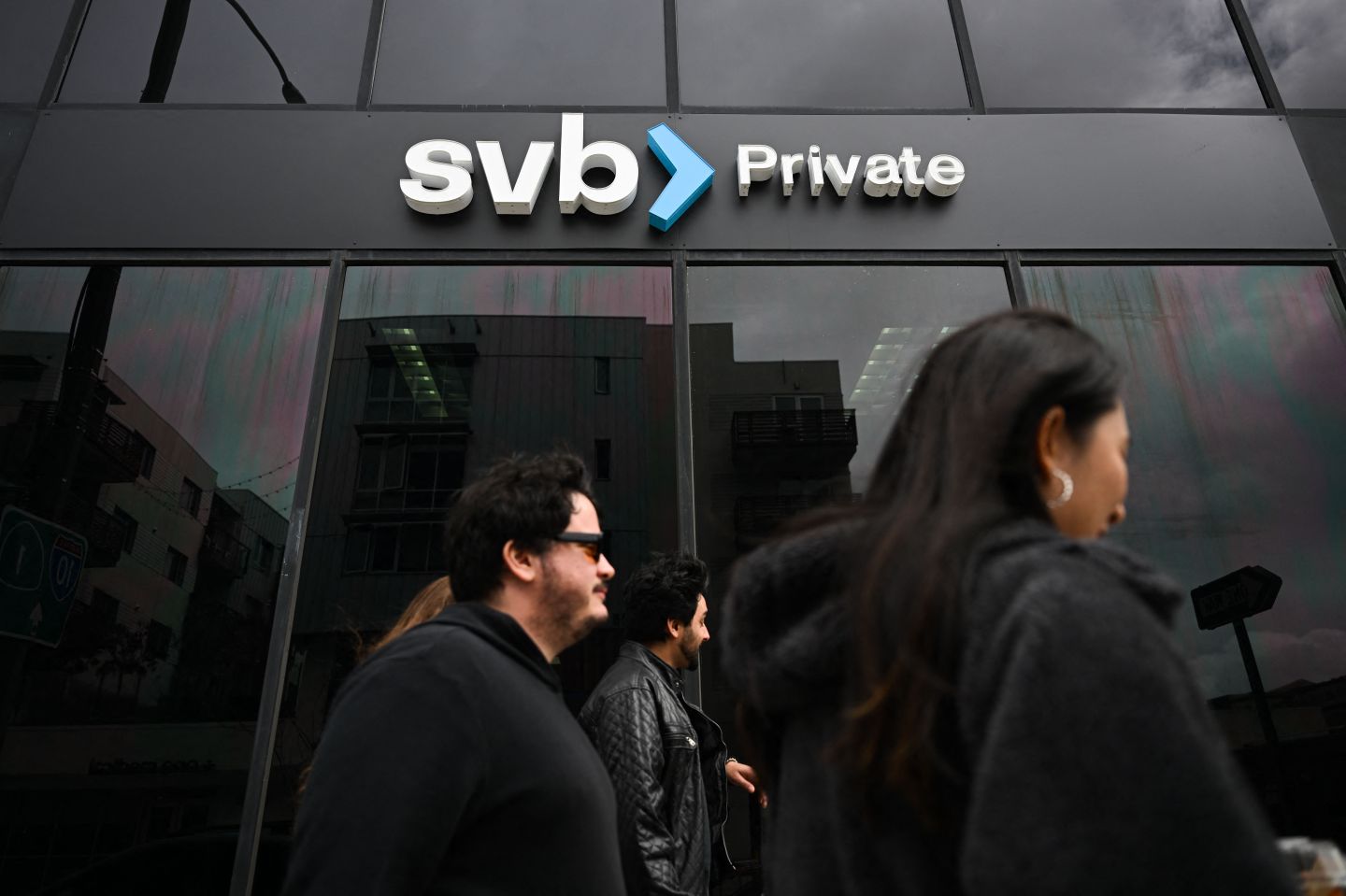
When two tech-linked U.S. banks failed this month, among the investors who lost millions were public-sector pension funds responsible for ensuring the retirements of teachers, firefighters and other government workers.
The pension funds, like others, have reaped the benefits of bull markets and, like many investors, have suffered when investments soured.
Last year, many lost value when their investments in Russian assets became nearly worthless after most of the world froze out that nation’s economy following its invasion of Ukraine. Some held stock in cryptocurrency-related businesses that have sputtered amid the downfall of FTX and its founder, Sam Bankman-Fried.
Since the pension funds are diversified investors whose holdings in Silicon Valley Bank and Signature Bank were small portions of their portfolios, experts aren’t overly concerned about losses for relatively small holdings.
But the losses show how pensions are exposed to risk as they try to reduce funding gaps.
Here’s a look at where the status of public pensions and the risks they take on.
WHICH FUNDS TOOK LOSSES WITH INVESTMENTS IN FAILED BANKS?
Equable, a privately funded nonprofit that researches public pensions and advocates for their security, has identified more than two dozen public-sector pension funds with direct holdings in Silicon Valley or Signature Bank, or both.
In every case, the banks’ stocks represented no more than a few dollars out of every $10,000 in assets in the fund.
The fund with the largest stake in Silicon Valley Bank was CalPERS, a fund serving public employees in California that is valued at $443 billion. It reported it owned $67 million in SVB stock and $11 million in Signature Bank. Combined, that amounts to .02% of the fund’s assets.
The Ohio State Teachers’ Retirement System, New York State Common Fund and State Teachers’ Retirement Fund and Washington State Investment Board were among those that had stock in one or both banks.
Trading on both stocks was halted this month. SVB’s shares were trading at more than $700 at the start of 2022 and Signature Bank’s were around $300.
It’s likely that many pension systems also owned shares of the banks as part of index-fund investments. It’s hard to know for certain because most funds do not make their complete holdings public in real time.
WHAT DO THE LOSSES MEAN?
They’re not helping the pensions, but experts do not see these investment losses as alarming.
Pension funds are big investors that seek to spread around their holdings. And while there were some signs of trouble for the banks that failed, they were still considered significant U.S. banks.
“It’s a mistake to say that an investment in Silicon Valley Bank stock alone is risky,” said Anthony Randazzo, executive director of Equable.
HOW ARE PUBLIC PENSIONS DOING?
They’ve improved in recent years, but most are still short of enough assets to pay for their promised benefits.
Most plans were fully funded in 2000. But around that time, many pension plans increased benefits, reduced contributions from the governments — or both. Those decisions amplified the impact of the 2008 financial crisis on the funds, with market losses widening their funding gaps. By 2016, the Pew Charitable Trusts found that the state-run funds had only two-thirds of what they needed to cover their obligations.
With mostly strong markets, bigger government contributions and benefit changes — including reducing the retirement promises for newly hired workers and requiring employees to contribute more — the funds’ conditions have improved. By 2021, after a year of massive market growth, Pew estimated that state pensions were 84% funded, the highest level since before the Great Recession started in 2008.
David Draine, who studies public-sector retirement systems at Pew, said the funding gaps are probably now about where they were before the market shockwaves during the coronavirus pandemic.
But he said the greater government contributions — including higher than required in states including California and Connecticut — and other changes have increased their likelihood of withstanding future market declines.
“It’s a low bar,” Draine said, “but they’re better prepared than they were proceeding the Great Recession.”
ARE PENSION FUNDS MAKING RISKY INVESTMENTS?
Stocks and fixed-asset investments still make up the majority of the holdings of public-sector pension funds tracked by the Center for Retirement Research at Boston College.
But the portion of assets in other — and often more volatile — investments such as real estate and hedge funds has grown over the last two decades. Investment in private equity, for example, nearly quadrupled, going from 2.3% of funds’ holdings in 2001 to 8.7% in 2021.
“They’re being asked to earn somewhere between 6.5% and 7.5% a year on average,” Equable Institute’s Randazzo said. “And the only way that’s possible is by taking some significant risk.”
Randazzo said that if governments want pension funds to play it safer, they can raise their contributions. But the more taxpayer money goes into retirement funds, the less there is for other priorities such as schools, roads and tax cuts.
Keith Brainard, the research director for the National Association of State Retirement Administrators, notes the stock market downturn in 2001 hit pensions hard because their holdings were mostly stocks.
Investing in other assets can help mitigate stock losses, he said.
“Some people cynically call it ‘chasing returns,’” Brainard said. “I think ‘diversifying’ is a better description.”