• Home
  • Latest
  • Fortune 500
  • Finance
  • Tech
  • Leadership
  • Lifestyle
  • Rankings
  • Multimedia
CommentaryHumanitarian Aid
Europe

The IFRC wants to leverage financial markets to keep up with the world’s unprecedented humanitarian needs. Here’s how

By
Nena Stoiljkovic
Nena Stoiljkovic
Down Arrow Button Icon
By
Nena Stoiljkovic
Nena Stoiljkovic
Down Arrow Button Icon
October 11, 2022, 6:07 AM ET
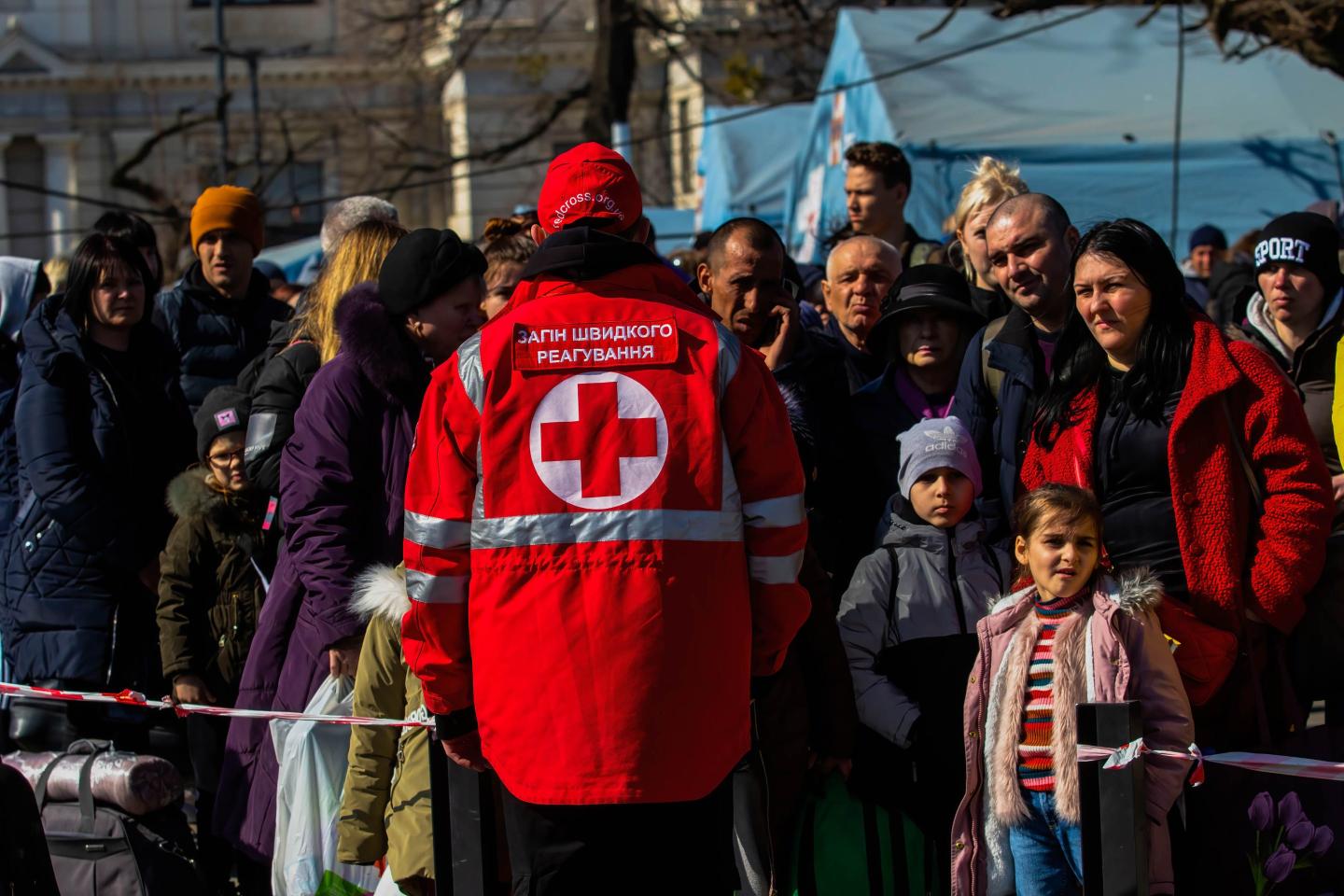
Refugees flee the Ukrainian city of Mariupol in March 2022. As Russia invaded Ukraine, the private sector mobilized to support humanitarian assistance through grants and donations.
Refugees flee the Ukrainian city of Mariupol in March 2022. As Russia invaded Ukraine, the private sector mobilized to support humanitarian assistance through grants and donations.Ty O'Neil—SOPA Images/LightRocket/Getty Images

The humanitarian and private sectors may appear to be at opposite ends of the spectrum, but closer collaboration could yield solutions to the world’s biggest problems.

From CSR to ESG, the corporate world has increasingly sought to engage in socially and environmentally beneficial activities. Meanwhile, humanitarian organizations are overwhelmed with rapidly increasing needs that traditional funding cannot keep up with.

The Global Humanitarian Assistance Report 2022 found that total funding for crisis response has plateaued despite historically high (and rising) demand. The report showed that the value of international humanitarian assistance reached an estimated $31.3 billion in 2021. The World Economic Forum anticipates an increase to $50 billion by 2030. 

The donors we currently rely on—primarily a core group of governments—are too few and too precarious. We need to grow and diversify our funding sources if we are to have any hope of keeping up with the level of humanitarian needs forecast.

I believe it’s possible to move toward a shared ownership approach, whereby both the private sector and humanitarian partners align their objectives, including financial returns.

The private sector’s responses to the conflict in Ukraine and the COVID-19 pandemic have shown its power in times of crisis. To date, this has been mostly through grants, but the private sector’s skills, knowledge, and expertise could be the real game changers for the humanitarian sector. 

Insurance companies are one example of where we have significant overlap when we drill down into our operations and goals: We are both dealing with the impacts and consequences of loss and damage caused by crises and disasters. 

Since 1985, the IFRC’s Disaster Response Emergency Fund (DREF) has worked as a central pot of money that can be quickly and transparently distributed to support community action in countries facing disasters before or when they hit. 

Now we are working with AON and the Centre for Disaster Protection to structure an innovative insurance mechanism that uses commercial insurance markets to leverage contributions of traditional donors in order to increase the capacity of the DREF for responding to natural disasters to CHF 100 million by 2025. We are aiming for the new insurance mechanism to be in place in 2023.

We are taking a system that’s been proven over three decades and adapting it to an uncertain future. Through the insurance mechanism, instead of putting up the money to fund disaster responses, donors pay the premium. This stretches the value of their contributions and transfers the risk to the private sector if allocation requests exceed available resources. The approach uses reinsurance markets to lay off the risk of excessive natural hazards and ensure funds for response are available in a timely and reliable manner even in periods of excessive or unanticipated demand.

Our ambition will not be possible to achieve through grants alone. We will need innovative financing that can leverage our resources and allow for the private sector to meaningfully engage. Through our initiative, we are keen to demonstrate the value of structures that can be more sustainable, replicable, and scalable to address humanitarian needs.

Currently, we’re exploring options of innovative finance for our other flagship programs, including the potential to use green bonds or climate bonds as well as impact bonds for our water, sanitation, and hygiene programming.

We’ve set up a pilot with the Islamic Development Bank following the impact bond model that unlocks private capital through investors. Instead of the donors paying grants ahead, they pay when the results are proven. Investors provide the upfront funding, while the bank acts as the guarantor, which reduces the cost of the bond and enables true additionality of capital.

In collaborative financing models, it is important to consider the value and approach for each partner: The private sector can engage in ways that drive social impact as well as profits, governments can lead the change by creating enabling frameworks, and humanitarian agencies can embrace more agility in their operating models—all with the goal of mobilizing more private sector funding for humanitarian assistance and leveraging overstretched government donors’ grants.

We also need to strike the right balance between risks and rewards and be alert to conflicts of interest, value for money, and ethical questions. Today’s humanitarian needs demand that we create opportunities and conditions for private capital to come in to scale up funding, but it is paramount that the product we develop is in line with our principles. 

This transition will take time and require making difficult compromises and changes to our operating models. We will likely fail before we succeed, but unless we try—with the will to learn from our mistakes—our humanitarian investments will continue to be mere drops in an ocean of needs. 

For the private sector, this will be an opportunity to design innovative solutions that align with their ESG approach and to be at the forefront of a new untapped market while saving the lives of millions of people.

Nena Stoiljkovic is undersecretary general for global relationships, humanitarian diplomacy, and digitalization at the International Federation of Red Cross and Red Crescent Societies (IFRC). Her background is in impact investing in emerging markets, change management, and innovative financial instruments such as blended finance. Stoiljkovic has held several leadership positions at the World Bank and the International Finance Corporation.

The opinions expressed in Fortune.com commentary pieces are solely the views of their authors and do not necessarily reflect the opinions and beliefs of Fortune.

More must-read commentary published by Fortune:

  • The Fed is oversteering on inflation–every signal suggests it’s already cooling
  • Patagonia: ‘We are turning capitalism on its head by making the Earth our only shareholder’
  • ‘Boomerang employees’ could be the untapped talent pool bosses have been looking for
  • I got rich by betting that inequality would destroy the U.S. and U.K. I’m sorry
Sign up for the Fortune Features email list so you don’t miss our biggest features, exclusive interviews, and investigations.
About the Author
By Nena Stoiljkovic
See full bioRight Arrow Button Icon

Latest in Commentary

Finance
Lorem ipsum dolor sit amet, consectetur adipiscing elit, sed do eiusmod tempor incididunt ut labore et dolore magna aliqua. Ut enim ad minim veniam
By Fortune Editors
October 20, 2025
Finance
Lorem ipsum dolor sit amet, consectetur adipiscing elit, sed do eiusmod tempor incididunt ut labore et dolore magna aliqua. Ut enim ad minim veniam
By Fortune Editors
October 20, 2025
Finance
Lorem ipsum dolor sit amet, consectetur adipiscing elit, sed do eiusmod tempor incididunt ut labore et dolore magna aliqua. Ut enim ad minim veniam
By Fortune Editors
October 20, 2025
Finance
Lorem ipsum dolor sit amet, consectetur adipiscing elit, sed do eiusmod tempor incididunt ut labore et dolore magna aliqua. Ut enim ad minim veniam
By Fortune Editors
October 20, 2025
Finance
Lorem ipsum dolor sit amet, consectetur adipiscing elit, sed do eiusmod tempor incididunt ut labore et dolore magna aliqua. Ut enim ad minim veniam
By Fortune Editors
October 20, 2025
Finance
Lorem ipsum dolor sit amet, consectetur adipiscing elit, sed do eiusmod tempor incididunt ut labore et dolore magna aliqua. Ut enim ad minim veniam
By Fortune Editors
October 20, 2025

Most Popular

Finance
Lorem ipsum dolor sit amet, consectetur adipiscing elit, sed do eiusmod tempor incididunt ut labore et dolore magna aliqua. Ut enim ad minim veniam
By Fortune Editors
October 20, 2025
Finance
Lorem ipsum dolor sit amet, consectetur adipiscing elit, sed do eiusmod tempor incididunt ut labore et dolore magna aliqua. Ut enim ad minim veniam
By Fortune Editors
October 20, 2025
Finance
Lorem ipsum dolor sit amet, consectetur adipiscing elit, sed do eiusmod tempor incididunt ut labore et dolore magna aliqua. Ut enim ad minim veniam
By Fortune Editors
October 20, 2025
Finance
Lorem ipsum dolor sit amet, consectetur adipiscing elit, sed do eiusmod tempor incididunt ut labore et dolore magna aliqua. Ut enim ad minim veniam
By Fortune Editors
October 20, 2025
Finance
Lorem ipsum dolor sit amet, consectetur adipiscing elit, sed do eiusmod tempor incididunt ut labore et dolore magna aliqua. Ut enim ad minim veniam
By Fortune Editors
October 20, 2025
Finance
Lorem ipsum dolor sit amet, consectetur adipiscing elit, sed do eiusmod tempor incididunt ut labore et dolore magna aliqua. Ut enim ad minim veniam
By Fortune Editors
October 20, 2025
Fortune Secondary Logo
Rankings
  • 100 Best Companies
  • Fortune 500
  • Global 500
  • Fortune 500 Europe
  • Most Powerful Women
  • Future 50
  • World’s Most Admired Companies
  • See All Rankings
Sections
  • Finance
  • Fortune Crypto
  • Features
  • Leadership
  • Health
  • Commentary
  • Success
  • Retail
  • Mpw
  • Tech
  • Lifestyle
  • CEO Initiative
  • Asia
  • Politics
  • Conferences
  • Europe
  • Newsletters
  • Personal Finance
  • Environment
  • Magazine
  • Education
Customer Support
  • Frequently Asked Questions
  • Customer Service Portal
  • Privacy Policy
  • Terms Of Use
  • Single Issues For Purchase
  • International Print
Commercial Services
  • Advertising
  • Fortune Brand Studio
  • Fortune Analytics
  • Fortune Conferences
  • Business Development
  • Group Subscriptions
About Us
  • About Us
  • Editorial Calendar
  • Press Center
  • Work At Fortune
  • Diversity And Inclusion
  • Terms And Conditions
  • Site Map
  • About Us
  • Editorial Calendar
  • Press Center
  • Work At Fortune
  • Diversity And Inclusion
  • Terms And Conditions
  • Site Map
  • Facebook icon
  • Twitter icon
  • LinkedIn icon
  • Instagram icon
  • Pinterest icon

Latest in Commentary

trump
CommentaryZoom
The U.S. has a $282 billion trade surplus you’ve never heard of — and it’s at risk
By Josh KallmerApril 19, 2026
1 day ago
benioff
CommentarySalesforce
AI’s next act: how Salesforce is turning efficiency gains into revenue
By Keith Ferrazzi and Wendy SmithApril 18, 2026
2 days ago
trump
CommentaryWhite House
Trump has already endorsed the Monroe Doctrine. Now he needs to endorse the Truman Doctrine
By Robert HormatsApril 18, 2026
2 days ago
trump
CommentaryManufacturing
Tariffs alone won’t save American manufacturing — here’s what actually will
By Johan "Kip" EidebergApril 18, 2026
2 days ago
hormuz
CommentaryIran
With Hormuz under strain, a trade corridor built for resilience faces a real-world test
By Angela Chitkara and Samantha SuttonApril 17, 2026
3 days ago
broker
CommentarySoftware
The 3 forces quietly dismantling the business model that made enterprise software fabulously profitable
By Michael Jacobides and Stefano PuntoniApril 17, 2026
3 days ago

Most Popular

Thousands of CEOs admit AI had no impact on employment or productivity—and it has economists resurrecting a paradox from 40 years ago
AI
Thousands of CEOs admit AI had no impact on employment or productivity—and it has economists resurrecting a paradox from 40 years ago
By Sasha RogelbergApril 19, 2026
1 day ago
Markets shudder as Strait of Hormuz starts resembling a combat zone. 'We're prepared to subject you to disabling fire'
Energy
Markets shudder as Strait of Hormuz starts resembling a combat zone. 'We're prepared to subject you to disabling fire'
By Jason MaApril 19, 2026
19 hours ago
The explosion of U.S. debt is wiping out the 'safety premium' of Treasury bonds, and time is running out for an orderly fiscal solution, IMF warns
Economy
The explosion of U.S. debt is wiping out the 'safety premium' of Treasury bonds, and time is running out for an orderly fiscal solution, IMF warns
By Jason MaApril 19, 2026
23 hours ago
Elon Musk bans résumés and cover letters in hiring for his chip team. These are the 3 bullet points he’s looking for instead
Future of Work
Elon Musk bans résumés and cover letters in hiring for his chip team. These are the 3 bullet points he’s looking for instead
By Jake AngeloApril 19, 2026
1 day ago
'We should absolutely be concerned about non-college-educated men today': higher rents, living at home, falling out of the labor market
Economy
'We should absolutely be concerned about non-college-educated men today': higher rents, living at home, falling out of the labor market
By Catherina GioinoApril 18, 2026
2 days ago
The $6 billion Vatican Bank was beset by scandals, disastrous investments—and ties to the Mafia. How Pope Francis tried to fix it
Banking
The $6 billion Vatican Bank was beset by scandals, disastrous investments—and ties to the Mafia. How Pope Francis tried to fix it
By Marco Quiroz-GutierrezApril 18, 2026
2 days ago

© 2026 Fortune Media IP Limited. All Rights Reserved. Use of this site constitutes acceptance of our Terms of Use and Privacy Policy | CA Notice at Collection and Privacy Notice | Do Not Sell/Share My Personal Information
FORTUNE is a trademark of Fortune Media IP Limited, registered in the U.S. and other countries. FORTUNE may receive compensation for some links to products and services on this website. Offers may be subject to change without notice.