
In the summer of 2020, Chinese coffeehouse chain Luckin Coffee languished on what appeared to be its deathbed. In April, the firm had confessed to falsely inflating its sales by over $300 million. Chinese police had raided the company’s headquarters. Debt and equity investors were suing the company for fraud. Luckin’s board ejected the company’s top executives. The price of the company’s shares, which traded over Nasdaq plummeted by more than 90%. In July, Nasdaq officials banished Luckin from the U.S. exchange. “It was quite a massive fraud,” says Henrik Bork, founder of Beijing-based research firm Asia Waypoint. “They cooked their books. Nobody expected they could survive.”
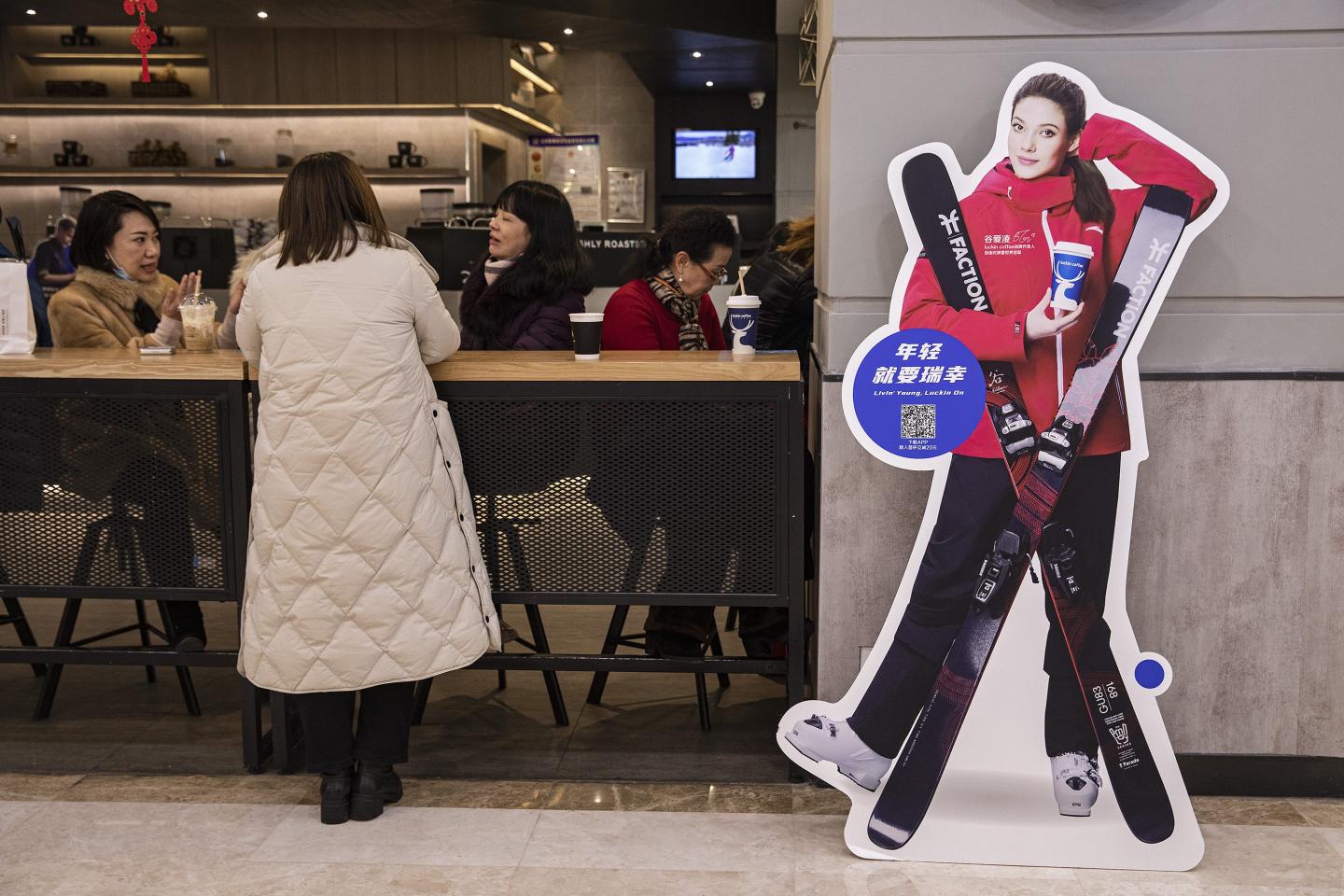
But now, less than two years later, Luckin Coffee is attempting one of the most audacious turnarounds in corporate history. The coffee chain recently overtook Starbucks as the largest coffee chain in China by store count. Luckin now claims 6,024 stores in China compared to Starbucks’ 5,654. The company has never operated at a profit. But last year, Luckin narrowed losses to $86 million, down from $406 million in 2020, while revenues soared 80% compared to the previous year, according to Luckin’s unaudited quarterly earnings statement. Luckin has recently enlisted Chinese snowboarder and Olympic star Eileen Gu as the face of a new ad campaign and, according to several media reports, is hatching plans to list in Hong Kong or even re-list on Nasdaq. Luckin denies that it is pursuing a Hong Kong listing. But the company, whose American Depository Receipts (ADRs) still trade over the counter, says it remains “committed to U.S. capital markets.”
That Luckin can even contemplate a return to Wall Street is extraordinary.
The Chinese coffee chain’s fabrications poured fuel on a fiery debate in the U.S. Congress about lax regulation of U.S.-listed Chinese firms. Critics who decried the failings of a system that subjected Chinese and Hong Kong-based firms to looser auditing and disclosure standards than firms from other markets cited the Luckin debacle as “Exhibit A.” The company’s spectacular implosion helped speed passage, by unanimous vote in both houses, of the 2020 Holding Foreign Companies Accountable Act, which could potentially force more than two hundred Chinese companies off of U.S. exchanges over the next three years if they fail to allow the U.S. Public Accounting Oversight Board to review all work documents for audits of the company’s non-U.S. operations.
Luckin’s bid for forgiveness on Wall Street comes amid a broader push by some of China’s most senior financial policymakers to restore the confidence of global investors in Chinese firms. In recent weeks, a gaggle of top economic planners led by vice-premier Liu He has sought to reassure industry executives at home and abroad that Beijing is backing off from a two-year regulatory blitzkrieg designed to weaken the power of consumer-facing internet companies like Luckin, ride-hailing platform Didi Global, e-commerce giant Alibaba Group Holding, and mobile gaming and messaging leader Tencent Holdings. The relentlessness of the central government’s regulatory crackdown has wiped out trillions of dollars in the market capitalization of Chinese tech firms, prompting analysts at JPMorgan to declare the entire sector “uninvestable” in March.
In a high-profile meeting Tuesday with dozens of executives and industry experts in Beijing, Liu, who is president Xi Jinping’s closest economic advisor, affirmed that China’s government “must support the platform economy and sustain the healthy development of the private economy.” He added that China should better “balance the relationship between the government and the market, and support digital companies to list on domestic and foreign exchanges.”
Experts differ as to whether Liu’s rhetoric signals a genuine policy shift—and if it does, how much that shift might benefit Luckin. On Wall Street, the conventional wisdom remains that the disgraced coffee company’s attempt to win reinstatement to Nasdaq is a long shot. Even so, a handful of contrarians—hailing the company’s new management team, a flurry of innovative new product offerings, and the rise of “consumer nationalism” in China even for something as basic as a cup of coffee—insist Luckin’s turnaround is real.
The crash
In 2018, Starbucks opened a lavish 1,000-square-meter Reserve Roastery in Beijing’s southern neighborhood of Qianmen. The three-story flagship store occupies a prime location—in a historic district directly south of the Forbidden City—that is one of China’s busiest tourist destinations. The store’s first floor features an “interactive coffee bar,” copper ceilings, and walls adorned with specially-commissioned coffee bean artwork. The second floor is dedicated to Starbucks’ tea brand Teavana, while the third serves coffee-infused alcoholic drinks.
Luckin Coffee’s Qianmen outlet is just down the street from Starbucks’. But the Chinese chain’s store—a dowdy counter surrounded by a few simple tables and chairs where a scrum of customers and delivery drivers jostle to pick up orders—couldn’t be more different than its American rival’s grand emporium.
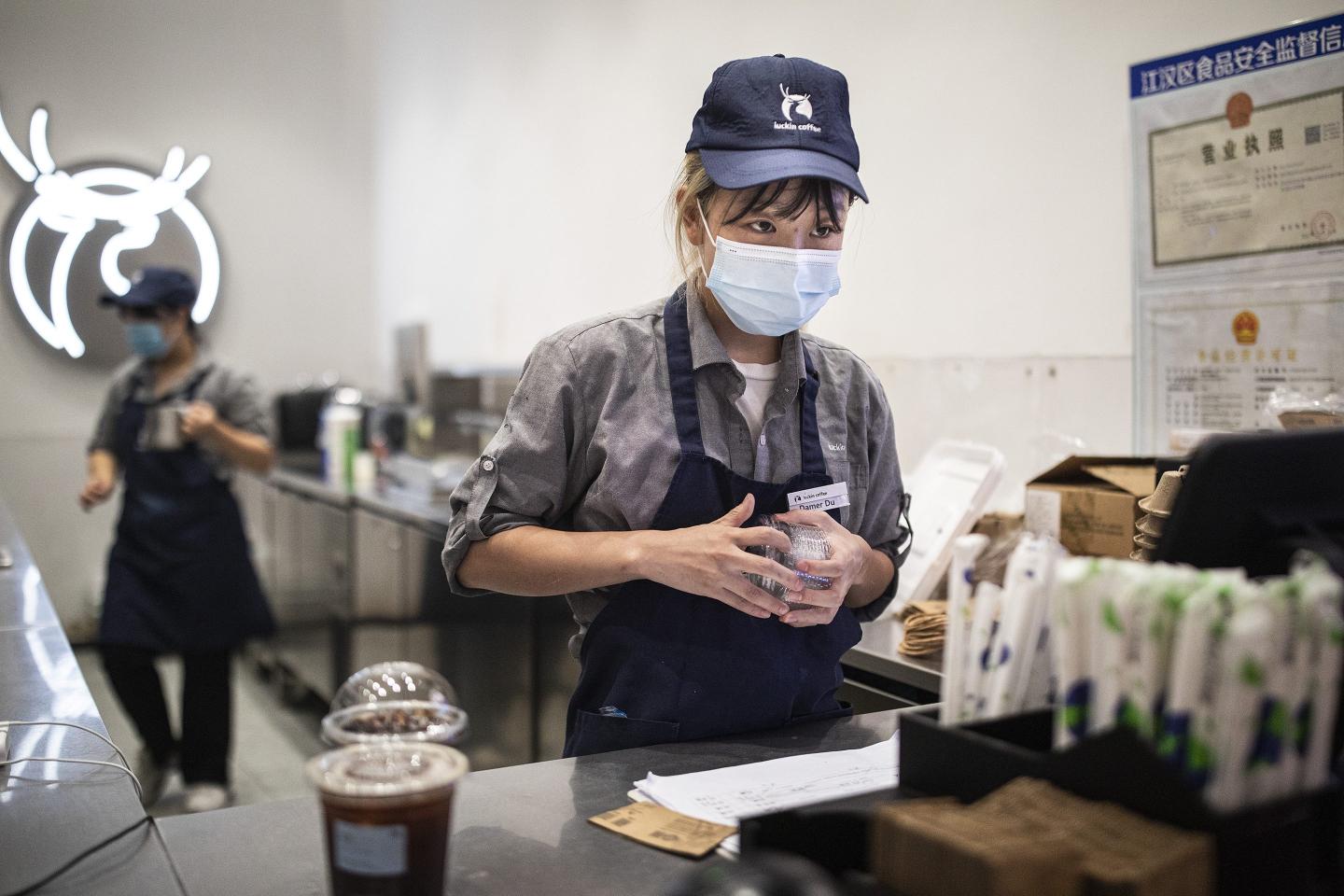
Luckin’s no-frills shop in Qianmen is typical of its thousands of other outlets, says Chen Lin, assistant professor of marketing at the China Europe International Business School in Shanghai. The company eschews prime properties and upscale interiors and operates instead from nondescript locations, using stores mainly as online hubs for delivery orders.
Luckin’s tech-forward and cost-efficient business model reflects the vision of Jenny Qian, a former executive at Car Inc., China’s largest car rental company, who thought she could disrupt Starbucks’ coffee dominance using the same strategy that had worked for her in the rent-a-car industry. Luckin, launched in 2017 in the southern coastal city of Xiamen, offered drastically lower prices than its competitor: where an americano at Starbucks costs roughly $5, Luckin’s version is $3 or less. Luckin was largely bankrolled by Qian’s former Car Inc. boss, hard-charging billionaire Charles Lu, who was famous for pushing for growth above all both at Car Inc., which he founded in 2007, and Ucar, a Shenzhen-based ride hailing venture he launched in 2015. At Luckin, Lu took a 30% stake, secured another 12% for his sister, assumed the company’s chairmanship, and pushed expansion at a blistering pace. The venture opened over 2,000 outlets in its first year and added another 2,500 in 2019.
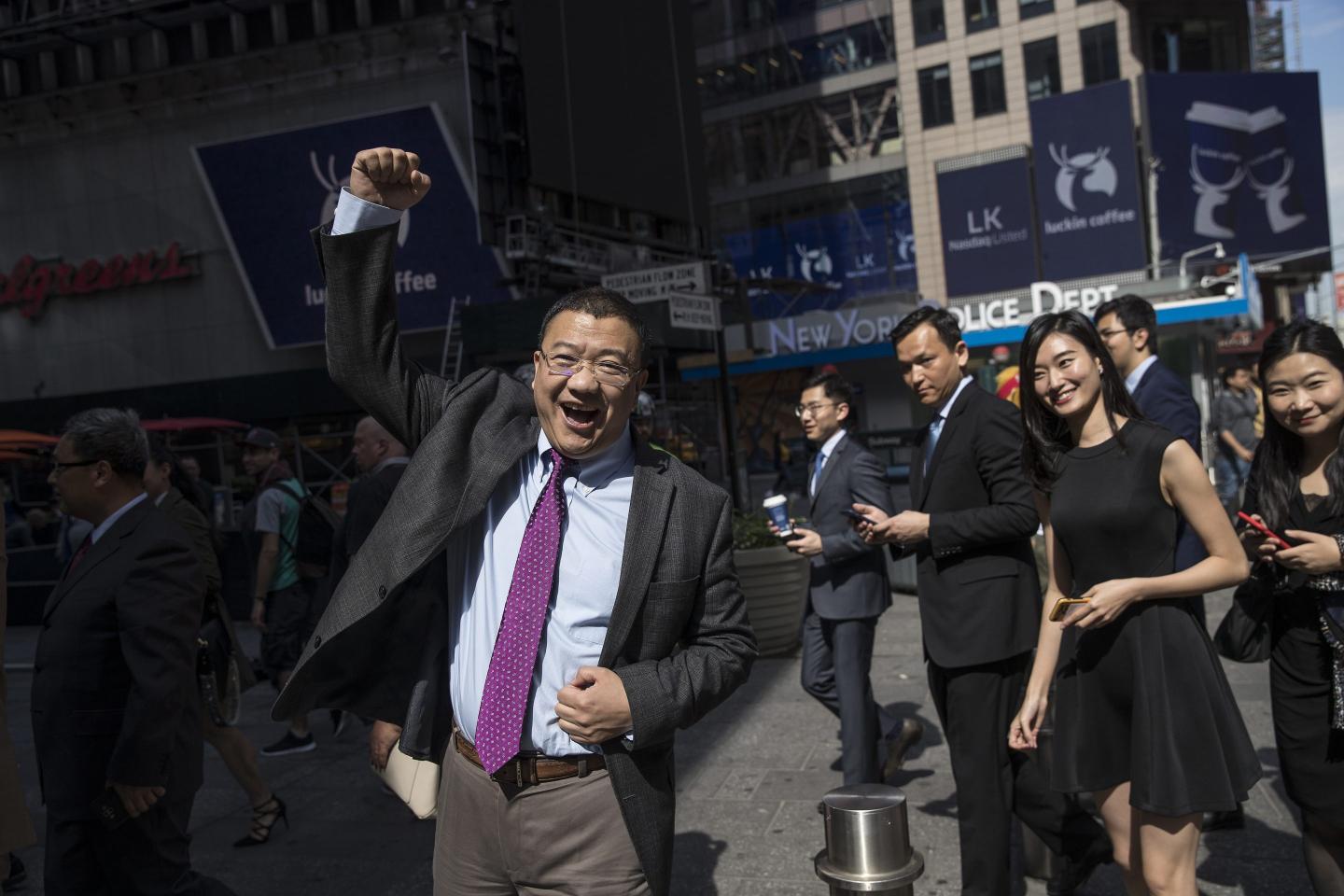
On Wall Street, investors woke up and smelled the coffee. Lu and Qian raised over $500 million in pre-IPO funding rounds from heavy hitters like Blackrock, GIC, and Louis Dreyfus. In May 2019, when Luckin debuted on Nasdaq, the company raised $651 million, valuing the two-year-old venture at over $5 billion. At the peak of its share price, Luckin's market value topped $13 billion.
And yet, a few analysts began to suspect Luckin's overnight success was over-caffeinated.
In January 2020, Muddy Waters Research, a San Francisco-based short seller that had bet heavily on Luckin's demise, published an 89-page report the short seller said had been produced by an outside research entity operating undercover. Muddy Waters declined to identify the research firm but claimed the report to be the product of over 1,500 investigators tracking sales and recording thousands of hours of video at over 600 Luckin retail outlets. The document alleged Luckin had been systematically inflating sales figures since its Nasdaq debut. The Wall Street Journal later reported that Chinese hedge fund Snow Lake Capital was behind the investigation; Snow Lake has declined to comment on its involvement.
Luckin “categorically denied” the report—at first. But as debt and equity investors dragged the company to court on fraud charges, Luckin agreed to conduct an internal audit. In April, Luckin publicly acknowledged that its chief operating officer Liu Jian and his subordinates had faked $337 million of 2019 sales—about a quarter of the company's business during that year. In May, the company ousted Qian and Liu. By mid-June, Luckin's stock had plunged 90%, erasing $11 billion in market value. Nasdaq announced that it would delist the company that same month. In July, Luckin's board pushed out Lu as chairman and replaced him with Jinyi Guo, an early Luckin employee who also took over for Qian as CEO.
China’s market regulator conducted a separate probe of Luckin which concluded in September 2020 that the company had indeed falsified financial records and misled consumers and investors. The Chinese agency let Luckin off with a wrist slap: a fine of just $9 million. But four months later, U.S. Securities and Exchange Commission issued a scathing assessment of misconduct at the Chinese coffee chain and fined the company another $180 million. In February 2021, Luckin filed for Chapter 15 bankruptcy, a legal filing that allows foreign debtors to seek protection from creditors in the U.S. court system.
The comeback?
Amid the turmoil, Guo, the new management team, and a handful of key financial backers have scrambled to keep Luckin afloat and plot the chain's resurrection. In April 2021, Luckin raised $240 million from private equity firm Centurium Capital, a Beijing-based private equity firm led by former Warburg Pincus executive David Li. At Warburg, Li oversaw the global private equity firm's investments Car Inc. and Ucar, and served briefly as Ucar's vice chairman. But in the wake of revelations of fraud at Luckin, Li has cut ties with Lu, telling the Wall Street Journal earlier this year he considered the company's fabrications "an enormous betrayal."
Centurium was one of Luckin's earliest investors and has been actively involved in trying to help the company restructure and straighten out its accounting practices. In January, Centurium announced that it had become Luckin's controlling shareholder by organizing a consortium to acquire shares held previously by two of the company's co-founders.
Luckin is emerging from bankruptcy court proceedings with remarkable speed. In October 2021, only eight months after filing for bankruptcy protection, the Chinese chain reached a $175 million settlement of class-action claims against it by investors.
Equally surprising is how well Luckin's underlying business operations weathered both the scandal and the outbreak of a global pandemic. The company says it lost only 12% of its stores between December 2019 to December 2020. It helped that Luckin still had $780 million in cash reserves left over from the $1.6 billion it raised from investors before and during its IPO.
Analysts say Luckin's financial shenanigans don't matter much to Chinese consumers. "Chinese consumers have been very pragmatic in the sense that because Luckin does not have a food safety problem they do not consider it a scam," says Lin. Consumers view Luckin's problems as "related to accounting" and "do not feel betrayed" in the same way investors might.
Many Chinese consumers are unaware of the scandal. The coffee chain's fraud was "big news," but it was "not as big of a deal" in smaller cities outside Shanghai and Beijing, says Yuwan Hu, associate director of Daxue Consulting in Shanghai.
Bork says that U.S. media attention on Luckin and its Nasdaq de-listing may have actually given the firm a boost among increasingly nationalistic Chinese consumers, eager to support any Chinese brand against a U.S. one. “Having committed fraud and becoming a pariah in the U.S. is not doing you any harm in [China],” he says.
Lin argues Luckin's decision to sign Chinese snowboarder Eileen Gu as company spokesperson during the Winter Olympics was also a "smart play" to attract patriotic consumers.
Luckin has re-invented itself in other ways since the scandal. The company has given up on trying to compete with Starbucks and has instead chosen to double down on a lower tier of consumers, according to Hu. "They are benefiting from [pursuing] mass markets and using very affordable pricing," she says.
Analysts say Luckin combined deep discounts with innovative products. "They realized that Chinese people are not that into traditional, American coffee that much," says Lin, who points out that Luckin's "killer products" are now a coconut milk latte and a red velvet latte, drinks more similar to Chinese milk tea than Starbucks lattes.
Redemption
Luckin's effort to reassure investors and regulators has been marred by tempestuous relationships with outside accounting firms. Prior to Luckin's delisting, the company's auditor was Ernst & Young Hua Ming, the China-based practice of the Big Four accounting firm. EY has denied responsibility for Luckin's fraudulant sales practices. In September 2020, Luckin replaced EY with New York-based auditor Marcum Bernstein & Pinchuk. But Marcum quit within months, complaining that it could not gather "sufficient third-party data" to complete an audit. In April 2021, Centurion ZD CPA, a Hong Kong-based auditor, took over auditing duties from Marcum.
The previous auditor was "apparently unable or unwilling to complete the job," John Zolidis, an analyst at Quo Vadis Capital, said in a note when Centurion ZD CPA took over as auditor. “Luckin was already one of the most unusual situations we’d ever seen... this continued today.”
Michael Norris, senior research analyst at Shanghai-based consultancy AgencyChina, remains wary of Luckin's claims about its financial performance, noting that in the fourth quarter of last year, Luckin reported 44% growth in same-store sales compared to -14% from Starbucks. That disparity is "eyebrow-raising," Norris says. “I'm not yet convinced that Luckin's new management…has parted with previous fraudulent practices.” Luckin declined Fortune's request for comment.
Shares in Luckin Coffee were priced at $8.20 on Thursday, better than their post-scandal low of $1.40, but still far below their peak of $50.02 in January 2020.
Bork says it's too early to tell if Luckin's turnaround will work. But he thinks the company may have a shot at redemption.
"Just like a criminal who gets released from prison," Bork says, Luckin "may just deserve a second chance."